
Microsoft Antitrust Case
Details
BECG006
10
2002
YES
300
Microsoft Corporation
Technology & Communications
India
Regulatory Environment,Accountability
Abstract
The case ‘Microsoft Antitrust Case’ gives an overview of the legal battle between Microsoft and Department of Justice, USA. In 1997, the DOJ sued Microsoft alleging that it forced computer manufacturers to ship Microsoft Internet Explorer Web browser with its Windows 95 operating system. The case discusses in detail, the proceedings of the trial, which spanned more than three and a half years. It also talks of the various options before DOJ and the chances of Microsoft being sued by private companies in the future.
Learning Objectives
The case is structured to achieve the following Learning Objectives:
- Monopolistic practices.
Contents
MICROSOFT A MONOPOLY?
“The government viewed Microsoft as a paranoid monopolist, someone who gets up in the middle of the night and shoots at any movement.”
- Harry Edwards, Chief Judge, US District Court for Appeals for the District of Columbia.
“The Sun was definitely shining in Seattle…. Today’s ruling really does go a long way toward positively resolving this matter for Microsoft, for our customers, partners, and shareholders.”
- Steven Ballmer, CEO, Microsoft, commenting on the US Court of Appeals for the District of Columbia reversing the District Court ruling that Microsoft be broken into two companies
In the late 1990s, as Microsoft1 was preparing to enter the new millennium, the company was fighting the anti-trust proceedings initiated against it by the US government. One of the main charges against Microsoft was that it was distributing its Internet browser software, Internet Explorer (IE), free of cost along with its Windows Operating System. Microsoft was a late entrant into the Internet software market. Subsequently, it adopted aggressive marketing tactics to catch up with the early entrant, Netscape Communications. Netscape protested against Microsoft's move calling it an attempt to shut out other software that competed on a stand-alone basis. Another important charge against Microsoft was that it had modified Sun Microsystems' Java language in order to make it Windows compatible.
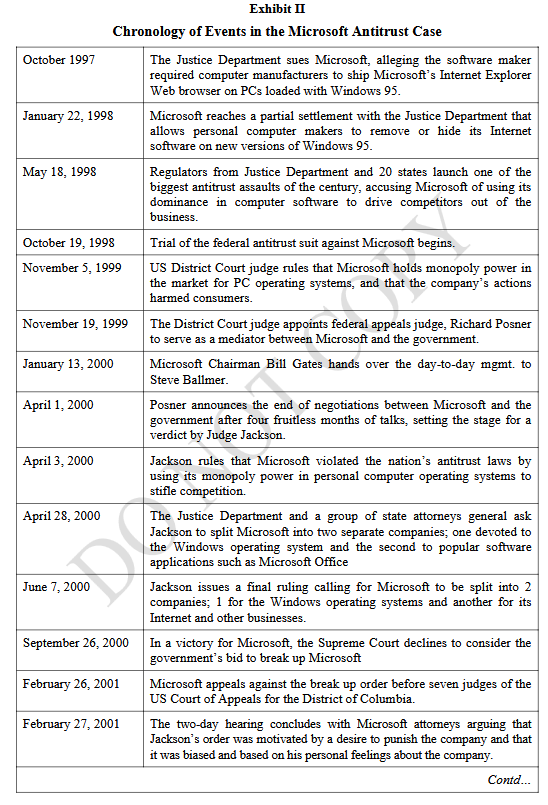
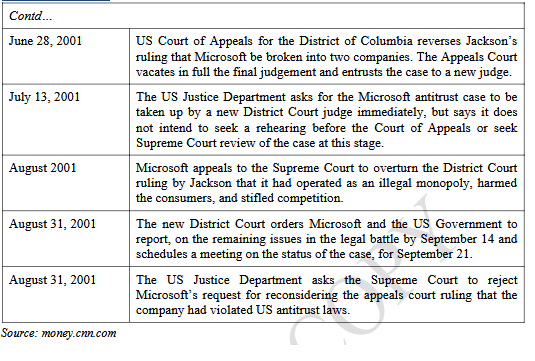
Some analysts argued that the overwhelming market share that Microsoft held was a major impediment to innovations in the software industry. Microsoft was not only a leading player, but also the standards provider for the industry. By controlling the standards, the company was in a position to curb innovations. Microsoft, however, maintained that its dominance of the market was due to its superior products and not because of any unfair market practices. In 2000, the US Department of Justice (DOJ) ruled that Microsoft be split into two smaller companies to prevent it from indulging in anti competitive practices. However, in June 2001, the US Court of Appeals reversed this ruling, but said that Microsoft did have a monopoly in the market and had violated US antitrust laws. (Refer Exhibit I for US antitrust policy). In August 2001, Microsoft appealed to the US Supreme Court to overturn the ruling that Microsoft was an illegal monopoly. A final verdict on the case was expected by October 2001. (Refer Exhibit II for the chronology of events in the case.)
THE TRIAL BEGINS
In October 1997, the DOJ began antitrust investigations to determine whether Microsoft was violating a 1994 consent decree4 by compelling PC makers to ship its Internet browser free with Windows 95. Joel I. Klein, Assistant Attorney General for the antitrust division, remarked, ?This kind of product-forcing is an abuse of monopoly power--and we will seek to put an end to it." Justice Thomas Penfield Jackson of the US District Court heard the case and, in May 1998, gave both the parties five months to gather 12 witnesses each, and to fight the suit. The DOJ collected strong evidence, which included a number of internal documents and e-mails written by Microsoft employees. In one such document, Microsoft had written that its "strategic objective was to kill cross-platform Java." In an e-mail, a company engineer had mentioned ?Screw Sun, cross-platform Java will never work. Let‘s…steal the Java language." The DOJ summoned 12 witnesses from different backgrounds to prove its point. Its main contention was that Microsoft was a monopoly, which had used its monopoly power to suppress competition and gain an unfair advantage.
During the trial, which started in October 1998, the 24 witnesses testified over a period of 62 days. At the end of the initial hearing, Microsoft‘s defense proved to be weak and in disarray. Bill Gates, (Gates) the then CEO of Microsoft himself testified and the videotapes of his deposition received wide publicity. There was a general opinion that Gates had bungled the opportunity by feigning ignorance of many of the major developments and events that had led to Microsoft‘s leadership. Gates‘ testimony seemed to have fallen far short of expectations and was totally out of line with his image as a brilliant strategist.
Though the proceedings had started with Microsoft‘s actions in the browser market, the government also dealt with Microsoft‘s attempts to undermine the Java language (of Sun Microsystems) by creating its own version of Java—the only version that could run comfortably on Windows. The Government felt that Microsoft should publicize the source code for Windows operating systems. Microsoft had bluntly refused to do so in the past.
The DOJ attempted to build the case around how Microsoft had used its formidable financial muscle to gain an unfair advantage over its competitors. Among the examples cited were Microsoft's aggressive pricing of products, its offers of free software to grab market share and its attempts to inflate bills of some corporate customers. Bundling of the Internet Explorer (IE) with Windows 95 threatened companies like Netscape that sold stand-alone software. The DOJ argued that Microsoft had resorted to unfair practices to deal with the combined threat of Netscape‘s Internet browser and Sun's Java. Java enabled software developers to write applications that could run on any platform. The 'cross-platform' Java could make the Operating System (OS) less important and severely cut into Windows' market share. DOJ argued that Microsoft licensed Java from Sun, developed its own Windows-only version of Java, and coerced software developers to use it. Netscape also used Java. By eliminating the rival browser, the growth of Java could be curbed.
Another charge against Microsoft was that it apparently made misleading statements and claims. The company often announced its products before they were launched in order to freeze buyers' decisions. Microsoft had succeeded in the PC software industry by using this strategy and it seemed to be using this strategy in the non-PC businesses also. For instance, in late 1998, Microsoft told the press that its electronic billing system was the world‘s first "end-to-end billing service." However, CheckFree, Atlanta, had been offering such a service for almost a year before Microsoft made its claim. Microsoft, however, argued that CheckFree also issued some paper checks and so it was not totally electronic. CheckFree CEO Peter Knight complained, "We‘re out ahead, but they try to get people to stop and wait for them."
Many industry observers felt that Microsoft‘s marketing strategies were unfair. According to consultants, Gartner Group, Microsoft 'hooked' customers with an initial low bid and made it up subsequently by an overall rise in costs in the name of 'policy shifts.' Gartner issued a warning to Microsoft customers to expect around 50% increase in payments through a period of four years due to 'changes in terms and conditions.' Microsoft's 'Enterprise licensing' enabled clients to get unlimited use of Windows NT, Office and BackOffice, as well as its upgrades for a single price. This tied down the customer to other Microsoft products. Microsoft strongly denied that it had used 'malicious pricing.' The company maintained that price changes were a consequence of the simplification of licensing agreements and were finalised after negotiation with customers. As for 'Enterprise licensing,' Microsoft explained that the ?one-price-for-all? enterprise agreements were common in the software industry. Even Microsoft-bashers admitted that many of the company's acts could not be termed strictly illegal.
Both the DOJ and Microsoft produced professors of economics to argue their case in the debate over whether the software giant should be viewed as a monopoly or not. DOJ's witness was Franklin M. Fisher, a 64-year old economics professor from MIT. Fisher strongly argued that monopoly in the OS market might seem to make life easy for the consumers, "but this case is not about being easy. If Henry Ford had a monopoly, we'd all be driving black cars. That‘s not what competition is about. That‘s not what helping consumers is about. We're going to live in a Microsoft world. It may be a nice world. But it is not a competitive world," he commented.
Microsoft's witness was Richard Schmalensee, another MIT professor, who was considered by many as one of the leading authorities on industrial economics (Schmalensee did his doctoral thesis under Fisher). He argued that Microsoft was not a monopoly, that it had not taken advantage of its dominance of the OS market, and that it had no power to do so. Schmalensee held that Microsoft‘s competition included its own existing products. An OS did not wear out like any other commodity and the installed OS was an obvious competitor to a newly launched OS. As a result, Microsoft had no alternative but to price upgrades very reasonably.
Microsoft countered the allegation of "polluting' Java by stating that its license agreement with Sun allowed it to modify Java. Microsoft explained that the modification was necessary to improve upon the technology. As for the war-like language used in the internal e-mails, James E. Allchin, Microsoft's Senior VP of Windows division, offered a spirited defense: "Yes, we‘re a competitive company. We don‘t apologize for that."
Gates argued that his rivals should spend less time being obsessed with Microsoft and more time on their own businesses. He also maintained that Microsoft‘s aggressive pursuit of new businesses could not possibly mean doom for its competitors. There was no assurance that Microsoft would succeed in any new market, much less dominate it. The emergence of Netscape's popular Navigator browser and Sun Microsystems's Java programming language, both of which Gates saw as threats to Windows, showed that the industry was highly competitive. He remarked, "No one has a guaranteed position."
THE VERDICT
In June 2000, the US District Court gave its ruling that Microsoft had violated the US antitrust laws by abusing its monopoly power in computer operating systems. Judge Jackson ruled that Microsoft was a monopoly, basing his conclusion on three factors: Microsoft‘s share of the market for operating systems was extremely large and stable; a high entry barrier protected Microsoft's dominant market share and; because of the high entry barrier, Microsoft‘s customers lacked a commercially viable alternative to Windows. Jackson ordered that the company be split into two smaller companies, one for the Windows operating system, and another for its Internet and other businesses, to prevent it from violating state and federal antitrust laws in the future.
Another remedy suggested by some experts was the mandatory licensing plan. This would require Microsoft to auction off the Windows source code - the underlying software commands that made the product work. Two or three other companies would then create their own versions of the OS. Mandatory licensing of the source code, however, had its own problems. Some analysts held the view that few would license it from Microsoft and compete with the software giant. They observed that the licensee company would have to establish, ?a massive development and distribution system to compete with Microsoft – which already has a smoothly running machine and knows every secret about Windows." Some experts, however, considered this plan to be far simpler than trying to dismantle the whole company.
In a report published in April 1999, Business Week emphasized that a structural remedy would be preferable to a conduct remedy. Traditionally, US antitrust policies had laid emphasis on monitoring bad conduct rather than on breaking up monopolies. A conduct remedy would involve restrictions on Microsoft's behavior such as limiting the features that could be built into the Windows operating system. Such a remedy would probably need tight supervision and monitoring by the government for several years to come. Business Week argued it was precisely because Microsoft had not conformed to a conduct remedy prescribed by a 1994 consent decree, that antitrust proceedings had to be started again in 1998. Business Week added, "Government supervision of Microsoft would set a bad precedent. Since Microsoft has its finger in virtually every high-tech pie, any monitoring of it would necessitate the regulation of its relations with other companies as well. The result would start a slippery and deadly slope to Government micro-management of the hi-tech sector." A structural remedy on the other hand would involve licensing of Windows or the breaking up of Microsoft into two or more smaller entities. Business Week argued that a structural remedy would have long-term benefits too. It said, "Given the ferociousness of Gates as a competitor, losing the Windows monopoly could very well unleash a powerful new groundswell of profitable software innovation by Microsoft. By contrast, effective conduct remedies hurt shareholders more by hobbling the company over the long run."
THE APPEAL
In September 2000, the Supreme Court declined to consider the government‘s bid to break up Microsoft as a remedy for uncompetitive practices and chose to send the case to the lower court. In February 2001, in response to Microsoft‘s appeal against Jackson‘s ruling, the appeals court heard arguments for two days, allowing only about 30 minutes for oral arguments. During these proceedings, attorneys for Microsoft focused on Jackson whose ruling they said was motivated by a desire to punish the company. They also argued that Jackson‘s ruling was based on his personal feelings about the company and its top executives, including Gates. The appeals court judges raised questions over the impartiality of Jackson, who in media interviews had compared Bill Gates to Napoleon and said that the firm‘s executives acted like children. The appeals court ruled that Jackson had conducted himself improperly, leaving himself open to allegations that he was biased against Microsoft. In June 2001, the appeals court reversed Jackson‘s ruling that Microsoft be broken into two companies. The court vacated in full the final judgement and entrusted the case to a new judge.
However, the court upheld Jackson‘s conclusion that Microsoft did have a monopoly in the market for computer operating systems and maintained that monopoly power gained through anticompetitive means violated US antitrust laws. The US Justice Department saw in the appeals court decision a "significant victory," because it upheld the government‘s position that Microsoft had abused its monopoly power.
In July 2001, the DOJ asked for the Microsoft antitrust case to be taken up by a new District Court judge immediately, but said that it did not intend to seek a rehearing before the Court of Appeals or to seek Supreme Court review of the case. In August 2001, Microsoft appealed to the Supreme Court to overturn the District Court ruling by Jackson that it had operated as an illegal monopoly, harmed consumers, and stifled competition. In its petition to the court, Microsoft claimed that Jackson's entire ruling should be "thrown out." However, analysts wondered whether the Supreme Court would agree to open the case. Said Bob Lande, Professor of Law, at the University of Baltimore, "The Supreme Court is not going to reverse the court of Appeals. Microsoft is not going to walk free. It is just a delaying tactic. They have no realistic chance of getting this overturned."
Analysts felt that as Microsoft geared for the release of its next generation Windows XP package, it seemed to be trying to forestall any interim efforts by prosecutors to reengineer XP or halt its October 25 release by stretching out the judicial review. Microsoft was likely to prolong the legal battle as many PC makers planned to sell XP loaded products over the Internet before the release date. However, this was not likely to go down well with the Justice department, which might try to opt for an interim action that Microsoft was trying to preempt. Analysts also felt that by bundling a package of programs into XP5—in the same way it bundled its Web browser with Windows 98, Microsoft was repeating the pattern that got it into trouble in the first place. Allowing XP to go forward could severely harm Microsoft competitors and ultimately, consumer choice.
In August 2001, the new District Court judge handling the Microsoft antitrust case ordered both the parties "Microsoft and the US Government" to report on the remaining issues in the legal battle by September 14 and scheduled a meeting on the status of the case for September 21. Judge Colleen Kollar Kotelly said Microsoft and the US government should also identify ways to resolve the remaining issues, decide whether any additional evidence were to be presented and submit a proposed schedule for the proceedings. In late August 2001, the DOJ urged the Supreme Court to reject Microsoft's request for reconsideration of the appeals court ruling that the company had violated US antitrust laws. The DOJ said that it would be a mistake for the Supreme Court to review a portion of the case before the District Court had resolved the entire case. The Supreme Court was expected to decide whether to hear the case after the judges returned from summer recess in October.
THE OPTIONS BEFORE DOJ
In September 2001, the DOJ said that it would ask for restrictions on Microsoft‘s business tactics. One option could be to force Microsoft to open its source code for the Windows operating system—to competitors. Said an analyst, "The biggest thing they will probably do will have some agreement on how much code Microsoft makes available so folks can make programs that fit in with Windows more readily." Analysts also felt that publishing the Windows blueprint would ensure that other software makers had the same access to the system‘s design as Microsoft‘s own programmers had.
Another option was to allow PC original equipment manufacturers (OEMs) to configure Windows any way they liked, removing Microsoft programmes, adding rival programs, and even changing the entire appearance of Windows. Said an analyst, "The measure of success (of a remedy) will be the degree to which the PC OEMs have the freedom to address their markets the way they want to address them."
THE DAMAGE IS DONE
Analysts felt that whatever be the outcome of the legal battle between Microsoft and the US Government, the ruling that Microsoft was a monopoly left the company open to a deluge of private suits. The company may face legal action over the inclusion of media-playback and instant messaging software in its new Windows XP operating system due for sale from October 2001. The ruling could also encourage regulators in Europe, where the European Union‘s (EU) competition commissioner, Mario Monti had ordered an investigation into Microsoft‘s conduct. Another result of the trial was that Microsoft would be widely distrusted. However, analysts felt that the trial had brought some benefits for consumers. The trial had prompted Microsoft to abandon many of its restrictive licensing agreements with PC makers. As a result, it was possible to buy PCs with Linux, a free operating system, rather than Windows, installed as standard. Before the trial, this seemed to be impossible, since PC makers did not want to offend Microsoft, which might have cut off their supplies of Windows.
QUESTIONS FOR DISCUSSION:
1. Microsoft bundled many features in its Windows operating system. It gave away its Internet Explorer to customers free. Do you think this practice to be unethical? Explain.
2. What according to you could be more suitable in the case of Microsoft – a structural remedy or a conduct remedy? Give reasons.
3. Do you think Microsoft's dominant position in the software industry will be affected by antitrust proceedings initiated by the DOJ? What do you think Microsoft should do to avoid future antitrust proceedings?
EXHIBITS
Exhibit I
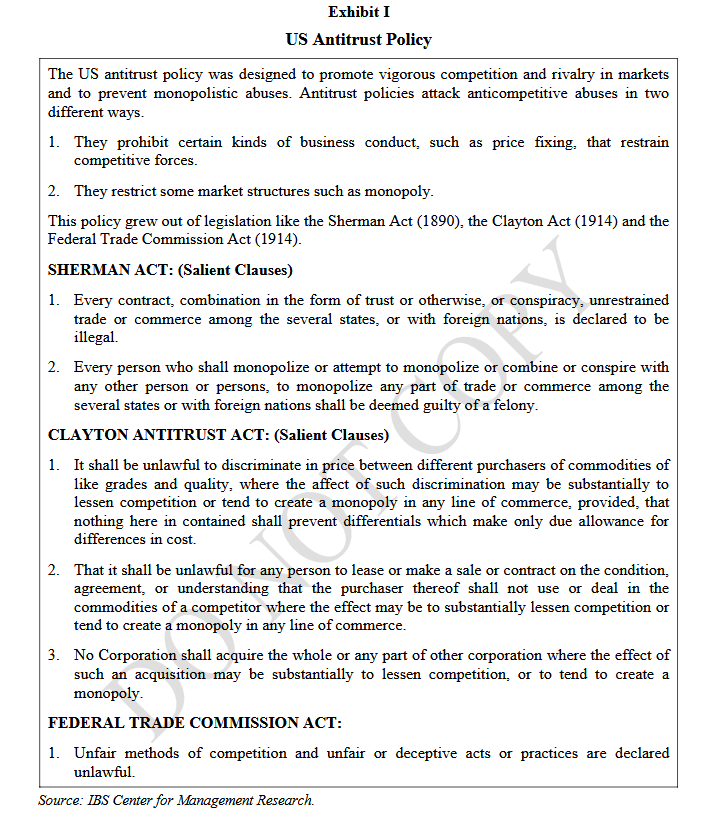
Exhibit II
Keywords
Microsoft Antitrust Case, legal battle, Microsoft, Department of Justice, USA,1997, DOJ, computer manufacturers, Microsoft Internet Explorer, Web browser, Windows 95, operating system, proceedings ,trial, spanned, three and a half years
Related Case Studies
| Case Title | Details |
|---|---|
|
Case Title Oracle’s PeopleSoft Bid (Part C)Case Code: BSTA106 |
Details |
|
Case Title Oracle’s PeopleSoft Bid (Part B)Case Code: BSTA105 |
Details |
|
Case Title Oracle’s PeopleSoft Bid (Part A)Case Code: BSTA104 |
Details |
|
Case Title Cipla - Capturing the Global AIDS MarketCase Code: MKTA009 |
Details |
|
Case Title Securities and Exchange Board of India - Role as a RegulatorCase Code: FINC036 |
Details |