
Doordarshan’s Problems
Details
BSTR012
8
2002
NO
200
Prasar Bharati
Leisure & Entertainment
India
Growth Strategy,Brand Strategy, Consumer Behavior, Market Segmentation
Abstract
In the mid 1990s, a number of private cable TV channels were launched in India. With their sleek presentation and innovative programming, they were surging ahead of Doordarshan (DD) in terms of both revenue and viewership. Due to the poor management at Doordarshan, transmission quality and program content were deteriorating. Viewers began to switch to private channels, which were better at catering to their tastes and needs.
Learning Objectives
The case is structured to achieve the following Learning Objectives:
- Private television channels and cable TV in India.
Contents
IS DD DEAD?
DD needs an owner.”
-Meenakshi Madhvani, CEO, Carat, media-buying agency
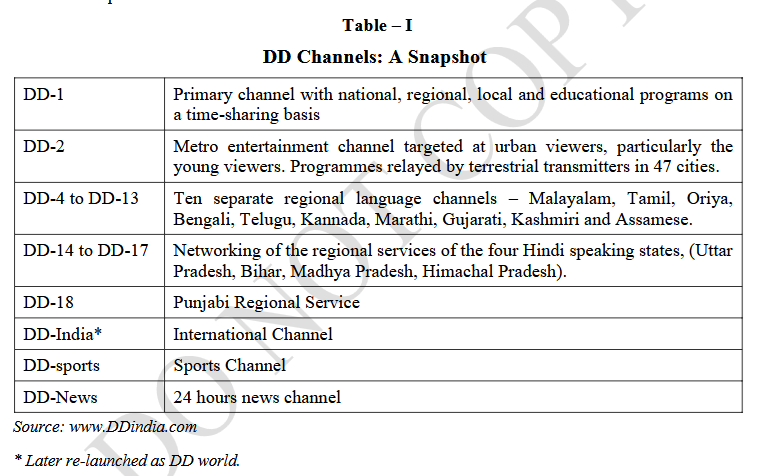
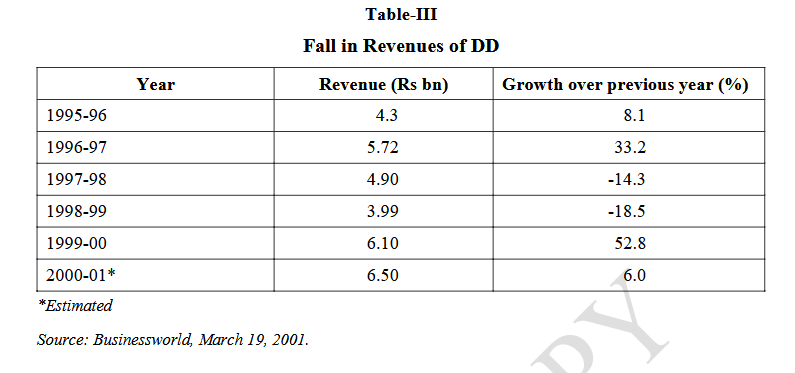
After years of falling revenues, in 1999-2000 Doordarshan (DD) had a revenue growth of 50%. In 1999-2000, DD earned revenues of Rs 6.1bn compared to Rs 3.99bn in 1998-99. DD showed signs of revival with the launch of DD World (a channel for NRIs) and had a certain measure of success with some of its regional channels (Refer Table I for different DD channels). However, by the end of 2000-01, DD's honeymoon with success seemed to be over. In 2000-01, DD's revenues were projected to grow at 6-15% while private channels such as Zee TV, Star, Sony had a projected 40-50% revenue growth.
According to some analysts DD's sagging revenues were only the tip of the iceberg. DD was plagued by several problems. By the late 1990s most private producers and advertisers and a good part of the audience had deserted DD. Not even one car company advertised on DD and even two-wheeler manufacturers kept away. Ads of Pepsi and Coca-Cola were found only during sports telecasts. Only FMCG companies stuck to DD, because its terrestrial network would help them to reach the rural and semi-urban audience. Despite having over 21,000 employees, DD outsourced 50% of its programmes from private producers.
In the late 1990s, DD faced allegations of large-scale scams and irregularities. Underutilized infrastructure, improper investments and poor financial management adversely affected DD's performance. In 1992, when the government opened the airwaves to private players, DD had to face competition from private satellite channels. In Cable & Satellite (C&S) homes it was found that DD programs had hardly any viewers. The depleting Television Viewer Ratings (TVRs)5 of the DD programmes was also a cause of concern as advertisers deserted due to its low viewer ratings.
According to analysts, DD would need a budgetary support of Rs 5 bn during fiscal 2000-01 to sustain itself, as its revenues would not cover its expenditure. Many analysts felt that privatization would be the only solution.
DD – THE INSIDE STORY
DD was launched in 1959 as the National Television Network with a modest 21 community sets, in Delhi. In the year 1982, with the introduction of a regular satellite link between Delhi and different transmitters, DD began the transmission of the National programme. In the same year DD switched to colour transmission. Soon it had penetrated every nook and corner of the country, cutting across demographic and geographic barriers.
DD had a three-tier programme service – national, regional and local. The national programs focused on the national culture and included news, programs on current affairs, and science, cultural magazines, serials, music & dance recitals, plays and feature films. At the regional level the programmes were similar to the ones broadcast at the national level, the only difference being they were broadcast in the regional languages.
In 1984, DD introduced a second channel (DD 2) in cities like Delhi, Mumbai, Kolkata and Chennai. DD 2 was targeted at urban viewers, particularly the young viewers.
In 1995, DD launched DD-India, its international channel, to cater to the NRI population. This service covered SAARC countries, Gulf countries, West Asia, Central Asia, North Africa and Europe. In the same year DD entered into an agreement with the Cable News Network (CNN) and launched a 24-hour news and current affairs channel-DD-News. In 1999, DD launched a separate channel for sports.
In the early 1990s, about 479 mn people in Indian homes viewed DD and an additional 1.5mn watched DD on community sets. DD was ahead of the private channels in terms of viewership with a 90% reach. However, in the late 1990s it could not maintain the lead and private channels were catching up in terms of revenue even though they lagged behind in viewership and reach.
CABLE ONSLAUGHT
In 1984, cable television entered India. For local entrepreneurs cable television provided a good business opportunity, as investments required to install a cable network were low. In the early 1990s many private television channels were launched. Zee TV launched in 1992 led the pack. During 1992-94, there was rapid increase in the number of cable connections in western and Northern India. In Tamil Nadu and Andhra Pradesh a number of Tamil and Telugu channels came up in the mid 1990s.
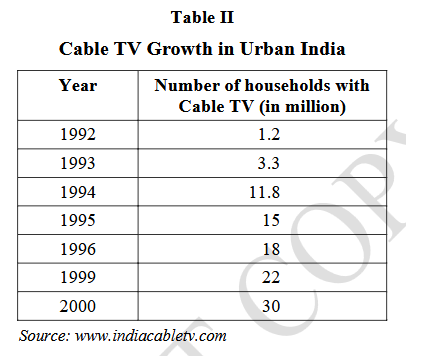
Though by 2000 DD had an incredible reach of 70 mn homes, in comparison to C&S's reach of only 30 mn homes, (Refer Table II for growth of cable and satellite penetration in India) it could not turn this network into an advantage. In urban households, DD programs had hardly any viewers. DD was also behind the private channels in terms of ad revenues, as its TVRs were very low compared to the TVRs of programs on private channels.
FALLING REVENUES
During 1996-99, the TV advertisement market grew by 76%, but DD's revenue from advertisement registered a negative growth (Refer to Table III). Though DD continued to be number one in overall audience share, it lost out on viewership segments that had the highest purchasing power.
In 1998-99, DD's revenues from advertisements were Rs 4 bn (25.8% of the market). Zee TV was close with Rs 3.85 bn, Sony had Rs 2.53 bn, and Star channels7 grossed Rs 2 bn. But the ad revenues of private channels have grown significantly, when compared to those of DD. During the period 1996-99, Zee registered a growth of 122% in ad revenues, Sony 299% and Star channels 206%. During the same period, DD's ad revenues went down by 70.17%. DD's falling TVRs were a matter of concern for clients like Hindustan Lever – DD's largest advertiser. Said Ashutosh Srivastava, Vice-President HTA-Fulcrum, the media-buying arm of HLL, “ Our only source of reaching 40% of this country is going down.” Till 1998-99, 70% of HLL's ad spend went to DD but by 2000-01 due to falling TVRs HLL's ad spend to DD had gone down to 50%.
During 1999-00, producers and distributors stopped giving films to DD when it began for a minimum guarantee of Rs 10 mn to broadcast a film. This forced DD to repeat the same old films that it had aired several times, and the TVRs went down further.
According to some analysts DD's revenues were going down because advertisers considered it a downmarket channel, which catered only to the lowest socio-economic groups, whose purchasing power was limited. The revenues earned by DD showed a negative growth during 1997-99. In 1999-00 DD saw its revenues grow by 52.8%, but in 2000-01 it was projected to grow only at 6% (refer Table-III).
IDENTITY CRISIS
DD's problems were largely attributed to what Kiran Karnik, former CEO, Discovery communications, India called “its loss of identity”. Said Kiran, “ The channel has lost its identity. What is Doordarshan: is it a public broadcaster or a commercial entity?” Initially, DD officials had envisaged that the national channel would play the role of public broadcaster, while DD Metro would be the commercial channel. Private producers and advertisers pointed out that this attitude increased the confusion. They argued that no other network has got two channels competing against each other.
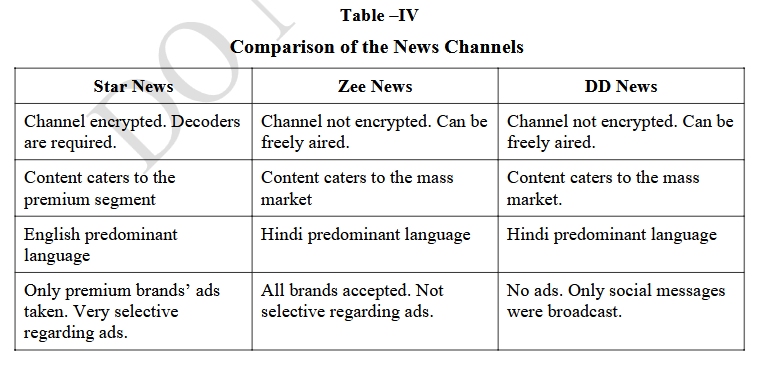
With the launch of the Star News channel9 (the first independent news channel) in 1998, DD News lost its viewers to Star news. The in-depth analysis of news items by Star News caught the imagination of the viewers (Refer Table IV for a comparative study of different news channels). DD's image of being the propaganda machinery of the government also went against it.
Some analysts said political interference and corruption were another reason for DD's poor performance. In 1997, The Indian Broadcasting Bill was introduced in Parliament. The bill was not passed, but it was enforced through an ordinance nearly a decade after it was enacted. DD was brought under a holding company called the 'Prasar Bharti'. In 1998, the government sacked Prasar Bharti CEO S.S. Gill and government made DD answerable to a parliamentary committee. Political interference at the top level made matters worse for DD.
There were allegations that members of the Central Commissioning Unit (CCU)10 of DD took bribes from producers to air their programs. In 1998, the CBI arrested two DD officials for taking bribes from a serial producer. This incident focussed attention on the rampant corruption in the organization and forced management to issue guidelines regarding acceptance of gifts by employees.
DD had a poor track record in both payments to and collections from private players. Over 50 companies owed Rs. 18.2 mn to DD, as on July 2001. Amitabh Bachchan Corporation Limited (ABCL) was DD's highest debtor with outstanding dues of Rs 330 mn.
Another allegation that DD faced was that it had allowed International Cricket Council (ICC) Chief Jagmohan Dalmiya and WorldTel?s Mark Mascarenhas to defraud it of Rs 160 mn over the telecast of a 1998 tournament in Dhaka.
The exorbitant prices that DD charged for advertisement slots also contributed to its poor performance. DD charged the producers around Rs 1 lakh for 10 seconds, while some of the highest rated soaps on private channels charged half that price.
DD did not have a marketing team, which could market the advertisement slots as a package. Private channels like ZEE and Star had their own marketing teams, which provided the advertisers with a package of advertisement slots on their programmes. But DD had 56 different producers with 56 different half-hour program slots for four hours of prime time each week. Each producer sold commercial time separately, to the advertisers. But advertisers preferred package deals, which would give them airtime across the programmes for a whole week.
BREATHING FRESH LIFE INTO DD
After S.S.Gill was sacked in 1998, Rajeeva Ratna Shah (Shah) was appointed as new CEO of Prasar Bharti. Shah began overhauling the programs of the two DD channels and weeding out corruption in the network. He stopped commissioning programs on DD1 and DD2. He decided to auction programming hours to the private players who produced the programs for the DD and market them. Shah also announced the setting up of a board comprising eminent filmmakers, actors, poets, writers and people from different walks of life. This board was to be entrusted the task of revamping DD.
In 2000, the government appointed a committee headed by Shunu Sen, (CEO, Quadra Advisory, a Strategic Marketing Consultancy), N. R. Narayanmurthy, (CEO, Infosys) and Kiran Karnik to work out a programs for reviving DD. The committee considered three options: privatizing of DD, continuing to run it as a Public service broadcaster (PSB), and running DD on both PSB and commercially viable lines. Of the three options, the committee recommended the third option. The committee felt that there was no need to privatize DD, but recommended drastic steps for reviving it.
Some of the important steps suggested by the committee were:
* Downsizing 25% of DD's 21,000 strong staff
* Getting into new media
* Setting up its own marketing department
* Developing a sharper programming focus
One of the recommendations was to improve the quality of broadcast DD sought the help of BBC to digitise its channels. Modi Entertainment Network13 begun distributing the five DD channels (National, Metro, News, Sports and World) via satellite. DD went in for a revenue sharing deal with B4U for showing movies, and auctioned the 7-10 p.m. slot on DD Metro to the HFCL-Nine network. In addition to Rs 1.21 bn that DD got from this deal, the move helped DD to penetrate urban homes as well as C&S homes to some extent. DD also entered into an agreement with Direct to Home (DTH) platforms like Echostar and Astra to distribute DD-World in 79 countries. DD employed Accenture to advise it on how to go about revamping its financial, management and administrative systems. The National Institute of Design was employed to redesign the logo.
In 2000, DD announced that it would start its own peoplemeter project through a separate corporate entity in partnership with a few private channels and some advertisers. DD felt that its programmes were not getting enough viewership ratings because the viewer samples used by the two firms doing the ratings – IMRB-Ac Neilsen and ORG-Marg were largely from C&S homes. Their ratings did not accurately reflect the viewing habits of the Indian populace.
According to most these steps were bound to have a positive affect on revenue. However, for real growth DD had to be freed from political interference.
QUESTIONS FOR DISCUSSION
1. Most of DD's problems are due to mismanagement of affairs. Discuss.
2. According to some analysts, privatization is the only solution to the DD's problems. – Do you agree? Give reasons for your answer.
3. A DD official said, “We'll change; that's what the game is about when you're in a competitive environment.” Discuss the steps taken by DD to revamp itself.
Keywords
private cable TV, channel, India, sleek presentation, innovative programming, Doordarshan, DD, revenue, viewership, poor management, Doordarshan, transmission quality, program content, deteriorating, tastes, needs
Related Case Studies
| Case Title | Details |
|---|---|
|
Case Title IBM in 2004: The Linux OptionCase Code: BSTA110 |
Details |
|
Case Title Oracle’s PeopleSoft Bid (Part C)Case Code: BSTA106 |
Details |
|
Case Title Oracle’s PeopleSoft Bid (Part B)Case Code: BSTA105 |
Details |
|
Case Title Oracle’s PeopleSoft Bid (Part A)Case Code: BSTA104 |
Details |
|
Case Title Ispat: Sidbec: Entering North AmericaCase Code: BSTA006 |
Details |