
The Tata Tea - ULFA story
🌐 International Buyers — Pay via PayPal
Details
BECG008
10
2002
YES
0
Tata Tea Limited
Home Appliances & Consumer Products
India
Questionable Payments
Abstract
The case outlines the problems faced by the tea industry due to militancy in Assam. The case explores in detail the problems Tata Tea faced following allegations that it was funding militants. The case also presents arguments put forth by the company as well as the Assam government in the debate on ‘militant-funding vs. protection payment. The case is so structured as to enable students to gain an understanding of the special problems faced by the tea industry in Assam due to the socio-political unrest and terrorism. The case touches upon social, political and legal aspects of the Assam tea industry/ULFA-NDFB story. The case can be used to help students see the wide gamut of problems that a company operating in a politically sensitive region could face. The case is aimed at MBA/PGDBA students, and is intended to be a part of the Business Environment curriculum. The case can be used to help students see the wide gamut of problems that a company operating in a politically sensitive region could face.
Learning Objectives
The case is structured to achieve the following Learning Objectives:
- Role of Government in safeguarding industry
- Social responsibility of Industry.
Contents
“If we don’t pay the militants, we get kidnapped or even killed. And when we buy peace with money, we are dubbed anti-national.”
- An Assam based tea company official, in 1997.
“The lack of security cannot be an excuse for the industry to help the militants financially.”
- The Assam Government, commenting on the Tata Tea/ULFA controversy, in 1997.
“The Tatas refused payment to the Assam Gana Parishad before the last assembly election and Mahanta was upset. Now he has got a chance to settle scores with them.”
- Paresh Barua, ULFA Commander-in-Chief, in 1997.
In August 1997, the Bombay police arrested a woman along with her newborn baby and two bodyguards from the Santacruz airport as she was leaving for Delhi. The woman was Pranati Deka (Pranati), cultural secretary of the banned militant organization United Liberation Front of Assam (ULFA) and the wife of ULFA?s finance secretary Chitrabon Hazarika. Prior to this incident, the Assam and Delhi police had been following Pranati for a few months.
The primary reason for the police?s interest in Pranati was not her link with the ULFA.It was her association with India?s leading tea company Tata Tea Ltd. (Tata Tea) that had led to her arrest. Tata Tea was alleged to have borne the expenses for her check-up at the Jaslok hospital, plus travel and hotel charges for her and her two companions.
In September 1997, the manager of Tata Tea's North India Plantation Division in Assam, S S Dogra (Dogra), was arrested on charges of „aiding and abetting terrorism and assisting persons involved in waging war against the state.? Charges were issued against the company's welfare officer Brojen Gogoi (Gogoi) also, who had accompanied Pranati to Bombay.
Dogra's arrest led to a controversy that soon engulfed many top names from India's corporate and political circles. Ratan Tata, the CEO of Tata Tea's holding company, Tata Sons, rushed to Delhi to meet the then Assam chief minister Prafulla Kumar Mahanta (Mahanta), Assam Chief Secretary V S Jafa (Jafa), the Union Home Secretary K Padmanabhaiah, the Home Minister Indrajit Gupta (Gupta) and the Prime Minister Inder Kumar Gujaral (Gujaral). Later, the issue was discussed at a meeting between Gujral, Mahanta and Gupta, as well as at a meeting of the United Front coalition's core group of leaders.
The Tata Tea-ULFA controversy brought to the attention of the rest of the country, what the Assam tea industry had had to live with over the last two decades – kidnappings, murders and extortion – both by the ULFA and National Democratic Front of Bodoland (NDFB) militants.
Tata Tea is the second largest tea company in India, after Hindustan Lever Ltd. (HLL). A part of the Tata group of companies1, Tata Tea was incorporated in 1962 as Tata Finlay Ltd. with a technical and financial collaboration with James Finlay & Co Glasgow, UK. The company commenced business in 1963, with a tea factory at Munnar, Kerala and a blending/packaging unit at Bangalore, Karnataka. Over the next few decades, the company acquired many tea plantations and set up new factories at Kakajan in Assam and in Munnar.
Tata Tea was the first Indian tea company to set up processing and packing facilities at the tea estates itself. In 1976, Tata Tea acquired Sterling Tea companies from James Finlay & Company and its 7 associates. In December 1982, the Tatas bought out the holdings of the foreign partners. In 1983, the company's name was changed to Tata Tea Ltd.
The company's subsidiaries comprised Consolidated Coffee Ltd., Conscofe Investments Ltd., Tata Tea Inc., and Tata Tetley GB Ltd. (TTGBL). Tata Tea also had joint ventures with Hitachi (marketing tea and coffee), NYK Line (acting as an agent for transportation, operations and management of sea ports, container depots etc.) and Lloyds (providing solutions to insurance companies regarding ship surveys, cargo surveys, pre-shipment surveys, mediclaims etc.)
Tata Tea's tea business was divided into bulk tea and packed & instant tea divisions. The company's major packaged tea brands included Kanan Devan, Agni, Gemini, Chakra Gold, Lucky Cup, Tata Tea, Leo, Zesta etc. The company pioneered the concept of poly packs in the tea industry. Besides tea, the company was involved in the coffee, strawberries, mushrooms and spices businesses.
The company had around 60000 employees, spread across 21 tea estates in Assam, 4 in West Bengal, 24 in Kerala, 4 in Tamil Nadu, besides a coffee and a cardamom estate in Tamil Nadu. Tata Tea produced 58.2 million kgs of tea in 1999-00. The company's distribution network comprised over 2,000 selling agents and retail outlets in almost every corner of the country. Tata Tea's profit after tax for 2000-01 was Rs 1 billion on a total income of Rs 8.7 billion.
With almost half of Tata Tea's tea estates being in Assam, the company faced several problems due to the political unrest in the state (See Box). The terrorists, usually from the poorer sections of society, sought funds from companies operating in Assam. Gradually, all businesses in Assam were coerced into making monthly payments to the terrorists. These payments varied from Rs 100 for cart-pullers to a couple of lakhs for owners of medium-sized factories.
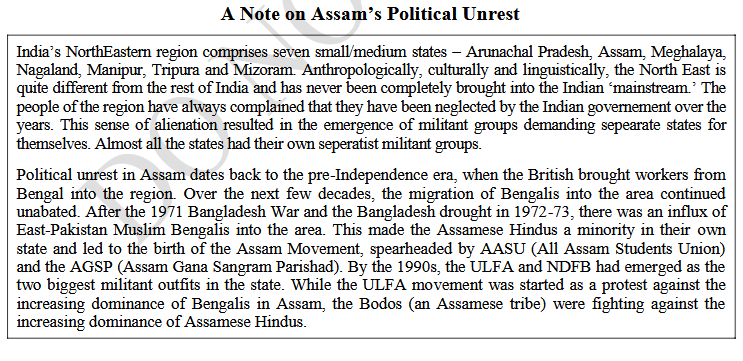
Till the late 1980s, militants did not interfere with the functioning of the Assam tea industry, as it was the single largest employer in the state. Even during the bandhs declared in the state during 1979-85, tea gardens were exempted, like other essential services.
The first victim of the Assam tea killings was D Choudhury, Assistant Manager, Ledo Tea Estate, who was hacked to death in February 1989. In August 1989, Amal Barua, a field clerk of Corramore estate of the Williamson Magor group was shot dead. In March 1990, a Tata Tea employee, P C Scaria was gunned down. The April 1990 killing of Assam Frontier Company Chairman and NRI tycoon Swaraj Paul?s brother, Surrinder Paul (Paul), sent panic signals, as it now became apparent that appropriate measures had to be taken for the safety of life and property in the gardens. In October 1990, Bodo gunmen opened fire at a New Year's party at a planter's club, killing a manager and wounding ten others.
In November 1990, executives of HLL's Doom Dooma Tea Estates in Assam and their families were airlifted out of the tea estates, with the help of the Army and the Air Force. HLL had been asked to pay Rs 35 lakh plus 5% of the net profits of Brooke Bond and Lipton. HLL refused to pay, and decided to close its business in the area instead.
Soon after Paul's murder, the ULFA called a meeting of the Assam tea industry officials, which was attended by representatives from Tata Tea, Williamson Magor, Warren Tea, and Goodricke. The representatives were threatened with further killings if they did not pay money to the ULFA. Most of the companies accepted the ULFA demands. Following this, the killings reduced substantially during 1991-93, though kidnapping and extortion continued unabated.
Alarmed by the killings and the industry's plight, the Assam government set up the Assam Tea Plantation Security Force (ATPSF) to protect the tea estates. The costs of hiring, training, and equipping the forces were borne by the tea industry. The tea estates were charged Rs 6 lakh per annum to hire one unit of the ATPSF. However, because of the high expenses, only 95 of the roughly 800 tea gardens in the state chose to maintain their own security forces. Also, the ATPPF just could not match the firepower of the militants.
Initially, the tea garden managers made direct cash payments to the militants. This was soon substituted by a system of paying via the tea garden contractors who could pay in cash and raise dummy bills on the companies. Exortion rates varied according to the size and number of gardens. Individual tea estate owners paid approximately Rs 5 per kg of tea, while larger gardens paid Rs 1-2 per kg. There was an atmoshpere of terror in the tea gardens, as is evident from the statement of the wife of a tea planter who said, “You begin to get really afraid if your husband doesn't return home by 5.30 in the evening.”
Though the companies officially denied it, it was common knowledge that they were paying the militants. Meanwhile, the murders resumed in 1994. By the end of 2000, over 15 tea management personnel were killed. All along, Tata Tea was reportedly the only company, which refused to pay the militants despite its own employees having been killed and kidnapped. ULFA's commander-in-chief Paresh Barua (Barua) also confirmed that Tata Tea had never paid money to the outfit.
The reasons as to why Tata Tea had been able to avoid making payments to the militants were rooted deep in a complex maze of events involving the Assam state government, the central government, the Intelligence Bureau (IB), the Assam police and Tata Tea itself.
The ULFA militants contacted Tata Tea for the first time in 1990. Unwilling to give cash to the militants, Tata Tea offered to invest in the 'upliftment of the Assamese people' instead. Over the next few years, the company set up 65 hospitals, 280 adult literacy centres, 173 childcare centres, a technical training institute and 110 schools. Tata Tea also instituted scholarships and started a welfare program for handicapped children. The company also took the Lifeline Express into Assam in 1995, which rendered critically needed medical assistance to people from the weaker sections of society. Tata Tea regularly carried out its 'Outreach Medical Program,' under which fully equipped ambulances with doctors went to remote rural areas.
Sensing that the company was serious about its commitment to the development of the Assamese people, the ULFA left Tata Tea alone. However, the situation changed in August 1993, when Bolin Bordoloi (Bolin), senior manager of Tata Tea?s Guwahati office in Assam, was kidnapped by Bodo militants. Tata Tea refused to pay ransom and began negotiations with the militants for his release. Bolin was eventually released in July 1994, reportedly after the payment of a Rs 10 million ransom –denied by Tata Tea and Bolin's family members.
The ULFA then contended that since the company was paying other militant outfits, they might as well ask for money too. In December 1995, Barua wrote a letter to Tata Tea demanding 100 pairs of walkie-talkies. The company?s officials met the home secretary of Assam and requested him to take action against the extortion threats. However, no action was taken in this regard. In January 1996, Tata Tea wrote to ULFA expressing its inability to supply such equipment, but also indicated its willingness to discuss legitimate development projects.
The company sent copies of this letter to the home secretary, but still no action was taken. Meanwhile, Managing Director K Krishna Kumar (Krishna Kumar) began receiving threatening calls asking him to stop sending such letters to the home secretary. At this point, Tata Tea decided to seek the help of the IB based in Delhi. The company was asked to deal with an additional director in IB, Rattan Sehgal (Sehgal). Tata Tea not only kept Sehgal fully informed, but also followed his instructions. Sehgal advised the company never to pay cash, never to give equipment that could have military use, to pursue a dialogue till the very end, and to always keep him informed.
Meanwhile, Tata Tea and ULFA decided to continue the talks at a meeting in Bangkok in early 1996. Dogra, Bolin and a few other company officials attended this meeting, where the ULFA reitereated its demand for either money or the walkie-talkies. Tata Tea refused to budge from its stand and offered to launch a medical scheme for the people of Assam, under which the needy people of the state could get medical treatment in specialist hospitals outside the state at Tata Tea's cost. The ULFA accepted this offer and Tata Tea launched the medical scheme within a few months.
Things seemed to be going smoothly for the company till the arrest of Pranati, who was later brought to Guwahati and produced before a court. During the interrogation by the Assam police and central intelligence officers, Pranati reportedly provided information about ULFA as well as Tata Tea's links with the organisation. This prompted the Assam DGP K Hrishikeshan (Hrishikeshan) to level charges against Tata Tea and the Assam police began interrogating Tata Tea's top executives including Krishna Kumar and Executive Director S M Kidwai (Kidwai) and many other Tata Tea officials.
Tata Tea claimed that ULFA had availed of the service without its knowledge and that Pranati was just one of the cases referred for treatment for a serious blood disorder during her pregnancy. ULFA sources too said that at no point of time had Tata Tea been told about Pranati?s ULFA links. However, there was a flaw in the company's defense. Tata Tea?s scheme provided only for treatment of cancer, heart and eye ailments in the BM Birla Hospital at Calcutta, Tata Memorial Hospital at Bombay, and Shankar Netralaya at Madras respectively. Pranati's treatement at the Jaslok hospital was outside the scope of the scheme and therefore came under scrutiny. Moreover, the fact that senior official like Gogoi had accompanied Pranati weakened the company's stand.
In the last week of September 1997, Tata Tea released advertisements, wherein the company admitted to having been forced to attend the Bangkok meeting with ULFA. The Assam government then accused Tata Tea of having a tacit understanding with the ULFA and the NDFB. The government said that it „failed to understand how any company could be forced to meet the militants outside India unless there was some tacit understanding.
A few days later, Tata Tea revealed the IB's role in the whole affair, taking everyone concerned by surprise. The Tatas claimed that all their meetings with the militants had been approved by the intelligence agencies of the central government. The company also said that the controversial meetings with militants were mostly organized by the intelligence agencies themselves, partly to negotiate for the release of their senior executive, and also to ensure the safety of the thousands of families working in the tea gardens. Tata Tea further claimed that the central government had itself sanctioned the controversial medical assistance scheme. The then IB Director later confirmed that the Tatas had indeed been communicating with the IB about all their dealings with the ULFA, including the Bangkok meeting.
This infuriated the Assam state government, as it had not been given any information regarding the Tata Tea-IB and Tata Tea-ULFA dealings.
It was not difficult to understand why the company did not make the Mahanta government a party to these deals. The 1990 airlifting of Doom Dooma tea estate executives out of the tea estates was also done without the knowledge of the Mahanta government. Even the Assam police did not have any clue about the undercover operation. The tea industry was reported to have lobbied with the central government and requested for the AGP government's dismissal after the airlifting. In November 1990, the Congress-supported Chandrashekhar government dismissed the AGP government and imposed President?s rule in the state. In the state assembly elections in 1991, the Congress defeated the AGP. Mahanta was reported to have 'never been able to forgive the tea industry' for this.
Mahanta came back to power after the 1996 elections. He soon expressed his displeasure with the tea companies, stating that though they had taken the earlier Hiteswar Saikia government into confidence whenever militants demanded funds from them, there had been no such coordination when the AGP was in power during 1985-90. Analysts however said that Mahanta seemed to have overlooked the fact that in corporate and business circles, it was believed that AGP had links with ULFA and that the party could not be counted upon to protect their interests8. Mahanta also said that the AGP government had not received any complaints from Tata Tea or its employees working in the state regarding any security infringement. Jafa said, “Most of the tea companies never bothered to tell us their security-related problems.”
Meanwhile, militancy in the state had reached alarming proportions. When the Centre began questioning the Mahanta government on the increasing violence, the AGP decided to take firm steps against the militants. When the ULFA realized that the AGP had turned against it, they even made unsuccessful attempts to kill Mahanta and other AGP leaders. At this time, the United Front government, which the AGP was a part of, was at the Centre. Analysts claimed that Mahanta saw the Tata Tea episode as a chance to take 'revenge' against the tea industry. Mahanta complained to Gujral that Padmanabhaiah was forcing Hrishikeshan to stop the interrogation of Tata Tea executives. This was strongly denied by home ministry officials.
In October 1997, in a conversation with Ratan Tata, Nusli Wadia – chairman of textile company Bombay Dyeing – extended his support to Tata Tea and mentioned the names of people in Delhi who would be of help. The conversation revolved around strategies for countering the Mahanta administration's charges against Tata Tea. The following day, the transcript of the conversation was reproduced in Indian Express, one of the leading newspapers in India.
The conversation revealed that Gogoi had been living in a Tata guesthouse in Calcutta all the while Tata Tea claimed it knew nothing of his whereabouts. To add to the company's troubles, the Assam police discovered documents revealing that the company had paid the airfare for four NDFB militants. (The militants had gone to New Delhi to attend a meeting with senior Tata Tea officials.)
As the company's troubles mounted, analysts commented that Tata Tea was losing out on every front. While it had estranged itself from the state governement by keeping it in the dark, the ULFA was angry at learning that the company had always kept the IB informed about their deals. An industrialist commented, “Who did they think they were when they tried to play detective? Didn't it ever cross their mind that it could jeopardise the lives of their employees?”
Barua said, “If the Tata Tea top brass have been keeping the IB informed of their dealings, it is only logical to assume that they have also been taking instructions from IB. This cannot but be regarded as hatching a conspiracy against ULFA. Under the circumstances, therefore, Tata Tea will have to face the consequences in Assam for their double-standards in their dealings with ULFA.”
The Indian Express expose directed coniderable attention to the phone tapping involved in the episode. The telecom secretary, MTNL, the Vice-President, the Rajya Sabha Chairman, the Prime Minister and many prominent corporate leaders were involved in the issue. The Central Bureau of Investigation (CBI) initiated an inquiry into the phone-tapping episode.
Towards the end of September 1997, Kidwai reached Guwahati after receiving a summon from the Assam police and was interrogated for over two days. Krishna Kumar also reached Guwahati a few days later and was interrogated. Over the next few weeks, media reports mentioned that the Tatas were contemplating pulling out of Assam.
In November 1997, former Assam governor Bhishma Narain Singh (Singh) mediated a meeting between Ratan Tata and Mahanta. Tata Tea had approached Singh in October 1997, as he was believed to have a good rapport with Mahanta. Singh was able to persuade Mahanta to hold talks with Ratan Tata. The differences between the two parties were reported to have narrowed down considerably after this meeting. The Tatas managed to convince Mahanta that Tata Tea should not be blamed if the Centre did not pass on the information to the state government.
In December 1997, the Assam government and Tata Tea decided to put an end to the conflict and Mahanta reportedly gave instructions to the officials involved in the case to go slow on the investigations and ensure that the matter was put to an end soon.
Media reports claimed that Mahanta's decision to put an end to the Tata Tea case was because he had 'completed his revenge' by showing the tea industry the trouble he could put the companies through. Moreover, since the biggest segment of the Assam government?s revenues came from taxes imposed on the tea industry, the former could not afford to be always at loggerheads with the latter.
An analyst said, “The determination of the state government to prosecute managers of the company for consorting with the enemy is sheer hypocrisy. With the Assam state government's writ barely extending beyond Guwahati and its compromised police and paramilitary forces unable to provide even minimal protection to the far-flung properties and personnel of tea companies, they had no option but to parley with militant organisations. The revelation that Tata Tea managers had kept the IB informed about the negotiations provides further proof of their bona fides.” Noted media personality Pritish Nandy, supported this stand: “A government that cannot protect its people and its corporates, has no right to punish anyone who is protecting himself.”
The Assam government however maintained its stand that the funding of extremists by business houses was an anti-national act. Mahanta said, “It is the moral responsibility of companies to inform the government, the police or intelligence agencies about extortion by militants.” Former West Bengal Chief Minister Jyoti Basu supported him, stating that no business house should pay insurgents to buy peace and that the tea companies in Assam should not have bypassed the state government.
In July 2000, the operational chief of the counter-insurgency operations in Assam claimed that the ULFA had renewed its links with the tea industry. Soon after, the manager of a tea-estate, belonging to the Williamson & Magor Group, along with two doctors, was arrested by the police for allegedly extending medical and financial aid to a senior ULFA leader. The arrest opened yet another round of debates over the tea industry-militant nexus.
In November 2000, terror returned to Assam's tea estates with the killing of J Basumatary, Assistant Manager of Fatemabad Tea Estate in Barpeta district.
1. Analyse the reasons why Tata Tea had to strike a deal with the ULFA and critically comment whether the Assam government was primarily responsible for the controversy or not.
2. Though Tata Tea managed to avoid paying cash to the ULFA, it could not avoid charges of encouraging terrorism. What were the options available to the Assam based tea estates facing extortion threats?
3. Comment on the role of the state and central governments in the Tata Tea-ULFA controversy. Do you agree that political power games have played a significant role in the crisis faced by the tea industry in Assam?
Keywords
Tea industry, militancy, Assam, Tata Tea, funding militants, militant-funding, protection payment, structured socio-political unrest, terrorism, social, political, legal, ULFA-NDFB, politically sensitive region, Business ethics
Related Case Studies
| Case Title | Details | Price | Add to Cart |
|---|---|---|---|
|
Case Title Hulken Bags: Can the Premium Viral Product Achieve Mass-Retail Success?Case Code: LDEN242 |
Details | 400 | Add to Cart |
|
Case Title The Nirma StoryCase Code: MKTG008 |
Details | 300 | Add to Cart |
|
Case Title China`s Midea Group`s Intelligent Manufacturing Strategy for Creating a New Human-Machine EcosystemCase Code: OPER158 |
Details | 500 | Add to Cart |
|
Case Title Debacle of Google GlassCase Code: CLCB066 |
Details | 200 | Add to Cart |
|
Case Title Johnson & Johnson’s Talcum Powder Controversy: Putting Profits before Consumer Safety?Case Code: CLBE024 |
Details | 200 | Add to Cart |