
The T-Series story
🌐 International Buyers — Pay via PayPal
Details
BECG010
8
2002
YES
0
Super Cassettes Industries Ltd.
Leisure & Entertainment
India
Accountability
Abstract
The case describes the role of the Indian music company, Super Cassettes Industries, in the music piracy business and examines the impact that this had on the music industry as a whole. The case also gives details of the fluctuating fortunes of Super Cassettes and presents the viewpoints of the group’s supporters as well as its critics. The case is so structured as to enable students to see how Super Cassettes built up a successful business empire through music piracy. Students can gain insights into the legal and ethical aspects of the T-Series story.
Learning Objectives
The case is structured to achieve the following Learning Objectives:
- Music piracy
- Music industry in India
- Ways to deal with music piracy.
Contents
“Piracy? Ji, hamare business mein to yeh sab chalta hai.” (Piracy? In our business, all this is acceptable.)”
- Gulshan Kumar in a July 1997 article on www.rediff.com.
In July 1997, some of the leading personalities from the Indian music industry gathered for a meeting at a five-star hotel in Chennai. Among those attending were representatives from music companies like Venus and Tips Industries (Tips) and the owner of Super Cassettes Industries, Gulshan Kumar (Gulshan). The meeting had been called to persuade Gulshan to co-operate with the other music companies.
One of the representatives pleaded with Gulshan, “You've ruined the market. No matter how hard we try to sell, you undercut us. We owe huge amounts to lenders. For God's sake, ease up on your business so that we can carry on with ours.” To this, Gulshan calmly replied, “I won't do it any more.” Though the others did not really believe him, the meeting ended on a peaceful note.
But Gulshan could not continue run his music empire for much longer. A few days after this meeting, he was shot dead, allegedly by the Mumbai underworld.
Two of Indian film industry's prominent names – music director Nadeem Saifi (Nadeem) and a promoter of Tips, Ramesh Taurani (Taurani) – were arrested for conspiring to kill Gulshan. The case, covered extensively in the national media, was still being fought in the courts in November 2001, with Nadeem hiding in UK and Taurani out on bail. Gulshan's death brought to the attention of the nation the story of a man who had allegedly built an empire on music piracy and plagiarism. Super Cassettes' 'T-Series' had completely changed the way the Indian music industry functioned, allegedly by successfully exploiting the loopholes in India's anti-piracy regulations.
The Rs 12.50 billion2 Indian music industry has long been considered to be synonymous with Indian film music. However, due to the promotional effects of satellite music television and the entry of global music companies in the 1990s, non-film genres, such as international music, Indi-pop and regional music have also become popular. Traditional music such as classical and devotional music and ghazals have also received renewed attention. The rapid increase in the number of corporate music retailing outlets, the increasing penetration of Compact Discs (CDs), the emergence of distribution channels such as the Internet and the ever-growing base of 60 million cassette players and four million CD players have facilitated the trend.
During 1990-2000, the industry grew by 18%, selling 210 million music cassettes and 13 million CDs in 2000. Cassettes dominated the industry – the penetration level of CDs in India was only 5-6%, against 70% in the developed markets. However, CD sales have been consistently growing ata faster pace than music cassette sales.
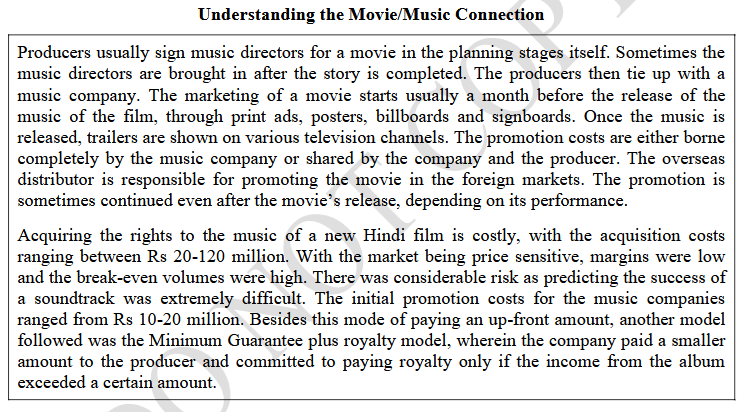
Music is an extremely important feature of Indian films (See Box). While a good soundtrack is vital for getting a movie pre-release publicity, a good movie aids the music sales after the release. Hindi film music accounts for 70% of the film industry's revenues. T-Series was the overall market leader, followed by Saregama3, which had the largest number of titles from old Hindi songs. The other players, in order of their position in the market were: Tips, Sony, Universal, Venus, BMG Crescendo, Magnasound and Times Music. In addition, there were many small players, both at the regional and national level.
The term piracy is generally used to describe the deliberate infringement of copyright on a commercial scale. It is illegal and criminal in nature. Music piracy basically refers to three kinds of activities:
* Counterfeiting – The copying of the sound as well as artwork, trademark, label and packaging of the original recording, with an aim to mislead the consumer into thinking that they are buying the genuine product.
* Pirate Recording – The unauthorized duplication of music from legitimate recordings for commercial gain. Pirated CDs or music cassettes may be compilations or combination of hit titles of different music companies. Unlike a counterfeit product, the packing and presentation of a pirate copy is usually not a replica of the legitimate commercial release.
* Bootlegging – The recording, duplication and sale of a live concert or broadcast without the permission of the artiste or the music company which has the recording rights for the artistes performances.
Those involved in music piracy range from owners of big recording facilities to small shops with a single music system, which is used to record songs that the customers ask for.
According to the International Federation of the Phonographic Industry (IFPI), a worldwide trade association for the music industry that identifies and attempts to solve problems of piracy, sales of pirate recordings were $ 2.1 billion in 1995. This represented unauthorized sales of 954 million music cassettes, 84 million CDs and 4 million LPs – indicating that one in every five recordings sold worldwide was a pirated copy.
India was the world's third largest pirate market in volume and sixth in value. The Indian music industry lost millions of rupees each year to the pirates. Of the nearly 580 million cassettes sold in the year 1997, 175 million were illegally manufactured and sold by pirates. The pirates evade payment of royalty, excise duty and sales tax and also they do not have to incur the promotion and publicity costs. Piracy levels were as high as 90 % in the early 1980s, coming down to 65% in the 1990s and to 40% in 2000.
Gulshan's father Chandrabhan and his family moved to Delhi from West Punjab in 1947. The family members began selling fruit on the roads and within a few years, earned enough money to establish a small fruit juice shop. Chandrabhan later started selling pre-recorded music by opening a record shop. In the early 1970s, Gulshan began looking after the music business and named it Super Cassettes.
By 2000, T-Series had become a $ 90 million group with a presence in the Consumer Electronics (color television, fans), CDs (12 million CDs per annum), Audio/Video Magnetic tapes and cassettes (186 million cassettes per annum) and mineral water businesses. The company had rights to over 2000 video and 18,000 audio titles, comprising of nearly 24,000 hours of music software. T-Series had a technical collaboration with Hyundai of Japan for its color television venture.
This meteoric rise of T-Series was termed by analysts as 'a story of avarice, greed and cunning and the clash of two mafias - one represented by Gulshan and the other by those whom he damaged.'
In the 1970s, the Indian music industry was dominated by GCI and Polydor (later named Music India Ltd.- MIL), which sold only expensive LP records through a few record shops. These companies did not set up facilities to manufacture cassettes on a large scale. Since cassette players were not very common in the country at that time, GCI and Polydor were happy offering cassettes in small numbers at very high prices.
In the late 1970s, cassette players flooded the country, many of them being Japanese 'two-in-ones' (radio and cassette player) brought in large numbers by workers returning from the Gulf states. In 1978, with the Indian government liberalizing the import and export trade, new kinds of luxury consumer goods appeared in the market. These goods were popular with the rapidly growing middle class population. Cassette players (and consequently, cassettes) were one such new item that quickly became popular in the country.
Compared to the LP records, cassettes were incredibly cheap to produce and reproduce and could be easily distributed and transported. Gradually, a large number of outfits began setting up illegal copying operations. Most copyright violators chose old Hindi film songs from the GCI catalog. All that was required to run a copying outfit were two cassette players and a supply of tape, spools and cases. Since the bootleggers paid no royalties and no excise and used cheap cassettes, they were able to sell their products at half of GCI?s prices. By the mid 1980s, cassettes reproduced in this fashion accounted for a significant portion of the music sold in India. A major part of this piracy industry was reportedly owned and operated by T-Series.
In the late 1970s and early 1980s, audiocassette production was defined as a small-scale industry (SSI). Thus, Gulshan was able to take advantage of the subsidies, loans and all the other incentives accruing to the SSIs. The only capital expense the company had was the cost of the cassette - Rs 7 -and the cost of duplicating. This cassette was retailed at about Rs 25. On the other hand, GCI and MIL cassettes retailed for Rs 36-45, as the companies had to pay, in addition to royalties, an excise duty of 15 % on every cassette. As T-Series did not pay any excise duty, the entire 15% benefit was passed on to the customer. Gulshan also kept his dealers/retailers as happy as possible - if a T-Series cassette was found to be defective, it was instantly replaced. Super Cassettes never became a member of the IMI, and therefore, was under no obligation to follow the organization's guidelines. The company quickly emerged as the biggest competitor to GCI, which even came close to winding up its operations.
By the mid 1980s, T-Series had reportedly stopped the pirated recording business and 'shifted' completely to the legitimate businesses. However, controversies continued to dog the company, with Gulshan coming out with the idea of „cover versions.? Cover versions were albums that used the musical compositions as well as the lyrics of original well-known Hindi film soundtracks. Fresh recordings were made using the same compositions and lyrics, but with a different orchestra and singers, from the ones used in the original. These recordings were then sold in the same market in which the original soundtrack albums were sold, in most cases with the same title. While some parties took permission before making the recording, others merely sent notices, as required by Rule 21 of the Copyright Rules Act 1958, along with a cheque for a paltry sum towards royalty for the literary and musical works. Cover versions were considered to be legal as long as the makers had acquired permission from the original music companies. The Supreme Court had passed a directive that cover versions done after a period of three years from the release of the original music score were legal.
Initially, Gulshan's cover versions featured only old Hindi film songs. Gulshan got unknown singers to sing these as their rates were low and Gulshan was able to make good margins on the overall deal. Soon, he began making cover versions of new movies as well. Though the cassettes always made it clear in small print that these were not the original recordings, the consumers were not always savvy enough to read the small print.
During the early 1990s, Gulshan released a number of albums featuring religious songs. These were fairly successful. He even acted in, sang for and directed a few of the videos of such songs. These were run on the state-owned television channel Doordarshan. T-Series also began producing Hindi films. One of the company's first ventures, the musical 'Aashiqui,' was a huge success. This was followed by many more movies, a majority of which flopped. However, the music of these movies was a success in almost all the cases. The success of 'Bewafa Sanam,' one of the many mediocre T-Series movies starring Gulshan's actor-brother Kishen Kumar, took the whole industry by surprise. Gulshan even invented the concept of the 'music bank' where tunes were stored till a movie or a record was identified to 'fit' them into.
Things were going on rather smoothly – till Gulshan released a cover version of what was reportedly one of India's biggest blockbuster movie, 'Hum Aapke Hain Kaun' in 1997, violating the three-year waiting period stipulated by the Supreme Court. This time around, the attack on GCI's profits was too strong to be ignored and the company filed a suit against T-Series. In the same year, a few music industry players approached the former finance minister V P Singh, demanding that Gulshan be punished for violating copyright laws and pirating music. However, V P Singh reportedly dismissed them saying, “Don't come to me with your hard luck stories. You've no marketing strategies so you haven?t discovered the marketplace. Gulshan has. And you want me to punish him for his entrepreneurial ability?”
As the 'Hum Aapke Hain Kaun' case went to the courts, Gulshan was murdered. With Gulshan's death began a period of uncertainty for the T-Series group. The music company was not doing very well as Gulshan had stopped buying music rights from outside and the T-Series' films had failed. The other businesses were all relatively new and not yet well established. There were reports of infighting in the family regarding the control of the various businesses. Saregama, Tips and Venus, who had emerged as the leading players in the Hindi film music segment, had also ventured into film production. Though Saregama's movies did not do well, quite a few Venus and Tips movies were huge successes.
The December 1998 Delhi High Court ruling in the 'Hum Aapke Hain Kaun' case, which put an end to the cover version recordings, was the biggest blow to T-Series. The High Court order said that the makers of version recordings relied upon a special provision of the Indian Copyright Act [S 52(1)(j)]. Taking advantage of this provision, the pirates claimed that copyright owners of the compositions and lyrics were only entitled to a statutory license fee. They also said that once the owners received the license fee, they had to allow the fee payers to make sound recordings.
The Delhi High Court held that there was no provision for such automatic licensing and the sound recordings could be made by third parties only after they had obtained permission from the copyright owners. The Court held that under the Copyright Act, assignments and licenses could only be made in writing. They had to be signed by the assignor/licensee. As GCI had categorically refused to grant a license/assignment in favor of T-Series and had also returned the cheque for the royalty amount sent by T-Series, it was able to win the case.
Though GCI had won this case against T-Series, the problem of music piracy still plagued the industry. The music companies were handicapped by the legal definition of copyright violation wherein piracy was not a cognizable offence. The companies had to prove that cassettes were being pirated before getting a warrant of arrest. According to certain reports, music pirates were always tipped off about police raids in advance.
The nexus between the film/music industry and the Dubai/Mumbai underworld was another problem. The mafia controlled a large portion of the Mumbai music piracy business. This nexus was so strong that after an IMI raid in the early 1990s in Mumbai, IMI officers were beaten up and its Mumbai office was destroyed. After this, all the markets in that area were closed for 15 days in protest against the raid. According to IMI estimates, almost 95% of the distributors and dealers were involved in piracy and on an average, only 40% of the stock was genuine. Analysts claimed that except for giving leads to the police and initiating raids on pirated music vendors, even the music companies had done precious little to curb music piracy.
The problems associated with the distribution network in the music business also substantially helped the pirates. Market observers claimed that around 50 distributors had an absolute control on the music industry?s distribution network.
Distribution was the most profitable part of the music business. The average cost of a cassette for the distributors was Rs 19. The selling price ranged from Rs 38 (large retailers) to Rs 44 (small retailers) for a cassette. The retailers added their own margins to the price. The price for the customer thus ranged between Rs 50 and 60. The problem was compounded by the fact that in the case of film music, if supplies were not made available immediately, the demand shifted either to pirated cassettes or to some other album that was easily available. Thus, it was imperative for the music companies to sell in bulk to the distributors.
The companies realized that they had a lot to gain by bypassing this network. The logical solution, though time consuming and costly, was to set up their own music stores. The biggest initiative in this direction had come from Saregama, whose owners, the RPG group had successfully established the Music World chain of music retailing outlets all over the country. The emergence of organized music retailing outfits like Planet M and Internet based stores such as fabmart.com was expected to help the companies improve their performance.
Indian film music lovers have always regarded the decades prior to the 1980s as the 'golden era' of Hindi film music. During the 1980s, there was blatant and sub-standard copying of international music. In the late 1980s, videocassettes became extremely popular among India's upper class and upper middle-class families. As these people began watching the latest films in their homes, video piracy became rampant. Now it were the lower classes that could not afford to buy color television sets and video players or recorders, that went to the theatres. Hence, films were made to cater to their tastes. These films were invariably medicore and the music was of very low quality.
T-Series was given credit for bringing the music industry out of this decline. Many critics praised Gulshan's unerring instinct in picking up saleable music. Some of the films for which Gulshan procured the music rights in the early 1980s went on to become huge successes. Almost all these movies featured melodious music, bringing back the sounds of the pre-1980s era.
Gulshan's supporters held that till he came along, GCI and MIL had been virtually looting the consumer by charging absurdly high prices for music cassettes. Gulshan had done the customers a great service by making cheaper cassettes, and retailing them through small shops all over the country, thus making cassettes affordable and easily available even to the common man. T-Series even took back unsold cassettes (to re-use the shells as well as tapes) so that these small retailers would not suffer losses. Gulshan was also lauded for promoting fresh talent8 through the cover versions. (Interestingly enough, after Gulshan?s death, the prices of audiocassettes increased in the late 1990s.)
Noted media personality Pritish Nandy said, “He may have made some money through cover versions and piracy. But what is more important is that he benefited listeners, expanded the market and created a galaxy of new stars. He broke, in that sense, the existing monopolies and drove hard and fiercely a sloth, decadent, exploitative market to make it boom. But, like all swashbuckling pioneers, Gulshan Kumar got a bad name for doing it first.”
The fact remains that while the music pirates made huge profits for themselves, they inadvertently ended up benefiting the music industry as well. Since their entry in the 1970s, the industry had more than quadrupled in size. Not surprising therefore, that some say the Indian music industry 'owes its growth to the pirates.'
1. Why do you think Super Cassettes became so successful in the early 1980s? Do you agree that the inaction of the then market leaders contributed to the growth of music piracy?
2. Though piracy and cover versions were ethically and/or legally unacceptable, they aided the growth of the music industry and promoted fresh talent. Critically evaluate this statement, with particular reference to the T-Series story.
3. Analyze the problems being faced by the Indian music industry. As the manager of a music company in the organized sector, what strategies can you adopt to curb piracy?
Keywords
Super Cassettes Industries, piracy business, music industry, successful business empire, piracy, Business Ethics Case Study, Case Study
Related Case Studies
| Case Title | Details | Price | Add to Cart |
|---|---|---|---|
|
Case Title When AI Goes Off Script: The Air Canada Chatbot Liability CaseCase Code: BECG203 |
Details | 300 | Add to Cart |
|
Case Title When AI Goes Off Script: The Air Canada Chatbot Liability CaseCase Code: BECG203 |
Details | 300 | Add to Cart |
|
Case Title Johnson & Johnson’s Talcum Powder Controversy: Putting Profits before Consumer Safety?Case Code: CLBE024 |
Details | 200 | Add to Cart |
|
Case Title OSI China in Food ScandalCase Code: BECG142 |
Details | 500 | Add to Cart |
|
Case Title Volkswagen Defeat Device ScandalCase Code: BECG139 |
Details | 700 | Add to Cart |