
The Indian Liquor Industry Prohibition Story
🌐 International Buyers — Pay via PayPal
Details
BECG011
8
2002
YES
0
Not Applicable
Food & Beverage
India
Accountability
Abstract
The case is so structured as to enable students to examine the political, economic and social consequences of liquor on society to discuss the ethical dilemma of the liquor business for the Governments, industry and the society to explore feasible alternatives to the dilemma faced by companies regarding their economic performance and social responsibilities.
Learning Objectives
The case is structured to achieve the following Learning Objectives:
- Prohibition and its consequence
- and Ethical dilemma of the governments in prohibition.
Contents
“States shall endeavor to bring about prohibition of consumption of intoxicating drinks except for medicinal purposes.”
- Article 47, Constitution of India.
“The industry is not threatened by prohibition as we are aware that it does not stay for long.”
- A liquor industry source in 1998.
In 1996, in the north Indian state of Haryana, the Haryana Vikas Party (HVP) promised to make it illegal to buy, sell, consume or produce alcohol in the state if it were elected to the state assembly. The opposing parties criticized the HVP for trying to gain political mileage out of a sensitive issue like liquor prohibition. Despite the criticism, HVP won the elections and its leader Bansi Lal carried out the party's promise within minutes of becoming the Chief Minister (CM).
Over the next year, the ban cost the state treasury Rs 12 billion in excise revenue and led to a loss of 20,000 jobs in brewing, distilling and retailing of alcoholic drinks. In addition, 40,000 truckers, farmers and bottle producers experienced a substantial decrease in their earnings. The state police filed 98,699 cases involving about 100,000 people caught intoxicated or in possession of liquor. Over 13 lakh bottles were seized and 7,000 vehicles were impounded. The state also saw an alarming increase in deaths, resulting from the consumption of spurious liquor by poor people.
To offset the loss of revenue, the government raised taxes and fees for various state-provided services - power tariff were increased by 10-50%, bus fares by 25%, and the petrol sales tax by 3%. New taxes were levied on businesses and self-employed people. Almost overnight, illicit brewing and liquor smuggling became one of the biggest industries in the state. Haryana's tourism industry suffered badly as tourists preferred to visit neighboring states where there was no prohibition. Profits of most hotels and restaurants, including the state-owned Haryana Tourism Resorts reached the nadir.
The HVP also paid heavily for imposing prohibition in Haryana. Not only did it lose 8 of the 10 Lok Sabha seats it held in the 1998 parliamentary elections, its leader's son spoke openly against prohibition. As a result, in a „not-so-surprising? move, the Haryana government decided to lift prohibition in April 1998. The Rs 60 billion Indian liquor industry was delighted by this move. At the same time, prohibition supporters all over the country voiced their objection to this decision, fuelling the age-old dispute over the efficacy of prohibition.
The consumption of alcohol is perhaps as old as civilization itself, and has played a significant role in religion, medicine and culture. Throughout the history of the world, drinking has been associated with revelry and feasting. Over the years, alcohol became an integral part of 'celebrations' - birthdays, holidays and religious events. Alcohol is believed to have the ability to give the consumer an overall sense of well-being. It is also known to help people overcome their inhibitions(Refer Box).
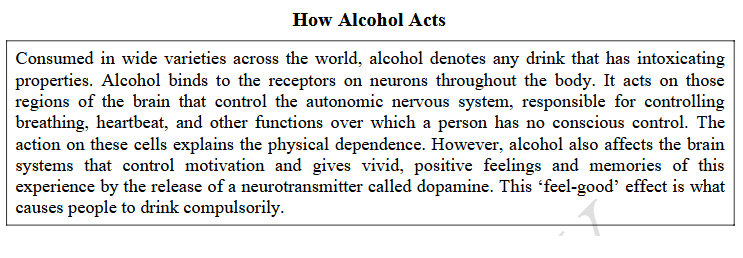
The moderate use of alcoholic beverages by adults is considered normal and acceptable in most countries. However, it has become the most widely abused substance in the world. In fact, alcoholism is now regarded as a disease in many countries. Alcoholism is a chronic, often progressive disease characterized by excessive and repetitive consumption of alcohol despite a decline in the health and social/economic functioning of the individual. Addiction leads to dependence, which leads to physiological problems, if a person stops consuming alcohol. In 1990, 62 million people worldwide were alcohol dependent.
The ills of alcohol were first documented in England in the 18th century. By the end of the 20th century, studies around the world had confirmed that alcohol consumption often led to addiction, increased the likelihood of various types of injury, and increased the chances of heart disease, cardiovascular disease, liver problems, various cancers and nervous system disorders. In addition, in developing countries, alcoholism led to serious social problems such as increase in domestic violence, poverty and crime rates. Though analysts have also claimed that mild to moderate alcohol consumption could actually result in a decreased rate of coronary disease, they invariably add that excessive consumption is definitely harmful. Not surprisingly, alcohol reportedly accounted for 5-10% of the global disease burden and resulted in 2 million deaths annually worldwide. Increasing awareness about the problems associated with alcohol induced governments to introduce prohibition as a tool to control its consumption.
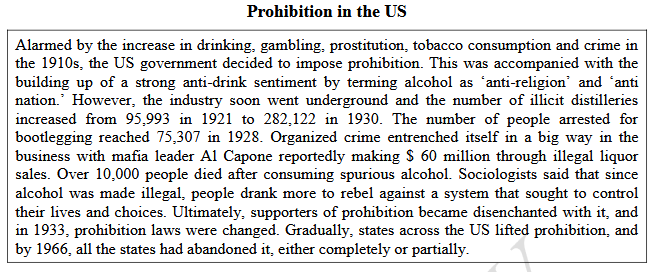
Prohibition refers to the legal prevention of the manufacture, sale, or transportation of alcoholic beverages with the aim of obtaining partial or total abstinence through legal means. The history of prohibition is also almost as old as alcohol itself with reports of attempts made in Aztec society, ancient China and feudal Japan. Over the centuries, governments have experimented with prohibition in the Polynesian islands, Iceland, Finland, Norway, Sweden, Russia and Canada. However, only a few countries (mostly Islamic nations) have been able to successfully implement prohibition at a national level. Most countries that have experimented with the ban soon lifted it. Finland, for instance, adopted prohibition in 1919 and repealed it in 1931, and the United States adopted it in 1919 and repealed it in 1933(Refer Box).
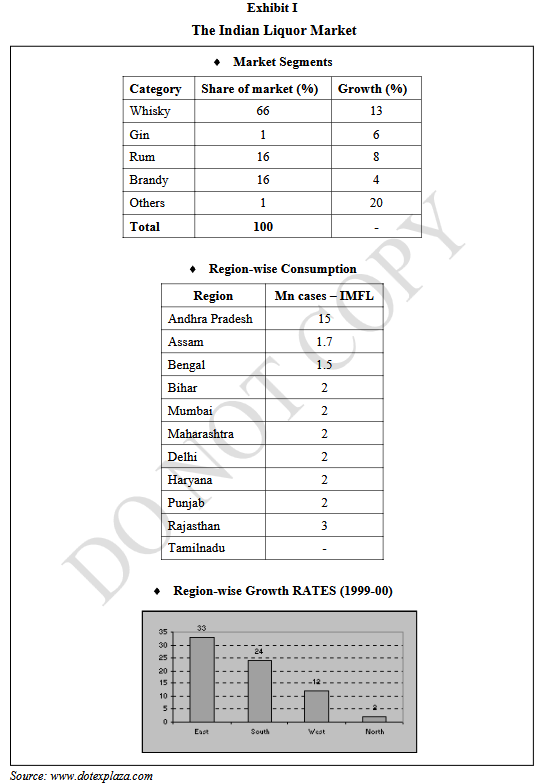
The Indian liquor industry is divided into two broad segments: Indian Made Foreign Liquor (IMFL) and country-made liquor. IMFL comprises alcoholic beverages that were developed abroad but are being made in India (whisky, rum, vodka, beer, gin and wine), while country-made liquor comprises alcoholic beverages made by local breweries. While many Indian and MNC players were present in the IMFL segment, the unorganized sector accounted for almost 100% of the country-made liquor segment.
During 1999-00, the Indian liquor industry grew at the rate of 10-12%. While IMFL was consumed by the middle and upper classes of society, country-made liquor was consumed by the economically deprived classes. In India, 40-50% of all males and 1% of all females consumed alcohol. Almost 62% of the drinkers could be classified as light drinkers (i.e. social drinkers), 29% percent as moderate drinkers, and about 9% as hard drinkers.
Many government restrictions regulated the liquor industry. Companies are not allowed to expand capacity without prior approval from the concerned state government. The government has banned the advertising of any alcoholic product in the electronic media. As a result, companies have resorted to surrogate advertising (advertising for sodas and lemonades using the liquor brand name). However, some states have even banned surrogate advertising. The satellite television channels initially showed liquor advertisements, but were soon banned from doing so. As a result, liquor companies could publicize themselves only through sponsorship of sports events and contests.
The distribution of liquor was also under state control in many states, in the form of auctions, open-market system and government-controlled markets. Under the auction system, the government fixed a floor price for the shops and the bidders had to quote prices. The license was given to the highest bidder. States following the open-market system gave companies substantial freedom to choose their distributor and to determine the price and the discounts. In the government-controlled system, liquor was distributed by state agencies such as BEVCO (in Kerala) and the Andhra Pradesh Beverage Corporation (in Andhra Pradesh). There were around 25,000-27,000 licensed retail sales outlets in the country, in addition to the bars, pubs, hotels and restaurants serving liquor. There were restrictions on the business hours of these outlets and location.
The above restrictions were, however, viewed by many critics as attempts by the state governments to disassociate themselves from the social evils associated with alcohol consumption. While on the one hand, the state governments imposed many restrictions on the companies, they also earned a significant portion of their revenues (Rs 200 billion in 2000 for the whole country) through the levies on liquor sales.
The industry, along with the tobacco and cigarette industry thus had to cope with government regulations and also face the hostility of those who felt that the state should not have allowed the trade in alcohol in the first place.
Soon after independence, prohibition was imposed in the erstwhile state of Bombay. The first large-scale movement against alcohol began in the 1970s, when rural women in various parts of the country protested against the sale of liquor in their villages. Explaining this, a news report commented, “Tortured to intolerable limits by the abuse and beatings of drunk husbands and the hunger and poverty in which their children grow and die, women have taken up chilly powder, broomsticks, kerosene and match boxes as weapons of war.” Over the next two decades, this movement went on to encompass millions of rural women.
In 1990, the women of Dubagunta, a small village in the Nellore district of the south Indian state of Andhra Pradesh began an anti-arrack agitation. They pressurized men to swear that they would stop drinking, physically restrained habitual drinkers, attacked liquor shops and godowns and fought with the police, liquor mafia and the drunks. The movement spread like wildfire to 800 villages throughout the state in a short period of time. Women in these 800 villages not only prevented the entry of liquor into their villages, but also prevented district collectors from holding arrack shop license auctions. It was reported that the women were beaten with rods, sticks, boots and rifle butts by the liquor contractors? henchmen as well as the police force. Non-bailable cases were filed against agitators who were then imprisoned. There were even reports that many women activists were raped and murdered.
These events soon become a matter of national debate and eventually led to the then Congress government of Andhra Pradesh announcing a statewide ban on the sale of arrack from October 1993. In the next state assembly elections, N T Rama Rao (NTR) of the opposition Telugu Desam Party (TDP) promised total prohibition and made it the party's main election plank. The TDP won the polls and NTR announced total prohibition soon after becoming Chief Minister.
The AP government lost $ 362 million in annual revenues after the prohibition. Despite new taxes on vehicles and consumer goods, the state?s budget deficit rose to $ 242 million. However, prohibition continued in the state till 1997. In that year, the new CM Chandrababu Naidu lifted the ban on liquor, claiming that he was forced to do so because of the state?s financial problems. This move met with unprecedented criticism in the media. Critics claimed that the state could have easily avoided unnecessary expenditure on many other fronts, such as salaries and various subsidies.
Besides AP and Haryana, Gujarat, Mizoram, Meghalaya, Kerala and Tamil Nadu had also experimented with prohibition. While Gujarat continued to remain completely dry even in late 2001, Kerala and Tamil Nadu had opted for a partial-prohibition policy3. Ten months after prohibition was imposed in Haryana, two surveys making contradictory claims regarding the efficacy of prohibition were made public. While the government-sponsored survey claimed that prohibition was successful, the independent study said it had failed miserably. Covering all the districts of the state, the latter survey interviewed over 900 persons, of whom 54% felt that prohibition was a failure, 36% said it was partially successful, and only 8% said it was a success. The survey claimed that people were drinking openly and the police was simply ignoring them.
To counter these allegations, the government quoted the findings of a survey report made by the Chandigarh-based Institute of Development and Communications. Interviewing 6,000 people in six districts, the study concluded that 58% of the alcoholics had kicked the habit following prohibition. The study claimed that liquor consumption in Haryana had come down by 67%. The fact that prohibition did not seem to have completely succeeded in any state strengthened the beliefs of prohibition?s critics that it was practically impossible to implement prohibition. Analysts claimed that politicians had used prohibition only as a means to garner popularity and votes.
The efficacy of prohibition to curb alcohol consumption became questionable when it became known that the availability of alcohol actually increased in Haryana and AP after prohibition, albeit at higher prices. The experiences with prohibition all over the world prove that it is extremely difficult to make it a success. These experiments with prohibition raised some important questions: was it possible to police the morals of society? Since alcohol consumption was an inseparable part of human life, could it be controlled?
Critics claim that prohibition led to nothing but an increase in organized crime, illicit distillation, deaths from spurious liquor, and widespread defiance of the law. Prohibiting liquor consumption simply created networks of smugglers and home brewers who encouraged people to drink even more than when alcohol was legal. Also, any prohibition exercise invariably ends up depriving those drinkers who do not form the section of society most troubled by alcohol related problems. The poor people continued to get their supply of country-made liquor while the middle and upper class people were unable to get IMFL. This negated the very purpose of prohibition as the poor continued to be affected by alcoholism. According to analysts, “In most Indian rural households, the man typically controlled the family's entire purse. And in far too many rural families, men divert scarce cash to liquor, depriving their womenfolk and children of money, of better food, education, or anything else. Many sink into debt, dragging their families down with them. So prohibition is not just a morality-versus-liberty issue, it also a civil rights issue for women and children.”
Sociologists claim that it is impossible to make anyone stop drinking alcohol, especially by force. Until and unless a person is willing to give up alcohol, he would find means to obtain alcoholic drink. This explains why after the imposition of prohibition, the business quickly passed on to illegal operators. This is further substantiated by the fact that the US liquor business shifted back to the corporate sector gradually after prohibition was lifted.
Supporters of prohibition however said that all these arguments did not hold good. They felt that prohibition was justified in the light of the plight of millions of families suffering the evils of alcoholism. Analysts reported that domestic violence in Haryana and Andhra Pradesh (drunk men reportedly beating their wives) had declined significantly after prohibition. The supporters of prohibition were of the view that liquor was freely available and consumed by many in dry states only because of regulatory and policing lapses.
Analysts claim that the fact that the business of alcohol has been legal for so many centuries does not negate the ill effects associated with it. If one strictly followed the logic of the necessity of excise revenues, then governments might as well legalize the narcotics, gambling and child labor businesses and earn substantial revenues.
One of the biggest sufferers during this period were the players in the Indian liquor industry. Though the financial implications of prohibition in only a few states were reportedly not that high, the companies had to nonetheless live with the constant threat of prohibition being imposed in some state or the other.
Restraining the consumption of alcohol to safeguard the interest of the society is a complex and complicated issue. According to analysts, unless the state governments established well-defined regulations; gained the complete co-operation of the enforcing authorities; ensured a speedy disposal of cases; took tough action against offenders; and set-up a fool-proof control system to prevent smuggling and the emergence of illicit liquor businesses, it would be impossible to make prohibition a success.
The Indian liquor industry argues that since the brewing of dangerous illicit liquor is difficult to control, it would be advisable to make safe, organized sector liquor available at reasonable, affordable prices. By introducing differential taxes for hard and soft liquor (beer) the illicit liquor evil could be weeded out. Instead of trying to curb the consumption of liquor, the industry felt that state governments should run sustained education campaigns in these states, advocating the virtues of moderate consumption of alcohol.
By the end of 2001, partial prohibition in the southern state of Tamil Nadu seemed to be failing miserably. During September-November 2001, over 85 people died due to the consumption of spurious liquor. Since the state government earned substantial revenues from arrack and toddy sales, it seemed to be unwilling to impose prohibition.
Meanwhile, in mid 2001, anti-liquor protests by women began once again – this time in Kadahalli, a small village in Karnataka. As a result, issues like the social responsibility of the liquor industry, its right to do business and the viability of prohibition again began to be hotly debated. It was also rumored that it was a matter of time before the Gujarat government lifted prohibition, since it was finding it difficult to do without the Rs 18-20 billion generated by excise duty on liquor sales.
1. 'The regulatory authorities have no right to impose prohibition after having allowed the alcohol business to grow into a Rs 60 billion industry.' Critically comment on the above statement highlighting the economic, social, moral and political aspects involved in the liquor prohibition issue.
2. Do you agree that alcohol consumption can never be completely eradicated and it is impossible to successfully implement prohibition, especially in India? Give reasons to support your answer.
Exhibit I: The Indian Liquor Market
Keywords
Liquor on society, ethical, Governments, Business Ethics, case study, The Indian liquor industry prohibition story
Related Case Studies
| Case Title | Details | Price | Add to Cart |
|---|---|---|---|
|
Case Title When AI Goes Off Script: The Air Canada Chatbot Liability CaseCase Code: BECG203 |
Details | 300 | Add to Cart |
|
Case Title When AI Goes Off Script: The Air Canada Chatbot Liability CaseCase Code: BECG203 |
Details | 300 | Add to Cart |
|
Case Title Johnson & Johnson’s Talcum Powder Controversy: Putting Profits before Consumer Safety?Case Code: CLBE024 |
Details | 200 | Add to Cart |
|
Case Title OSI China in Food ScandalCase Code: BECG142 |
Details | 500 | Add to Cart |
|
Case Title Volkswagen Defeat Device ScandalCase Code: BECG139 |
Details | 700 | Add to Cart |