
The BAT-ITC Tussle
🌐 International Buyers — Pay via PayPal
Details
BECG012
11
2002
YES
0
ITC Limited
Food & Beverage
India; UK
Corporate Governance
Abstract
The case examines the tussle between ITC Limited (ITC) and its parent company British American Tobacco (BAT) during the mid-1990s. The case also details the issues over which the two companies disagreed, with a focus on the ITC Chairman K L Chugh’s role in the battle.
Learning Objectives
The case is structured to achieve the following Learning Objectives:
- Tussle between BAT and ITC
- Corporate Governance
- and FERA Violations by ITC.
Contents
“ITC does not need BAT.”
- J N Sapru, former ITC Chairman, in 1994.
In March 1995, a press release issued by the UK-based global tobacco major British American Tobacco (BAT) shocked the Indian corporate world. Expressing a lack of confidence in K L Chugh (Chugh), the chairman of its Indian subsidiary, the Indian cigarette industry leader ITC, the press release demanded his resignation. The incident took place soon after Chugh had accused BAT of trying to forcibly increase its stake in ITC to gain majority and that BAT was not in favor of ITC’s diversification into the power generation business.
Though the ITC-BAT relationship had been strained for quite some time, the move took ITC by surprise. The surprise element was BAT’s claim that it was not demanding Chugh’s resignation because of the shareholding issue, but because it had detected certain financial irregularities in the company. BAT said, “Chugh should resign in the interests of the company, its employees and its shareholders.”
Soon after, Chugh called a press conference, at which he categorically refused to resign, “Just because one of the shareholders throws a tantrum does not mean the chairman goes.” He reiterated his stand that BAT was trying to increase its stake and added that BAT only wanted to use ITC’s funds for its own benefits.
Soon, the inside details of the ITC-BAT conflict became public knowledge as a series of allegations and counter-allegations from both the parties surfaced in media reports. Commenting on the showdown, a report said, “As skeletons come tumbling out, ITC’s carefully nurtured public image as a professionally managed enterprise has been tarnished.”
ITC’s history goes back to 1905, when BAT set up the Peninsular Tobacco Company (Peninsular) in India. Peninsular was involved in cigarette manufacturing, tobacco procurement and processing. It set up a full-fledged sales organization named the Imperial Tobacco Company of India Limited (Imperial) in 1910. To cope with the growing demand, BAT set up another cigarette manufacturing unit in Bangalore in 1912. To handle the raw material (tobacco leaf) requirements, a new company called Indian Leaf Tobacco Company (ILTC) was incorporated in July 1912. The poor quality of tobacco obtained from Bihar prompted ILTC to search for better alternatives, leading to the establishment of the South India Leaf Area (SILA) in Andhra Pradesh.
By 1919, BAT had transferred its holdings in Peninsular and ILTC to Imperial. Following this, Imperial replaced Peninsular as BAT’s main subsidiary in India. Throughout the 1920s, Imperial appointed distributors and agents in various parts of the country. As sales were growing faster in North India than elsewhere in the country, Imperial set up its third factory at Saharanpur in UP in 1924. A year later, Imperial set up a printing factory at Munger. In 1928, Imperial’s head-office in Calcutta was inaugurated.
In the early 1930s, Imperial’s sales declined sharply. The Independence movement and its aftermath left the company’s distribution network severely damaged and many areas became inaccessible overnight due to the partition. The company however managed to re-establish its distribution network and went on to become very successful in the next few decades. By the late 1960s, the Indian government began putting pressure on multinational companies to reduce their holdings. Imperial divested its equity in 1969 through a public offer, which raised the shareholding of Indian individual and institutional investors from 6.6% to 25%.
Though Imperial clearly dominated the cigarette business, it soon realized that making only a single product, especially one that was considered injurious to health, could prove to be a problem. In addition, regular increases in excise duty on cigarettes had a negative impact on the company’s profitability. To reduce its dependence on the cigarette and tobacco business, Imperial decided to diversify into new businesses. It set up a marine products export division in 1971. The company’s name was changed to ITC Ltd. (ITC) in 1974. In the same year, ITC reorganized itself and emerged as a new organization divided along product lines. In 1975, ILTC was made a division of ITC. In the mid 1970s, ITC decide to concentrate on filter cigarettes where it had identified a latent demand. ITC’s Wills Filter brand, promoted through the ‘Made For Each Other’ campaign, became an immediate success.
In 1975, ITC set up its first hotel in Madras. The company diversified into the textile industry with Tribeni Handlooms in 1977. The same year, ITC set up Bhadrachalam Paperboards. In 1981, ITC diversified into the cement business and bought a 33% stake in India Cements from IDBI. This investment however did not generate the synergies that ITC had hoped for and two years later the company divested its stake. In 1986, ITC established ITC Hotels, to which its three hotels were sold. It also entered the financial services business by setting up its subsidiary, ITC Classic Finance.
In 1994, ITC commissioned consultants McKinsey & Co. to undertake a detailed study of the businesses of the company and make suitable recommendations. McKinsey advised ITC to concentrate on its core strengths and withdraw from agri-business where it was incurring losses. During the late 1990s, ITC decided to retain its interests in tobacco, hospitality and paper. ITC either sold off or gave up the controlling stake in several non-core businesses. ITC divested its 51% stake in ITC Agrotech to ConAgra of the US, the world’s fourth largest company in the food business. ITC Zeneca, the seed manufacturing company, and ITC Palm Tech were also merged with the new agri-business entity. Tribeni Tissues (which manufactured newsprint, bond paper, carbon and thermal paper) was merged with ITC.
Throughout the early 1990s, relations between ITC and BAT remained rather strained. According to analysts, this was because, “ITC is one of the few BAT companies which are ‘associates’ rather than subsidiaries. ITC has always been wayward from the BAT point of view. It is not constrained to follow BAT’s global objectives and business plans and does its own thing with BAT approval.”
BAT was unhappy with Chugh because it was under his regime that ITC had openly disregarded BAT’s authority over the company. What started as a battle between an MNC parent and its subsidiary, eventually became a battle between a person (Chugh) and a corporate.
Chugh had joined ITC as an engineer at the Munger factory. Having made rapid progress up the corporate ladder, he was given full responsibility for ITC’s Bhadrachalam Paper project. Not only was the project successfully commissioned, but Chugh also played a crucial role in lobbying with the Andhra Pradesh state government when it withdrew certain crucial concessions. On the strength of his successful track record, Chugh was made the vice-chairman of ITC in 1989 and the Chairman in 1991.
According to many ITC insiders, Chugh’s style of functioning was radically different from that of his predecessor Sapru. Sapru believed in decentralized decision-making and encouraged debate and disagreement. Chugh, on the other hand, was a hands-on executive and tried to keep decision-making centralized. There were rumors that some of Chugh’s trusted lieutenants had been encouraged to bypass their bosses and report directly to the chairman.
Gradually, Chugh’s autocratic style began to create problems within the organization. The re-induction of Deveshwar (believed to be Chugh’s protege) who had quit ITC to be with Air-India for two years, as the number two man in ITC, was seen as a case of clear favoritism. BAT was informed that Deveshwar’s re-induction had the full consent of the other board members, although, another director Misra, had in fact protested against the move. The responsibilities of Ashok Bhatia (head of the hotels division) and Misra were changed without consulting them. In April, following a stormy EGM, their portfolios were restored. By 1995, ITC’s main executive body, the committee of directors had virtually become defunct and nonfunctional. Notwithstanding these problems, Chugh was able to consolidate his position due to the company’s consistently strong financial performance.
ITC had always received BAT’s full support right from the time A N Haksar became the first-ever Indian chairman of the company in 1968. Even ITC’s diversification into other businesses had received BAT’s approval. Sapru, who took over as Chairman in 1983, maintained very cordial relations with BAT. He always kept BAT informed of all major strategic decisions. However, Chugh chose not to inform BAT about ITC’s tie-up with Peregrine, a global financial services major in 1993. BAT, which was also a global player in financial services, viewed this move with concern. Though the venture did not work out, Chugh’s relations with BAT soured. In September 1993, ITC launched its $ 91.8 million GDR issue, managed by Merrill Lynch and Peregrine. While the issue had in principle been cleared by BAT, it was not intimated before the launch.
The main conflict between BAT and Chugh however was over BAT’s intention of acquiring a 51% stake in ITC. After the liberalization of the Indian economy in the early 1990s, BAT wanted to acquire majority shareholding in ITC. In early 1994, Chugh reportedly wrote to BAT stating that he supported this move. He even set up a team headed by the company’s Finance Director to work on the stake-hike proposal.
At a board meeting in November 1994, BAT proposed a nomination committee to screen future board appointments. Chugh saw ulterior motives behind this move. In a February 1995 board meeting, the differences between Chugh and BAT deepened when Chugh wanted to include Y C Deveshwar (Deveshwar) in the nominations committee and BAT strongly opposed the move.
Things worsened when BAT came to know that Chugh had changed his mind regarding the stake-hike issue. Chugh claimed that he opposed BAT’s move only because he did not want ITC to be reduced to being just a tobacco company. Chugh claimed that under his regime, ITC had done very well financially (Refer Exhibit II). He also played his swadeshi card, posing as an Indian professional making valiant efforts to ward off an MNC marauder. This won him a lot of favorable publicity in the media.
In March 1995, Chugh was called for a meeting with BAT officials in London. During the meeting, BAT made clear its intentions to increase its equity stake in ITC. It also demanded Chugh’s resignation. Chugh asked for a week’s time to submit his resignation and returned to India. Instead of complying with BAT’s wishes, Chugh held a meeting with his close associates including Deveshwar, R.P.Agarwal, R.K.Kutty and Mukesh Palta (Vice President of ITC’s tobacco division.) It was at this point that BAT raised the issue of financial irregularities in ITC.
BAT expressed alarm at the manner in which Chugh had apparently ‘departed from the standards of professional management.’ BAT’s accusation was made on the eve of the EGM convened in March 1995 to approve ITC’s diversification into the power sector (deemed to be Chugh’s pet project.) The venture implied a considerable financial commitment from BAT. BAT made it clear that it would approve the diversification only if Chugh resigned. Chugh, however, refused to do so.
At the EGM, BAT was surprised to see two nominees from UTI and ICICI on the board. Media reports said that the FIs had acted in concert with ITC, in a ‘well laid-out plan’ to thwart BAT’s attempts to remove Chugh. However, the FIs strongly denied this allegation and claimed that their nominees had been co-opted only because substantial FI money was involved in ITC’s proposed diversification plans .
Thereafter, Chugh presented his case before the media. BAT seemed to have been completely taken aback by these actions, and realized that it would not be able to put down Chugh easily. In May 1995, Broughton met Chugh to assure him that it did not have any takeover plans and that it would support ITC’s diversification efforts.
The charges of financial irregularities were confirmed later on by an audit committee. The committee said that ITC was involved in certain questionable deals, which had led to a drop in profits of Rs 2.61 billion for 1995-96. However, the committee cleared Chugh of all charges. A few days later in September 1996, Chugh summoned a press conference and to the surprise of everyone, announced his decision to step down from his post by December 1996.
Chugh said, “Unfortunately, certain serious differences of opinion developed between BAT and myself over organizational issues. Even though genuine efforts were made by both sides to resolve these differences, due to a variety of reasons this was not possible. I feel that it will be in the best interests of the growth of the company that I step down.” This was a dramatic turnaround from Chugh’s hitherto anti-BAT stand. To add to the mystery, media reports revealed that not only had BAT agreed to drop all charges against Chugh, it had given him a very handsome severance package as well as the ‘Chairman Emeritus’ status at ITC. The media considered the peace making moves as efforts by the two sides to avoid having to ‘wash dirty linen in public.’
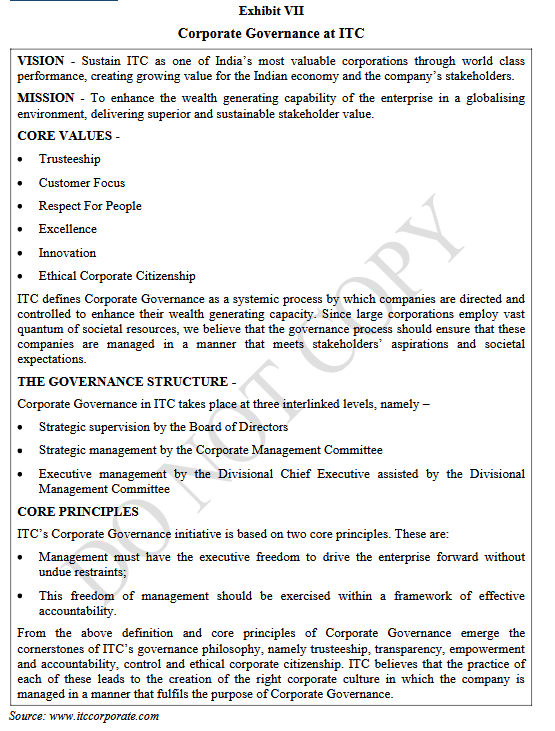
In a November 1996 board meeting, the ITC board decided to suspend three Executive Directors in addition to the three already suspended. They were suspended after ITC was charged with several unethical practices during the 1990s . Following this, in December 1996, BAT again sent a letter to the FI shareholders in ITC proposing to remove Deveshwar and two other directors. BAT claimed that the ITC board was not discharging its duties effectively and should be removed. It was reported that BAT did not want to license its brands to ITC because of the Chugh episode. However, BAT changed its stand, following measures taken by ITC to improve its corporate governance practices beginning 1997.
By June 1997, the two companies seemed to have resolved their differences, as BAT licensed ITC to manufacture and sell some of its prestigious global brands including 555 State Express and Benson & Hedges. Though analysts expressed concern over these brands cannibalizing ITC’s own brands, Deveshwar claimed, “This is a win-win situation for both ITC and BAT.”
Exhibit I: ITC: A Chronology of Events Exhibit II: ITC Shareholding Pattern Exhibit III: Income & Expenditure Statements Exhibit IV: ITC - Segment Wise Sales Exhibit V: ITC - The Board Structure Exhibit VI: A Profile of BAT Exhibit VII: Corporate Governance at ITC
1. BAT was not concerned about the financial irregularities at ITC - its demand for Chugh's resignation was just a cover-up for the stake-hike issue. Critically comment on this statement. What were the reasons for the BAT-ITC tussle during Chugh's tenure?
2. Why do you think ITC claimed that it 'did not need BAT?' Do you think ITC was justified in making such a claim, especially in view of the fact that in June 1997 it entered into a deal with BAT to manufacture and sell some of BAT's premium global brands?
Exhibit I
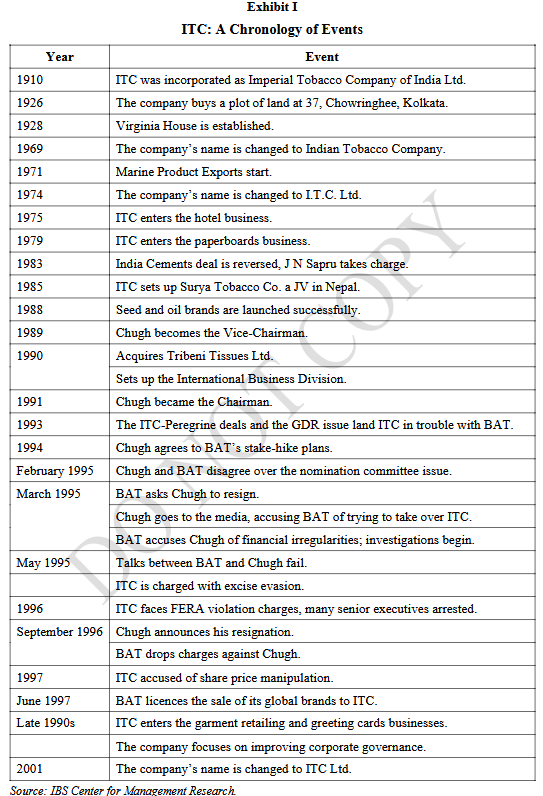
Exhibit II
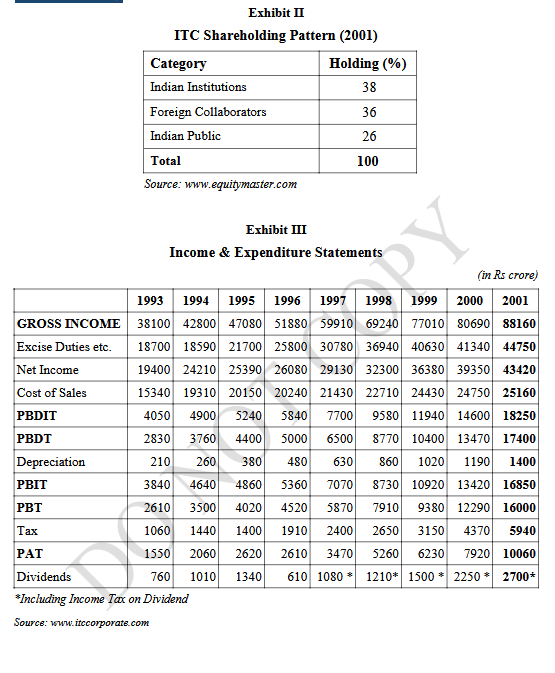
Exhibit IV
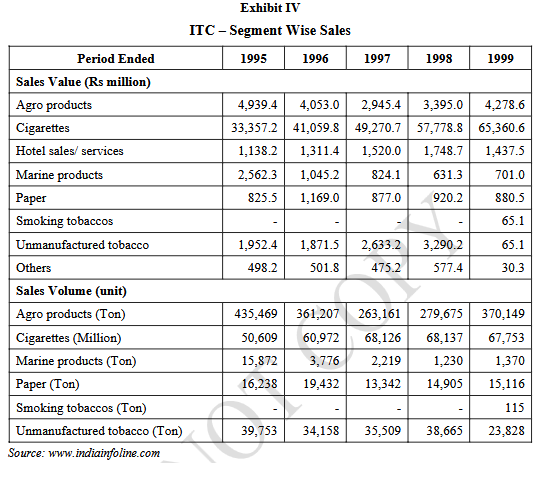
Exhibit V
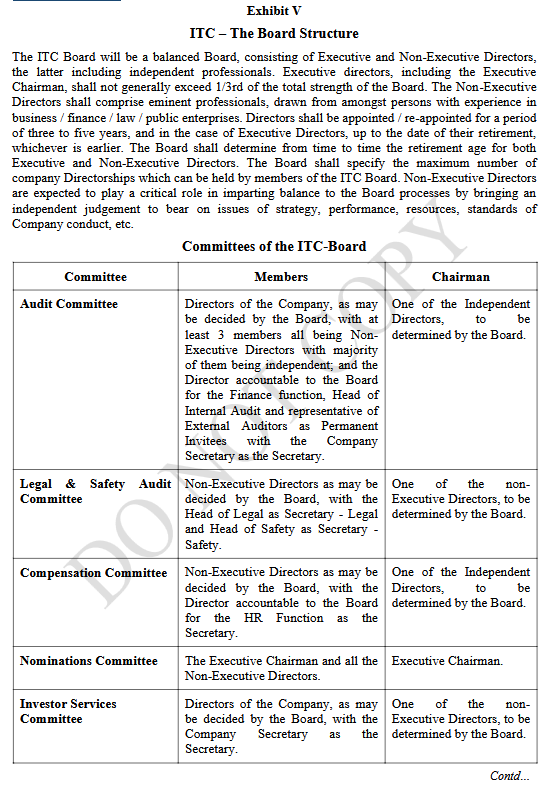
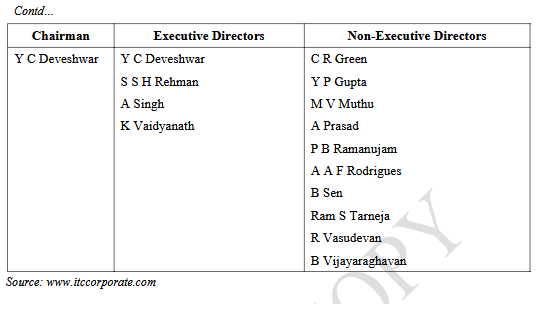
Exhibit VI
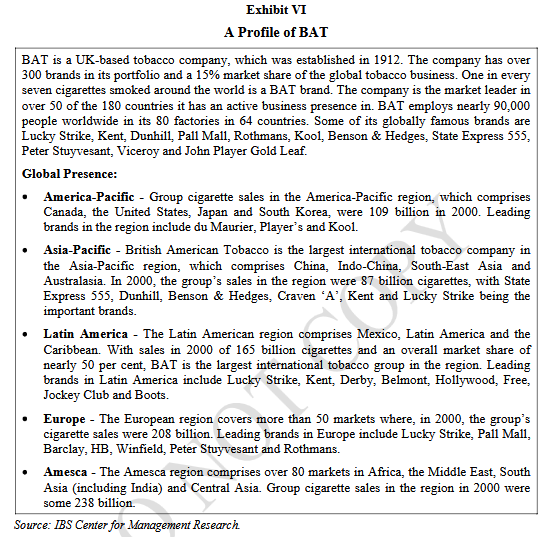
Exhibit VII
Keywords
British American Tobacco in India, ITC Ltd, KL Chugh, Diversification moves by ITC, Financial irregularities at ITC, Tussle between BAT and ITC, Corporate Governance, Role of BAT in the whole issue, FERA Violations by ITC, role of Chugh in the ITC controversy
Related Case Studies
| Case Title | Details | Price | Add to Cart |
|---|---|---|---|
|
Case Title The Tech Phoenix: Satyam’s 100-Day TurnaroundCase Code: BSTR703 |
Details | 600 | Add to Cart |
|
Case Title Vizag Gas Leak Tragedy: Is LG Polymers to be blamed for Negligence?Case Code: BECG182 |
Details | 400 | Add to Cart |
|
Case Title Leadership Communication and Employee LayoffsCase Code: HROB231 |
Details | 400 | Add to Cart |
|
Case Title Company Valuation vs. Leadership Values: The Better.com ExperienceCase Code: LDEN191 |
Details | 400 | Add to Cart |
|
Case Title Governance Issues at BharatPeCase Code: BECG180 |
Details | 300 | Add to Cart |