
The Reality TV Controversies
🌐 International Buyers — Pay via PayPal
Details
BECG013
10
2002
YES
0
Fox Corporation
Media
US
Accountability
Abstract
The case is intended to give an insight into reality TV programming and the controversies surrounding it. It explores in detail the trends in reality TV programming and the severe criticism it received from various groups worldwide. The case also discusses the moral and ethical responsibility of TV networks and the viewers who encourage such shows
Learning Objectives
The case is structured to achieve the following Learning Objectives:
- Impact of reality TV programming on the social, moral and ethical values of the viewers.
Contents
“TV networks are willing to do anything to get ratings, including being controversial.”
- Ritchie Lucas, President and CEO, Creatability ad agency, Florida, in March 2002.
“The audience has spoken, and they’ve demonstrated they have a huge appetite for this kind of programming.”
- Sandy Grushow, Fox TV Entertainment Group, in January 2001
In January 2001, religious and conservative pressure groups worldwide (America, Europe, Australia and Asia) protested strongly against the airing of, ‘Temptation Island,’ a TV show. The show, belonging to the genre of reality TV, was made by the US media house Fox TV (Fox TV). It was designed to ‘test the fidelity’ of four unmarried but committed couples, who were taken to an exotic island, where 26 singles tried to lure them so that they would cheat on their partners. Whoever succeeded in remaining faithful to his/her partner was declared the winner.
Critics of the program demanded a ban on it on the grounds that it promoted illicit sex and endangered the relationship between the participating couples. A spokesman for the American Family Association, Randall Murphree, remarked, “Even the trailers for the show were enough to upset conservative organizations and various religious groups.” The activists, in their campaign, publicized the advertisers' identity and encouraged the public to compel the advertisers to boycott the show.
Though Fox TV authorities argued that the focus of Temptation Island was on exploring the dynamics of serious relationships and not on sex, the fact that Fox screened all contestants taking part in the show for sexually transmitted diseases weakened its arguments. Many family associations accused it of capitalizing on the entertainment value of sex and infidelity. The controversy deepened when it was discovered that one of the four couples had an infant son. Though Fox TV pleaded ignorance and removed the couple from the series, the protesters argued that Fox TV could have broken up a family. Melissa Caldwell of Parents TV Council, a division of Media Research Center, said, “I think a lot of people are appalled at the concept of trying to break up committed relationships for the purpose of entertaining millions of viewers.”
The program attracted similar reactions in other countries, especially in conservative countries such as Japan, Taiwan and India. In Taiwan, the show was scrapped even before a single episode was aired. In India, though the program was aired, it faced severe opposition and the Star TV network had to give up the idea of making an Indian version of the program.
The ‘Temptation Island’ controversy sparked off a fresh round of heated debates worldwide regarding reality TV shows. Since its inception in the late 1980s, Reality TV had always been controversial genre because if emphasis on violence, crime and sex. Some of the major controversial reality TV programs during the late 1990s and 2000 included Fox TV’s ‘Who Wants To Marry A Multi-Millionaire,’ CBS’ ‘Survivor,’ Endemol Entertainment’s ‘Big Brother,’ and UPN’s ‘Chains of Love.’ These and many other reality TV shows had been criticized for encouraging voyeurism in viewers and exploiting the human weakness for violence and sex.
In 1926, John Logie Baird demonstrated the first television (TV), a black and white model, which marked the beginning of a communication revolution in the world. Regular scheduled telecasts first began in England in 1936. The TV market grew at a healthy pace in the late 1940s. By 1949, there were over 100 TV stations and over one million families owning TV sets in US. By 1951, the number of TV owning families in the US increased to over 100 million. After color TV was launched in the 1950s, the TV market grew quickly across the world. The popularity of TV over other communication media was attributed to the impact created by visual images.
During its initial years TV shows were primarily adaptations of existing radio shows. However, in the mid 1950s, TV shows created a distinctive identity for themselves in the entertainment and communication media. In the next two decades TV media extended its roots to all corners of the world and became an inseparable part of almost every household.
The advent of satellite broadcasting technology during the mid 1970s transformed the entire TV industry. It now became possible for TV networks to show their programs all over the world. In the next couple of years, the satellite TV industry established itself strongly, reaching out to millions of subscribers all over the world. By the 1980s, TV had established itself as one of the most effective and powerful media, generating huge revenues through advertisements, with access to the drawing rooms of billions of households.
Over the decades, TV became an integral part of the advertising strategies of companies the world over. Companies either sponsored programs or developed ‘between-the-program’ advertisements or sponsorship rights. A wide variety of programs were offered through a large number of TV channels, targeting different sections of society. TV programming content worldwide has been mostly dominated by trends in the Western countries, specially the US (see Table I for Eras of TV Programming).
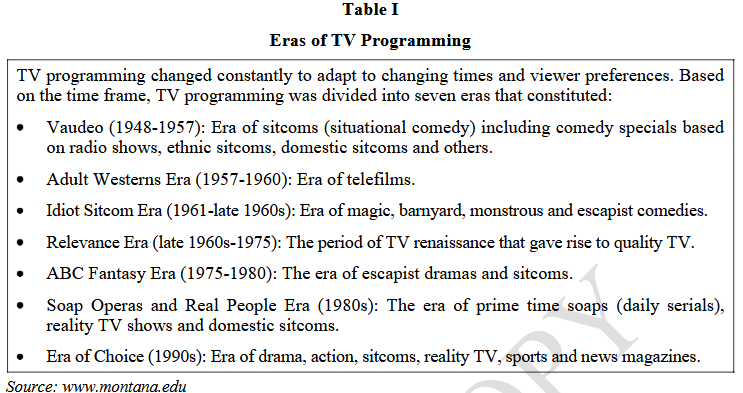
By the late 1990s, TV viewership seemed to be saturating. As a result, competition between various TV channels intensified. With almost all channels offering similar stuff such as soaps, sitcoms and do-it-yourself infotainment programs, companies realized the need for innovative and novel programs that would attract users to their channel. Reality TV programs were soon identified as a powerful method for attracting viewers.
Reality TV constitutes non-fictional programs that supposedly provide a realistic account of current or historical events or situations. Various reality TV programs comprised interviews and talk shows; news and public affairs programming; documentaries; entertainment-news and review programs, portrayed as a re-creation of real world events.
Reality TV programs were initially launched by major networks in Europe and the US. Fox TV, one of the first media companies to realize the potential of reality TV, launched a series of tabloid and crime-based reality shows. Three of its reality shows - A Current Affair, COPS and America’s Most Wanted topped the TV ratings. During the 1980s NBC, ABC and CBS also offered reality TV shows.
In the early 1990s, reality shows focused mainly on tabloid news shows and reality-based entertainment-news programs. The main growth sectors constituted syndicated talk shows, network newsmagazines (including reality based police shows and tabloid shows).
Reality programming quickly became popular in North and South America and Eastern and Western Europe . In other parts of the world such as Australia , Asia and Africa, reality TV programming only picked up in the late 1990s. Soon, almost all the major TV Networks in every country got into reality TV programming. Most of these shows were based on popular shows across the world. Country-specific versions of ‘Who Wants to be a Millionaire,’ ‘The Weakest Link,’ ‘Survivor’ and ‘Big Brother’ attracted a large number of viewers (and recorded high TV ratings) even in conservative Asian countries like Hong Kong, India, China, Russia, Taiwan, and Japan.
The proximity of the presented reality to the experiences of the viewers was a major reason for the success of reality TV shows. The huge cash prizes also contributed to the success of these programs. Since, these shows did not require actors and scriptwriters, they had low development costs. As a result, reality TV was lucrative for TV channels (see Table II for Advantages and Disadvantages of Reality TV).
However, the growing popularity of reality TV shows was accompanied by opposition from critics, scholars and family associations on social, psychological, moral and ethical grounds. Reality programs were criticized for degrading morals, through high focus on tabloid shows. It was reported that during the mid-1990s the advertisers, unwilling to associate their products to such sensational and exploitative tabloid programs, refused to sponsor them. However, the rising viewership for such programs and the growing competition in the industry coaxed the advertisers back into sponsoring them.
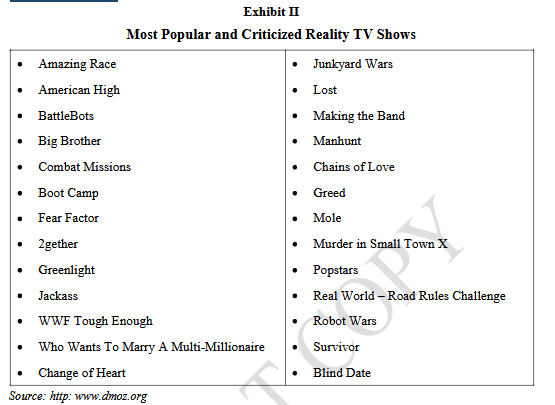
Though reality TV programming also offered newsmagazines and entertainment and education based shows, analysts claimed that there was an obsession of reality TV producers towards the lives and loves of real people, tending to the inherent voyeuristic nature in every human being (See Exhibit I and II for Genres of Reality TV Programming and Most Popular and Criticized Reality TV Programs).
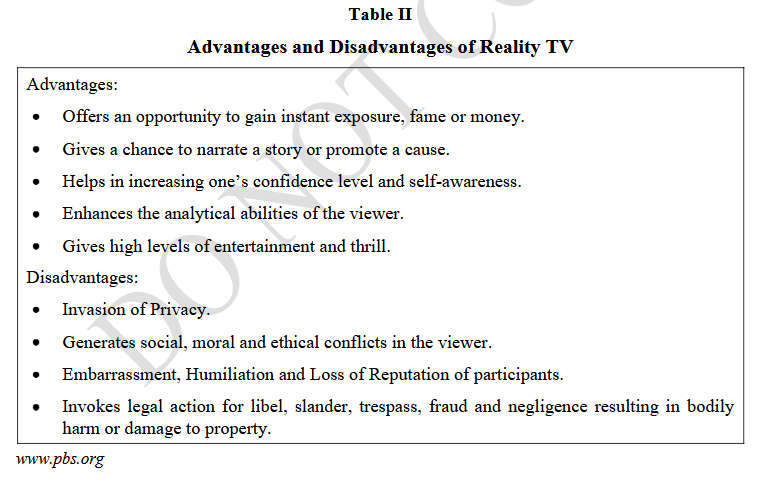
According to experts, TV has a great influence over morality of viewers, as they tend to match their own judgments of what is good and bad with the value system created by TV programs. This could create moral and ethical conflicts in the viewer. As reality TV programs were perceived to be more ‘real’ than other TV programs, their effect on the viewers’ attitudes and values was stronger.
A majority of reality TV shows during the late 1990s and early 2000 were criticized for portraying criminality and abnormality as normal day-to-day occurrences. Analysts remarked that realism in TV programs increased the aggression and involvement of the viewer. They claimed that the high violence shown in reality TV programs adversely influenced viewers’ perceptions; such programs made viewers regard the real world to be violent as that shown on TV. A media critic said, “The greatest flavoring of life that comes from these shows is a kind of knowing cynicism, an embrace of the idea that everything is staged, that feelings are shallow, that the difference between life and simulation is insignificant.”
Reality TV was also criticized by critics and psychologists for fueling voyeurism and exhibitionism in society. Dr Edward Spence, Lecturer in Media Ethics at Charles Sturt University, pointed that it is the intrinsic tendency of human beings to revel in other people’s miseries and misfortunes. Voyeurism is the darker side of human nature, buried deep in every person. According to experts, every person has a tendency to take pleasure from the embarrassment, humiliation and discomfort of others.
Interviews with many viewers revealed that they enjoyed seeing participants and contestants, indulging in inter-group fights and eliminate each other from the game. According to analysts, viewers actually waited in anticipation to see the embarrassment and misery caused to contestants during the course of the program. To quote Brian Reeney, an employee of Channel Nine (a media center) Program Department, “I think there is more opportunity for it (voyeurism) possible and we’re feeding it as well. The success of one program sprouts the creation of similar programs and similar formats in that genre.”
Critics of such shows claimed that the ‘reality’ in reality TV programs was often modified or customized by TV networks to make a more powerful impact on the viewers. TV networks, they argued, re-created ‘reality’ to promote their channels.
The fact that such shows were being made at the cost of what analysts called good programming (news, entertainment, education and information-oriented shows, motivational and counseling shows) added to the resentment against them. However, TV networks across the globe seemed to be unperturbed by these developments. Not only was the number of reality TV shows going up, they were increasingly featuring violence, crime, profanity, helplessness and violation of privacy. TV networks argued that they had created a new genre, which demonstrated that the common man could be as interesting as any film or TV character. The networks claimed that they had ‘ignited a spirit to participate and achieve’ in the people through their reality based programs.
The strongest argument put forward by the networks in support of such shows was that viewers wanted to see reality TV programs. This was borne out by the high viewership ratings recorded by these programs. Bob Littiera (Littiera), Vice-President, DKB and Partners (New Jersey) Media Division, said, “People will watch anything, they’ll watch whatever is thrown at them. There’s always going to be someone who’s watching, always a new audience for it, and there will always be executives who give this to them. And there will always be advertisers.”
Rabbi Kenneth Roseman, a renowned critic of reality TV, said, “Every human being is faced with moral choices, temptations to make mistakes. But we’re not faced with people who deliberately set out to undermine or distort our morals, particularly for ratings and profit. This is really offensive.” He argued that TV networks deliberately exposed millions of people to moral conflicts, encouraging them to give in to temptation, all for the sake of popularity and profitability. How far are these TV networks justified in endangering the moral environment of the society as a whole?
In late 2001, a survey conducted in the US by Adweek revealed that 50% of the surveyed people had become more selective to the kind of programs they watched. Around 57% of the surveyed people indicated that they were less willing to watch reality based programs. As many as 60% of the respondents said that they were willing to watch comedies. This trend seemed to be catching on in many parts of the world in early 2002. Though the repeated telecast of the September 11th terrorist attacks in the US, which brought viewers very close to reality, was partly responsible for this change, it was also caused to some extent, by viewer fatigue. The continuous telecast of reality TV shows with more or less the same content, had bored viewers.
Many of the major networks had reportedly begun efforts to modify their offerings accordingly, prompting rumors of the onset of ‘the end of reality TV.’ However, industry observers claimed that the passiveness towards reality TV programs would be soon over as ‘viewer memory’ tends to be very short.
Analysts observed that viewers continued to watch reality TV in spite of the criticism it received. They therefore argued that viewers were as much to blame for these shows as the TV networks and advertisers.
Bill Press, a TV host and critic, summed up the situation: “I’ve got to tell you, as long as people will go to casinos or continue to build them, as long as people will watch this junk on TV they’re going to continue to produce it. There’s nobody to blame but the idiots who tune in to it.”
1. Briefly comment on the evolution of TV programming worldwide over the decades. Why do you think reality TV shows became the rage overnight in almost all parts of the world?
2. "Reality TV shows only aim at generating viewership by dealing in controversial issues." Critically comment on the social, moral and ethical issues involved in such programming.
3. How far do you think viewers are responsible for encouraging reality shows? Are they as much to blame as TV networks?
4. Do you think reality TV shows have a bleak future in light of the increasing opposition? As part of a management team at a TV network, how would you balance the lure of high viewership (and the corresponding ad revenues) with the social, moral and ethical obligations of the company?
Exhibit I
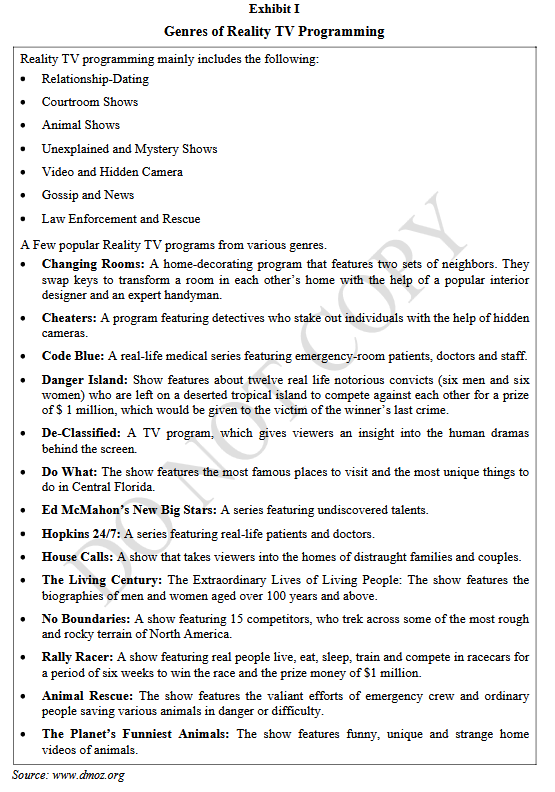
Exhibit II
Keywords
Reality TV programming, controversies, criticism , various groups, worldwide, moral, ethical responsibility, TV networks, viewers
Related Case Studies
| Case Title | Details | Price | Add to Cart |
|---|---|---|---|
|
Case Title When AI Goes Off Script: The Air Canada Chatbot Liability CaseCase Code: BECG203 |
Details | 300 | Add to Cart |
|
Case Title When AI Goes Off Script: The Air Canada Chatbot Liability CaseCase Code: BECG203 |
Details | 300 | Add to Cart |
|
Case Title Johnson & Johnson’s Talcum Powder Controversy: Putting Profits before Consumer Safety?Case Code: CLBE024 |
Details | 200 | Add to Cart |
|
Case Title OSI China in Food ScandalCase Code: BECG142 |
Details | 500 | Add to Cart |
|
Case Title Volkswagen Defeat Device ScandalCase Code: BECG139 |
Details | 700 | Add to Cart |