
The Johnson & Johnson Tylenol Controversies
🌐 International Buyers — Pay via PayPal
Details
BECG015
14
2002
YES
0
Johnson & Johnson
Pharmaceuticals & Biotech
US
Corporate Responsibility
Abstract
The case gives an overview of the problems faced by J&J because of Tylenol. Tylenol was the first acetaminophen-based analgesic to be sold as an OTC drug. The product was promoted aggressively and had become a leader within a few years. In 1982, it was found that Tylenol capsules were laced with Cyanide. This resulted in the death of many people. However, with the company’s proactive and effective public relations program, Tylenol regained its market share within six months. J&J again faced problems when people died due to overdoses of Tylenol. This was mainly because the public as well as the medical practitioners were not well informed about the product’s side-effects. Though the company received bad publicity and had to spend millions of dollars in legal settlements, J&J was reluctant to have more explicit warnings on Tylenol’s labels. This was in contrast to the company’s response in the previous product tampering crises. However, in 1997, following the the FDA labeling rules, J&J made many changes in Tylenol’s labels.
Learning Objectives
The case is structured to achieve the following Learning Objectives:
- Business ethics
- Crisis management.
Contents
“We should encourage physicians to talk with their patients about all the risk factors, while at the same time, finding more ways to educate the public about this avoidable risk.”
- Robert Fontana, Asst. Prof., University of Michigan Health System, talking about Acetaminophen-related liver and kidney problems.
In September 1982, a 12-year-old girl, Mary Kellerman of Chicago, US died after taking extra strength Tylenol for headache. Three more people, Adam Janus, his brother and sister-in-law died on the same day after taking extra strength Tylenol. Three more deaths were reported on the next day due to Tylenol. The news of the incident spread quickly causing a nationwide panic. Responding to the crisis, Johnson and Johnson (J&J) recalled 31 million bottles of extra strength Tylenol worth over $100 million from all retail stores in the US. In addition, the company offered to exchange tablets for capsules at no extra cost for all customers.
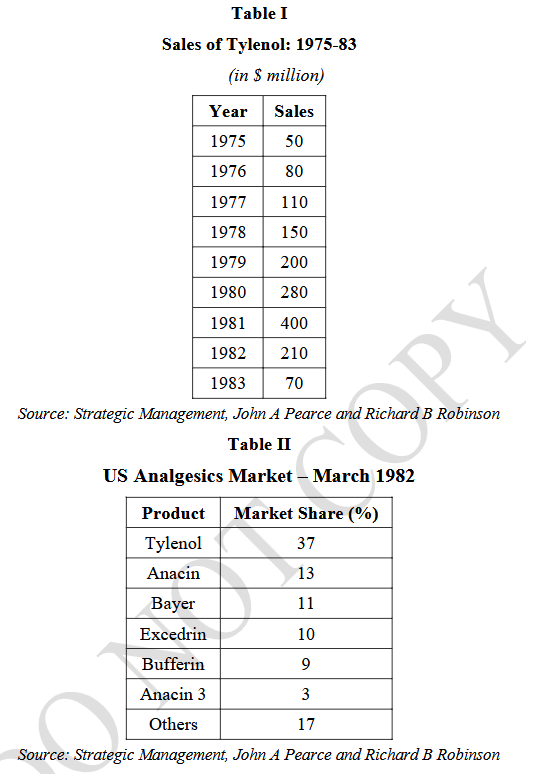
According to an analyst, J&J suffered a loss of $1.24 billion due to the depreciation of the company's brand value. Tylenol's share fell from 37% of the US analgesics market in early 1982 to just 7% by late 1982. According to media reports, the sudden deaths occurred because the Tylenol capsules had been laced2 with cyanide. The capsules had been opened and filled with 65 mg of cyanide. Inspite of the deaths, J&J was praised for its quick action and sincere efforts in recalling Tylenol and giving consumer safety as top priority.
In 1986, J&J faced a similar crisis when yet another incident of product tampering was reported. A woman in New York died after taking a cyanide laced extra strength Tylenol capsule. J&J had to once again recall all the capsules. The company promised to offer Tylenol only in the tablets or caplets form.
In 1989, J&J faced another problem when deaths were reported due to overdoses of Tylenol. Following this, there were hundreds of deaths and severe liver damages all attributed to Tylenol's main ingredient – acetaminophen. Many analysts felt that J&J‘s label should have been more explicit, in warning customers.
According to media reports, at least 100 suits had been filed against J&J over acetaminophen poisonings between 1990 and 1997. However, despite the bad publicity and the costly legal settlements, J&J did not seem keen on warning its customers. Analysts wondered about the company which had been a role model in prioritizing consumer safety during the 1982 crisis.
Inspired by the discoveries of Sir Joseph Lister (Lister), Robert Wood Johnson (Robert) and his two brothers formed a partnership firm to nurture the idea of a practical application of Lister's discoveries. Robert planned to enter the surgical dressings industry with a new type of readymade, sterile, wrapped and sealed surgical dressing in individual packages and suitable for instant use without the risk of contamination. In 1887, the trio converted the partnership into a company and the company was incorporated as Johnson & Johnson.
Over the years, J&J established itself as a leading player in the healthcare industry. The company introduced revolutionary surgical dressings, acquired established companies8, and expanded internationally.
In 1956, Tylenol became a part of J&J, when the company acquired McNeil Laboratories. Tylenol was sold as an over-the-counter (OTC)10 drug. During the 1960s, J&J aggressively promoted Tylenol among doctors and pharmacists as an alternative pain reliever. Soon, the product became very popular among consumers, as it was less irritating to the stomach as compared to other OTC analgesics like Aspirin or Ibuprofen (See Exhibit I).
In 1974, J&J acquired StimTech, a healthcare company selling a unique product – Transcutaneous Electronic Nerve Stimulator (TENS). The product reduced pain by electronic means and was claimed to be effective against headaches, backaches and arthritis. Industry observers expected TENS to become a substitute for analgesics including Tylenol. However, while J&J's marketing made Tylenol the leader of the US analgesics market, TENS failed. StimTech‘s founders filed a suit against J&J saying that the latter bought the company to suppress TENS‘ growth as it was seen as a potential competitor to Tylenol. StimTech‘s founders won the suit and J&J had to pay them US$170 million.
In early 1975, Tylenol faced heavy competition from a similar low-priced product called Datril, manufactured by Bristol-Myers. In late 1975, J&J reduced Tylenol's price by one-third and also advertised it aggressively. This increased the revenues of Tylenol‘s line of products (See Exhibit II) from $50 million to $400 million by 1981 (See Table I). According to the figures for financial year ended 1981-82, Tylenol was the leader with 37% share of the US $1.3 billion12 analgesics market. (See Table II). Tylenol accounted for about 17-18% of J&J‘s net earnings and 7.4% of the worldwide revenues for the same period.
By mid-1980s, J&J had further expanded its presence in a broad range of products in healthcare and other fields. The company's products were grouped under four segments namely consumer, professional, pharmaceuticals, and industrial (See Exhibit III).
Tylenol received a major setback in late 1982 when it was found that many bottles of Tylenol extra strength capsules were laced with cyanide. The publicity about the poisoned capsules caused a nationwide panic. A hospital in Chicago received 700 telephone calls about Tylenol in just one day. People in cities across the US were admitted to hospitals on suspicion of cyanide poisoning. Within the first 10 days of the crisis, J&J received 1,411 telephone calls.
J&J acted immediately after the first reports of deaths came in. The company immediately alerted consumers across the US, via the media, not to consume any type of Tylenol product. The police drove through Chicago where the incidents were first reported, announcing the warning over loudspeakers, while all the three national television networks reported the deaths on their evening news broadcasts. The company told consumers not to use the product until the extent of the tampering could be determined. It recalled all Tylenol bottles and publicized the recall with full-page newspaper ads. Consumers were asked to return the bottles to the stores and exchange them for Tylenol capsules that were not subjected to cyanide tampering. The company shut down the production, distribution and advertising of the medicine temporarily. A day later, the Food and Drug Administration advised consumers to avoid taking Tylenol capsules.
From the beginning, J&J worked with federal investigators. After eight million recalled capsules were tested, it was determined that the bottles had been tampered with on store shelves. The poisoned capsules were placed on the shelves of six different stores in Chicago, IL, US. Only 75 capsules from different eight bottles had actually been laced with cyanide.
Analysts opined that recalling all Tylenol products was not an easy decision for J&J. There was a great deal of discussion on recalling Tylenol at the national level. Some executives were worried about the panic that could result in the industry over such a wide scale recall.
A month after the crisis, J&J launched an aggressive campaign to re-build (See Exhibit IV) Tylenol‘s image. The then Chairman and CEO of J&J, James E. Burke said, ?It will take time, it will take money, and it will be very difficult; but we consider it a moral imperative, as well as good business, to restore Tylenol to its preeminent position.? The company decided to re-launch the product in a new triple-tamper-resistant package by the end of 1982. It's efforts paid off and the company was able to recapture 32 of its original 37 percent market share just six months after the cyanide poisoning.
According to analysts, the way J&J handled the crisis became the model for crisis management. They said that the company's response to the crisis demonstrated its commitment to customer safety and the quality of its product. Also, J&J‘s openness and communication with the public helped the company maintain a high level of credibility and customer trust. Burke repeatedly assured the public of J&J‘s commitment to customer safety. Rather than thinking about the financial implications, Burke followed the company‘s Credo13 (See Exhibit V). He immediately sent a team of scientists to find the source of tampering. R. David Pittle, former commissioner for the US Consumer Product Safety Commission, commented, ?They did the right thing and they did it promptly. Putting consumer safety above all else can help develop a loyalty from the consumer. Though J&J's stock declined in the initial weeks of the crisis, it soon rebounded because of the company's positive communications.
An article published in The Washington Post (Post) on October 11, 1982, said, "Johnson & Johnson has effectively demonstrated how a major business ought to handle a disaster. What Johnson & Johnson executives have done is communicate the message that the company is candid, contrite, and compassionate, committed to solving the murders and protecting the public." Post applauded J&J for being honest with the public. It stressed that it must have been difficult for the company to withstand the temptation to disclaim any possible link between Tylenol and the deaths. They added that the company never attempted to do anything, other than try to get to the bottom of the deaths. It also mentioned that J&J almost immediately put up a reward of $100,000 for the killer.
In 1986, while the public fear about Tylenol was subsiding, J&J was again in the news due to product tampering. A woman in New York died after taking Tylenol. J&J had to once again recall all capsule products. The company decided to permanently discontinue capsule products. It replaced the product with new solid caplets that were relatively less susceptible to tampering.
The 1986 incident, however, attracted negative criticism from analysts. They said that after the 1982 incidents, J&J should have been more proactive and vigilant about product safety. A section of industry observers remarked that the media had played an important role in J&J‘s public relations campaign in 1982. They said that if J&J had not been cooperative with the media, it would have received less positive media coverage which in turn would have affected Tylenol's reputation permanently.
In 1989, J&J faced yet another problem when deaths occurred due to Tylenol overdoses. In 1989, five-year-old Lacy Keele died after being given four extra strength Tylenol tablets in one day twice what she should have taken. In early 1990s, fourteen-month-old Sophie Regosin-Hodges was given an overdose of Tylenol, which severely damaged her liver. As per the pediatrician‘s advice, Sophie was given infant Tylenol drops. The infant drops were three and half times stronger than the children's medicine. Though Sophie survived with a transplant of liver tissue from her father she was put on immunosuppressant14 drugs for the rest of her life. In another incident reported in 1993, Antonio Benedi, an alcoholic, took ten extra strength Tylenol in four days. He survived only after a liver transplant.
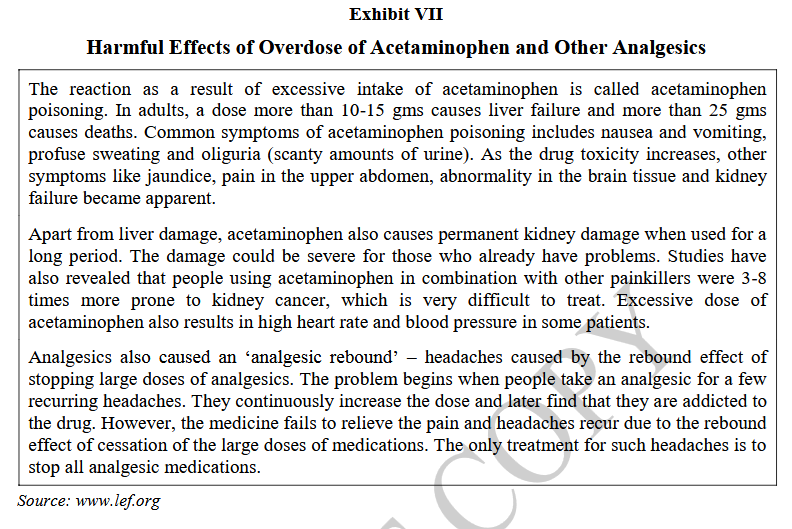
In the following years, there were hundreds of deaths and severe liver damages that were all attributed to Tylenol‘s main ingredient – acetaminophen. Acetaminophen was used to treat mild to moderate pain and fever including simple headaches, muscle aches and mild form of arthritis. The drug was more useful for patients who could not use Aspirin or Ibuprofen, because of gastrointestinal ulcers or bleeding disorders. It was the main ingredient of Tylenol and other pain relieving drugs (See Exhibit VI) and damaged the liver severely, if the medications were taken in large doses (See Exhibit VII).
Slowly, people became aware that though safe in proper doses, Tylenol could be dangerous even in a little overdose. Even twice the prescribed dose could damage the liver. Unfortunately, overdoses could happen due to many reasons. For children, Tylenol came in kid-pleasing flavors and was marked as a ?SAFE' alternative to Aspirin. As children liked the flavor, they could just take another dose. It was also found that in many cases, one parent was not aware that the other had given the dose, and accidentally gave a second dose. Also, parents were not aware about the strengths and doses of Tylenol line of products. Acetaminophen was also harmful to people with liver problems, if taken along with alcohol and certain other medicines or on an empty stomach. However, Tylenol was marketed with the ad line 'Nothing's Safer.' The required warning labels as per the US Food and Drug Administration rules only stated alcohol-related risks. Some health practitioners felt that stronger warnings against overdoses were very important.
According to analysts, inspite of the bad publicity and legal settlements, which cost the company millions of dollars, J&J refused to put explicit warnings on its Tylenol labels. The company had only made just cosmetic changes on the warning label. After the Keele case, J&J added to the extra strength package: 'Not for use for children.' In 1994, after Benedi's case, it added a warning about using any pain reliever after a drink. Analysts said that J&J resisted writing the kind of label that would really alert people about the dangers of taking overdoses. For example, according to J&J it resisted warning customers about possible liver failure because the company felt that 'organ specific' warnings would confuse people. Similarly, the company resisted warning about the risk of death to avoid suicides: If people knew that acetaminophen was potentially deadly, they might use it for suicide. In response to the studies revealing Tylenol-related liver damages, J&J advised its sales representatives not to discuss the issue with the doctors. Rather than taking some concrete measures to prevent patients from taking overdoses, J&J recommended that the patients should keep a log for doses taken. The recommendation was made in a patient education brochure given to the doctors.
According to media reports, at least 100 suits had been filed against J&J over acetaminophen poisonings between 1990 and 1997. In four cases, the company reportedly made out-of-court settlements under agreements that required the plaintiffs to maintain silence about the terms. Analysts felt that the huge profits were the main reason behind J&J‘s reluctance to make people aware of Tylenol‘s side effects. Wall Street analysts estimated J&J‘s revenue for Tylenol at $1.3 billion a year in 1996. The fact that acetaminophen was available at about half the price suggested that J&J's profit margin was very high. J&J spent a major part of this profit to strengthen Tylenol's image. According to Advertising Age, the company‘s domestic ad budget for Tylenol was $250 million in 1997, more than Coca-Cola spent on Coke.
Analysts remarked that J&J's response to the overdose issue was in steep contrast to its quick and sincere efforts in 1982. Burke had taken personal responsibility for the public‘s safety. The American Association of Poison Control Centers reported about 100 deaths a year from acetaminophen. This figure seemed to be understated since hospitals were not required to report such cases.
An article15 published in 1997 commented on the alternatives available to Ralph Larsen16, J&J's new CEO, "He can rewrite the label, putting on it the verbal equivalent of a skull and crossbones. Or he can go on paying off victims, and hope for the best. Which is the moral choice? Which, in the long run, is the best business decision?"
In September 1997, the FDA's OTC drug advisory committee recommended additional changes in the labeling for acetaminophen used in painkillers. The FDA wanted manufacturers to explain the correct dosages for children under two years, instead of simply directing parents to consult a doctor before using the medication.
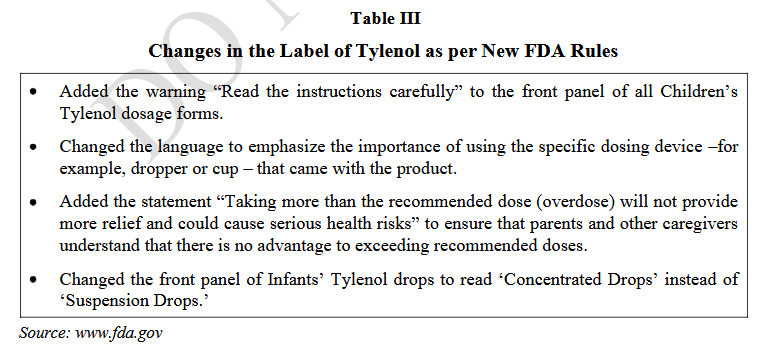
In October 1997, J&J announced that it would inform parents about Tylenol's side effects on children through labels and advertisements (See Table III). The new labels cautioned consumers against overdose. From November 1997, J&J also released magazine and TV ads informing parents about correct dosages.
1. "J&J was lauded for its quick decisions and sincere concern for its customers, during the product tampering crisis in 1982." Discuss briefly J&J‘s strategy which helped regain its market share and customer trust.
2. Despite bad publicity and costly legal settlements, J&J was reluctant to put adequate warnings on its Tylenol tablets. Why was J&J hesitant in warning the public?
3. What are the alternatives available to the management to overcome the overdose controversy? How far do you think would the steps taken by the company help it to tide over the controversy?
4. Do you think there is a conflict between the economic performance and the social performance of J&J in the Tylenol overdose controversy? Recommend the methodology that would help J&J reach right, proper and just decision.
Exhibit I
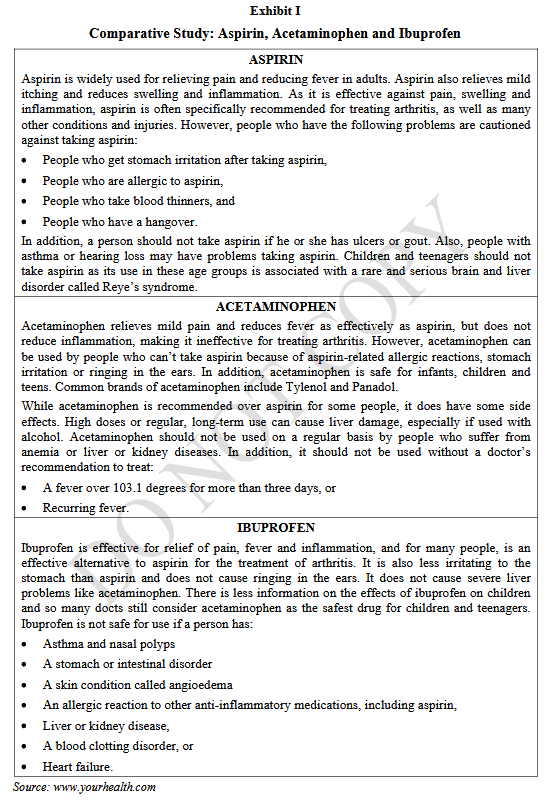
Exhibit II
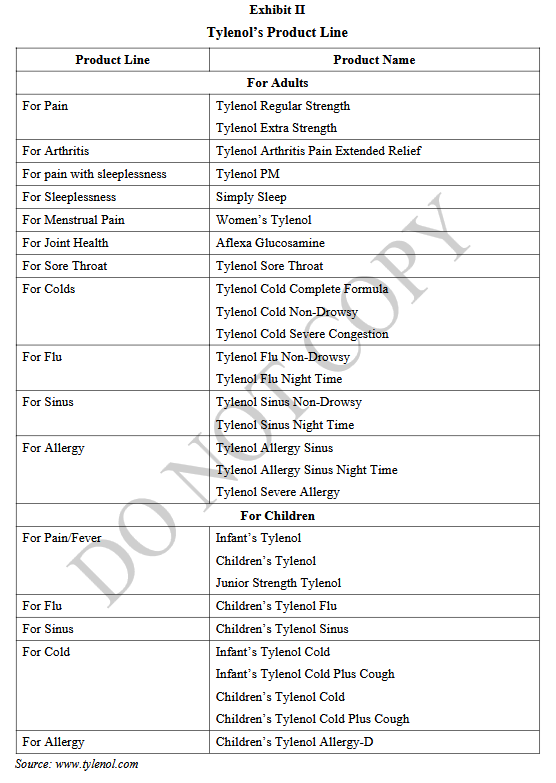
Exhibit III & IV
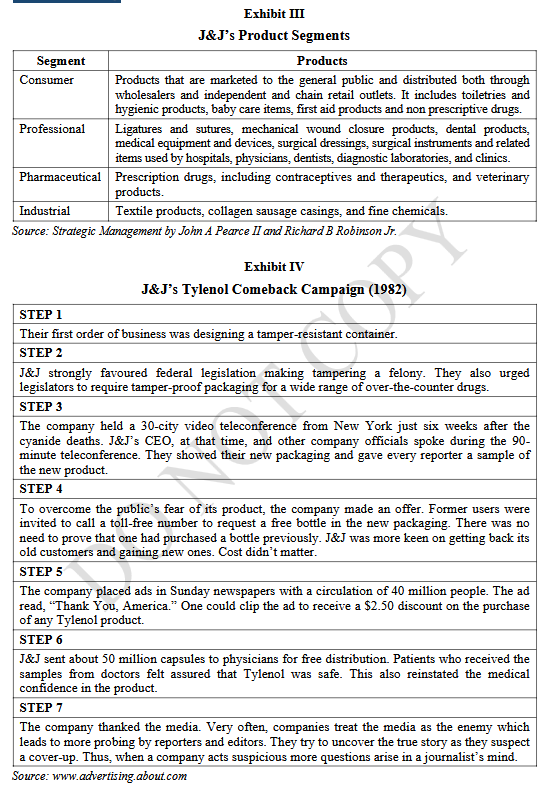
Exhibit V & VI
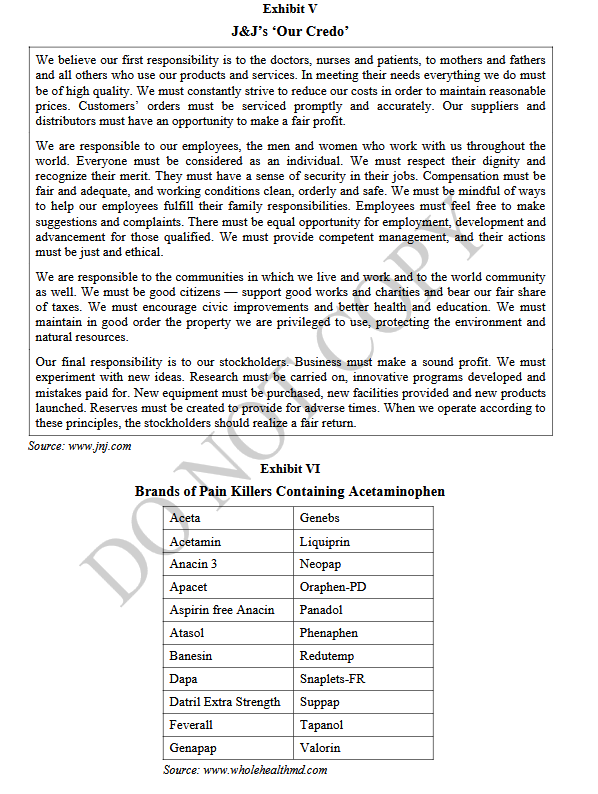
Exhibit VII
Keywords
J&J, Tylenol, acetaminophen-based analgesic, OTC drug,leader,1982, Cyanide, six months, Tylenol, medical practitioners, side-effects, bad publicity, millions, dollars, legal settlements,1997, FDA labeling rules