
ITC: The FERA Violation Story
🌐 International Buyers — Pay via PayPal
Details
BECG016
15
2002
YES
0
ITC Limited
Home Appliances & Consumer Products
India
Leadership & Values
Abstract
The case examines the charges of FERA violations against tobacco major ITC in the 1990s. The case details the dubious international trading deals by ITC and its partners, the Chitalias, the Enforcement Directorate’s investigations and the arrests of ITC executives. The case also looks at charges of excise duty evasion and share price manipulation against ITC. The case ends with a discussion on the measures taken by the company to restore its corporate image in the light of the light of the various charges.
Learning Objectives
The case is structured to achieve the following Learning Objectives:
- Corporate governance
- Unethical practices.
Contents
“It is extremely disgusting to see what is happening to Chugh and Sapru today.”
- S.L. Rao, Former Director, National Council of Applied Economic Research, commenting on the arrests of former ITC Chairmen, in November 199
In October 1996, officials of the Enforcement Directorate1 (ED), Customs and Department of Revenue Intelligence (DRI) conducted raids on the various establishments of tobacco to hotels major ITC in Kolkata. The raids were conducted because the ED suspected ITC of having contravened FERA regulations to the tune of $ 100 million.
ED sources claimed to have found conclusive documentary evidence of FERA violations by ITC from the raids. Following this, on October 30th, 1996, ED officials arrested R. K. Kutty, Director and head of ITC subsidiary International Business Division (IBD), G. K. P. Reddi, former IBD Director and Chairman, E. Ravindranath, former IBD Vice-President, Operations, IBD, and M. B. Rao, former export manager, IBD. The arrests were made under section 35 of FERA, to conduct interrogations on FERA violations by ITC in international trading deals during 1991-95. All the arrested officials were remanded to judicial custody until November 13th, 1996.
On 31st October 1996, former Chairmen of ITC Ltd. (ITC), J.N. Sapru (Sapru) and Krishen Lal Chugh (Chugh) were summoned to the ED?s office in Kolkata for interrogation. They were arrested the same day. On November 5, 1996, the ED interrogated ITC Chairman, Y.C. Deveshwar, who promised to submit a complete report on alleged FERA violations. By mid November, the ED arrested a few more ITC executives taking the total number of arrested officials to 15.
By June 1997, ITC's board of directors was facing prosecution on account of allegations of FERA contravention. An ED official said, “For the first time in Indian corporate history, the entire board of directors of a company has been held liable for irregularities.” The case attracted extensive media attention, resulting in serious debates regarding the stringent FERA regulations and the need for efficient corporate governance practices in companies. The issue was discussed in both the houses of parliament, where MPs accused ITC of poor corporate governance practices and lack of transparency. The MPs wanted the DCA3 to investigate into the matter, as they felt ITC had contravened various sections of the companies Act and willfully and deliberately misinterpreted information causing loss to the shareholders. Though ITC performed very well on the financial front for the fiscal 1996-97, charges of FERA violation, excise duty evasion and share price manipulation in the early 1990s seemed to have tarnished the company?s image beyond repair (Refer Exhibit I & II).
ITC was started by UK-based tobacco major BAT. It was called the Peninsular Tobacco Company (Peninsular), for cigarette manufacturing, tobacco procurement and processing activities. In 1910, it set up a full-fledged sales organization named the Imperial Tobacco Company of India Limited (Imperial). To cope with the growing demand, BAT set up another cigarette manufacturing unit in Bangalore in 1912. To handle the raw material (tobacco leaf) requirements, a new company called Indian Leaf Tobacco Company (ILTC) was incorporated in July 1912. By 1919, BAT had transferred its holdings in Peninsular and ILTC to Imperial. Following this, Imperial replaced Peninsular as BAT?s main subsidiary in India.
By the late 1960s, the Indian government began putting pressure on multinational companies to reduce their holdings. Imperial divested its equity in 1969 through a public offer, which raised the shareholdings of Indian individual and institutional investors from 6.6% to 26%. After this, the holdings of Indian financial institutions were 38% and the foreign collaborator held 36%. Though Imperial clearly dominated the cigarette business, it soon realized that making only a single product, especially one that was considered injurious to health, could become a problem. In addition, regular increases in excise duty on cigarettes started having a negative impact on the company's profitability.
To reduce its dependence on the cigarette and tobacco business, Imperial decided to diversify into new businesses. It set up a marine products export division in 1971. The company?s name was changed to ITC Ltd. (ITC) in 1974. In the same year, ITC reorganized itself and emerged as a new organization divided along product lines. In 1975, ILTC was made a division of ITC. In 1975, ITC set up its first hotel in Chennai. The company diversified into the textile industry with Tribeni Handlooms in 1977. The same year, ITC set up Bhadrachalam Paperboards. In 1981, ITC diversified into the cement business and bought a 33% stake in India Cements from IDBI. This investment however did not generate the synergies that ITC had hoped for and two years later the company divested its stake. In 1986, ITC established ITC Hotels, to which its three hotels were sold. It also entered the financial services business by setting up its subsidiary, ITC Classic Finance.
In 1994, ITC commissioned consultants McKinsey & Co. to study the businesses of the company and make suitable recommendations. McKinsey advised ITC to concentrate on its core strengths and withdraw from agri-business where it was incurring losses. During the late 1990s, ITC decided to retain its interests in tobacco, hospitality and paper and either sold off or gave up the controlling stake in several non-core businesses. ITC divested its 51% stake in ITC Agrotech to ConAgra of the US. Tribeni Tissues (which manufactured newsprint, bond paper, carbon and thermal paper) was merged with ITC.
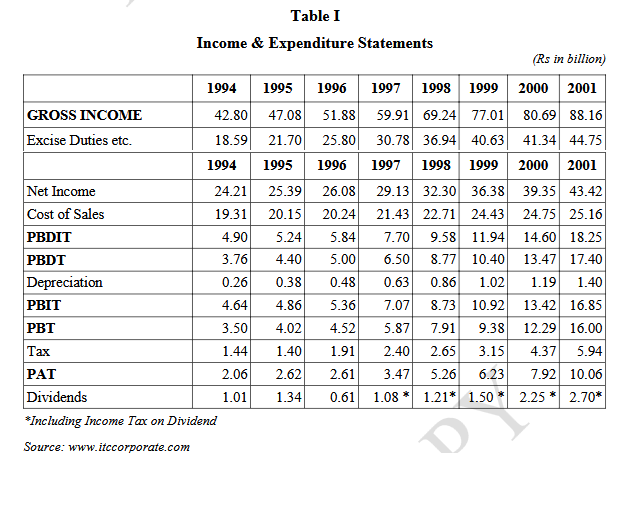
By 2001, ITC had emerged as the undisputed leader, with over 70% share in the Indian cigarette market. ITC' popular cigarette brands included Gold Flake, Scissors, Wills, India Kings and Classic. ITC's revenues for the fiscal 2001 amounted to 88.16 billion (Refer Table I For ITC's income and expenditure statements).
A majority of ITC's legal troubles could be traced back to its association with the US based Suresh Chitalia and Devang Chitalia (Chitalias). The Chitalias were ITC's trading partners in its international trading business and were also directors of ITC International, the international trading subsidiary of ITC. In 1989, ITC started the 'Bukhara' chain of restaurants in the US, jointly with its subsidiary ITC International and some Non-Resident Indian (NRI) doctors. Though the venture ran into huge losses, ITC decided to make good the losses and honour its commitment of providing a 25% return on the investments to the NRI doctors. ITC sought Chitalias' help for this.
According to the deal, the Chitalias later bought the Bukhara venture in 1990 for around $ 1 million. Investors were paid off through the Chitalias New-Jersey based company, ETS Fibers, which supplied waste paper to ITC Bhadrachalam. To compensate the Chitalias, the Indian Leaf Tobacco Division (ILTD) of ITC transferred $ 4 million to a Swiss bank account, from where the money was transferred to Lokman Establishments, another Chitalia company in Liechtenstein. Lokman Establishments made the payment to the Chitalias. This deal marked the beginning of a series of events that eventually resulted in the company being charged for contravention of FERA regulations.
During the 1980s, ITC had emerged as one of the largest exporters in India and had received accolades from the government. This was a strategic move on ITC's part to portray itself as a 'good corporate citizen' earning substantial foreign exchange for the country. In the early 1990s, ITC started exporting rice to West Asia. When the Gulf war began, ITC was forced to withdraw rice exports to Iraq, which resulted in large quantities of rice lying waste in the warehouses. ITC tried to export this rice to Sri Lanka, which however turned out to be a damp squib because the rice was beginning to rot already. There were discussions in the Colombo parliament as to the quality of the rotting rice. This forced ITC to import the rice back to India, which was not allowed under FERA.
There were a host of other such dubious transactions, especially in ITC?s various export deals in the Asian markets. The company, following the Bukhara deal, had set up various front companies (shell or bogus companies) with the help of the Chitalias. Some of the front companies were Hup Hoon Traders Pvt. Ltd., EST Fibers, Sunny Trading, Fortune Tobacco Ltd., Cyprus, Vaam Impex & Warehousing, RS Commodities, Sunny Snack Foods and Lokman Establishment, the one involved in the Bukhara deal. These front companies were for export transactions. It was reported that ITC artificially hiked its profits by over-invoicing imports and later transferring the excess funds as export proceeds into India. Analysts remarked that ITC did all this to portray itself as the largest exporter in the country.
In 1991, ITC asked all its overseas buyers to route their orders through the Chitalias. The Chitalias over-invoiced the export orders, which meant they paid ITC more than what they received from overseas buyers. For instance, in an export deal to Sri Lanka, ITC claimed to have sold rice at $350 per ton – but according to ED, the rice was actually sold for just $175 per ton. ITC compensated the difference in amount to the Chitalias through various means including under invoicing other exports to them, direct payments to Chitalia companies and through ITC Global Holdings Pte Ltd. (ITC Global), a Singapore-based subsidiary of ITC. ITC Global was involved in a number majority of the money laundering deals between ITC and Chitalias.
However, by 1995, ITC Global was on the verge of bankruptcy because of all its cash payments to the Chitalias. It registered a loss of US $ 16.34 million for the financial year 1995-96, as against a profit of US $1.7 million in 1994-95. The loss was reportedly due to the attrition in trade margins, slow moving stock and bad debts in respect of which provisions had to be made.
It was also reported that ITC Global incurred a loss of $20 million on rice purchased from the Agricultural Products Export Development Authority5 (APEDA), which was underwritten by the Chitalias. By the time this consignment was exported to S Armagulam Brothers in Sri Lanka through Vaam Impex, another ITC front company, there was an acute fall in international rice prices. The consignee (S Armagulam Brothers) rejected the consignment because of the delay in dispatch. Following this, ITC bought back that rice and exported it to Dubai, which was against FERA.
This resulted in huge outstanding debts to the Chitalias, following which they turned against ITC and approached BAT complaining of the debts and other financial irregularities at ITC in late 1995. BAT, which was not on good terms with Chugh,6 reportedly took this as an opportunity to tarnish his reputation and compel him to resign. BAT appointed a renowned audit firm Lovelock and Lewes to probe into the irregularities at ITC. Though the audit committee confirmed the charges of financial irregularities at ITC during the early 1990s and the role of the Chitalias in the trading losses and misappropriations at ITC during the year 1995-96, it cleared Chugh of all charges. Chugh agreed to resign and BAT dropped all charges against him. He was given a handsome severance package as well as the „Chairman Emeritus?7 status at ITC. However according to industry sources, though the Chitalias were on good terms with ITC, it was BAT, which instigated the Chitalias to implicate the top management of ITC. BAT reportedly wanted to 'step in as a savior' and take control of ITC with the active support of the FI nominees on the board, which had supported ITC before charges of unethical practices surfaced.
Meanwhile, the Chitalias filed a lawsuit against ITC in US courts to recover their dues. They alleged that ITC used them to float front companies in foreign countries in order to route its exports through them. They also alleged ITC of various wrongdoings in the Bukhara deal. These events attracted ED's attention to the ongoings at ITC and it began probing into the company's operations. ED began collecting documents to prove that ITC had violated various FERA norms to pay the NRI Doctors.
The ED found out that around $ 83 million was transferred into India as per ITC's instructions on the basis of the accounts maintained by the Chitalia group of companies. According to the ED officials, the ITC management gave daily instructions to manipulate the invoices related to exports in order to post artificial profits in its books. A sum of $ 6.5 million was transferred from ITC Global to the Chitalias' companies and the same was remitted to ITC at a later date. Another instance cited of money laundering by ITC was regarding the over-invoicing of machinery imported by ITC Bhadrachalam Paperboards Ltd., from Italy. The difference in amount was retained abroad and then passed to the Chitalias, which was eventually remitted to ITC.
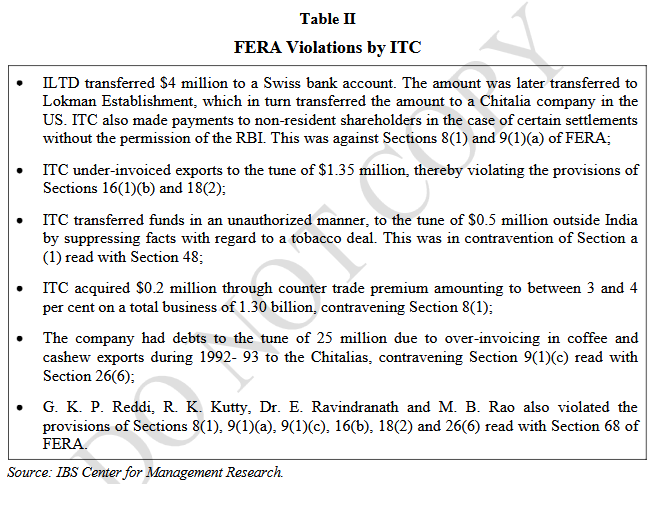
The ED issued chargesheets to a few top executives of ITC and raided on nearly 40 ITC offices including the premises of its top executives in Kolkata, Delhi, Hyderabad, Guntur, Chennai and Mumbai. The chargesheets accused ITC and its functionaries of FERA violations that included over-invoicing and providing cash to the Chitalias for acquiring and retaining funds abroad, for bringing funds into India in a manner not conforming to the prescribed norms, for not realizing outstanding export proceeds and for acknowledging debt abroad (Refer Table IV and Exhibit III for details of the charges).
The ED also investigated the use of funds retained abroad for personal use by ITC executives. Though the ED had documentary proof to indicate illegal transfer of funds by top ITC executives, nothing was reported in the media. The top executives were soon arrested. In addition, the ED questioned many executives including Ashutosh Garg, former chief of ITC Global, S Khattar, the then chief of ITC Global, the Chitalias, officials at BAT and FI nominees on ITC board.
Meanwhile, the Chitalias and ITC continued their court battles against each other in the US and Singapore. ITC stated that the Chitalias acted as traders for ITC?s commodities including rice, coffee, soyabeans and shrimp. ITC accused the Chitalias of non-payment for 43 contracts executed in 1994. ITC sued the Chitalias seeking $12.19 million in damages that included the unpaid amount for the executed contracts plus interest and other relief. Following this, the Chitalias filed a counter-claim for $55 million, accusing ITC of commission defaults (trading commission not paid) and defamation.
In August 1996, the Chitalias indicated to the Government of India and the ED their willingness to turn approvers in the FERA violation case against ITC, if they were given immunity from prosecution in India. The government granted the Chitalias, immunity under section 360 of the Indian Criminal Procedure Act, following which the Chitalias were reported to have provided concrete proof of large scale over-invoicing by ITC mainly in the export of rice, coffee and cashew nuts. In another major development, a few directors and senior executives of ITC turned approvers in the FERA violation case against the company in November 1996. A top ED official confirmed the news and said that these officials were ready to divulge sensitive information related to the case if they were given immunity against prosecution, as granted to the Chitalias.
The same month, the High Court of Singapore appointed judicial managers to take over the management of ITC Global. They informed ITC that ITC Global owed approximately US $ 49 million to creditors and sought ITC?s financial support to settle the accounts. Though ITC did not accept any legal liability to support ITC Global, it offered financial assistance upto $26 million, subject to the consent and approval of both the Singapore and Indian governments.
In December 1996, most of the arrested executives including Chugh, Sapru, R. Ranganathan, R K Kutty, E Ravindranathan, and K.P. Reddi were granted bail. ITC sources commented that BAT instigated the Chitalias to sue and implicate its executives. BAT was accused of trying to take over the company with the help of the financial institutions (FIs), who were previously on ITC's side. In November 1996, BAT nominees on the ITC board admitted that BAT was aware of the financial irregularities and FERA violations in ITC. However, BAT authorities feigned ignorance about their knowledge of the ITC dealings and charges of international instigation against ITC.
According to analysts, ITC landed in a mess due to gross mismanagement at the corporate level. Many industrialists agreed that poor corporate governance practices at ITC were principally responsible for its problems. They remarked that nominees of the FI and BAT never took an active part in the company's affairs and remained silent speculators, giving the ITC nominees a free hand. R.C. Bhargava, Chairman, Maruti Udyog, said, “It is difficult to believe that FIs and BAT nominees had no idea of what was going on. The board members have many responsibilities. They need to ask for more disclosures and information.” Few industry observers also commented that ITC followed a highly centralized management structure where power vested in the hands of a few top executives (Refer Exhibit IV for the ITC board composition in 1996).
However, some other analysts claimed that problems associated with India?s legal system were equally responsible for the ITC fiasco. Subodh Bhargava, Vice-Chairman, Eicher Group remarked, “The root cause for a case like ITC to occur is the complexity of laws in our country and the continuing controls like FERA. We have to admit that the limits imposed on industry are not real and, therefore, every opportunity is sought to get around them. This leads to different interpretations of the law and so legal violations occur” (Refer Exhibit V for a note on FERA and FEMA).
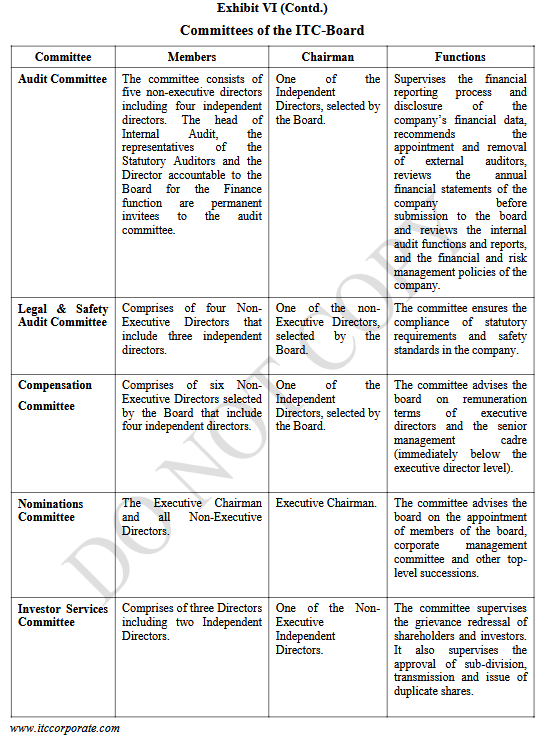
Alarmed by the growing criticism of its corporate governance practices and the legal problems, ITC took some drastic steps in its board meeting held on November 15, 1996. ITC inducted three independent, non-executive directors on the Board and repealed the executive powers of Saurabh Misra, ITC deputy chairman, Feroze Vevaina, finance chief and R.K. Kutty, director. ITC also suspended the powers of the Committee of Directors and appointed an interim management committee. This committee was headed by the Chairman and included chief executives of the main businesses to run the day-to-day affairs of the company until the company had a new corporate governance structure in place.
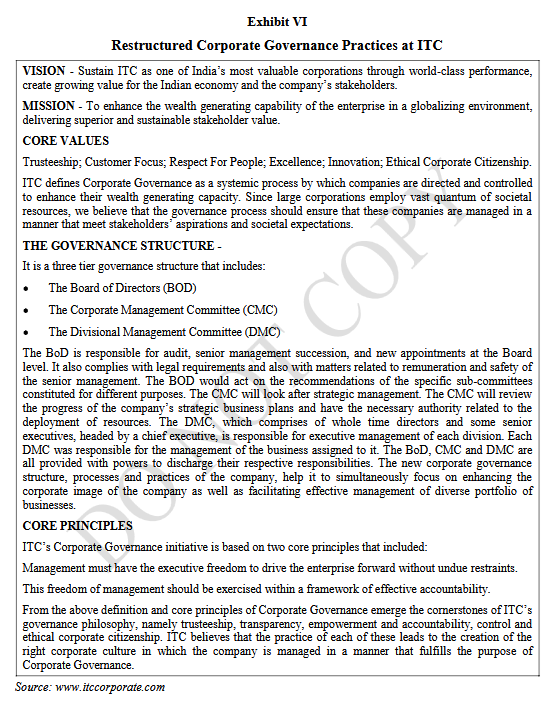
ITC also appointed a chief vigilance officer (CVO) for the ITC group, who reported independently to the board. ITC restructured its management and corporate governance practices in early 1997. The new management structure comprised three tiers- the Board of Directors (BOD), the Core Management Committee (CMC) and the Divisional Management Committee (DMC), which were responsible for strategic supervision, strategic management, and executive management in the company respectively.
Through this three-tiered interlinked governance process, ITC claimed to have struck a balance between the need for operational freedom, supervision, control and checks and balances. Each executive director was responsible for a group of businesses/corporate functions, apart from strategic management and overall supervision of the company (See Exhibit VI for the restructured corporate governance practices at ITC).
However, the company's troubles seemed to be far from over. In June 1997, the ED issued showcause notices to all the persons who served on ITC's board during 1991-1994 in connection with alleged FERA violations. The ED also issued notices to the FIs and BAT nominees on the ITC board charging them with FERA contravention. In September 1997, the ED issued a second set of show-cause notices to the company, which did not name the nominees of BAT and FIs. These notices were related to the Bukhara restaurant deal and the irregularities in ITC?s deals with ITC Global.
In late 1997, a US court dismissed a large part of the claim, amounting to $ 41 million, sought by the Chitalias from ITC and ordered the Chitalias to pay back the $ 12.19 million claimed by ITC. The Chitalias contested the decision in a higher court, the New Jersey District court, which in July 1998 endorsed the lower court's order of awarding $ 12.19 million claim to ITC. It also dismissed the claim for $ 14 million made by the Chitalias against ITC. The judgment was in favor of ITC as the US courts felt that the Chitalias acted in bad faith in course of the legal proceedings, meddled with the factual evidence, abused information sources and concealed crucial documents from ITC. Following the court judgment, the Chitalias filed for bankruptcy petitions before the Bankruptcy Court in Florida, which was contested by ITC.
In early 2001, the Chitalias proposed a settlement, which ITC accepted. Following the agreement, the Chitalias agreed to the judgement of the Bankruptcy Court, which disall owed their Bankruptcy Petitions. As a part of this settlement ITC also withdrew its objections to few of the claims of Chitalias, for exemption of their assets. However, ITC?s efforts to recover its dues against the Chitalias continued even in early 2002. The company and its directors inspected documents relating to the notices, with the permission of the ED, to frame appropriate replies to the notices. It was reported that ITC extended complete cooperation to the ED in its investigations.
However, the ED issued yet another show-cause notice (the 22nd notice so far) to ITC in June 2001, for violating section 16 of FERA, in relation to ITC?s offer to pay $ 26 million to settle ITC Global?s debts (under section 16 of FERA, a company should take prior permission from the RBI, before it can forgo any amount payable to it in foreign exchange). ITC replied to the showcase notice in July 2001, stating it did not accept any legal liabilities while offering financial support to ITC Global. On account of the provisions for appeals and counter-appeals, these cases stood unresolved even in early 2002. However, ITC had created a 1.9 million contingency fund for future liabilities.
Although the company went through a tough phase during the late 1990s, it succeeded in retaining its leadership position in its core businesses through value additions to products and services and through attaining international competitiveness in quality and cost standards. Despite various hurdles, the company was a financial success, which anal ysts mainly attributed to the reformed corporate governance practices. What remains to be seen is whether the company would be able to come out unscathed from the various charges of unethical practices against it.
1. Take a look at the international trading deals ITC carried out in association with the Chitalias and critically comment on the company?s role in the Bukhara restaurant scam.
2. Examine the charges of FERA violations, excise evasion and share price manipulation against ITC. In the light of these allegations, do you think the company was right in claiming it was not guilty?
3. While ITC blamed the Chitalias and BAT for its troubles, some others blamed the legal framework that forced companies to resort to dubious business practices. Where do you think or with whom do you think the fault lies? Give reasons to justify your answer.
4. What were the consequences faced by the company on account of these charges. What were the initiatives taken by the company to remedy the situation and how far do you think they are adequate and effective to eliminate recurrence of such unethical practices in future?
Exhibit I
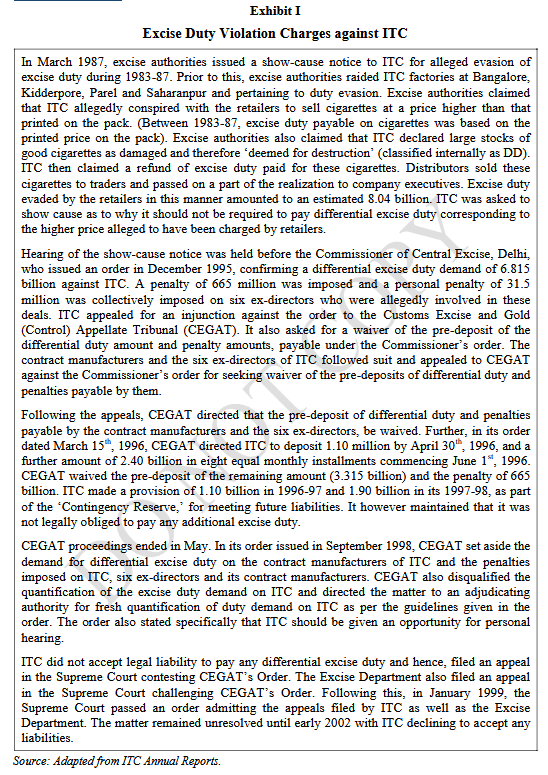
Exhibit II, III, & IV
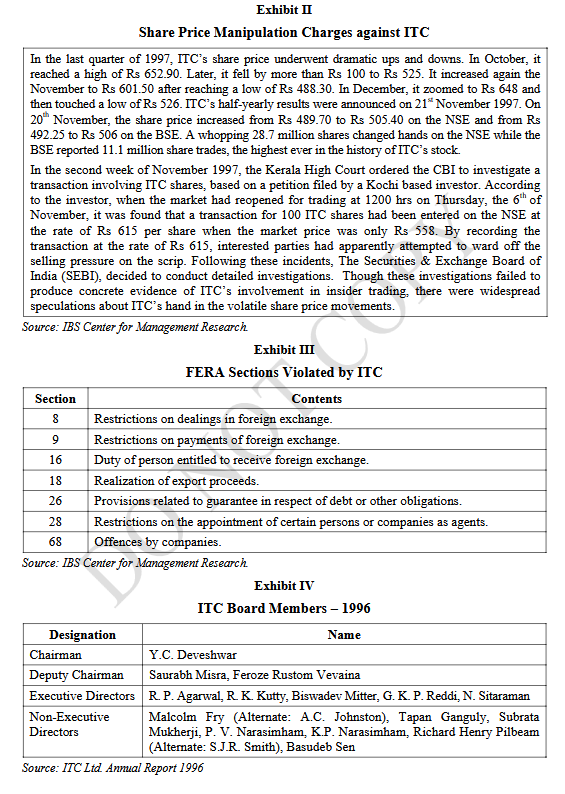
Exhibit V
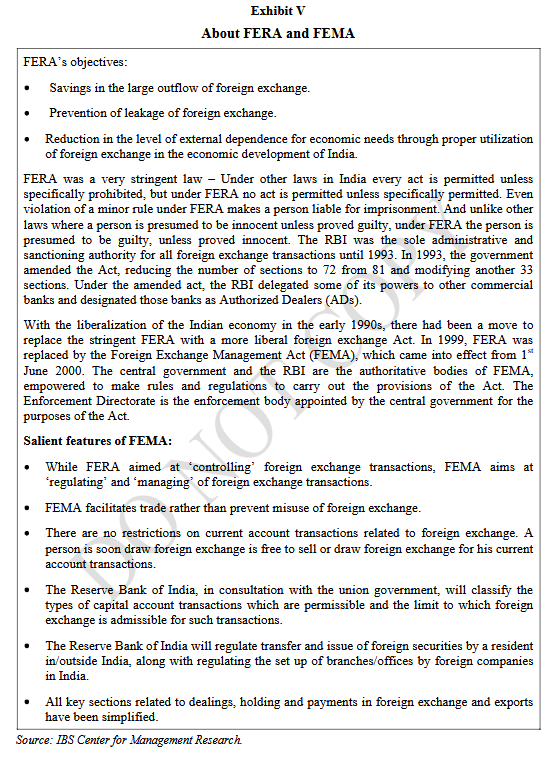
Exhibit VI
Keywords
FERA, tobacco, ITC,1990,dubious international trading deals, ITC, Chitalias, Enforcement, directorate, ITC executives, excise duty evasion, share price manipulation, corporate image
Related Case Studies
| Case Title | Details | Price | Add to Cart |
|---|---|---|---|
|
Case Title Dharma Over Entitlement: Rama’s Ethics of LeadershipCase Code: LDEN240 |
Details | 400 | Add to Cart |
|
Case Title Persuasion under Pressure: Duryodhana`s Negotiation with King ShalyaCase Code: LDEN227 |
Details | 300 | Add to Cart |
|
Case Title Rolls-Royce: The Turnaround ChallengeCase Code: BSTR505 |
Details | 500 | Add to Cart |
|
Case Title Battling Perceptions: The Next Challenge in Huawei’s Globalization AgendaCase Code: BSTR498 |
Details | 700 | Add to Cart |
|
Case Title Tommy Hilfiger (B): TurnaroundCase Code: BSTR492 |
Details | 600 | Add to Cart |