
Nike’s Labor Practices
🌐 International Buyers — Pay via PayPal
Details
BECG018
13
2002
YES
0
Nike Inc.
Home Appliances & Consumer Products
US
Accountability
Abstract
The case describes the maltreatment of employees and sweatshop conditions in Nike’s Asian factories. In many Asian countries, Nike violated local labor laws. According to the Vietnam labor watch, Nike did not pay the minimum wages, did not provide proper working conditions, and did not take adequate health and safety measures. In addition, Nike turned a blind eye to child labor and sexual harassment in its factories. Though the company has taken some measures to improve the situation, it has failed to improve the working conditions and put an end to the ill treatment of its employees.
Learning Objectives
The case is structured to achieve the following Learning Objectives:
- Human rights abuses, exploitation of labor, role of NGOs.
Contents
“Nike is being hypocritical in its support of children’s programs in public schools while exploiting child labor in its shoe factories.”
- The Canadian Catholic Organization for Development and Peace.
“I think that’s always been true, that basically we have not had a problem with child labor. It has been somewhat of a problem in the apparel industry, but it hasn’t been a problem at Nike factories.”
- Philip Knight, CEO, Nike
On 17 October 1996, CBS News ran a 48 hour program covering the inhumane treatment of workers by their supervisors, the payment of wages below the legal minimum wage, and the sexual abuse of several women workers at Nike?s shoe manufacturing plants in Vietnam. Workers had been physically assaulted on the job. Temporary workers were paid, on an average, 20 cents per hour while team leaders were paid $42 per month2; regular workers were paid even less. The CBS news program aired interviews with team leaders and even showed a copy of a labor contract to substantiate its claims. On March 14, 1997, Reuters reported that 56 women were forced to run around one Nike factory. Twelve of them went into shock, fainted and were taken to hospital.
As a result of these reports, a group of Vietnamese Americans contacted labor groups and journalists in Vietnam. A group called Vietnam Labor Watch (VLW) was organized to study the working conditions of workers at factories in Vietnam and monitor Nike's labor practices on an ongoing basis. VLW visited Nike's factories in Vietnam and met workers, shoe manufacturing executives, labor union representatives and legal experts. By late 1997, VLW came out with a report that accused Nike of violating numerous labor laws. According to the report, Nike did not pay the minimum wages, did not provide proper working conditions, did not take adequate health and safety measures. In addition, Nike turned blind eye to child labor and sexual harassment in its factories. The report also observed that there was a difference between the practices in Nike's factories in Vietnam and what Nike told American consumers about its labor practices.
Analysts said that in spite of its good image in the US, Nike was a very different company in Vietnam and other Asian countries. The sweatshop conditions in Nike's Asian factories was confirmed by several leading newspapers and journals including The New York Times, USA Today, The Wall Street Journal, AP, and Reuters.
However, Nike had repeatedly claimed that it did not tolerate worker maltreatment in its Asian factories. The company had developed and published both a “Code of Conduct” and an agreement with its Asian subcontractors, setting out the company's position on wages and working conditions. But analysts felt that in spite of some cosmetic measures, the company had not really shown any real interest in addressing the issue. Jim Cox, executive president of the New York based GCI group, said, “Nike has adopted a defensive attitude throughout. Recently, Nike seems to be grudgingly coming around to admitting something may be wrong but they missed an opportunity at the outset when they effectively said „we?re Nike and we're not doing anything wrong. We don't own these plants so they aren't our problem."
In 1958, Phil Knight, a keen athlete and an undergraduate at the University of Oregon, and his track coach Bill Bowerman realized the need for a good American running shoe. The track shoes produced by Adidas and Puma were made of leather, had little cushioning, and used steel spikes for traction. Knight felt there was scope for improvement in these shoes. After graduating, Knight enrolled in the School of Business at Stanford University. At Stanford, Knight analyzed the shoe manufacturing industry and arrived at the conclusion that with cheap Japanese labor, an American manufacturer could sell track shoes that rivaled Adidas in quality, at significantly lower prices.
In 1964, Knight and Bowerman decided to form their own athletic shoe company and called it the Blue Ribbon Sports (BRS) Company. Bowerman's job was to test the shoes, offer design ideas, and persuade coaches he knew to endorse the shoes. The company decided to specialize in designing and selling high-performance shoes made in Japan. In 1971, the duo developed a distinctive trademark and a new brand name. They named the brand Nike, after the Greek winged Goddess of Victory. A local Portland student, Carolyn Davidson, who was paid $35 for the design, created Nike?s 'Swoosh' symbol. The new Nike shoes were launched at the 1972 Olympic trials held in Eugene, Oregon. Knight and Bowerman quickly cashed in on the publicity by advertising that Nikes were worn by “four of the top seven finishers.”
During the first half of the 1970s, Nike's sales grew from $10 million to $270 million. The growth was facilitated by the creation of the waffle sole and the cushioning system (patented by Nike), known as Nike Air. In the 1970s, most Nike shoes were made in South Korea and Taiwan. When workers there gained the freedom to and form unions, wages began to increase, so Nike started looking for other countries where it could employ cheap labor. In the 1980s, Nike started its operations in Indonesia and China.
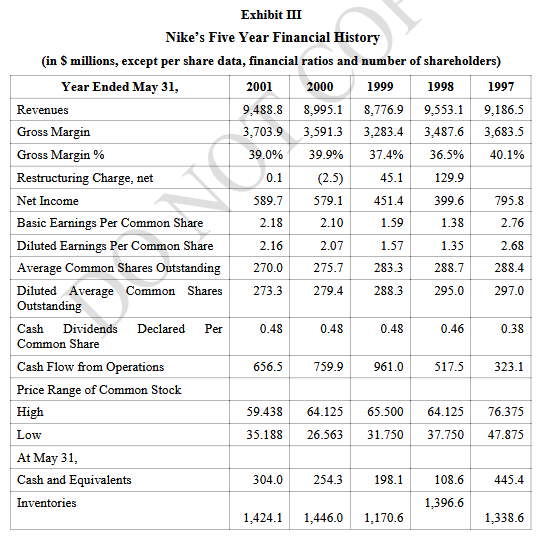
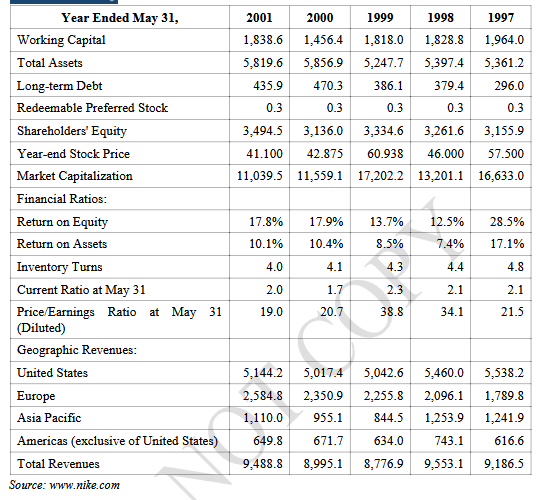
In the early 1980s, Nike replaced Adidas as the leading athletic shoe company in the US. In the Forbes 1982 Annual Report on American Industry, Nike was listed as the most profitable organization in America (based on performance over the past five years). It was also during the 1980s that Nike became a publicly traded company, making Knight one of the richest men in the world. In the late 1980s, Nike launched several new brands: the Air Jordan (named after basketball superstar Michael Jordan of Chicago Bulls) in 1985; the Cross-Trainer in 1987; Air Pressure (Basketball shoes with inflatable soles) in 1989; and Aqua Sock (water shoes) in 1990. In 1991, Nike became the world's first sports goods company to surpass $3 billion in total sales. By 1994, international revenues had increased to more than $1 billion, making up 33% of Nike's total revenues.
By the early 1990s, Nike had extended its operations to Vietnam. In a continuing effort to globalize its operations, Nike acquired its Chilean distributor, secured 100% ownership of Nike Japan and Nike Korea, and entered into a joint venture with Alpargatus CTE to establish a distribution network in Argentina.
In 1993, the athletic shoe industry underwent a major structural change. An increasing number of consumers started purchasing casual shoes and moderately priced athletic shoes instead of branded athletic shoes. Knight responded to this change: “Although to some it may appear to be a simple industry, success within it is complicated by the huge human factor. The industry defies automation. It is not a single product model, nor a single manager, nor one ad, nor a single celebrity, even a single innovation that is the key to Nike. It is the people and their unique and creative way of working together, that has brought our shareholders earnings increases of over $140 million during the last two years.”
In 1995, the company also received a license to place its logo on the National Football League (NFL) uniforms. In 1996, Nike focused on the soccer market with a series of high dollar advertisements. The firm also vied with Adidas and Reebok for the consumer's attention at the 1996 Summer Olympics in Atlanta.
In late 1997, VLW came out with a report charging Nike for operating sweatshops in Vietnam. The report said that Nike's subcontractors6 violated many important Vietnamese labor regulations. When this report was released, human rights organizations in the US were up in arms against Nike. Nike, however, denied all these charges.
In April 1998, Nike faced a lawsuit on charges of lying about 'sweatshop' conditions in its Asian factories. The suit, filed in San Francisco Superior Court, accused Nike of violating California's consumer laws by willfully misleading the public about working conditions for its Vietnamese, Chinese and Indonesian workers. The suit stated that Asian 'sweatshop' workers were regularly subjected to physical punishment and sexual abuse. It mentioned that Nike factory workers were often forced to work overtime, sometimes without pay, and were often unable to earn a 'living wage,' despite working 14 hours a day.
In some cases, the suit said, young women were exposed to dangerous chemical solvents like toluene and acetone, highly toxic substances that could cause serious health problems and even lead to birth defects. According to the suit, Nike?s Asian factories had allegedly abused workers physically. The suit cited a number of alleged incidents: workers forced to run around factory premises as punishment; workers forced to kneel in front of their supervisors; and workers beaten with shoe soles for using the wrong color in shoe production.
The suit demanded that Nike return any profits made in violation of California's unfair business practice laws and undertake a 'corrective' advertising campaign to explain how its shoes were produced. According to Patrick Coughlin, one of the lawyers fighting the case against Nike, "Nike is either going to disclose how they have these people work or change their conditions."
According to surveys and interviews carried out by VLW, workers in Nike's factories in Vietnam were exploited in many ways. Nike's Code of Conduct (see Exhibit I) was being violated consistently by its contractors. Though Nike claimed that it was trying to monitor and enforce its Code, it did not have an effective system in place for monitoring and enforcement. There were not enough Nike supervisors in all of Nike's factories in Vietnam to ensure that its contractors were complying with the Code of Conduct on a day-to-day, shift-to-shift basis.
Nike's contractors' violated labor laws concerning overtime wages, night shift wages, and Sunday wages. Many workers received below minimum wage during the first three months of employment. Forced and excessive overtime to meet high quotas was the norm at Nike factories in Vietnam. The subcontractors asked many workers to work over the legal maximum of 200 hours of overtime per year. In 1997, several workers were forced to work such long hours that they reached the yearly limit for overtime in only first two months. In a sharp contrast to Nike's Code of Conduct, which assured payment of minimum wages, employees in Vietnam were not paid even living wages. The daily wage was approximately $1.60 while the cost of three simple meals was $2.10 per day. The employees had to make a choice between eating a balanced meal or paying rent for the single rooms that most of them lived in.
Over 90% of Nike's workers in Vietnam were women, and most of them were between the ages of 15 and 28. These women were abused physically, verbally and sexually by the factory managers. In one particular case, 56 female workers at a Nike factory were forced to run around the factory's premises because they weren't wearing regulation shoes. Twelve of them went into shock and fainted and had to be taken to the hospital. In another case, a woman manager hit 14 workers with a shoe upper. Reacting to these incidents, Knight said: "I'll point out that there's something like 530,000 workers in Nike shoe factories in Southeast Asia with literally billions of incidents a day and when you find two of them that basically embarrass you, it doesn't really characterize what goes on in those factories." Several factory rules violated human dignity. Workers were not allowed to go to the toilet more than once during an 8-hour shift and were not allowed to drink water more than twice per shift.
Nike factories in Vietnam ignored many health and safety standards. Several workers fainted from exhaustion, heat and poor nutrition during their shifts. The medical facilities at the factories were inadequate. There were two nurses for approximately 6000 employees and only one doctor who worked for two hours a day, even though the factory operated 20 hours per day.
Nike constantly denied that it used unfair labor practices. The company sent representatives to college campuses in the US in an attempt to convince students that Nike's treatment of foreign labor was fair. In addition, Nike targeted journalists in countries in which they had factories to report their side of the story. Vada Manager, Nike's senior spokesperson, explained the rationale for this move, “Unlike US-based reporters, who are writing about factories they have never visited, journalists working in those countries understand the local conditions.”
Nike offered a 12-minute online video tour of its contracted shoe facilities in Vietnam. It also produced video films of its factories in Indonesia, Thailand, China and Vietnam. Manager said, “We're a very open company and don?t have anything to hide.” Reacting to Nike's image building exercises, Jason Mark, a spokesman for the San Francisco-based Global Exchange, a labor-rights group said, “It's easy for a factory to be set up that may or may not be a model and publicize it as some great thing. It seems more like a publicity stunt than a genuine effort to make systematic changes across the board.”
Ultimately, because of pressure from labor activists and human rights organizations, Nike severed ties with four factories in Indonesia for failing to meet company requirements for wages and working conditions. It also created a labor relations department, hired an accounting firm Ernst and Young to monitor its factories, and contracted former UN Ambassador Andrew Young to review implementation of Nike?s Code of Conduct. In May 1998, Knight promised to take four steps to improve working conditions at Nike?s factories (refer Table I).
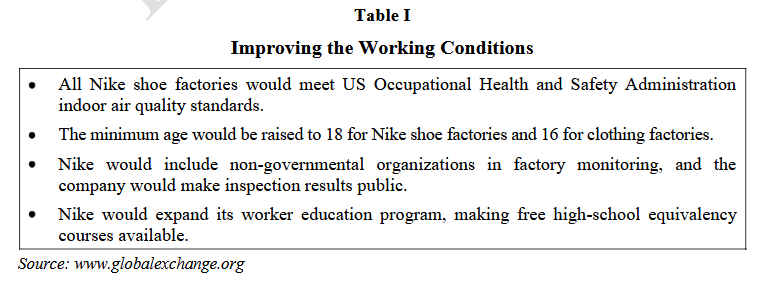
In May 2001, a report8 prepared by a labor rights group claimed that even after three years, Nike had not delivered on its promises. The report said that Nike used to warn its factory managers about inspections by its own inspectors in advance, allowing them to minimize toxic fumes by the time they arrived. Workers claimed that managers took such opportunities to mask working conditions.
Moreover, according to the report, Nike workers were still paid wages that were below the legal minimum. Leila Salazar, Global Exchange's corporate accountability director said, “Nike workers in sweatshops abroad still work for wages they and their children can?t live on, are forced to work long overtime hours, and face harassment, violent intimidation and firing when they organize to defend their rights or tell journalists about labor abuses in their factories. Over the last three years, Nike has treated the sweatshop issue as a public relations inconvenience rather than a serious human rights issue.” However, Knight denied the charges. He said that Nike had done more than any other corporation in the shoe-and-clothing industry to ensure that workers are treated fairly.
1. Do you think there is a conflict between economic performance and social performance in Nike's labor practices? Recommend Nike the methodology to reach right, proper and just decision with due regard to its Code of conduct.
2. Nike has employed more than 0.5 million workers in its Asian factories. The company has failed to follow the labor laws of the countries it operates in and has not succeeded in effectively implementing its Code of Conduct. What measures must Nike take to convince the public that it really wants to put an end to the maltreatment and exploitation of workers in its Asian factories?
3. The ultimate test for any company is selling the product to its customers. Do you think the customer has a role to play in improving Nike's labor practices? If yes, what steps must Nike's customers take to force the company to improve its labor practices?
Exhibit I
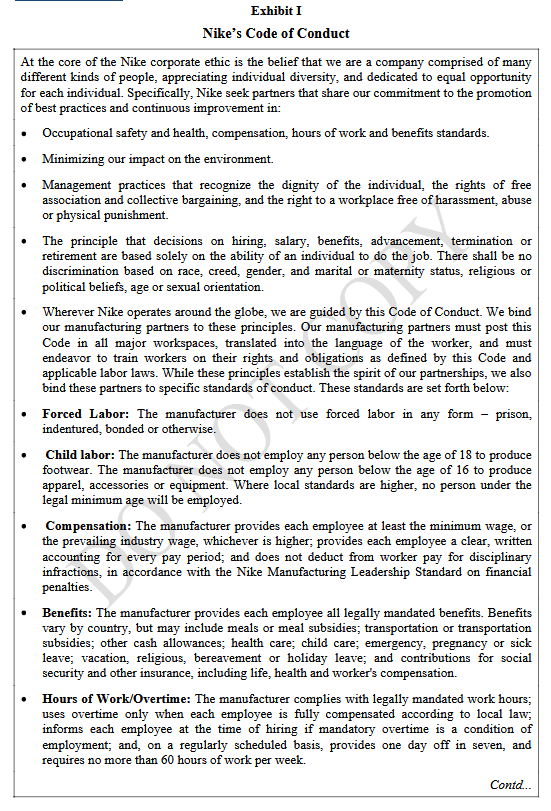
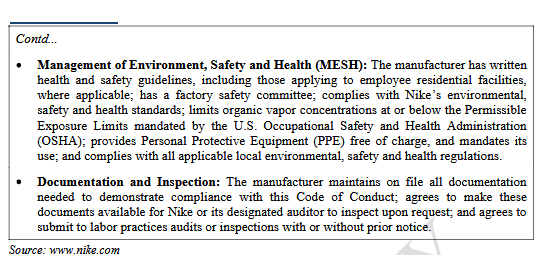
Exhibit II
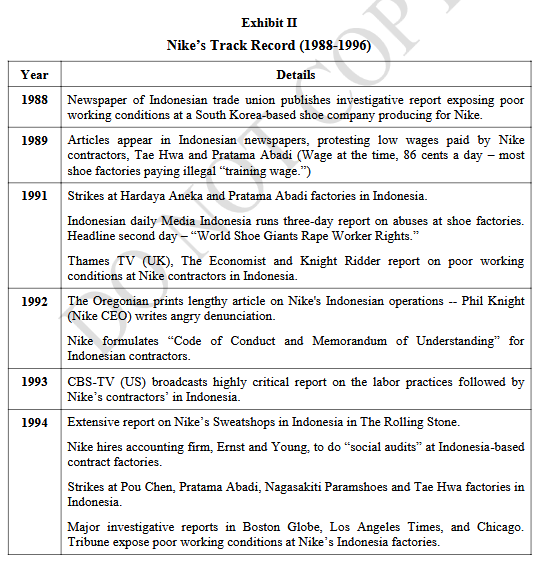
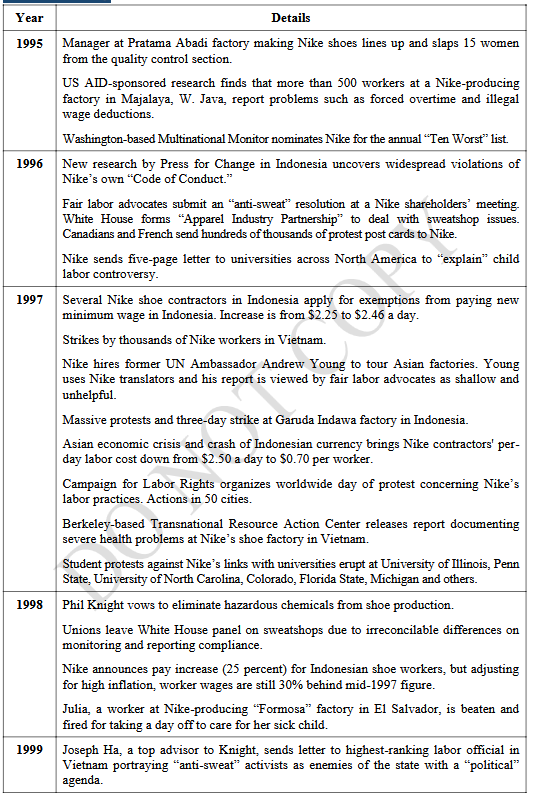
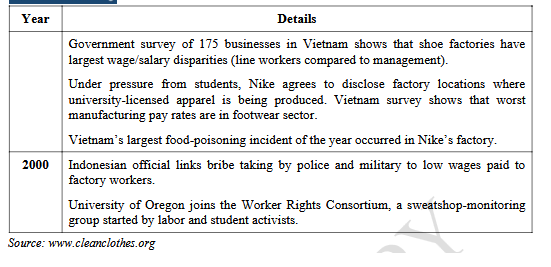
Exhibit III
Keywords
Maltreatment, employees, sweatshop, Nike, Asian, local labor laws, Vietnam labor watch, wages, proper working conditions, adequate health, safety measures, blind eye, child labor, sexual harassment, factories
Related Case Studies
| Case Title | Details | Price | Add to Cart |
|---|---|---|---|
|
Case Title When AI Goes Off Script: The Air Canada Chatbot Liability CaseCase Code: BECG203 |
Details | 300 | Add to Cart |
|
Case Title When AI Goes Off Script: The Air Canada Chatbot Liability CaseCase Code: BECG203 |
Details | 300 | Add to Cart |
|
Case Title Johnson & Johnson’s Talcum Powder Controversy: Putting Profits before Consumer Safety?Case Code: CLBE024 |
Details | 200 | Add to Cart |
|
Case Title OSI China in Food ScandalCase Code: BECG142 |
Details | 500 | Add to Cart |
|
Case Title Volkswagen Defeat Device ScandalCase Code: BECG139 |
Details | 700 | Add to Cart |