
Crossroads: Retailing Lessons
🌐 International Buyers — Pay via PayPal
Details
BSTR005
6
2002
NO
0
Crossroads (Indiareit)
Retailing
India
Consumer Behavior,Consumer Marketing
Abstract
The case focuses on the various problems faced by India's first shopping mall, Crossroads. The case describes the initial success enjoyed by the mall and the problems it faced later. It gives an overview of the developments that took place after the mall management decided to restrict entry on weekend. The case also mentions how Crossroads tried to deal with the situation. It also refers to Crossroad's plans to start a mall for the mass to middle segment. The case is intended for MBA/PGDBM level students as part of the Business Strategy curriculum. This case should familiarize with the Indian retailing scenario and the various problems faced by the malls. Students should also be able to form an opinion regarding the future of shoppertainment in India.
Learning Objectives
The case is structured to achieve the following Learning Objectives:
- Concept of Shoppertainment, restructuring plans, strategies for shopping malls.
Contents
“I was shocked by the new rules. When questioned, the security guard said it was for my own safety. This was the way to keep the phaltu crowd away.”
- An angry Sunday shopper at Crossroads.
“Not even Harrod’s stops people from entering the store. There could have been better ways to screen out undesirable elements.”
- Vineet Chadha, Director, Celebrations.
In the first week of August 2000, visitors to Crossroads, a retail mall, saw a polite notice informing them that a mobile phone, a credit card or a club membership card would act as an entry ticket. People without these new age accessories would have to pay Rs. 60 as entry fee, for a coupon redeemable against purchases made at any time.
Within days, the number of visitors reduced by more than 70%. Many of the visitors felt it very insulting to prove that they possessed a credit card or a mobile phone. Traffic continued to fall even when after the ban was lifted two months later. It hovered around 6000-8000 a day, as against the initial walk-ins of 30,000-40,000 on weekdays and up to a lakh on weekends.
Disappointed with the low traffic, Fountainhead, a bookstore, opted out of Crossroads. Shyam Ahuja, famous for his carpets and dhurries, vacated two-thirds of the space. Other unhappy tenants too, started renegotiating rentals.
Crossroads, situated near Haji Ali in South Mumbai, and spread across 1,50,000 sq.ft., was launched by Piramal Enterprises1 in September 1999. The chairman of the group, Ajay Piramal aimed at introducing the concept of 'shoppertainment' to the Indian consumer through Crossroads, complete with food courts, recreation facilities, and a large car parking space. The mall was created on four levels offering jewelry and children's goods; gifts and women's wear; houseware; and men's wear.
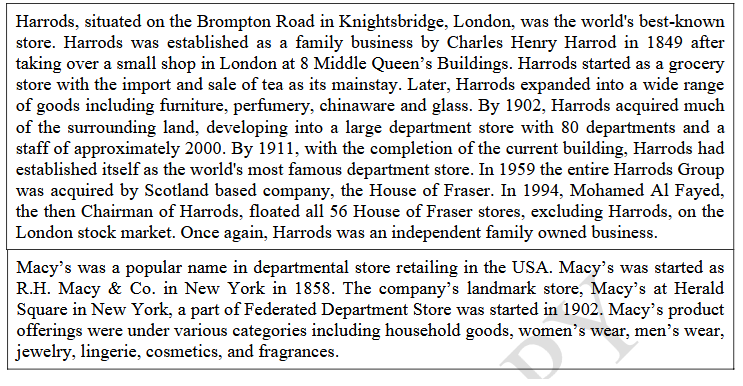
Prior to the establishment of Crossroads, Piramal Enterprises had set up a Roche factory at that location. To utilize the real estate in a better way, the group considered many options with the help of consultants McKinsey and KSA Technopak. The surveys by these agencies revealed that the urban population always sought a shopping environment that let a family spend time together. Keeping this in mind, the group developed the Crossroads model. Crossroads was Ajay Piramal's answer to the malls like London's Harrods or New York's Macy's. (Refer box).
The shopping arcade of the mall, spread across 60,000sq.ft., offered 125 top Indian and international brands in fashion, jewelry, footwear, watches, etc. It also had an in-house department store, Pyramids, that offered about 150 brands. Pyramids was the biggest store in the mall, followed by Pallazzio, which had 80 brands of jewelry, watches, and other accessories. Other brands available in this arcade were Levi's, Lee Cooper, Adidas, Lacoste, Swarovski, Reebok, Nike and Benetton. Outlets of Indian designers like Rohit Bal, Ritu Beri, and JJ Valaya were also a part of this arcade. (Refer Table I).
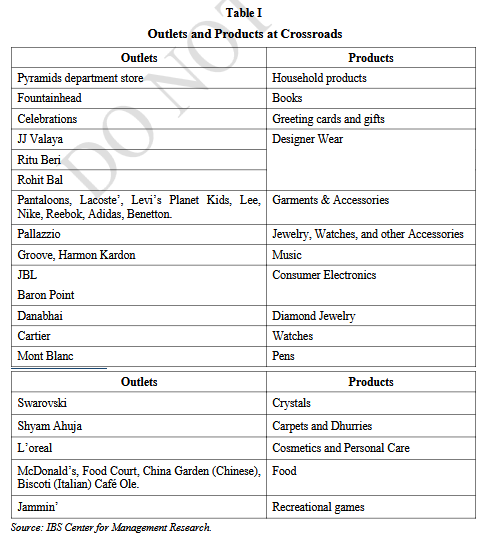
The mall had a plethora of entertainment options at the Jammin', which covered three floors. It offered simulation games, bumper cars, pool tables and a ninepin bowling alley. The entrance of the mall had a spacious atrium with a video wall. One side of the atrium featured the works of the celebrated local cartoonist, Mario Miranda, flanked by a piano bar. On the other side, were the Jammin' and the Chinese restaurant China Garden.
The ground floor was completely devoted to food. The Food Court offered six types of cuisine including Indian, Lebanese, Chinese, Italian and others. McDonald's also had an outlet here. Crossroads had a rooftop car parking facility on the Teflon retractable roof (Asia's largest, outside of Japan), apart from the basement parking facility with a capacity of about 150 cars.
Crossroads was expected to begin a new era in Indian shopping. The mall attracted huge mobs during the initial stages of its inception, leading to terrible traffic jams. During weekdays, the mall saw about 30,000-40,000 people walk in, as against McKinsey's projection of 10,000. The number increased to a lakh on weekends and holidays. Vineet Chadha, Director, Celebrations remarked, “I could see double-deckers empty out at the mall.”
With such huge crowds, the mall's infrastructure came under immense pressure. Escalator queues were long and aisles became crowded. Moreover, these huge crowds didn?t comprise of the posh clientele that Crossroads had targeted. Regular customers started enquiring when the crowds would be low so that they could shop undisturbed. To tackle this problem, the management decided to restrict entry on weekends.
The management had put a notice at the entrance stating that one had to produce a credit card, cell phone, visiting card, or a student ID card to gain entry. Or they had to pay Rs.60 as entry fee, refundable against purchases at any time. Said Chadha, “We argued against it, but the management sided with more premium tenants like J.J. Valaya.”
Many people turned back, insulted that they had to prove that they had a credit card or a cell phone. Adding fuel to the fire, the media also started lambasting the mall. Within days, traffic fell drastically by more than 70%. A couple of months later, the management hurriedly lifted the ban, but traffic still continued to fall. It stabilized around 6000-8000 a day, which affected business at some of the outlets. To deal with this situation, Crossroads initially relied on using anchor tenants like McDonald?s and Pantaloons to attract crowds. The management reasoned that the shoppers at these outlets would then disperse to the other outlets of the mall, but this plan did not workout as expected.
The premium tenants seemed to be happy to see that the crowd was manageable. Initially, in the case of Pallazzio, the conversions were mere 10-15% 4 when 3000-4000 people visited the store a day, the conversions were. Many of these visitors were window-shoppers, and had discouraged the regular clientele of these outlets. After the restricted entry, though the walk-ins fell to 5000-6000 a week, conversions rapidly increased to 45-50%.
However, traffic-dependant outlets like bookshops and music stores were highly disappointed with the new development. For instance, Fountainhead needed at least 1000 walk-ins every day, with daily sales of about one lakh, to cover its monthly expense of Rs.8 lakh. But, there were days when just 100 people walked-in. Monthly sales fell to 12-15 lakh. Hurriedly, Fountainhead opted out of Crossroads. Many of the other tenants also started demanding lower rentals from the prevailing Rs.250 per sq.ft.
Falling traffic was not the only reason for Fountainhead opting out. There were also problems with the mall's layout. Books offered very little margins, unlike jewelry or electronic goods. Also, they were mostly impulse-buys and hence needed more traffic. The greatest disadvantage for the store was that it was on the fourth floor. Said an ex-store manager, “When I saw our shop was on the fourth floor, I knew it would be hard-going.” People hardly went up till the fourth floor just to browse through. The store would have been a little better off at the entrance or on the first floor. However, analysts felt that as there were too many entrances and exits, the flow of traffic was difficult to regulate. People could walk-in from any entrance and leave from any exit.
The only two tenants, that were not complaining were McDonald's and Pantaloons. McDonald's sold around 8000 meals a day, which made it one of the most successful outlets in Mumbai. The success of these outlets could not be completely attributed to the mall as such. Originally, it was expected that the onus for drawing traffic would lie with the mall management. But, soon after inception, the relationship between mall management and the tenants soured. The tenants started regarding themselves as stand-alone entities. “No one has time to listen to our demands,” remarked Kishore Biyani, managing director, Pantaloons. These tenants also started feeling that the Piramals were more interested in promoting the in-house store, Pyramids, than the mall as a whole.
The recreation arcade of the mall was also facing problems. The novelty value of Jammin' seemed to be over. Footfalls fell to a low of 2000-4000 people a day, from the initial 15,000 a day. Piramals planned to close down the entertainment center and use the space profitably for selling saris and footwear.
Piramals faced the dual threat of loss of tenants, and falling traffic. Many of the tenant leases would lapse in 2002. Also, with many new malls in the pipeline in Mumbai, the situation at Crossroads was unlikely to get any better, as the group planned to widen its shopping basket to establish itself as a destination store. It planned to initiate a multi-storied extension with 20,000 sq.ft. of retail space and a car park.
Crossroads entered into a strategic alliance with Larsen and Toubro to establish an entertainment complex and shopping mall at Nariman Point. The mall would be called Crossroads E Zone and would house a Cineplex, a health club, besides the food courts and a shopping plaza. Crossroads was also planning to establish similar stores in the Central suburbs, Western suburbs and New Bombay. It also planned to set up establishments in Bangalore, Delhi, Calcutta and Chennai.
These new outlets would offer a mix of products that were not available at Crossroads, like computers, footwear, and saris. Said Jaydev Mody, managing director, Crossroads, “While Crossroads at Tardeo (Mumbai) caters to the middle to premium end of the market, we are looking at a similar set-up for the mass to middle end of the market. In such malls, within the same categories, we will look at stocking a shirt in a range of Rs. 100-150 instead of a premium brand in the shirts category. Such a mall will be set up in a place like suburban Mumbai.” Is this the right strategy?
1. Briefly outline the problems faced by Crossroads. What can future malls learn from Crossroads? experiences?
2. 'Shoppertainment' did not prove to be successful at Crossroads. What is the future of 'Shoppertainment' in India?
3. The management of Crossroads restricted entry to the mall. Do you think they were justified in doing this? With some tenants happy with the low traffic, and some unhappy, how do you think Crossroads should manage the situation?
4. When Crossroads started, its focus was mainly on the premium segment. Later on, it decided to concentrate on the mass and middle segment. Do you think this is going to dilute its brand equity? Give a reasoned answer.
Keywords
Crossroads, mall management, middle segment, Business Strategy, curriculum, Indian retailing scenario, shoppertainment
Related Case Studies
| Case Title | Details | Price | Add to Cart |
|---|---|---|---|
|
Case Title L’Oreal Using Generative AI to Transform Marketing ActivitiesCase Code: MKTG496 |
Details | 300 | Add to Cart |
|
Case Title PepsiCo: Gamifying Recycling through AICase Code: CSRS022 |
Details | 400 | Add to Cart |
|
Case Title Zudio Beauty: Tata`s Foray into Affordable Glamour. A Wise Move?Case Code: MKTG481 |
Details | 500 | Add to Cart |
|
Case Title Burger King’s Satisfries: The Failed French FryCase Code: CLCB067 |
Details | 200 | Add to Cart |
|
Case Title Debacle of Google GlassCase Code: CLCB066 |
Details | 200 | Add to Cart |