
The Escorts - Yamaha Motors Break-Up
🌐 International Buyers — Pay via PayPal
Details
BSTR008
7
2002
NO
0
Yamaha Motor Escorts Ltd.
Automotive
India; Japan
Strategic Alliances,Growth Strategy
Abstract
The case traces the various developments from the time the joint venture took place till the breakup in 2000. In 1995, Escorts and Yamaha Motors formed a 50:50 joint venture (EYML). From 1995 to early 2000, EYML took several steps to become the number one player in India's two-wheeler market. However, in mid 2000, Escorts divested 24% equity to Yamaha Motors and as a result, Yamaha Motors became a majority stakeholder in the venture (74:26). In May 2001, Escorts sold its remaining 26% equity, thus, exiting from the joint venture.
Learning Objectives
The case is structured to achieve the following Learning Objectives:
- Diversification into unrelated businesses
- problems in joint ventures.
Contents
“The role of the Escorts group was always minuscule since Yamaha has been gradually hiking its stake in the joint venture. The Nandas of the Escorts were only promoters in the JV.”
- Yamaha Motors’ official commenting on whether Escorts’ exit form the joint venture would affect the performance of Yamaha Motors in India.
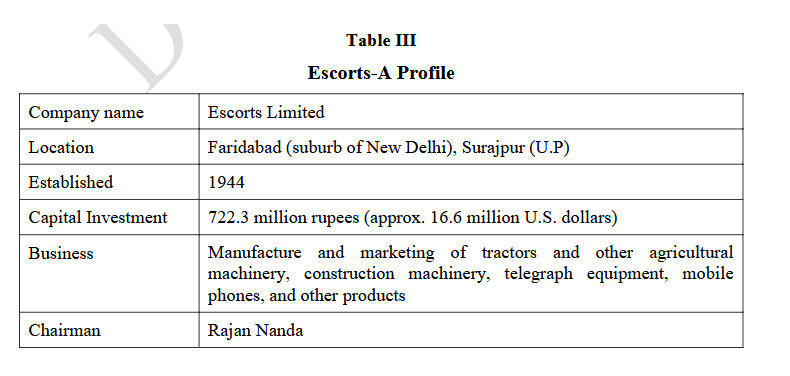
On April 24, 2000, at the board meeting of Escorts Limited (Escorts), (Refer Table III for a profile) members seemed to know precisely what to expect. Just five days earlier, Rajan Nanda (Nanda), Chairman of Escorts, the flagship of the Rs 35 billion Escorts group, had been to Japan to hold talks with the Yamaha Motor Company (Yamaha Motors) officials- Escorts’ equal partner in the Indian motorcycle venture, Escorts Yamaha Motor Ltd (EYML). Before leaving, he had left instructions that a board meeting should be convened on April 24. An important announcement was to be made. At the meeting, Nanda informed the directors that, subject to the board’s approval, Yamaha Motors could be given a majority stake in the joint venture company. The Japanese two-wheeler major had offered to buy an additional 24% stake in EYML from Escorts at Rs 200 per share. The deal would add Rs 2.3 billion to Escorts’ coffers. The announcement seemed to have been well accepted by the board, as there was not even a murmur of protest.
For the Escorts board, such announcements were not new. In a little over a year, Escorts had offloaded substantial chunks of its equity in three joint ventures to its overseas partners. It all started in 1999 when Escorts sold one-third of its shares in the construction equipment company Escorts JCB to JCB of the United Kingdom for Rs 490 billion. This brought its stake down from 60% to 40%. Next came the turn of Hughes Escorts Communication, a 51:49 joint venture between Hughes Communications of the United States and Escorts. In December 1999, Escorts offloaded 23% of its stake to Hughes for Rs 750 million. This brought its shareholding in the company to 26%.
This was the second such exercise undertaken by Nanda since 1995 when he took over the reins of the company from his father, Har Prashad Nanda as chairman of the group. At that time, he had identified six areas of growth for Escorts—agri-business, construction equipment, two-wheelers, auto-components, telecom and finance. And each business was spun off into a separate company, leaving Escorts, the flagship, to focus on agri-business. Nanda then identified four thrust areas for Escorts-agri-business, telecom, software and healthcare. The idea behind giving Yamaha Motors the majority stake in the joint venture was to focus more on the four thrust areas.
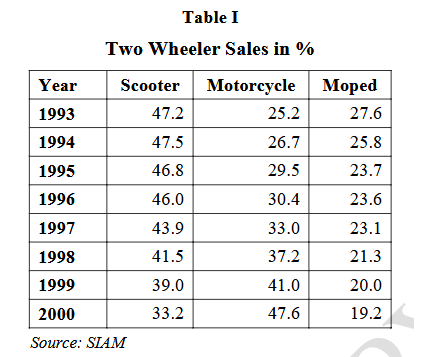
The 3.8 million two-wheeler market in India included scooters, motorcycles and mopeds. In the late 1990s, the domestic two-wheeler industry had undergone many structural changes. Motorcycles consistently gained market share from the scooter and the moped (Refer Table I). The trend was expected to continue in 2001-02.
150cc vehicles from Bajaj Auto and LML dominated the scooter market. Northern India was the major market accounting for nearly 46% of the total scooter sales.
The Indian motorcycle market could be broadly categorized into Indian motorcycles and Indo- Japanese motorcycles. The Hero group, Bajaj and Escorts dominated the Indo-Japanese motorcycle segment in collaboration with Japanese vehicle manufacturers Honda, Kawasaki and Yamaha respectively.
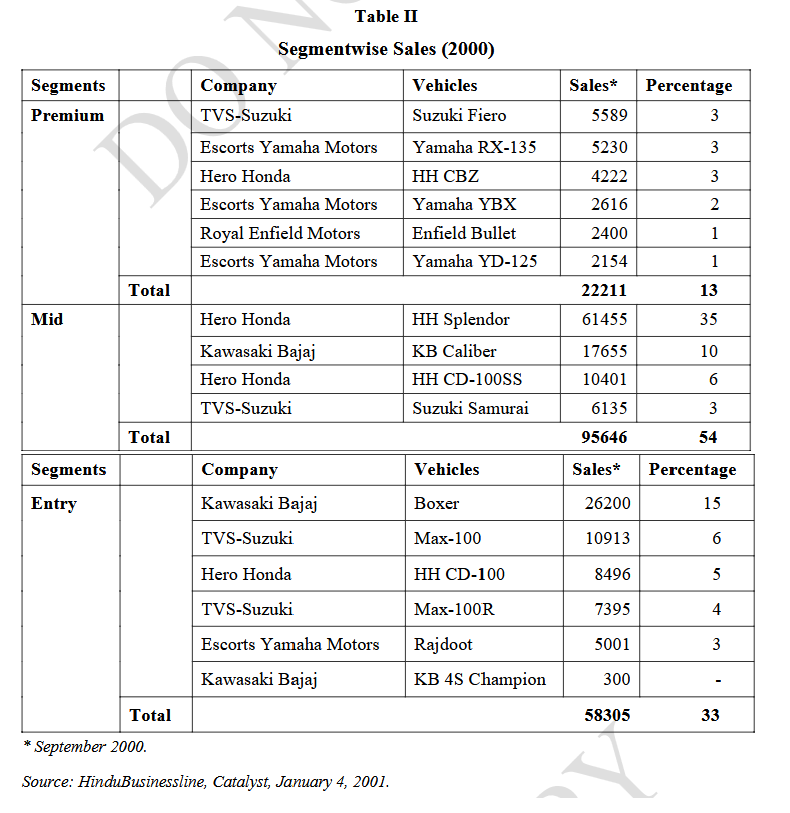
In 2000, the market for motorcycles was segmented into three categories based on price: the premium segment (45,000 and above); the mid segment (Rs 40,001-45,000); and the entry segment (upto Rs 40,000) In the premium segment, the competition was between TVS Suzuki, Hero Honda and Escorts Yahama Motors. In the mid segment, Hero Honda was the clear leader with 35% share. In the entry segment, Bajaj Auto was the choice of many (Refer Table II for segmentwise sales & marketshare).
Yamaha Motors was a major competitor in the premium segment, but after the break up with Escorts in May 2001, there was no sign of rejuvenation. The Indian market favored four-stroke vehicles. This posed a problem for Yamaha Motors, whose strength was two stroke vehicles. TVS-Suzuki was not very aggressive as far as new launches were concerned. Between 1992, when the Samurai was launched, and 2000 when the Fiero was launched, the company had nothing really new to offer. With the break up of the TVS-Suzuki venture in 2001, TVS was likely to keep a low profile.
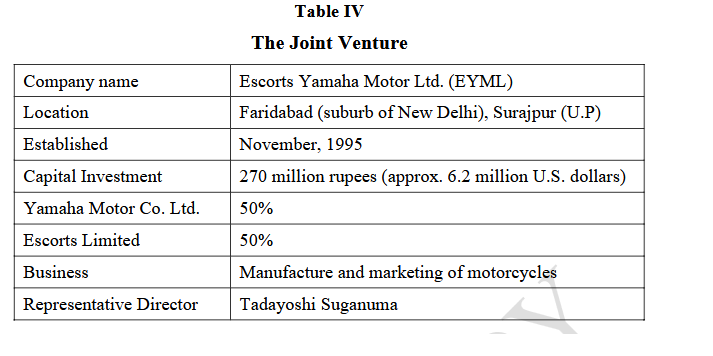
In 1985, Yamaha Motors entered into a technical support agreement with Escorts, and started local production of Yamaha motorcycles. In 1995, Yamaha and Escorts signed another contract, establishing EYML to manufacture and market motorcycles in India. Each company invested 50% of the capital for the original venture (Refer Table IV).
EYML produced a wide range of motorcycles for the urban and rural markets at its Faridabad (Haryana) and Surajpur (Uttar Pradesh) plants. The joint venture manufactured Rajdoot motorcycles at Faridabad and the RX and four-stroke YBX series at Surajpur. EYML had the largest countrywide network of over 500 dealers, supported by a wide base of sales & service outlets and spare parts stockists.
In 1996, Escorts transferred its motorcycle manufacturing facility at Faridabad to the joint venture. Anil Nanda, chairman, EYML, said the Surajpur and Faridabad facilities would be modernized and upgraded with a Rs 3.75 billion budget. EYML would turn out upgraded versions of the current high performance bike, RX 100, and RXG 135 to meet stringent emission norms. In 1997, a further upgraded RXZ 135, a sleeker version would be launched and the 4 stroke YBX 125 would be launched in February 1998 to meet the growing demand for fuel-efficient bikes. YBX 125 would deliver the best of both worlds-performance along with fuel efficiency. EYML also planned to launch 2-3 product variants every year.
The new generation products were expected to position EYML as a number one player in India's two-wheeler market. With the additional investments, volumes were expected to go up from 300,000 units in 1996 to 500,000 units by the year 2000. Sales turnover too was projected to rise from Rs 9 billion, (including exports of Rs 1.2 billion) to Rs 20 billion (including exports of Rs 3 billion) over the same period.
In 1997, EYML announced that it would enter the scooter market in India very soon. R. P. Prasad, Deputy General Manager (sales and marketing), said that although there was a 4% slump in the scooter segment of the two-wheeler industry and a 9% appreciation in bikes, EYML was confident of creating a niche market. Market survey, R&D and design were already “on the road” and EYML expected to set up a 0.5 million capacity by the year 2000 in their plant at Faridabad at a total investment of Rs 5.5 billion.
In 1999, EYML closed down its moped manufacturing facility and discontinued production of its two existing brands3 due to lack of adequate demand. The company decided to concentrate fully on its motorcycle production. Company sources said that EYML decided to discontinue the production as earning was low from moped business. Against a 5% growth recorded by the moped segment in 1998-99, sales of EYML mopeds declined by 17.7%. Its market share also declined from 1.9% in 1997-98 to 1.5% in 1998-99.
In April 2000, Escorts announced that it was likely to sell around 20% stake in EYML to Yamaha Motors. Escorts would thus become a minority shareholder in EYML. However, an official said that Escorts' holding in the joint venture would not be less than 26% and it would not exit from the joint venture. Said Nanda, “I have no intentions of selling off the entire stake to Yamaha. Escorts will retain the 26 per cent stake we now hold in the venture.” In late April 2000, the board of Escorts approved the proposal to divest 24% equity. With the change in the equity pattern, Yamaha Motors would control the management of the joint venture. Commented Nanda, “We have always believed that business relationships are driven by the value added by each partner. We have decided that it would be appropriate for Yamaha Motors, as the technology provider, to take the lead role in the business.”
With the change in management, Yamaha Motors was expected to build global capabilities, bring in new technology and offer a wide range of cost effective quality products. All this was expected to give them an edge over competitors. The company would also have the additional benefit of enlarging its scale of operations for manufacturing and supplying products worldwide. On its part, Escorts would continue to provide a stronger base for manufacturing facilities, a countrywide dealership network and skilled manpower.
In May 2000, EYML was renamed Yamaha Motors Escorts Ltd (YMEL) following Escorts decision to sell off 24% stake. The board of directors of EYML met on May 26 to approve the new name. Under the agreement between the two partners, Escorts would have the first right of refusal if Yamaha decided to offload its stake in future. The entire transaction was expected to be completed by May-end or beginning of June.
In May 2001, Yamaha Motors struck a deal with Escorts for acquiring the latter's 26% shareholding in YMEL for Rs 700 million. The deal marked Escort’s exit from the joint venture. Yamaha Motors would now hold 100% stake in the company. Commenting on Escorts’ exit from the joint venture, an official said, “We would like to get out of businesses where we are not in the driver’s seat and in the case of Yamaha technology it was not a part of our expertise.” He said Escorts would now concentrate on agri-business, telecom and healthcare.
Escorts' exit from the joint venture seemed to be a well-planned move. The group had already moved out of businesses where it believed it did not have a sustainable advantage. On August 22, 2000 at the group’s Annual General Meeting, Nanda announced that Escorts would now focus on the new economy. He said, “To continuously create value, we have strategically moved our investments from low-growth areas to high growth avenues, or in other words, shifted our focus to businesses, which have a potential for higher growth and profitability.”
Escorts would now focus on four core businesses: agribusiness (tractors), telecom services (cellular telephony), IT and Internet services and healthcare services (cardiac healthcare). However analysts were sceptical about Escorts’ success in these areas. One analyst said, “It’s been almost 12-18 months since it identified these as core businesses, and Escorts is still grappling with the new economy initiatives.”
After buying out the 26% stake owned by Escorts, Yamaha Motors was gearing up to go solo in India. It was eyeing India as a major manufacturing base for its global motorcycle markets. Yamaha Motors was the largest exporter of motorcycles from India. During 2000-01, it exported 20,000 units worth Rs 800 million. These bikes were exported to 26 countries in South America, Europe, Africa and South Asia.
Yamaha Motors was also working to regain its lost market position. From being number two in 1996, it had slipped to the fourth position in 2001. Said S K Taneja, Senior Vice President (Manufacturing), “We are optimistic of climbing back to number two by 2003. At present we have a 14% share in the Indian market which improved marginally in March to 15%.” He added, “ As a part of our marketing strategy we plan to introduce one new model each year and we are working on one such model at present.”
After acquiring the entire stake in its India operations, Yamaha Motors introduced a new logo that had three overlapping tuning forks on a circular disc. The tuning forks were a symbol of the most important constituents that drove Yamaha Motors’ operations across the world—the customers, the employees and the community.
In December 2000, Yamaha Motors launched Crux-a four-stroke bike. By mid 2001, Crux had already sold 33,000 units. Yamaha Motors devised an extensive marketing and promotion campaign marketing the bikes as: the complete bike.
India was the second largest two wheeler market in the world, with an annual demand of approximately 3.8 million units. The annual demand was expected to grow to 4.4 million units in 2003. Analysts felt that by becoming a 100% subsidiary of the parent company, Yamaha Motors would be able to speed up the development, production, and marketing of motorcycles that met customer needs in this rapidly growing market.
The demand for motorcycles was expected to increase in the future as more and more customers shifted from other two wheelers to the motorcycle. India—the world’s second largest motorcycle market, after China—was a crucial battleground for motorcycle manufacturers, especially the Japanese companies—Honda Motor Co, Yamaha, Suzuki Motor Corp and Kawasaki Heavy Industries. Clearly, the competition is likely to hot up in the coming months.
1. Why do you think Escorts sold off its entire stake in the Escorts-Yamaha Motors Joint Venture?
2. Write a note on the two-wheeler industry in India. What changes has the industry seen in the past few years? How did EMYL perform during 1995-2000?
3. After buying out Escorts 26% stake in EYML, Yamaha Motors was gearing to go it alone in India. Yamaha Motors is likely to face stiff competition from Hero Honda, Bajaj Auto and TVS Suzuki. Suggest ways by which Yamaha Motors can increase its market share in India.
4. “To continuously create value, we have strategically moved our investments from low-growth areas to high growth avenues or in other words, shifted our focus to businesses which have a potential for higher growth and profitability.” Do you think Escorts’ new economy ventures are likely to succeed? Give reasons for your answer.
Keywords
Escorts, Yamaha Motors, 50:50, EYML, 24%, equity, 74:26, May 2001,26%, Business Environment