
Hindustan Times vs The Times of India
🌐 International Buyers — Pay via PayPal
Details
BSTR016
9
2002
NO
0
Hindustan Times
Media
India
Restructuring,Growth Strategy, Pricing
Abstract
The case discusses the fierce competition in Delhi and northern India between two major publishing houses - Hindustan Times and Times of India. The case focuses on the aggressive pricing strategies adopted by the companies to counter each other. However, to gain a bigger share, Hindustan Times' vice chairperson Shobhana Bhartia chalked out a restructuring plan with an investment of Rs.4 billion. The case discusses in detail, the restructuring plan. The case is intended for MBA/PGDBM level students as a part of the Business Strategy curriculum. From the case, students are expected to understand and analyze the strategies of the two newspaper companies. Students also ought to analyze whether Hindustan Times should counter Times of India in Mumbai, Chennai and other cities or stick to northern India.
Learning Objectives
The case is structured to achieve the following Learning Objectives:
- Competition between media groups
- restructuring plans.
Contents
We are totally baffled by this price war and don?t have funds to compete. Pricing a paper at Re.1 is ridiculous, even by their own admission. We can only hope this irrational pricing does not last.”
- A Senior Manager at The Indian Express.
“For many years, no one (at HT) considered ToI competition. We thought the advertiser can't do without us. Now, we are on our toes, always looking at what the competition is doing.”
- Shobhana Bhartia, Vice Chairperson, Hindustan Times.
In the late 1990s, Hindustan Times (HT) was facing tough competition in Delhi from The Times of India (ToI) so far as circulation, readership and revenues were concerned. HT earned more than half of Delhi’s ad revenue, but ToI too, was getting close to 40% by 1999-2000. This was a major cause of worry for HT, as three-fourths of its ad revenues came from Delhi. Also, except for the Hindi daily Hindustan, HT had no other strong brand whereas ToI had The Economic Times, Filmfare and Femina.
For the first time in its 76-year history, HT made an operating loss in the first quarter of fiscal 2000-01. Though the gross profit stood at 6% in 2000-01, it was far below the average of 30% earned during 1990s.
In 2001, Shobhana Bhartia, Vice Chairperson of the HT Group, decided to fight back and announced an investment of Rs.4 billion to counter ToI. It seemed to be the beginning of a spectacular battle in the domestic publishing industry.
Newspaper companies in India came to be projected as public service institutions after independence. However, in the late 1980s, they became just another fast moving consumer commodity. The companies started aggressive marketing and promotional strategies to increase circulation and readership. The industry witnessed tough competition both regionally and nationally. In 1999, the top 10 newspapers accounted for about 90% of the readership and the top two made 90% of the profits. There was fierce competition for the advertising rupee.
By late 1990s, electronic media like television had made a dent into the print media revenues. Print media was facing a squeeze due to the increasing popularity of television—initially color television and then satellite television.
The ad market worth about Rs.90 billion slowed down and newspapers saw a steady decline in advertising share – from about 75% in 1995 to almost 50% in 2000. Newsprint costs too spiraled. The companies survived by increasing the ad rates every year. However, analysts felt that newspapers could not survive for long by increasing advertising rates. In 2001, the print industry was expected to see a negative growth in revenues for the first time.
Therefore, the need to diversify quickly was recognized by many publishing houses. And, by late 1990s, publishing houses in India were diversifying into non-print media and other businesses to improve returns and shareholder value. ToI had experimented with Timesbank, Times TV, Editors’ Choice Tea, and others, but they were either sold off or closed down eventually. HT launched Home TV and Go4i.com, both of which were not successful. It also planned to diversify into the insurance industry but dropped the idea and put all its resources back into the print business.
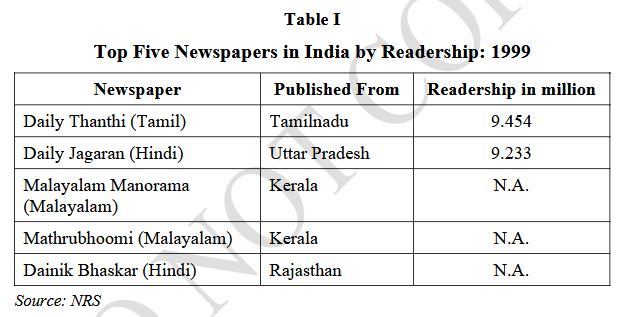
According to NRS-1999, regional newspapers from South India had higher readership. (Refer Table I) This was mainly because rural literacy rate was higher in southern India compared to the North and therefore newspaper readership was much higher in the South.
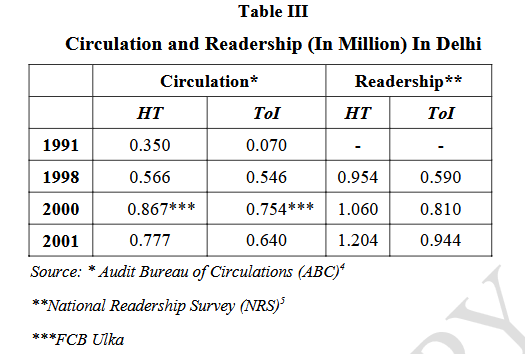
The early 1990s saw HT and ToI engaged in a bitter battle for supremacy in Delhi, which is perceived to be the most important market in India. In 1991, ToI had a circulation of around 70,000 in Delhi as against 0.35 million for HT. In 1994, ToI slashed its price from Rs.2.30 to Rs.1.50. By 1998, the difference in circulation figures narrowed down to a few thousand copies. (Refer Table III). Since 1991, ToI's circulation has increased in percentage terms more than HT. Analysts felt that ToI increased its share largely by breaking into HT’s readership.
A fresh round of price-cuts began in 1999. On March 19, 1999, HT cut its price from Rs.1.50 to an all-time low of Re. 1 on all days except Sundays. Commenting on the price cut, Satish Aggarwal, the spokesperson of the New Delhi Newspaper Distributors Association, said, "The price cut came as a shock because The Hindustan Times had supported us in our strike against The Times of India when they had cut prices in 1994. Increasing our commission on the Hindustan a day before the price cut was just a way of keeping the trade happy."
ToI followed suit by slashing its price from Re.1.50 to Re.1 on all weekdays except Wednesdays. Analysts felt that the new round of price war raised many questions about the future of the newspaper business in Delhi. They said that due to the price war, both ToI and HT might have to walk out of the ABC, because they were giving more than the stipulated 40% discount set by the ABC to their vendors. In 1999, both HT and ToI had to quit the ABC. Pramod Sharma, President, Delhi Newspaper Distributors Association, said, "The ABC exit is deliberate. HT was losing circulation. So it wants to consolidate before re-entering ABC."
From a strong one-city brand in the early 1990s, ToI emerged as the only national newspaper with a circulation of 1.7 million all over the country by 2000. HT with a circulation of about 0.9 million in Delhi was still restricted to Northern India. With revenues of Rs.4.05 billion during 2000-01, HT’s share was roughly a third of ToI in revenue. (Refer Exhibit I) To strengthen its presence in Delhi as well as to expand nationally, Shobhana Bhartia initiated a major restructuring plan in 2000-01. (Refer Exhibit II)
As a first step towards realization of the plan, in September 2000, Vir Sanghvi was appointed editor of HT. Rajan Kohli, of Fujitsu-ICIM was brought in as the executive president to head a new team of 20, which redesigned the paper and made it more youthful. Five new supplements were introduced, and new editions were launched in nine cities in India.8 HT followed the ToI style of marketing blitzkrieg: events, promotions and ad campaigns.
HT also acquired a new printing press with an investment of Rs.2.3 billion. Other initiatives included buying FM time and bundling it with the print space, launching editions in Bangalore, Chennai, and Mumbai, and starting a financial daily. The plan also envisaged setting up an IT- enabled service centre for media companies to handle subscription and billing tasks. Commenting on the expansion plan, Rajan Kohli said, "We want to be a national player which dominates the media space in key markets in this country through alliances, acquisitions and Greenfield projects in the areas of print, online and FM."
However, analysts felt that HT was spending all the money in northern India. Some opined that HT could attack ToI in Mumbai (western India), the city that contributed more than 70% to ToI's revenues. Vir Sanghvi admitted, "(Going to Mumbai) is the only way to grow." Rajan Kohli added, "The launch will happen in 2003. HT might end up buying a financial daily, instead of launching it." According to industry reports, HT and Business Standard were in talks in early 2001. But Vir Sanghvi denied this saying, "The Business Standard is a good newspaper, but I am not in favor of a financial newspaper. If ABP9 and Kotak10 couldn’t do it, why attempt it?"
Since 1991, HT had been toying with the idea of launching the Mumbai edition. In 1996, it finalized a deal to launch the Mumbai edition, but this didn’t materialize owing to the slowdown of the ad market to 8% in 2001 from about 17% in the late 1990s. This could be the possible reason behind delaying its Mumbai launch in 2001 as well. A senior ex-HT manager said, "Attacking ToI in a regular market is like attacking Russia in winter."
Analysts felt that despite the revamp, ToI had a stronger editorial team than HT. There seemed to be only one factor in HT’s favour – the backlash among advertisers. Many media planners admitted that they were quite sick of ToI's overwhelming dominance. To take on ToI in Mumbai, HT had to reach a circulation of more than 0.2 million. If the circulation base was 30-40 thousand, it would not attract media buyers and clients. Rajan Kohli agreed saying, "If we are say 50% of their circulation, say, 0.2-0.25 million, it is a significant dent."
To make such a dent, HT would require an investment of more than Rs.1 billion over three years and HT would break even only in the fifth year. However, Rajan Kohli was confident that HT could make that investment. He said that the HT balance sheet was healthy with Rs.4 billion in reserves and it planned to use Rs.2 billion from the reserves, and borrow another Rs.2 billion. It had already invested Rs.2.3 billion for the new printing press and about Rs.0.7 billion on the north Indian expansion. In a cost-cutting drive, HT also planned to initiate a project to reduce the width of the paper from 64 'to the international standard of 55'. This was expected to reduce the costs by about Rs.0.4 billion. HT also planned to create a 100% subsidiary, HT-Media, and raise funds through equity. However, analysts felt that raising money in the current market scenario could be more difficult than what HT had anticipated.
In 2001, the number of editions of HT and Hindustan, were increased from three (Delhi, Patna and Lucknow) to 12. But the focus was more on Hindustan, which was launched in Patna (Bihar) in 1989. In August 2001, HT entered into an alliance with Amar Ujala11 to dominate the Hindi segment. HT claimed that profits from Bihar, where Hindustan dominated, contributed to more than half of its cash profits in March 2001. It expected Hindustan to become a Rs.650 million brand by March 2002. However, analysts felt that HT dominated only in Bihar. In Jharkaand12, the richer part of the unified Bihar, Prabhat Khabar was more popular. To penetrate into this market, HT planned to publish from two more cities.
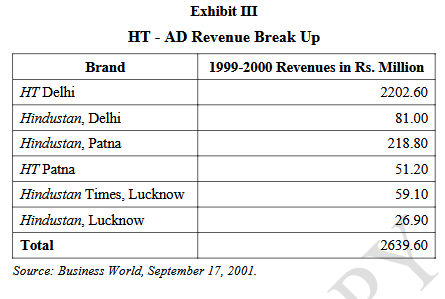
Though HT claimed that Hindustan was doing well in the north, analysts wondered whether the concentration in the north paid off. Sivadasan, Director (Media Marketing), HT, defended this saying, "National advertising is 20-25% of my ad revenue, Delhi is 80%. It was important to be strong in the market north of the Vindhyas. I can offer the entire belt to the advertiser and charge a premium." (Refer Exhibit III for HT's ad revenues) For, instance, HT-Delhi sold column space at a 25% premium over ToI.
In early 2001, HT entered into an alliance with The Indian Express14, and Mumbai-based Mid-Day. The alliance was to offer a joint advertising package for appointment ads. The idea behind this alliance was to counter ToI in its area of strength – the Rs.5 billion market for appointment ads.
Analysts felt that the alliance would also enable HT to counter ToI in Mumbai. While HT was strong in Delhi, Mid-Day was the leader in the afternoon newspapers in Mumbai and the Indian Express and Loksatta16 jointly had a good share in Mumbai, Pune and Chennai. The trio had a total readership of 3.577 million against 2.152 million of ToI. Commenting on the alliance, Rupak Agarwal, General Manager – Media Marketing, HT, said, "Our combined package gives the advertiser more than 80% of any demographic profile that you want." The trio charged Rs.1500 per column centimeter as against Rs.2200 of ToI.
Meanwhile, in 2001, ToI entered into an alliance with Dainik Jagran in Uttar Pradesh and withdrew Navbharat Times18 from Patna as the market seemed to be unprofitable.
As per the NRS-2001, Hindustan was ranked among the top ten dailies in India. HT too, recorded a growth of 17%, as compared to ToI's 11% in North India. In Bihar, Madhya Pradesh and Punjab, readership was up by double digits. However, to grow further, HT had to go to Mumbai and other metros, which could add more than Rs.1 billion to its annual revenues. It remained to be seen whether HT would manage to reach these markets or would remain in dozen small towns.
1. In 2001, Hindustan Times decided to invest Rs.4 billion to counter competition from The Times of India. Do you think the company’s strategy would help it to face competition from The Times of India?
2. Analysts felt that Hindustan Times was spending all the money in the North. While some analysts felt that Hindustan Times should enter Mumbai, others felt that it was too late. Do you think Hindustan Times should enter Mumbai, or concentrate in northern India where it was an undisputed leader?
Exhibit I
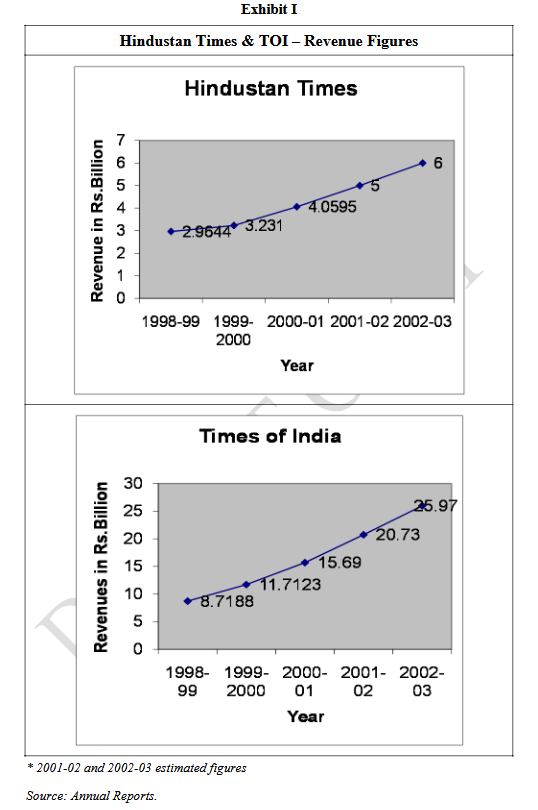
Exhibit II
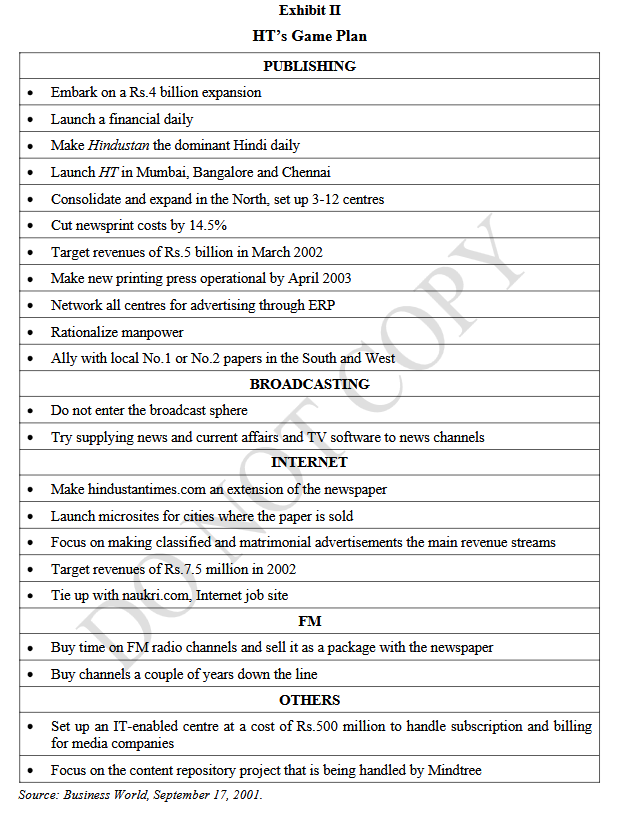
Exhibit III
Keywords
Delhi, northern India, publishing houses, Hindustan Times, Times of India, aggressive pricing, vice chairperson, Shobhana Bhartia, Rs.4 billion, Business Strategy, Mumbai, Chennai, northern India
Related Case Studies
| Case Title | Details | Price | Add to Cart |
|---|---|---|---|
|
Case Title Flyadeal: Saudi Arabian Airline’s Growth ChallengesCase Code: BSTR720 |
Details | 300 | Add to Cart |
|
Case Title Calbee’s Monochrome Packaging: Crisis Management Response or Marketing Strategy?Case Code: MKTG497 |
Details | 500 | Add to Cart |
|
Case Title The Nirma StoryCase Code: MKTG008 |
Details | 300 | Add to Cart |
|
Case Title Biscoff in India: The Premium ParadoxCase Code: CLMM170 |
Details | 200 | Add to Cart |
|
Case Title Ulta Beauty under CEO Kecia Steelman: Unleashing Growth in a Slowdown?Case Code: BSTR713 |
Details | 500 | Add to Cart |