
Modern Foods: Disinvestment and After
🌐 International Buyers — Pay via PayPal
Details
BSTR018
12
2002
NO
0
Modern Food Industries Ltd
Food & Beverage
India
Turnaround Strategy
Abstract
The case gives an overview of the disinvestment of Modern Foods (India) Limited (MFIL) by the Government of India (GoI) and turnaround strategy formulated by the Hindustan Lever Limited (MUL) for MFIL. When MUL took over MFIL, it was believed that MFIL would perform better under the HLL's management. However, after being sold to MUL, the company incurred cash losses to the tune of Rs. 69 million from 1998 to 99. As accumulated losses mounted to Rs.470 million and wiped off MFIL's equity of Rs. 330 million, it was referred to the Bureau of Industrial Finance and Reconstruction (BIFR). The case discusses various steps taken by MUL management for turning around the company. It also gives an insight into the disinvestment process and throws light on the reasons why the GoI was not able to hasten the process that was initiated in the early 1990s.
Learning Objectives
The case is structured to achieve the following Learning Objectives:
- Performance of public sector firms, divestment, hurdles to divestment.
Contents
“We are committed to making Modern a thriving and exciting business.”
- Gunendra Kapur, Executive Director (Foods), Hindustan Lever Limited
In February 2000, as part of its disinvestment program,1 the Government of India (GoI) sold Modern Food Industries (India) Limited (MFIL)2 to Hindustan Lever Limited (HLL) for Rs 1.05 billion. This was hailed as a major step in the GoI‘s disinvestment plan (Refer Exhibit I for a list of Public Sector Units (PSUs) approved by the GoI for disinvestment and Exhibit II for the important issues involved in disinvestment). However, some analysts questioned the GoI‘s decision to sell MFIL – a company with 14 production units spread across the country and almost 0.5 million square meters of land – for just Rs 1.05 billion.
In 2000-01, employees at MFIL accused HLL of trying to shut down some manufacturing units by retrenching more than half of the 2,000 workforce and relying on third parties to meet production needs. By December 2000, 10 months after HLL took over MFIL, its accumulated losses went up to Rs 470.40 million as against its networth of Rs 330.1 billion. Subsequently, under the Sick Industries Act (SICA), MFIL was referred to the Board of Industrial and Financial Reconstruction (BIFR).
In 2001, HLL announced that MFIL would be able to make a cash profit in two years. It announced a turnaround strategy which involved improving the quality of the product and the raw materials (refined flour), improving the manufacturing process controls, and modernizing the plant and machinery. Existing distributors would be trained and new ones identified. HLL was also looking for new outlets that could sell bread. To implement this strategy, HLL invested Rs 80-90 million in MFIL.
Modern Bakeries (India) Limited, incorporated in October 1965, was renamed Modern Food Industries (India) Limited (MFIL) on 11th November 1982. The company had 14 bakery units located in 13 cities and 6 other units at other places. Its products were bread, oil, flour, fruit pulp, fruit juice drinks, beverage concentrates and energy food. In the early 1990s, the bakery units accounted for 82% of the turnover of MFIL.
In the early 1990s, due to labour trouble, decline in market demand and the closure of a plant, capacity utilisation remained low, between 19% and 30% at the Ranchi unit, between 31% and 53% in the Calcutta unit, and below 50% in the Jaipur, Kanpur and Delhi-11 units. (Refer Exhibit III for unit-wise capacity, production and profits). Consequently, many bakery units were running at a loss.
MFIL fixed a norm of 0.50% of total production as defective production. In addition, a norm of 0.50% for bread returned from the market was also allowed. However, the percentage of defective production and return of unsold, damaged and defective bread exceeded the norms (Refer Exhibit IV & V).
Upto 1993-94, the cumulative losses of MFIL‘s Roller Flour Mill, Fruit Juice Bottling I Plant, Fruit Pulp Processing Plant and Oil Plant were Rs 11.85 million, Rs.64.4 million, Rs.32.40 million and Rs.81.94 million respectively. In 1997, MFIL was referred to the Disinvestment Commission. In February 1997, the Commission recommended 100% sale of the company. While making this recommendation, the Disinvestment Commission identified some of MFIL‘s weaknesses: under-utilisation of the production facilities, large work force, low productivity and limited flexibility in decision-making. In September 1997, the government approved 50% disinvestment to a strategic partner through competitive global bidding. In October 1998, ANZ Investment Bank was appointed as the Global Advisor for assisting in the disinvestment. In January 1999, the GoI decided to divest up to 74% of its stake in MFIL. An advertisement inviting Expression of Interest from the prospective Strategic Partners was issued in April 1999.
Ten parties responded to the advertisement. Of these, only four conducted a due diligence of the company, which included visits to the Data Room, interaction with the management of MFIL, and site visits. After conducting a due diligence, only two parties remained in the field, and on the last day (October 15, 1999) only HLL submitted a bid.
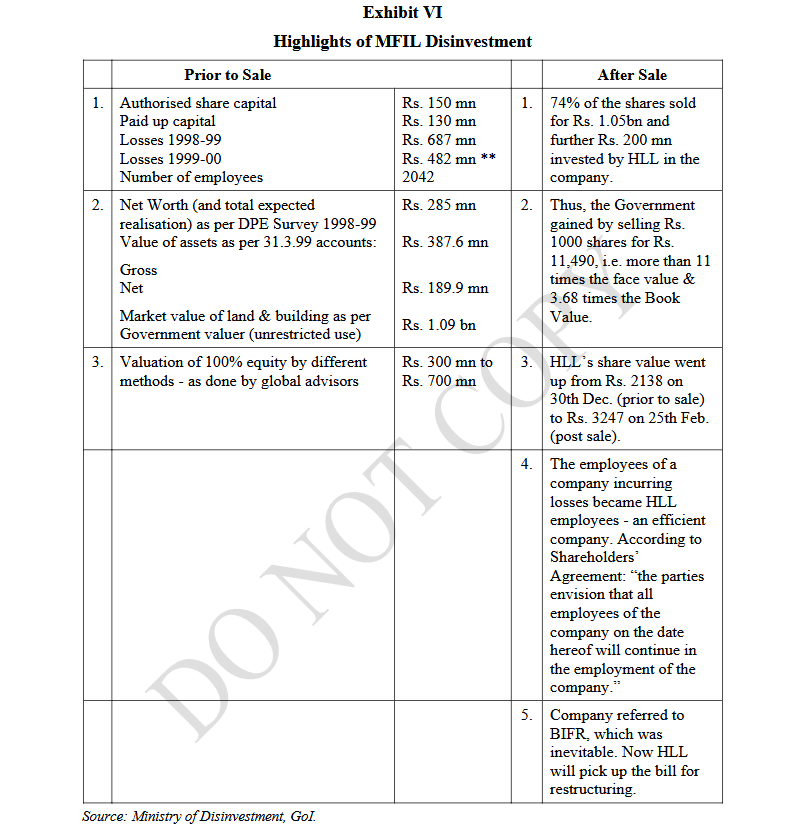
In January 2000, the cabinet committee on disinvestment approved HLL‘s bid for buying out a 74 per cent government stake in MFIL for Rs 1.05 billion (Refer Exhibit VI for highlights of the strategic sale). As per the agreement signed with the government, HLL would have five Directors on the Board of MFIL, while the government would nominate two people to the Board, including the Chairman. The agreement restricted the retrenchment of employees within a year of the buy-out. HLL was, however, free to implement a VRS after that period. The government also had the option to sell its remaining holdings to HLL after the completion of the first year and up to the end of the third year of the shareholders‘ agreement.
The acquisition of Modern Foods provided HLL control over 14 bread manufacturing units and a distribution network5 with 22 franchise units. HLL officials said that the vast distribution network of MFIL would help the company's growth in the high-end of the foods business. HLL, which sold branded wheat, felt that it could generate synergies in procurement. This would be critical to success in a low margin, high volume business.
Analysts felt that private-sector interest in MFIL disinvestment could herald a radical change in the Indian market for breads. In the early 1990s, Indian companies were not interested in major investments in the bakery segment, especially breads because of the relatively low margins. MFIL used its status as a government company to procure wheat at subsidized rates. As a result, it could produce and distribute at prices which competitors would not be able to match. The quasi monopoly status bestowed by this cost advantage would vanish after privatisation, making investments in the sector more attractive for others.
Analysts felt that the sale of MFIL was well timed since the company was sold as a going concern, not as a BIFR case. However, some analysts were of the opinion that the sale was undervalued. Apart from machinery at its 14 bakeries, MFIL had 19 franchises and six ancillary units scattered across the country. Some analysts felt that the real estate alone—16 acres in Delhi, 4 acres in Kanpur and 18 acres in Mumbai— would be worth over Rs 5 billion. They felt that HLL had paid for the brand and got the fixed assets for free.
The Comptroller and Auditor General of India (CAG) also criticised the government for not valuing MFIL correctly. The CAG said that the value of the plant and the machinery should have been considered, and not just dismissed as scrap. The CAG also criticised the valuer of MFIL (ANZ Grindlays Bank) for not taking into account the value of surplus land in Delhi Business Unit-I as well as the leased land of the Silchar unit in Assam. The CAG report stated that the "government seemed to have fortuitously received a bid for a far higher amount from the single bidder compared to the value arrived at by the Global Advisor." ANZ Grindlays Bank valued a 74 per cent stake in MFIL at Rs 463 million, while HLL actually paid Rs 1.05 billion for it.
The GoI said that its decision to sell off 74 per cent of its stake in MFIL to HLL ensured a cash flow higher than ANZ Grindlays Bank‘s valuation and prevented the company from being declared sick. ANZ Grindlays Bank had valued the entire company at Rs. 785 million only, while HLL had valued MFIL at Rs 1.65 billion. HLL made an upfront payment of Rs. 1.05 billion for the 74 per cent government equity in MFIL, besides agreeing to infuse Rs 200 million for technology upgradation and modernisation. The GoI also claimed that HLL was the only bidder which submitted a formal proposal and offered a higher sum than ANZ Grindlays Bank‘s valuation. Thus, the best option before the GoI was to sell majority equity to HLL and save the company from being caught in the BIFR‘s net.
The GoI also said that the finances of MFIL had come under serious strain: MFIL‘s net worth had recorded an erosion of 20 per cent in 1998-99, and efforts to turn it around would have required fresh capital infusion to the tune of Rs. 800 million. In addition, when MFIL was sold to HLL, its capacity utilisation was a dismal 15 per cent. Capacity utilization was expected to substantially improve in the near future, with HLL planning a major brand building initiative for MFIL. Officials of the Department of Food Processing said that with a 75% enhancement in capacity utilisation, a total of about 5,000 employees would be required as against the current strength of just 2,000. According to a senior official, "The employees have gained as they are no longer employees of a potential BIFR company, but are employees of a highly profitable group with no threat to their jobs."
In mid 2000, the officers of MFIL protested against the sale of 74 per cent of MFIL's equity by the GoI. One official said, "The sale of the 74 per cent equity of Modern Foods this January to HLL without our consent amounts to violation of our fundamental rights." Union sources said that as per the terms and conditions of service in PSUs, it was their fundamental right to determine the rightful ownership of the company. The Union complained that HLL had already started pruning the existing manpower. They were also apprehensive about the fate of the employees belonging to the backward classes as most of them were taken purely on the basis of their "reserved" status.
After HLL acquired MFIL, MFIL's losses went up. By December 2000, MFIL‘s accumulated losses increased to Rs 470 million (in 1998-99, MFIL made losses of around Rs 69 million) as against its networth of Rs 330 million. In early 2001, MFIL was referred to the Board of Industrial and Financial Reconstruction as more than 50% of its networth had been eroded by its losses. Officials of MFIL alleged that HLL wanted MFIL to be referred to BIFR so as to get some relief from banks and financial institutions. They further contended that if HLL had used the Rs 200 million it infused into MFIL as preference share capital instead of loans, MFIL would not have become sick. However, HLL officials said that they had little choice but to go to the BIFR, because MFIL‘s accumulated losses had exceeded 50 percent of its peak net worth, over a four year period. According to section 23 of the Sick Industries Act (SICA) if a company's accumulated losses over four years exceed 50 percent of net worth, then it has to be declared sick and referred to BIFR.
However, analysts felt that HLL could have prevented MFIL from entering the BFIR‘s ambit. According to one analyst, "If the amount that HLL brought in was brought as equity or preference capital before December 31, 2000, Modern Food could have escaped the clutches of the BFIR." MFIL officials alleged that referring MFIL to the BIFR was a strategy for retrenching employees and closing unviable units. However, Gunender Kapur, Executive Director (Foods), HLL was of the opinion that taking MFIL to the BIFR was just a 'technicality'; he was confident that in two years MFIL would be able to post a cash profit as a result of the turnaround strategy initiated by HLL. HLL officials also claimed that between February and December 2000, MFIL‘s sales had doubled.
In 2001, HLL set a two-year timeframe to turn around MFIL. The turnaround included providing financial assistance to distribution channels and introducing better-quality bread ingredients to improve quality. HLL had already pumped in around Rs 200 million in MFIL by way of secured loans and corporate guarantees. HLL officials claimed that MFIL's sales had more than doubled since it was acquired. Said Kapur, "While we have already achieved a turnaround in sales, a turnaround in financial terms (profitability) will happen in the next two years." The increase in sales (actual figures not revealed) was mainly due to an increase in the number of outlets that sold MFIL bread. In Mumbai, the number of outlets increased to about 250 from 100, and crossed the 400-mark in New Delhi.
Ever since HLL took over the company, it seemed to have focussed on improving the quality of the product and its distribution It also helped MFIL leverage on HLL's strengths in areas such as wheat procurement, communication, treasury, and training. According to Kapur, "Post-acquisition, the task before Levers was not only to increase distribution and sales, but also to ensure that Modern bread‘s daily delivery system was well established and further strengthened to ensure the delivery of fresh stock of bread twice a day." He further added, "Improvement in quality is an ongoing process which will continue in the year 2001."
In mid 2001, HLL introduced a voluntary retirement scheme for employees of four units of MFIL that were closed and for its surplus employees at other locations. Work was suspended between 1991-99 at four of MFIL's 19 factories—Kirti Nagar (closed since June 1999), Ujjain (closed since March 1994), Bhagalpur (since October 1998) and Silchar (abandoned at the project stage itself in October 1991). Workers in these units were drawing wages. Moreover, many units at different locations had surplus manpower.
HLL officials said MFIL's losses would reduce to Rs. 200 million in 2000-01 from Rs 480 million in 1999-00. In 2000-01, the first year under HLL‘s management, bread sales of MFIL increased to Rs 1.02 billion from Rs. 780 million in 1999-2000. Growth in bread sales in the first four months of 2001 was 80 per cent over the corresponding period of 2000.
However, MFIL employees were not ready to accept that the performance of the company would improve in the future. Said an employee, ?How can HLL revive the company when it‘s is going about shutting down plants.? They pointed out that the units at Bhalgalpur in Bihar and Kirti Nagar in Delhi had been closed and just about half of the Lawrence Road factory in Delhi was operational. The employees were not confident that capacity utilization would go up to 75% as claimed by HLL from the dismal 15% at the time of takeover. Since November 2000, MFIL's franchisees had been turned into ancillaries and as a result, the sales figures of these franchisees had been added to the sales figures of MFIL. The employees therefore argued that there had been no real increase in sales. The employees also felt HLL‘s turnaround strategy for MFIL would involve shutting down of units, laying off workers and relying on third party production (outsourcing).
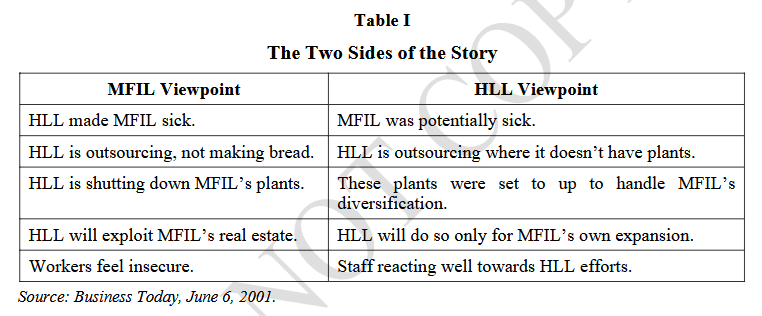
However, HLL officials said that its outsourcing plan was based on the presence or absence of an MFIL unit in a given region. For instance, in Mumbai, MFIL had its own plant, so HLL did not outsource bread for that region. On the other hand, in Pune it did not have its own plant and so it relied on an ancillary (Refer Table I for both sides of the story). Kapur said that HLL had no plans for using MFIL's vast stretches of land for its expansion. He said, "We will use Modern‘s land for Modern‘s expansions, and nothing else."
In August 2001, Peter Selvarajan, Managing Director of MFIL, said that MFIL would break-even in another two to three years. When the three-year lock-in period would come to an end in 2003, HLL would be able to call for the balance 26 per cent stake of GoI in MFIL, at a price that would not be less than the first acquisition. This price would be determined by an independent accounting agency. Meanwhile, MFIL‘s management was planning to initiate talks with the employee federations to put in place a streamlined and productivity-linked incentive scheme for its workforce. Selvarajan said that MFIL management would initiate the second round of talks with the two employee federations, Hind Mazdoor Sabha (HMS) and Indian National Trade Union Congress (INTUC), to chalk-out a streamlined productivity-linked package of a permanent nature. Industrial relations had assumed great significance at MFIL after the disinvestment process was initiated, as a result of apprehensions regarding closure of units and subsequent lay-offs, he said.
MFIL's management had initially worked out a one-year agenda with employee federations in September 2000. MFIL had a workforce of about 2000 of which 490 had applied for the VRS scheme introduced by the company in June 2001. Of the 520 applications for VRS, about 490 were cleared at a cost of an estimated Rs 150 million to the company.
In late 2001, MFIL was also looking for ways to spread its manufacturing base and was aggressively setting up ancillaries through arrangements with existing bakeries. The company was exploring the possibility of expanding in big towns, where MFIL did not have a presence, besides spreading to other smaller towns. The next few years would tell whether MFIL could be transformed from an ailing PSU into a breadwinner by HLL.
1. Analysts felt that by taking over MFIL, HLL could consolidate its position in the food business. Identify and describe the synergies that HLL was looking for by taking over MFIL.
2. MFIL was plagued with capacity under-utilisation, and labour problems. Turning around MFIL would not be an easy task for HLL. Discuss the various problems faced by HLL in turning around MFIL.
3. In the early 1990s, the GoI initiated a disinvestment programme. However, the disinvestment process in India was plagued by various problems. Why do you think the GoI could not expedite the disinvestment programme?
Exhibit I
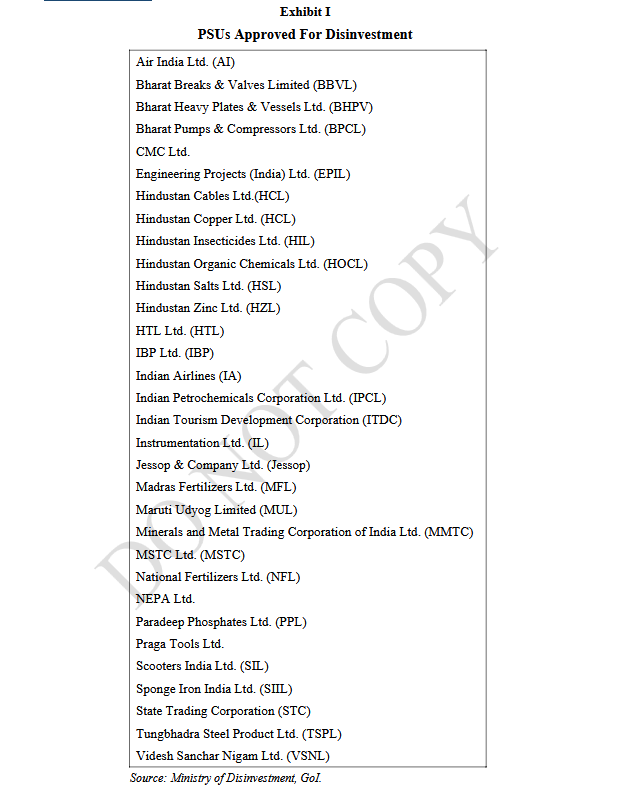
Exhibit II
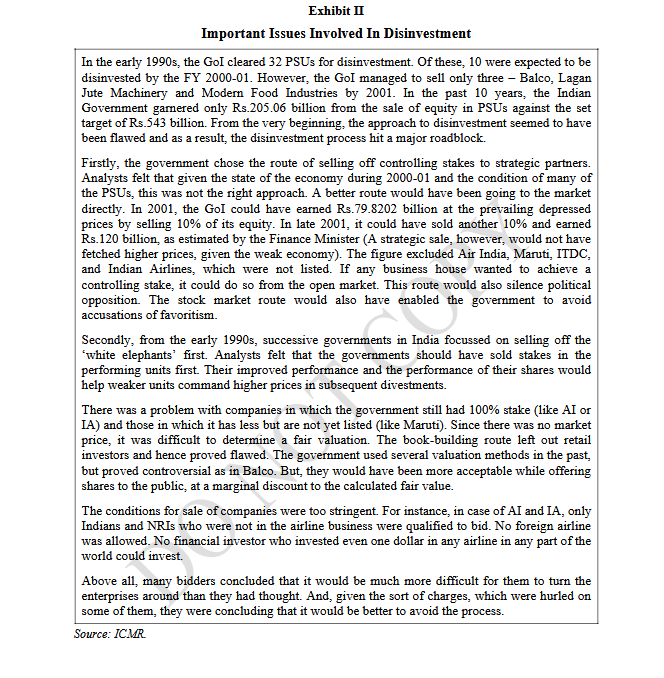
Exhibit III
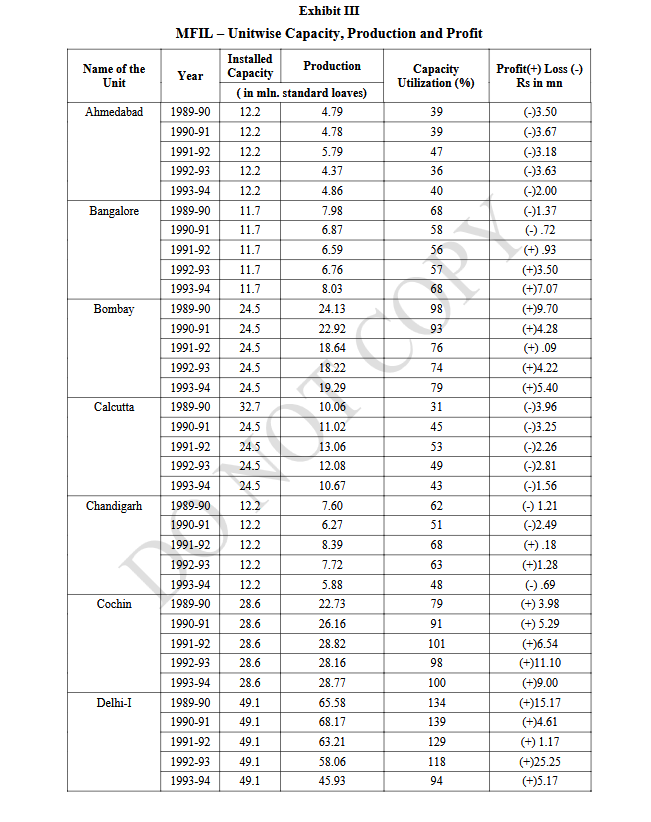
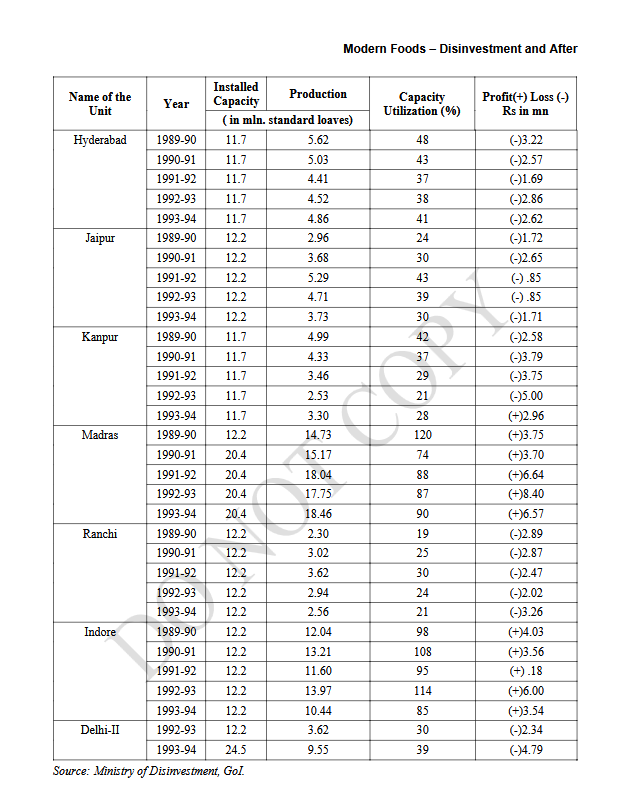
Exhibit IV and V
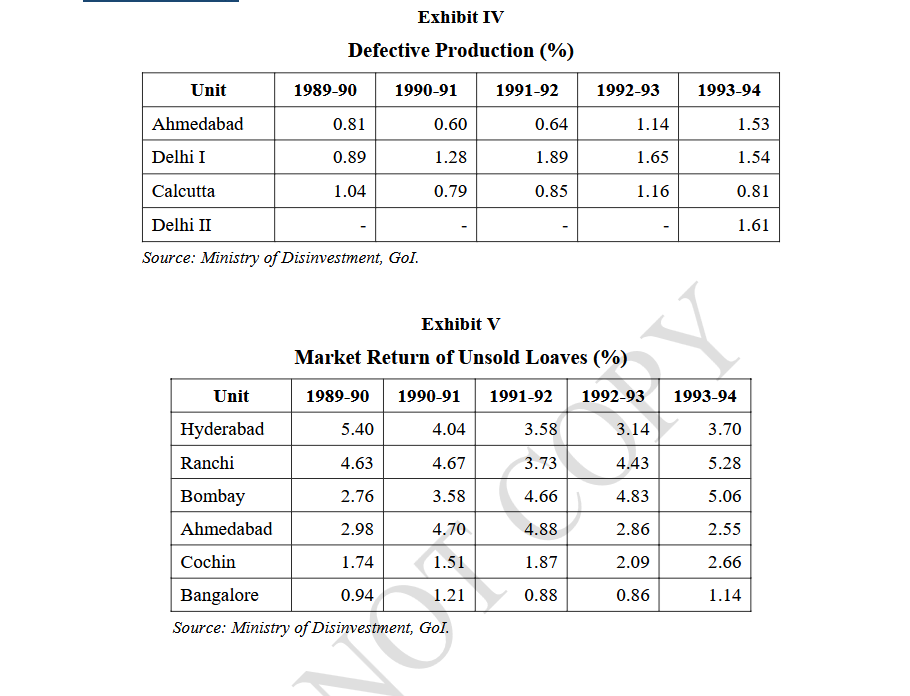
Exhibit VI
Keywords
Disinvestment, Modern Foods India Limited, MFIL, Government of India, GoI, turnaround strategy, Hindustan Lever Limited, MUL, MFIL, HLL, management, cash losses, Rs. 69 million, 1998, 1999, Rs.470 million, equity, Rs. 330 million, Bureau of Industrial Finance and Reconstruction, BIFR
Related Case Studies
| Case Title | Details | Price | Add to Cart |
|---|---|---|---|
|
Case Title Turbulence at Boeing: Can Kelly Ortberg Steer the Company to Safety?Case Code: BSTR710 |
Details | 500 | Add to Cart |
|
Case Title Can Kelly Ortberg help Boeing Navigate through its Troubles?Case Code: HROB292 |
Details | 500 | Add to Cart |
|
Case Title The Tech Phoenix: Satyam’s 100-Day TurnaroundCase Code: BSTR703 |
Details | 600 | Add to Cart |
|
Case Title Rolls-Royce: The Turnaround ChallengeCase Code: CLBS154 |
Details | 200 | Add to Cart |
|
Case Title Rolls-Royce: The Turnaround ChallengeCase Code: BSTR505 |
Details | 500 | Add to Cart |