
Air India: The Virgin Airways Saga
🌐 International Buyers — Pay via PayPal
Details
BSTR019
8
2002
NO
0
Air India
Transport & Logistics
India
Strategic Alliances,Growth Strategy
Abstract
The case deals with the code sharing agreement between Air India and Virgin Airways, the second biggest airlines in UK after British Airways. The arrangement was considered to be a significant development for the ailing Air India. Under the arrangement, Virgin Airways was to fly three flights a week on the Delhi-London route. In July 2000, Virgin Airways started off with two flights a week. It was to start the third flight from October 2000. However, until late 2001, Virgin Airways was not allowed to fly a third flight. With the global aviation downturn in 2001, Virgin Airways was finding it difficult to sustain itself with two flights a week. It threatened to exit from India, if it was not allowed to fly the third flight.
Learning Objectives
The case is structured to achieve the following Learning Objectives:
- Code sharing agreements between airlines, strategic alliances.
Contents
“We are grateful to A-I, but as it is a government regulated body, it fails to understand many commercial implications, namely, that to operate two flights a week, we need to create the same infrastructure we require to operate six. This has led to an increase in Virgin’s overhead costs as the crew keeps waiting for a week. This way, we will scarcely be able to pass on the envisaged benefits to our customers.”
- Mackenzie Grant, Virgin Atlantic’s General Manager (India), in 2000
In December 1999, India?s national carrier, Air India (A-I) signed an agreement with Virgin Atlantic Airways (VA) by which VA would fly three flights on the Delhi-London route on a code-sharing2 basis with A-I. This was hailed as a significant development for the ailing A-I. The code sharing arrangement was expected to trigger off a price war in the Delhi-London route where British Airways (BA) was a dominant player. According to the agreement, VA would fly three more flights a week on this route by 2001.
In July 2000, VA started off with two flights a week on Thursdays and Saturdays from Delhi. It planned to have a third flight by October 2000. However, till late 2001, VA was still flying two flights. A-I did not seem ready to allow VA fly the third flight because A-I too had a flight from Delhi on Monday, the day VA wanted to fly from Delhi. Meanwhile, the Government of India (GoI) granted rights to BA to fly three more flights per week from Kolkata to London. This was in violation of the bilateral pact signed between Britain and India according to which BA and A-I were allowed to fly 16 flights a week to each other?s country. BA was already flying 16 flights a week-seven from Delhi, seven from Mumbai and two from Chennai.
In late 2001, VA was severely affected by the downturn in the global aviation industry. VA was finding it difficult to sustain its operations in India with only two flights a week. VA had made it clear that unless it was allowed to increase the frequency to three, its exit from India would be a distinct possibility.
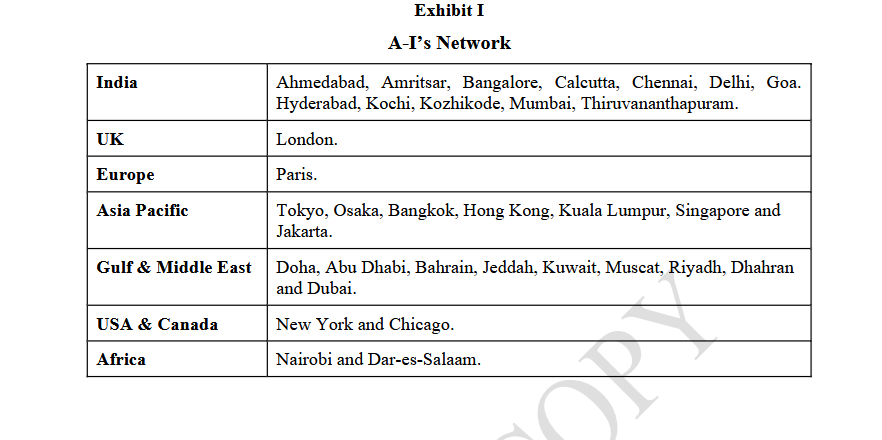
A-I was registered as Air India International in 1948. Later in 1962, the word 'International' was dropped and from March 1994, the airline began functioning as Air-India Limited. In 2000, A-I's network covered 44 destinations (Refer Exhibit I). In addition, A-I had a code sharing arrangement with a number of foreign airlines. These included Air France, Swiss Air, Bellview Airlines, Austrian Airlines, Asiana Airlines, Scandinavian Airlines, Singapore Airlines, Aeroflot, Air Mauritius, Kuwait Airways and Emirates.
In the late 1990s, as part of its disinvestment programme, the GoI decided to divest 40% stake in A-I and began looking for a strategic partner. The strategic partner would take up 40% stake with only a 26% cap to foreign airlines.
Ever since it began operations in 1984, VA focused on international routes. After the airlines maiden flight, from London's Gatwick airport to Newark on the outskirts of New York, Richard Branson added several lucrative routes to his kitty. Till 1999, VA's route network in the Asian region included Heathrow-Tokyo-Heathrow, Heathrow-Hong Kong-Heathrow and Heathrow-Shanghai-Heathrow. The airline had code-share agreements with Continental Airlines, Malaysian Airlines, and British Midland. In the late 1990s, Branson was targeting the lucrative Delhi-London route. Every year an estimated 0.3 million passengers traveled from Delhi to London, which was nearly 40 per cent of the total outbound traffic from India. The only available direct route codes were held by BA and A-I. As a result passengers were forced to take circuitous routes offered by airlines like Emirates and Royal Jordanian, which made them wait for hours at distant airports.
Branson's efforts to woo A-I started in 1997. He said, “Air-India was once famous for its service and I'd like to think that as well as competing with Air-India we can share with it our experience of making Virgin Atlantic the success it is today.” Analysts felt that A-I would learn from VA's innovation in hospitality. VA was the first airline to offer a TV monitor with every seat (in every class). It offered in-flight beauty therapy including the services of masseurs, ice-cream cones during in-flight movies and a chauffeured motorcycle service to airports. Also in the offing were email and Internet services. Upper class passengers were provided laptop power leads with every seat, and headsets to reduce noise in the cabin.
Besides commercial cooperation on cargo services, yield management, and product development, the arrangement with Branson would give AI's staffers access to cabin crew training. However, analysts felt that once VA started its operations, it would be an all-out fight to lure passengers and AI would be the worst sufferer. As VA promised to offer tickets at 15 per cent less than BA, a Delhi-London VA ticket would be cheaper than A-I's.
In 1999, the ministry of civil aviation said that it was willing to consider an agreement between VA and A-I that would benefit both carriers. The agreement was to include a code-sharing arrangement or sharing of A-I flight quotas. The entry of VA on the London-India routes was likely to bring down the fares on the sector.
In December 1999, VA signed an agreement with A-I to fly three services a week on a code share basis between Delhi and London from July 2000. The arrangement with A-I was for five years and apart from the initial three flights a week, frequencies, it had agreed to give away the remaining three to V-I by 2001.4 VA and A-I would share seats on each other's routes and VA would operate flights to the UK on routes not covered by A-I. VA would also fly on days that were not flown by A-I. Under the terms of the agreement, flights would carry both VA and A-I flight numbers, and both airlines would sell seats on those services in competition with one another. Said Branson, “Launching flights between the UK and India has always been an ambition of mine. It is a very potent route and currently I see a lack of capacity on this route, which has decreased tourist flow between the two countries. I think between the two airlines - Air-India and Virgin - we will be able to improve the route.”
According to some analysts, the GoI was interested in forging an alliance with VA because of the group's interests in entertainment, music, telecom, insurance and financial services. Branson had raised hopes of further investments in publishing, holiday homes and telecom. He said, “This is just the beginning. We will study the Indian market and see what business is best suited for the market and for us and proceed accordingly. We will see where we can make a difference.” A-I had been in the red for a long time and was hoping that the VA venture would improve its bottomline. Said Branson, “We are paying a significant amount to A-I under the code-sharing agreement, though I would not like to reveal the amount. Let me assure you: Air-India can make a few millions.”
However, Air India officials felt that more than the financial gains, it was the partnership that mattered and the move would bring in fresh traffic to the country. Besides traffic, VA's arrival could also mean reduction in airfares. Said Branson, “Our upper class and premium class as we call them are as competitively priced as the first class and business class fares of other airlines respectively. Except, of course, we give more services such as limousines, manicure, beauty treatment, etc, to every passenger on board. As for our economy class, our priority is to fly it houseful and hence the pricing is whatever it takes to get the customer. Hence, since we will be competing with Air-India too despite this agreement, the pricing and services will be competitive.”
VA's arrival was also expected to improve A-I?s services and even bring about a reduction in the fares depending on the market conditions. Said M. P. Mascarenhas, the then Managing Director of A-I, “We will have to compete and hence we will have to perform, even if it means fare reduction.” Analysts felt that a possible fare reduction would have an adverse effect on the bottomline of A-I. Responded Mascarenhas, “I don't think it would because it would increase traffic and improve the overall situation. You see, now, between the two airlines, there will be services all days of the week.”
Analysts felt that with the AI-VA code sharing agreement, other carriers such as Thai Airways and Cathay-Pacific, which were asking for more flights, would pressurize the GoI for code-share arrangements with AI in lieu of more flights.
Analysts felt that with the entry of VA, the Indian skies would see some fierce price wars between VA and BA. Branson said that VA?s first class fares would be equivalent to the business class fares of BA and that the economy fare would be 30-50% cheaper than BA?s. If BA brought down ticket prices as it had done in May 2000, VA would fly for less, Branson said. Since BA had proposed a fare of about Rs 27,000 on the Delhi-London sector, Branson said VA would file an application with the GoI for a lower fare. At the same time, VA would respect the Government's sentiments on fares, since it was a regulated market, Branson said.
In June 2000, VA announced that it would start its operations in India in July with a bi-weekly service-Wednesdays and Fridays from London and Thursdays and Saturdays from Delhi. VA planned to launch a third weekly flight around October. The airline would offer low introductory fares. Mackenzie Grant, VA's general manager for India said the initial fare was still being worked out and that it would be difficult to give a comparison with competing airlines.
Analysts felt that VA would give BA some stiff competition, not only in terms of fares, but also with its array of services such as sleeper seats, massage services and lounge facilities. Said one, “Virgin's entry will certainly be a boost to services between India and Europe. The airline has a high quality product.” Branson promised VA fare would be extremely competitive. Analysts felt that competitive pricing would mean that VA would price its Delhi-London flight for less than Rs 25,000, which was approximately the A-I fare. A-I feared there would be an exodus of its already dwindling passenger list.
Meanwhile, BA was bracing itself to meet the VA challenge on the Delhi-London sector. The airline announced direct daily services between London and Delhi from October 30, thereby increasing capacity by 25 per cent on this sector. For this, the airline suspended its twice-weekly service to Calcutta and terminated its five times-a- week service from Delhi to Dhaka from October 30. The changes were made as part of a renewed bilateral agreement between UK and India signed in February 2000.
On July 5, 2000, VA dropped a bombshell. It slashed its introductory airfare from the normal Rs 42,598 to Rs 31,000 for a return ticket on the busy London-Delhi route. But just before VA's entry into Indian airspace, BA also announced a special economy-class fare: a Rs 27,635 round trip ticket. According to analysts, consumers were at last getting the benefits of a liberalised competitive sector.
In July 2000, BA won the right to three more flights per week between India and Britain, drawing an immediate protest from VA. According to BA?s South Asia manager Alan Briggs, under a special arrangement outside a bilateral aviation agreement, the GoI had given BA permission to fly three times a week to the eastern city of Calcutta. Under the bilateral pact, which was renewed in February 2000, BA and A-I were each allowed to fly 16 times a week to each other's home country. A-I used 10 of its 16 weekly flight entitlements on the route. BA used all 16 of its flight entitlements, with seven flights a week to Delhi, seven to Mumbai and two to Madras. BA had been lobbying since 1993 to increase the number of its flights to India.
By October 2000, VA was to start its third code share flight as per the agreement with A-I. In addition to the Rs 100 million per flight per annum that A-I got from VA, the third flight would fetch A-I Rs 300 million per annum. However, till late 2001, VA was flying only two flights a week. Also, there was no progress on the remaining three flights that VA was entitled to fly from 2001. This seemed to the bone of contention between VA and A-I. VA officials were particularly unhappy that BA was granted rights to fly three additional flights per week from Kolkata to London against the prevailing norms. What seemed particularly strange was that there was no commercial agreement or code share for any of these additional frequencies. Commenting on the GoI's interest in BA, a leading business magazine in India wrote, “The needle of suspicion automatically points to vested interests in the ministry and their sudden penchant for BA.”
By December 2000, it became clear that VA would have to wait a bit longer for final clearance from A-I to commence the third code-share flight on the India-London sector. While VA officials claimed that they would start the third code-share flight within a reasonable period of time following clearances from Indian authorities, A-I officials said that nothing was in the offing as yet. Said a VA official, “The ball is in the court of A-I and the Indian Government. The day we get the permission, we will start the service in a reasonable time period, which will allow us to relocate aircraft and crew to commence the third flight. Further, the airline will be only too happy to serve other destinations in India.”
Some analysts said that while VA was keen to operate the third flight on Sundays from London with a Monday departure from Delhi, A-I was opposed to as the Indian carrier also had a Delhi to London flight on Monday morning. VA was willing to schedule its flight at 2 p.m. in the afternoon, ensuring a gap of more than 6 hours between its flight and A-I?s London flight. But this was not acceptable to A-I, which pointed out that according to the agreement signed between VA, and A-I, VA was to operate flights only on those days when A-I did not operate services to London.
A VA official said that the delay in granting permission to VA to operate the third flight on the sector was proving to be financially disastrous for A-I. However, despite these problems, VA said it was interested in code sharing with A-I to other cities such as Chennai, Bangalore, Hyderabad and Ahmedabad.
In late 2001, VA was in some trouble because of the downturn in the transatlantic aviation business and shrinking revenues. VA announced 20 per cent reduction in operations, grounded five of its aircraft and pruned the workforce by 1200 to tide over one of the worst crises for the international aviation business in the aftermath of the US attacks6. Having already announced 20 per cent reduction of activities, the airline seemed unable to sustain its operations in India with just two flights a week. Said Paul Smitton, general manager-India, VA, “Two flights each from Delhi is not a viable proposition in the long run. At least three or more flights makes the business viable as it would enable us to get more traffic and meet economies of scale from our operations here.” He added, “No airline can sustain loss making regions for long. And this time round, we will wait for just months and not years before taking a decision.” Analysts felt that VA was likely to review its strategy for its fledgling unprofitable Indian operations. During its short stay in India, VA had already notched up losses on the Delhi-London sector and industry sources ruled out the chances of VA breaking even unless the frequency increased from the current level. VA officials have indicated to the GoI that VA may have to pull out of India if the frequency of operations was not increased.
VA informed the GoI that it had agreed to provide A-I with income worth Rs 100 million per annum for each flight on the basis of the understanding that a third frequency would be allowed on schedule. VA also said that it had hired Indian crew for three flights and spent on publicity, as it was confident its frequency would be increased. It informed the GoI that it would have to pull out of India if the third flight was not cleared. In October 2001, the GoI ordered a full review of the code-sharing pact.
What remained to be seen was whether the much-hyped I-A-VA alliance would be sustainable in the long run.
1. Air India's code sharing arrangement with Virgin Atlantic was expected to benefit the ailing Air India. However, by the end of 2001, relation between Air India and Virgin Atlantic deteriorated and Virgin Atlantic threatened to pull out of India. Explain why the Air India-Virgin Atlantic code sharing arrangement failed to have the desired effect.
2. “Tie-ups between major airlines have become a key part of the global aviation strategy in the late 1990s. They range from mere code sharing arrangements and joint frequent flyer programmes to alliances.” Discuss.
Exhibit I
Keywords
Code sharing agreement, Air India, Virgin Airways, UK , British Airways, fly three flights, week, Delhi-London route., July 2000, third flight, October 2000, 2001, global aviation downturn