
Fiat’s Indian Journey
🌐 International Buyers — Pay via PayPal
Details
BSTR020
7
2002
NO
0
Fiat S.p.A.
Automotive
India; Italy
Market Entry ,Growth Strategy, Product Launch, Market Segmentation
Abstract
The case explores reasons for the poor performance of the Italian automobile company Fiat in India. It examines in detail the company's efforts to make its Uno and Siena cars a success. The case also takes a look at the changes made by the company for ensuring the success of its new car, the Palio, launched in September 2001. The case is so structured as to enable students to understand how certain mistakes on the marketing, product development and the strategic alliance fronts resulted in Fiat's poor performance over the years in the Indian car market. The students should also understand the rationale behind the measures taken by the company for ensuring the success of the Palio.
Learning Objectives
The case is structured to achieve the following Learning Objectives:
- Entry of automobile multinationals into India, product failures, problems in JVs.
Contents
“We will show what Fiat means, in terms of technology, service, deliver, cost, finance, mobility solution to the customer.”
- Maurizio Paolo Bianchi, Managing Director (Fiat India), in October 2001.
In September 2001, Fiat India Automobiles Limited (Fiat) held a lavish function in the Indian coastal state of Goa. The function, featuring performances by leading Indian musicians Louis Banks and Sivamani, who had composed music especially for this event, was held to celebrate the launch of Fiat's much-awaited car, the Palio. Designed by well-known Italian automobile designer Giorgetto Giugiaro, the Palio was already a huge success in countries like Brazil and Argentina.
The media termed the high-profile launch of Palio, backed by a Rs 120 million endorsement deal with leading Indian cricket player Sachin Tendulkar (Tendulkar), as a desperate attempt by the Italian automobile giant to establish itself as a serious contender in the Indian car market. The Palio was expected to boost the company's sales, which had been declining for the past few years. Known as the Fiat Group's 'world car', the Palio was being seen as Fiat's last chance to tackle its accumulated losses of Rs 10 billion.
Fiat did appear to be taking a 'last chance' with this new car. It had dedicated more than 83% of its total installed capacity for the production of the Palio. The company had invested an additional $250 million at its Kurla, Maharashtra, plant for the new car. Unlike some of the other small cars that had been adapted to suit tough driving conditions in India, the Palio had been designed from scratch with these conditions in mind.
Fiat had even decided to reduce the combined production of its other models – Uno, Siena and Siena Weekend - to 10,000 per year. Instead, the company planned to build 50,000 Palios during the first year of its launch. It was reported that the company was ready to stop producing the Uno completely, if necessary. Company sources revealed, “The decision regarding whether the Uno should be continued will be taken after the Palio is launched and after observing the performance of the former car.” Fiat had also postponed the launch of the Multipla (part van, part car) for the time being.
Fiat India's Managing Director Maurizio Bianchi was extremely optimistic regarding Palio's prospects, “With the Palio we plan to give the widest range possible in the B-segment. We will launch with the 1.2 and 1.6-liter petrol (versions) and by 2003 offer a 1.9 diesel (version). We will also try to give a wide range of options to suit every pocket and taste. In this way we will be able to span the complete spectrum of the B-segment which today accounts for 40% of the Indian market.”
Although Bianchi was optimistic, his skeptics far outnumbered his supporters. The reasons were not difficult to understand, as the company's five decade long existence in the Indian automobile market had only produced failures. In spite of having invested over Rs 30.1 billion since 1996 in the country, Fiat's market share in 2001 was only 1.3%.
Credited as one of the founders of the European automobile industry, Fabbrica Italiana Automobili Torino (FIAT) SpA was established in 1899 in Turin, Italy by a group of individual investors. FIAT's automobiles achieved instant popularity, not only in Italy, but also internationally. Over the next century, FIAT consistently followed a two-pronged growth strategy: penetration of foreign markets and focus on innovation. The innovation strategy fuelled the company's diversification plans into agricultural and construction equipment, commercial vehicles, metallurgical products, components, production systems, aviation, publishing and communications and insurance.
Some of the company's famous car models include the Balilla (1932), the Fiat 500 and the Topolino (1936), the Fiat 500 B two-door sedan and station wagon, the 10 B and 1500 D (1948), the 500 C, 1100 E and 1500 E (1949), the 1400 (1950), the 1100/103 sedan and the multipurpose 103 TV, Seicentos, Cinquecentos (mid 1950s), the 850, 128, 130, 127 and 126 (in the 1960s), Ritmo (1978), Uno (1983) and the Punto (1993). FIAT also acquired the Autobianchi, Lancia, Alfa 164 and Alfa 156 brands over the years. The company also owned a host of popular brands in its other businesses.
By 2001, with revenues around 57 billion Euro, FIAT emerged as one of the world's biggest industrial groups, operating in 61 countries with 1,063 companies involved in automobiles. The group ran 242 production facilities and 131 research centers, with almost half of them located outside Italy.
As part of its globalization effort, FIAT entered India in 1951 through a technical collaboration with Premier Automobiles Limited (PAL) to manufacture the 'Fiat 500' car. PAL was one of India's first automobile manufacturing companies, established in 1944 by the Walchand Hirachand family. The family owned many other businesses, including Hindustan Shipyard, Hindustan Aeronautics, Hindustan Construction, Rayalgaon Sugar and Walchandnagar Industries. PAL was the 'flagship company' of the Hirachand family's industrial empire due to its profitability over the years.
PAL began manufacturing the Fiat 500 in 1951, the Millicento in 1954, and the Fiat 1100 Delite (commonly known as the Premier Padmini) in 1964. Over the years, Premier Padmini became the 'de-facto' name for Fiat in India. In the absence of any serious competition, except from Hindustan Motors, PAL attained a significant market share by the mid 1970s.
Until the 1980s, only two choices were available in the Indian automobile market: the Ambassador and the Padmini. The situation however changed drastically in 1981 with the setting up of the Maruti Udyog Limited (MUL) joint venture between the Indian government and the Japanese automobile major Suzuki Motor Corporation. MUL's small, fuel-efficient and well-designed car, Maruti 800, soon became a huge success. Consumers, whose choice had been restricted to the 'old-fashioned' Fiat and Ambassador cars, rushed to buy the vehicle. By the late 1980s, MUL became the market leader, leaving Fiat and Hindustan Motors way behind.
After the Indian economy was opened up to foreign players in the early 1990s, many multinational auto manufacturers entered the country. The industry scenario was changed forever when many companies, including Daewoo, General Motors, Daimler-Benz, Hyundai and Honda, entered India via the joint venture/subsidiary routes. This competition affected PAL badly. As a result, Fiat decided to launch new vehicles in the Indian market through PAL. However, much to the company's chagrin, one after the other, its efforts to make a success of its brands failed miserably.
- UNO -
In March 1996, Fiat signed an agreement with PAL to import and assemble CKD kits of the 999-cc car 'Uno.' Uno, launched by FIAT in 1983, was the most successful car in the company's history.
Uno was launched in 1996, amidst much fanfare and acquired around 3,00,000 bookings in just three months. However, in June 1996, just when the company had closed the bookings, the employee union at the Kurla plant forced a lockout. The lockout was the result of a go-slow agitation led by militant trade union leader, late Datta Samant, started in April 1996. The lockout was lifted in November 1996, after a majority of the workforce defied the Datta Samant-led union and opted to go back to work. As a result of the lockout, production suffered greatly and the company could not deliver the booked vehicles in time – only 617 cars were delivered by the end of 1996. The non-delivery of the vehicles upset many consumers and around three-fourths of the orders were cancelled.
The lockout was just a small manifestation of the problems affecting the plant. PAL's management was staid and unprofessional and due to frequent infighting and break-ups within the Hirachand family, the management was not even able to infuse fresh capital into the plant when required. In addition, the company had an excessive workforce with around 10,000 workers.
In 1997, Fiat took over PAL through its newly set-up 51% subsidiary Ind Auto Pvt. Ltd. (Ind Auto) at a cost of Rs 5 billion and began working towards replacing the plant's old machinery, setting right the dealer network and improving after sales services. Fiat also took over PAL's auto finance company, PAL credit and capital. As a result of this takeover, the company's plans for launching its '178 world car project?6 were delayed. Fiat later offered a VRS to the staff at the Kurla plant in 1998, which was accepted by around 95% of the targeted employees.
Uno's performance in the Indian market was far from satisfactory. Fiat sold 5,194 Unos during April – October 1998. But with the launch of Hyundai's small car Santro in October 1998, Uno's sales started declining rapidly. While 1,123 Santros were sold in October 1998, Uno managed to sell only 612. The launch of other small cars, Daewoo's Matiz and Telco's Indica further ate into Uno's market share. Heightened competition from MUL in the form of more versions of Zen added to the company's troubles.
Tough competition was not the only reason for the Uno's poor performance; Fiat's poor dealer network and after sales services and the non-availability of spare parts were also to be blame for the Uno's failure. Moreover, Indian consumers still perceived Fiat to be synonymous with PAL and its old-fashioned Padmini. The company's 1997 advertising campaign for the Uno was also believed to be rather sporadic and focussing more on the company rather than the brand. Analysts felt that the fact that the Uno was two generations older than its competitors affected its image negatively.
The company then began working towards launching the hatchback Palio in 1999. However, after the launch of Santro and Matiz, both small hatchback cars, Fiat decided to postpone the Palio's launch. Company sources revealed that this was due to the fact that Palio was reportedly bigger, and hence costlier, than the hatchbacks present in India. Had the company launched a higher priced hatchback during this period, it would not have been able to project itself as a manufacturer of low-priced, good quality, utility cars. Thus, to establish its image as a company that offers great 'value-for-money' cars, the company reworked its strategy and decided to launch the Siena instead.
- SIENA & SIENA WEEKEND -
Fiat launched the Siena in October 1999. Priced at Rs 0.55 million, the Siena was placed in the premium segment against MUL's Esteem VX and Daewoo's Cielo. The company also launched a diesel version of the Siena, around Rs 0.15 million cheaper than the nearest competitor, Escort diesel. Though Siena performed well initially, selling about 1,200 cars a month, it soon repeated the Uno story. After the launch of Ford Ikon and Hyundai Accent, Siena's sales started plummeting. Surprisingly, Fiat raised the prices of the Siena, this causing a further decline in sales.
After Siena's failure, Fiat launched its first station wagon,8 the Siena Weekend, in September 2000. Available in both petrol and diesel versions, the Siena Weekend was a variant of the Siena. Unfortunately, it was a failure from the very beginning. Analysts commented, “The Weekend is the finest product in its category. It?s their marketing which has been a disaster.”
Through the 12 months from September 2000, Fiat sold 12,303 Unos, down 10.6% from the previous year; 2,901 Sienas, down 4.1%; and only 94 Siena Weekends. In 2000, Uno's sales averaged only 600 cars per month, even as almost all the other small car sales picked up. The Siena's sales also slipped to around 150 units per month, as against 450-500 units in 1999.
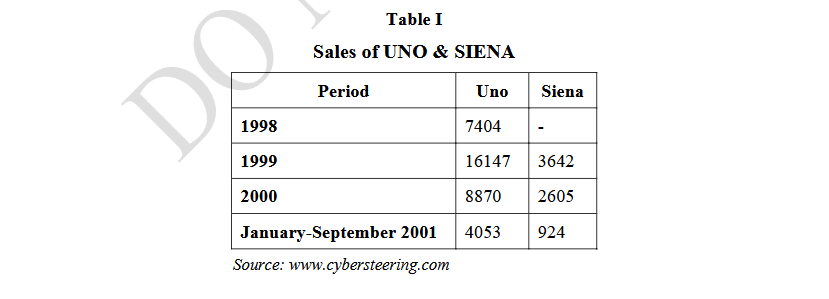
In May 2001, Fiat announced the launch of the Uno Trend, a low-priced variant of the Uno, and the CNG9 versions of the Uno and the Siena. These variants were targeted at the taxi segment and expected to generate additional sales. However, the cars did not find many takers. Between January – August 2001, the company sold 650 Sienas. In September 2001, only 49 Siena Weekenders were sold as compared to the 1,527 Hyundai Accents, 1,150 Ford Ikons and 979 Maruti Esteems. Table I gives the sales figures for the Uno and the Siena from 1998 to 2001.
Commenting on the poor performance of Fiat, former Managing Director, Giovanni B Ravina said, “In India, we were the last to enter the market in 1998, while most of our competitors came in by 1995 or 1996. Our original plan was to build a greenfield plant in Ranjangaon, in which case we would have launched our cars only by end 2000. But we were forced to start early, due to trouble created by PAL on the issue of bookings. The brand, therefore, suffered. We launched the Uno and Siena ahead of schedule. Our plan was not to make volumes.”
At this point, Fiat seemed to have accepted the fact that the Palio would be the 'make or break' car for the company. This was reflected in the fact that in 2001, for the first time since 1998, Fiat's assembly line was working two shifts a day. Even the workers, notorious for their militancy, seemed to be totally focussed on „saving? the company through the Palio.
Fiat also reshuffled its entire senior management in 2000-01. The company also decided to make the customer the focal point of its future strategies. Costs were rationalized wherever possible so that the benefits could be passed on to the customers. As Palio had a localization level of 75%, Fiat was able to significantly reduce the price of spare parts.
On the logistics front, Fiat divided the country into north and south, with Mumbai as the center. While Sundaram Pvt. Ltd. was appointed to handle distribution in the west and south of India, Carriers Pvt. Ltd. was chosen to handle north and east. Fiat also increased number of its dealerships from 55 to 70, and the number of service points to 150. The company also set up a training center at its Ranjangaon facility in 1999. A new manufacturing technology department was created to help vendors focus on quality improvement measures.
Analysts claimed that Fiat's poor marketing efforts contributed greatly to the failure of its brands. Though Fiat's products were considered the best products in their respective categories by motoring experts, they seemed to have failed to hit the right note in the Indian markets. In January 2001, Fiat showed the Palio to the existing B-segment car owners and potential new customers in Delhi and Mumbai. The exercise revealed that the consumers wanted a car that was similar to the Zen, but more stylish, more powerful and more modern. Based on these findings, Fiat decided on the 'Technology to the Maximum' positioning for the Palio.
The successful endorsement of Hyundai's Santro by Hindi film actor Shahrukh Khan prompted Fiat to opt for the celebrity endorsement route. Fiat wanted a strong brand ambassador to remove the negative perceptions consumers had about the company due to its history of poor after-sales service and delays in delivery. Tendulkar was chosen as Palio's brand ambassador. Arvind Sharma, Managing Director of Palio's advertising agency, Leo Burnett, said, “Sachin represents a philosophy. He doesn't do anything half-heartedly, he lives life to the maximum, gives the game the maximum. It ties in with our claim that the Palio offers the maximum in its category.” The company also helped customers meet their car financing needs by setting up a joint venture, Fiat India Sundaram Auto Finance.
Four versions of the Palio were launched in September 2001; the prices ranged from Rs 0.349 million to Rs 0.499 million. Analysts remarked that these models were priced competitively against the Santro and the Zen. The entry-level models of the Palio (EL) and the Santro cost Rs 0.349 million and Rs 0.334 million respectively. Fiat claimed that it offered a net Rs 26,000 worth of content more than the Santro. The market seemed to agree with Fiat as the car was received rather well. In just two days, over 1100 cars were sold.
This prompted Fiat to increase the daily production at its Kurla plant in October 2001. Bianchi said, “While daily production at the Kurla plant has already been increased from 50 to 70 cars a day, we plan to increase it further to 100 cars a day by mid-October and 150 by November-December.” The company was also planning to add a third shift and produce 220 cars a day.
Some analysts remarked that the market's initial excitement over the Palio seemed to be a repetition of the Uno and Siena episodes. They were skeptical about Fiat's ability to achieve the 50,000- sales target set for 2001-02. Competitors even claimed that the Palio was going to be a flop, in line with Fiat's past experiences.
Fiat, however, did not seem to be worried. Company sources claimed that this time around, the large-scale changes introduced at the company would ensure that the previous mistakes were not repeated. Would the Palio be able to turn the initial excitement into volumes and profits?
1. Why do you think all of Fiat?s earlier car models – Uno, Siena and Siena Weekend – failed to click in the Indian market? Do these failures indicate a lack of strategic insight on the 5 part of the company? Give reasons to support your answer.
2. "The association with PAL was responsible to a large extent for Fiat's problems.? Critically comment on the above statement with specific reference to the failure of the Uno.
3. Do you agree that the Palio was Fiat's 'last chance' to succeed in India? Answer the question in the backdrop of the large-scale organizational changes put in place at Fiat.
Keywords
Poor performance, Italian automobile, Fiat, India, Uno, Siena, Palio, September 2001, marketing, product development, strategic alliance, Indian car market, Business Strategy