
The Jet Airways Story
🌐 International Buyers — Pay via PayPal
Details
BSTR022
9
2002
NO
0
Tailwinds Private Limited (Jet Airways)
Transport & Logistics
India
Corporate Strategy,Corporate Strategy, Growth Strategy, Marketing Strategy
Abstract
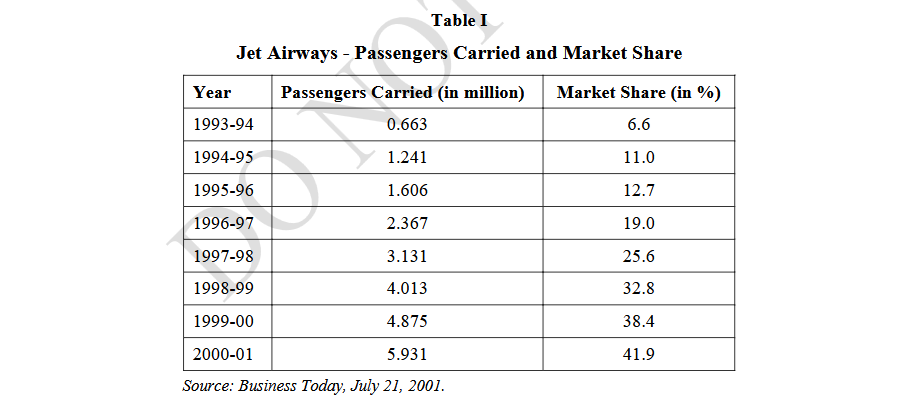
The case gives an overview of Jet Airways' success in the domestic airlines industry. The case talks about the performance of Jet Airways since its formation in 1992. Over the years, Jet Airways improved its market share significantly from 6.6% in 1993-94 to 42% in 2000-01. Right from the start, Jet Airways focused more on customer service than anything else. It was because of its superior customer service that Jet Airways had become the most popular airlines in India. The case makes a point about the strategy adopted by Jet Airways. Jet Airways started its operations in India with leased aircrafts because buying an aircraft would have cost Jet Airways around $ 40-$ 50 whereas a monthly lease was as low as $ 0.4 million. Jet Airways also started its operations with the new Boeing 737-300s and not the older Boeing 737-200s. This was because the new aircrafts were fuel-efficient and cheaper to maintain. Jet Airways also had only one type of aircraft'the 737--in its fleet. This ensured that maintenance and flight crew training was simpler. Because of the above factors, Jet Airways' aircraft utilisation and number of flights per day was more than that of Indian Airlines. Another reason for the success of Jet Airways was its lean structure. Compared to Indian Airlines' 397 employees per aircraft, Jet Airways had only 163 employees per aircraft. The case also highlights the fact that Jet Airways was virtually the only private player in the aviation industry. It did not face any competition from the other private player-Sahara Airlines. With more private players planning to enter the Indian sky, Jet Airways has to gear up for competition ahead. The company was also embroiled in a controversy regarding its ownership, with Naresh Goyal, chairman of Jet Airways claiming that he owns Jet Airways.
Learning Objectives
The case is structured to achieve the following Learning Objectives:
- Private airlines in India, competition between private and government airlines.
Contents
“If we keep our passengers happy, they will keep us in business.”
- Ernest Collette, General Manager, (Service Quality), Jet Airways, 2001.
“There is no doubt that Goyal has played his cards well.”
- Vinod Kashyap, Joint MD, Indian Airlines, 2001.
By 2001, with revenues of $542.18 million, (Refer Exhibit I), Jet Airways (JA) had emerged as the most popular domestic airlines in India. JA started its operations in 1993; the number of its passengers increased from 0.663 million in 1993 to 5.9 million in 2000-01. By 2001, when other private airlines such as Modiluft, East West, NEPC and Damania had stopped their operations, JA not only continued to survive, but had become a formidable competitor to India's national domestic airlines-Indian Airlines (IA). JA seemed to be the lone challenger to IA with Sahara Airlines in the third position. JA's market share increased to 42% in 2001 from 6.6% in early 1990s (Refer Table I).
In 2001, JA ran 215 flights per day compared to IA's 208. Unlike the loss making IA, (Refer Exhibit II), JA is making profits. At the end of the first year, JA achieved average seat factor close to break-even level of 71%. Thereafter it broke even and has been making profits ever since. In 2001, JA recorded profits of Rs 125 million compared to IA which recorded a loss of Rs 1.77 billion.
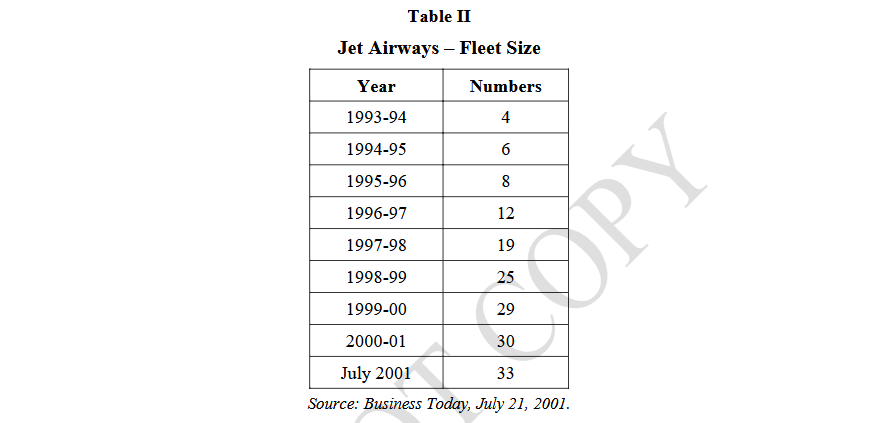
JA became a favorite with travelers because of its friendlier approach and new generation cleaner planes more importantly, seasoned air travelers were confident that if they have crucial appointments to keep in other cities, JA was reliable than IA. JA?s on-time performance and schedules attracted business travelers who accounted for 80% of its customers. JA had a fleet of 33 planes in 2001, (Refer Table II), as against IA that had a 57 planes. But JA's fleet was much younger and the average daily flying time of JA was greater than IA. Greater utilization meant higher revenues and a more efficient utilization of capital assets.
In 2000-01, Indian Airlines, Jet Airways and Sahara Airlines were the major players in the Indian domestic market. Till the early 1990s, IA had a monopoly in the sector. However in 1993 the Government of India (GoI) under its open skies policy allowed private participation and 8 new airlines were allowed to commence operations. Of these, only two survived - Jet Airways and Sahara Airlines (Refer Table III for market share of IA vis-à-vis private players in 2000-01).

IA's network covered Kuwait in the west to Singapore in the east and included 75 destinations - 59 within India and 16 abroad. IA's international network covered Kuwait, Oman, UAE, Qatar and Bahrain in West Asia, Thailand, Singapore, Yangon (Rangoon) and Malaysia in South East Asia and Pakistan, Nepal, Bangladesh, Myanmar, Sri Lanka and Maldives in the South Asian subcontinent. In 2001, IA had a fleet strength of 57 aircrafts, JA had 33 and Sahara 9.
In 2000, GoI announced that private sector participation would be a major thrust area in the airlines industry. Private participation was expected to increase investment, improve quality and efficiency, and increase competition. A competitive regulatory framework with minimal controls was to be created to encourage entry and operation of private airlines. The GoI would gradually reduce its equity in Indian Airlines.
Naresh Goyal (Goyal), chairman of JA was the one-man show behind JA's birth. Goyal started his career as a marketing executive at the general sales agent (GSA) with Lebanese International Airlines in Delhi. He then worked with Iraqi Airways for a couple of years, before joining Royal Jordanian Airlines as regional manager. Goyal's diligence and incredible ability to memorize flight schedules caught the attention of Ali Ghandour, who was then chairman and president of Royal Jordanian Airlines. Ghandour introduced Goyal to the wider world of aviation outside India.
In 1974, Goyal decided to get into the GSA business himself and established Jetair Transportation representing Kuwait Airways and Air France. Simultaneously Goyal was appointed regional manager of Philippine Airlines. Over the next few years, Goyal expanded his network picking up agencies for some more airlines. He was a regular member at the annual general meetings of International Air Transport Association (IATA), the global aviation body.
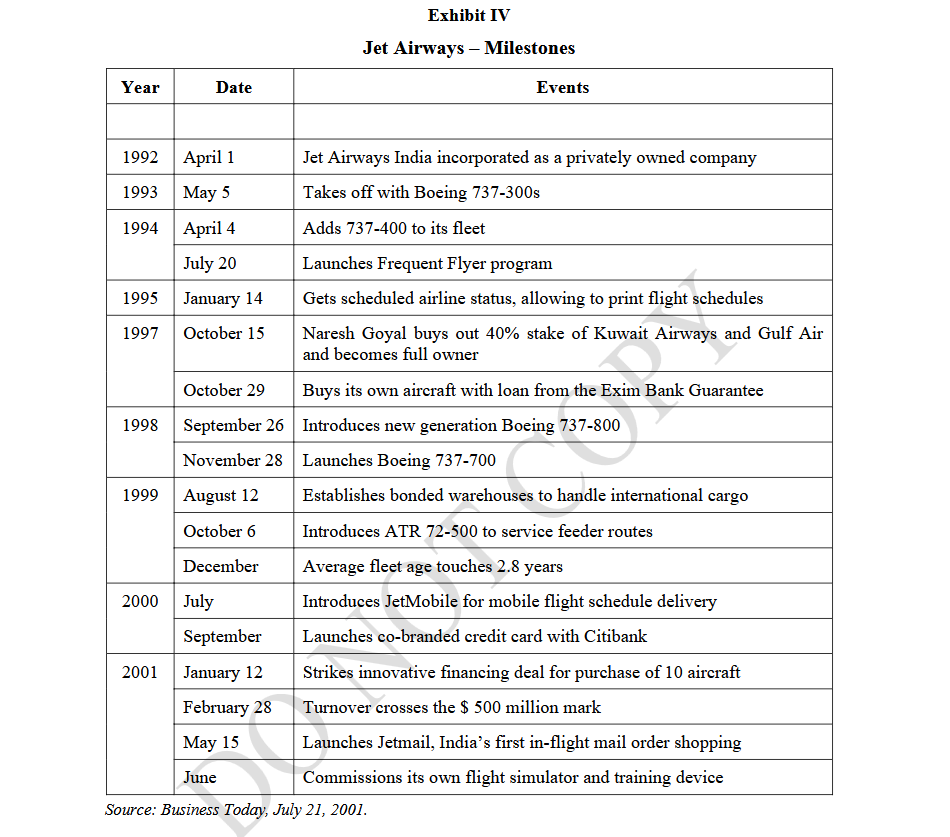
Meanwhile, Goyal turned a Non Resident Indian (NRI) and shifted his base to London. During the same time, Goyal also toyed with the idea of setting up his own airlines. The opportunity came in the early 1990s, with the GoI?s open skies policy permitting private investment (including NRIs) in domestic aviation. In April 1992, JA India was set up as a 100% subsidiary of TailWinds Ltd., a company registered in Cayman Islands (situated in the Northwest Caribbean Sea). Kuwait Airways and Gulf Air had 40% stake in Tailwinds Ltd.2 Soon after being incorporated as a privately owned airlines, JA hired Lintas the ad agency to develop JA?s corporate logo, IMRB the market research firm to do a consumer survey and Andersen Consulting to do a feasibility study and help prepare the business plan. By 1992, Goyal put his start-up team in place. Saroj Datta (Datta) and B. P. Baliga (Baliga), both directors at Air India, Rolland Thomas from Malaysia Airlines and Steven Jagannathan from Singapore Airlines joined the broad. In May 1993, JA started its operations in India with four Boeing 737-300s and made Mumbai the base for operations. After that there was no looking back. (Refer Exhibit IV for milestones).
JA started its operations with leased aircrafts. The idea was to expand faster by using funds to lease more aircrafts than buying one or two. A Boeing 737 could cost anywhere between $40 and $50 million, whereas a monthly lease could be as low as $.4 million. The most crucial decision was the choice of aircraft. While Damania, East West and ModiLuft who also started their operations at the same time opted for the older Boeing 737-200s, JA chose newer 737-300s, whose lease costs were at least 40% higher. Four planes(about three years old) were leased from Ansett Airlines. Although the 737-300s were more expensive to lease they were more fuel efficient (consumed 8% less fuel) and were cheaper to maintain. Goyal felt that the young fleet would help attract customers.
Analysts felt that by having one type of aircraft-the 737-in its fleet, JA made the maintenance and flight crew training far simpler. Spares were common and inventories were lower as well. For engineers, dealing with one type of aircraft. Baliga claimed that JA's technical dispatch reliability was 99.6 per cent, which meant that a JA flight was rarely held up on account of technical snags. JA also had another advantage in the form of a ready-made distribution network in sister company Jetair's 85 offices countrywide through which it had access to a larger market beyond the metros. Unlike other start-ups that started with manual reservations, JA went in for computerized reservations from day one. This airlines reservation system, though expensive, delivered superior service.
JA's number of employees per aircraft was 163 and a total employee strength of 4,000 as against IA's 397. The focus was on productivity and cost control. JA was not a lavish paymaster and increments were modest. Salaries were not as high as foreign airlines offered. JA also invested heavily to train its pilots. An aviation academy housing the state-of-art Boeing 737 700/800 flight simulator and a flight training device for 737-400s was set up at the cost of $ 10 million.
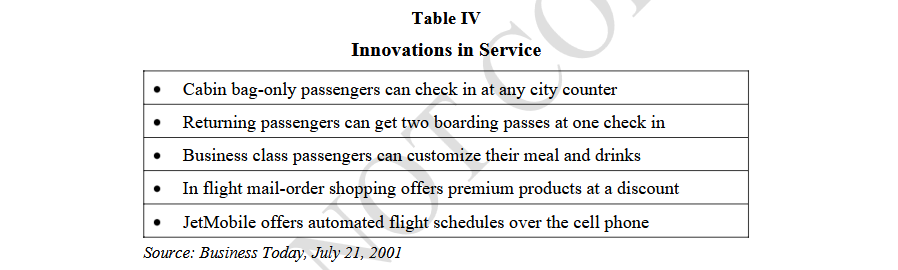
JA's success was mainly due to its service excellence (Refer Table IV for innovations in service). JA always ensured that its service surpassed customer expectations. Goyal ensured that the flight attendants and front line staff were fresh recruits trained in the 'Jet way' and not people from other airlines who would bring with them the old culture. According to frequent travelers, the hallmark of JA's service was its cheerful attitude. If a flight was delayed, travelers were phoned and informed in advance. According to an analyst, JA managed to achieve service excellence, because of being strictly disciplined from the start. Lapses were not tolerated and the focus was on performance.
JA always focused on the business traveler. To attract and retain business travelers, it offered superior services. JA picked up IA's service module as a framework and borrowed a few ideas from KLM Royal Dutch Airlines for managing systems. JA always believed in keeping close watch on its customer service. On all its flights more than 20 minutes long, light refreshments were served and on longer flights passengers were served non-alcoholic drinks, cold towels and a three course meal. JA received 16,500 service monitor questionnaires (SMQs) every month and they were analyzed at various levels to plug loopholes in service. Every new flight attendant was put through at least three months of training in the first year and thereafter several more hours of in-flight and classroom training.
In December 1999, JA relaunched its frequent flier program under the 'Jet Privilege'(JP) name (the frequent flier program was initially launched in 1994). JP customers were not required to pay membership fees. They also did not have to produce boarding cards or other proof of travel. A passenger could earn free JP miles (points) by taking a JA flight. The new program offered three different levels of privileges: JP Blue, JP Silver and JP Gold, depending on the number of miles accrued or the number of flights flown. JP Silver and Gold members could earn bonus miles on all JA flights and enjoyed lounge access, tele check-in benefits. JA tied up with international carriers like KLM Royal Dutch Airlines and Northwest Airlines as a result of which JP members could earn miles on these airline networks too. They could redeem their miles when they had earned at least 10,000 miles or had flown 10 flights. JA also tied up with Oberoi Hotels and Resorts, Radisson Worldwide. Members of JP could earn miles on each stay at any of these hotels.
In 2001, JA launched an inflight mail order catalogue, JetMall for high quality products. The inflight shopping program enabled passengers to browse through a specially-designed mail order catalogue which helped them select products and get them products delivered at home within two to four weeks anywhere in India. JA claimed that the mail order catalogue was at par with the in-flight shopping catalogues on international flights.
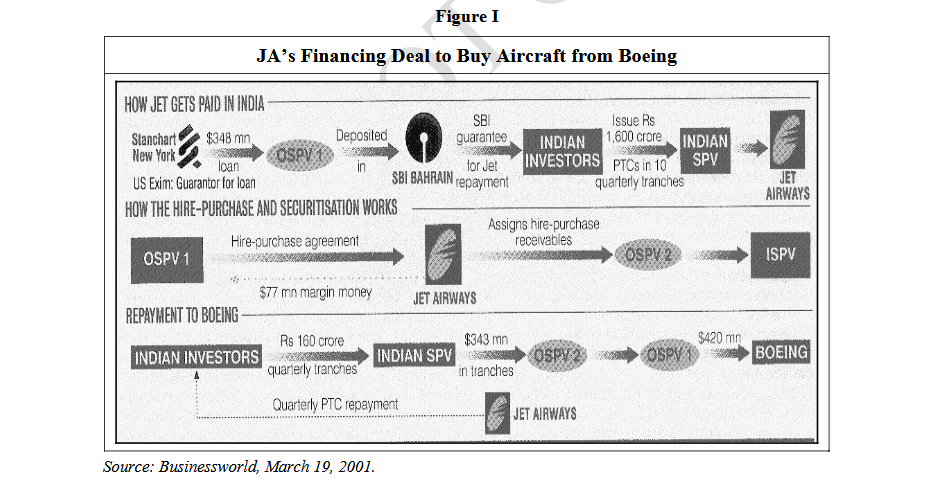
In early 2001, JA finalized a Rs 16 billion loan for the purchase of 10 Boeing 737s to be delivered over the next two years. This was the first deal in India that involved the US Exim Bank and an Indian bank along with two offshore special purpose vehicles (SPVs). According to analysts, the beauty of the deal was that JA would finally end up borrowing from Indian investors and not from a foreign bank. Standard Chartered Bank would lend $ 348 million, guaranteed by the US Exim Bank to an offshore special purpose vehicle (OSPV1). These funds would be placed as a deposit in the Bahrain branch of the State Bank of India (SBI), against which SBI would issue a letter of credit to Indian investors guaranteeing JA's repayment. On the basis of this guarantee, Indian investors would issue Pass Through Certificates (PTCs) worth Rs 16 billion to an Indian SPV (ISPV). Therefore JA would draw funds from Indian investors in ten tranches for each aircraft and the repayment obligations to these investors would also be in India. However, Boeing needs to be paid in dollars. So, OSPV1 would enter into a hire-purchase agreement with JA to securitise its hire-purchase receivables and transfer them to another vehicle, OSPV2 and finally to the ISPV.
For the payment trial back to Boeing, JA would pay a $ 77 million initial hire amount to OSPV1 (it would finally repay the Indian investors in rupees). In addition to this, the ISPV would pay $ 343 million to OSPV2 in separate tranches. OSPV2 would pass this to OSPV1which already had the initial $ 77 million with it and the entire $ 420 million would pass to Boeing. At the end of the deal, Standard Chartered would get its deposit back from SBI (Refer Figure I).
Analysts felt that part of JA's success was ensured by IA. Being government owned, IA was not allowed to expand its fleet and had to get the approval from the ministry of aviation for everything and that made it a poor competitor. In 2001, IA served 70 stations with a fleet of 57 while JA plied its 33 aircrafts to 30 key stations. JA operated more flights than IA from lucrative station like Bangalore. However, flexi-pricing was JA's biggest threat. Analysts felt that with flexi-pricing, IA could take customers away from JA. An afternoon IA flight was cheaper by 15% than the morning flight on the same route. To prevent IA from grabbing its passengers, JA had to reduce its fares on key routes by 10 to 15%.
The purchase of 10 Boeing 737s would help JA to operate flights to neighboring countries. It had already applied for permission to fly countries such as Malaysia, Singapore and UAE. However, analysts felt that JA would face a new kind of competition in the international arena. Apart from Air India and IA, which deployed 22% of their capacity on international routes to get 30% of the revenue, JA would face competition from international players such as United Airlines, Singapore Airlines, Lufthansa, British Airways and Cathay Pacific. Also, JA's overwhelming dependence on passenger business could prove fatal.
JA's immediate goal was to consolidate its market share by improving its service levels further and adding more routes to its network. By early 2002, JA planned to include three more Boeing 737 in its fleet. Steve Forte, CEO, Jet Airways said, “We feel that a satisfied customer is the best defence against the threat of new entrants.”
In 2001, JA was embroiled in controversy regarding its ownership. The GoI announced in the Parliament that despite its best efforts, it could not trace the owner of JA. Responding to this, a company press release said that JA has always been an Indian company incorporated under Indian Law. It is owned by TailWinds Ltd., an approved NRI/OCB, whose shares are 100% owned by Mr. Naresh Goyal, an NRI with an Indian passport. This information was disclosed to all regulatory authorities from time to time, the press release said.
Analysts felt that JA was virtually the only private player in the domestic airlines industry and this could lull JA slide into complacency. According to Saroj Datta, Executive Director, JA, the company could be suffering from the perils of inordinately fast growth. Analysts felt that JA have to offer more value-added services, which could prove difficult given the infrastructural constraints that confronted private operators. In 2000-01, JA rode high in the absence of serious competition. Once competition stiffers Jet would have to upgrade its services.
1. In 1993-94, Jet Airways had a market share of 6.6 percent. By 2000-01, it had gone up to 42 percent. Analysts feel that Jet Airways was successful because of its superior customer service. However, there are some areas where Jet Airways is weak compared to Indian Airlines. Attempt a SWOT analysis of Jet Airways and comment on the same.
2. The attractiveness of an industry depends on several factors. Attempt Porter's five forces model to analyze the domestic aviation industry in India.
Exhibit I and Exhibit II
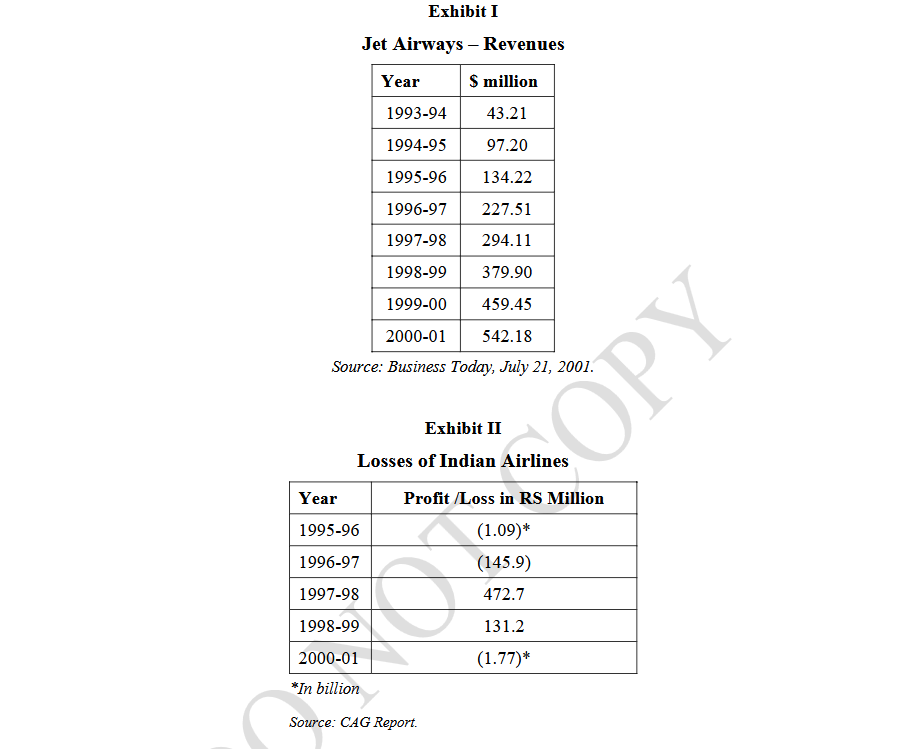
Exhibit III
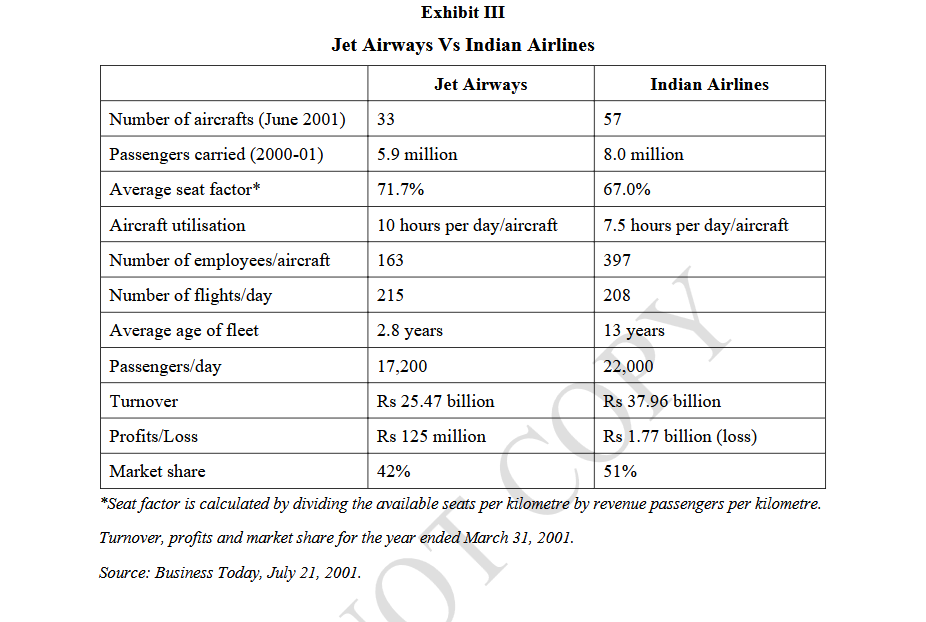
Exhibit IV
Keywords
Jet Airways, domestic airlines industry, 1992, market share, 6.6% ,1993-94 ,42% , 2000-01, customer service, airlines, India, leased aircrafts, buying, aircraft, $ 40-$ 50, million, Boeing 737-300s, Boeing 737-200s, cheaper, 737, fleet, Indian Airlines, lean structure, 397, 163 employees per aircraft, Sahara Airlines, Indian sky, Naresh Goyal, chairman
Related Case Studies
| Case Title | Details | Price | Add to Cart |
|---|---|---|---|
|
Case Title Flyadeal: Saudi Arabian Airline’s Growth ChallengesCase Code: BSTR720 |
Details | 300 | Add to Cart |
|
Case Title Calbee’s Monochrome Packaging: Crisis Management Response or Marketing Strategy?Case Code: MKTG497 |
Details | 500 | Add to Cart |
|
Case Title Reliance Jio’s Next Act: Monetizing a Mass Brand without Breaking TrustCase Code: MKTG494 |
Details | 500 | Add to Cart |
|
Case Title The Nirma StoryCase Code: MKTG008 |
Details | 300 | Add to Cart |
|
Case Title IKEA’s ‘Punch’ Moment: Using Reactive Marketing to Build Brand ConnectionCase Code: MKTG493 |
Details | 300 | Add to Cart |