
Corporate Governance at Infosys
🌐 International Buyers — Pay via PayPal
Details
CGOV001
13
2001
YES
0
Infosys Limited
Technology & Communications
India
Corporate Governance
Abstract
The case, ‘Corporate Governance at Infosys’talks about the corporate governance practices at Infosys, one of India’s largest software companies. Till late 1990s, corporate governance did not have much significance in India. In 1999, two committees (Confederation of Indian Industries, CII and the Kumar Mangalam Birla Committee) were set up to recommend good governance norms. These committees came out with several recommendations, which were made mandatory for the companies to adhere to by 2001. Infosys was one of the first companies in India which had complied with the recommendations made by the committees. The case discusses in detail, the corporate governance practices at Infosys, which complied with most of the recommendations made by the committees. The case is intended for MBA/PGDBM level students as a part of the Business Ethics and Corporate Governance Curriculum. From the case, students are expected to understand the corporate governance practices at Infosys. From the case, students can understand how Infosys became the best managed company in India because of its good governance practices. The case would also enable the students understand the importance of corporate governance in business. The objective of the case is to make the students understand that good governance would make a company more professional.
Learning Objectives
The case is structured to achieve the following Learning Objectives:
- Corporate governance in an IT company.
Contents
“The fundamental objective of corporate governance is the enhancement of long-term shareholder value while, at the same time, protecting the interests of other stakeholders.”
-Kumar Mangalam Committee report on corporate governance, 1999.
“We’ve always striven hard for respectability, transparency and to create an ethical organisation. There are certain expectations that we haven’t fulfilled. But we’re also a very young organisation and in areas like track record of management, we may be low because we’re yet to show longevity.”
-Narayana NR Murthy, Chairman and CEO, Infosys Technologies Limited (Infosys), 2001.
By the late 1990s, Infosys Technologies Limited (Infosys)1 had clearly emerged one of the best managed companies in India. Its corporate governance practices seemed to be better than those of many other companies in India. Because of its good governance practices, Infosys was the recipient of many awards. In 2001, Infosys was rated India’s most respected company by Business World. Infosys was also ranked second in corporate governance among 495 emerging companies in a survey conducted by Credit Lyonnais Securities Asia (CLSA) Emerging Markets. It was voted India’s best managed company five years in a row (1996-2000) by the Asiamoney poll. In 2000, Infosys had been awarded the "National Award for Excellence in Corporate Governance” by the Government of India. In 1999, Infosys had been selected as one of Asia’s leading companies in the Far Eastern Economic Review’s REVIEW 2000 Survey and voted India’s most admired company by The Economic Times.
Infosys had benchmarked its corporate governance practices against those of the best managed companies in the world (Refer Exhibit I for broad structures and processes for good governance). It was one of the first companies in India to publish a compliance report on corporate governance, based on the recommendations of a committee constituted by the Confederation of Indian Industries (CII). Infosys had also provided all the information required by the Cadbury committee on corporate governance even though this was not a legal obligation. The Cadbury Committee had made nineteen recommendations, and by 2001, Infosys had complied with all of them. Infosys maintained a high degree of transparency while disclosing information to stakeholders. It had been providing consolidated financial statements under US GAAP to its global investors and financial statements under Indian GAAP to Indian shareholders. Infosys provided details on high and low monthly averages of share prices in all the stock exchanges on which the company’s shares were listed. It was one of the few companies in India to provide segmentwise breakup of revenues.
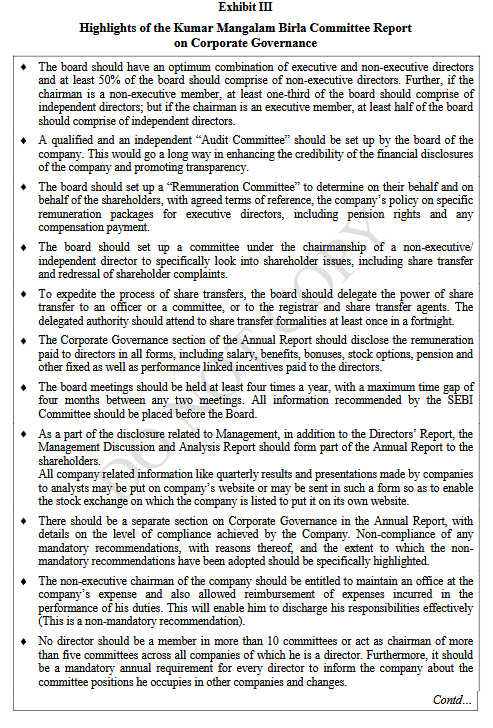
In the late 1990s, the Confederation of Indian Industries (CII) published a code of corporate governance (Refer Exhibit II for the highlights of the report). In 1999, the Securities and Exchange Board of India (SEBI) appointed a committee under the Chairmanship of Kumar Mangalam Birla4 to recommend a code of corporate governance. The report was submitted by the committee in November 1999 and accepted by SEBI in December 1999 (Refer Exhibit III for the highlights of the report).
Infosys had accepted the recommendation of both the CII and the Kumar Mangalam Birla Committee. This section provides an overview of corporate governance practices followed by Infosys. Infosys had an executive chairman and chief executive officer (CEO) and a managing director, president and chief operating officer (COO). The CEO was responsible for corporate strategy, brand equity, planning, external contacts, acquisitions, and board matters. The COO was responsible for all day-to-day operational issues and achievement of the annual targets in client satisfaction, sales, profits, quality, productivity, employee empowerment and employee retention. The CEO, COO, executive directors and the senior management made periodic presentations to the board on their targets, responsibilities and performance.
In 2001, the board had sixteen directors. There were eight executive directors and eight non-executive directors (Refer Table I). Infosys believed that the one thing that could help them to improve corporate governance was to bring international professionals on corporate boards (See Table I). The board members were expected to possess the expertise, skills and experience required to manage and guide a high growth, hi-tech software company. Expertise in strategy, technology, finance, and human resources was essential. Generally, they were between 40 and 55 years of age and were not related to the other board members. They did not serve in any executive or non-executive position in any company in direct competition with Infosys. The board members were expected to rigorously prepare for, attend, and participate in all board and relevant committee meetings. Each board member was expected to ensure that other existing and planned future commitments did not interfere with the member’s responsibility as a director of Infosys.
Normally, the board meetings were scheduled at least a month in advance. Most of the meetings were held at the company’s registered office at Electronics City, Bangalore, India. The chairman of the board and the company secretary drafted the agenda for each board meeting and distributed it in advance to the board members. Board members were free to suggest the inclusion of any item on the agenda. Normally, the board met once a quarter to review the quarterly results and other issues. The board also met on the occasion of the annual shareholders’ meeting. If the need arose, additional meetings were held. The non-executive directors had to attend at least four board meetings in a year. The board had access to any information that it wanted about the company.
In 2001, the board had three committees - the nominations committee, the compensation committee and the audit committee. To ensure independence of the board, the members of the nominations committee, the compensation committee and the audit committee were all non-executive directors.
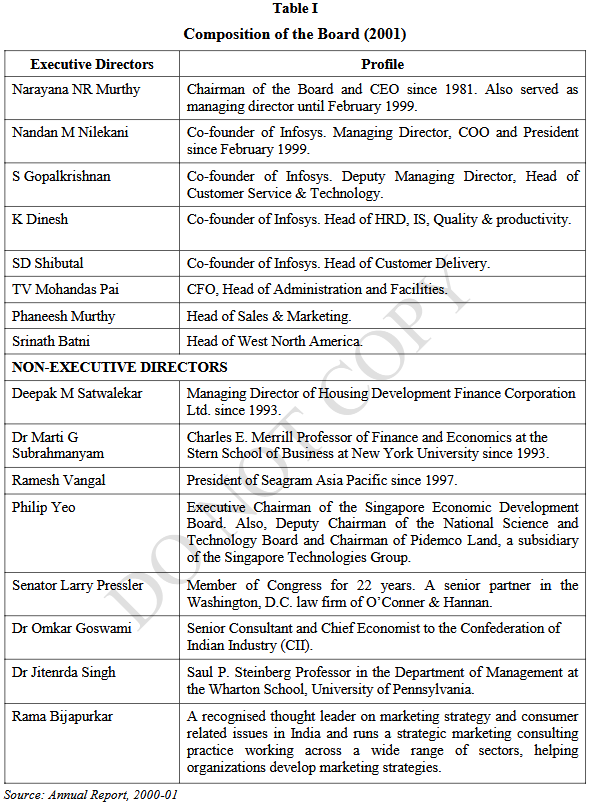
The nominations committee had four non-executive directors who looked after the issue of retirement of existing members and their re-appointment, on the basis of their performance. The nominations committee constantly evaluated the contribution of the members of the board and recommended to shareholders their re-appointment. The executive directors were appointed by the shareholders for a maximum period of five years, but were eligible for re-appointment upon completion of their term. The nominations committee adopted a retirement policy for the members of the board under which the maximum age of retirement of executive directors, including the CEO, was 60 years, which was the age of superannuation for the employees of the company. Their continuation as members of the board upon superannuation / retirement was determined by the nominations committee.
The compensation committee, which had three non-executive directors, looked after issues relating to compensation and benefits for board members. It determined and recommended to the board, the compensation payable to the members of the board. The compensation of the executive directors consisted of a fixed component that was paid monthly, and a variable component, which was paid quarterly, based on performance. The annual compensation of the executive directors was approved by the compensation committee within the parameters set by the shareholders at the shareholders meetings. The shareholders determined the compensation of the executive directors for the entire period of their term.
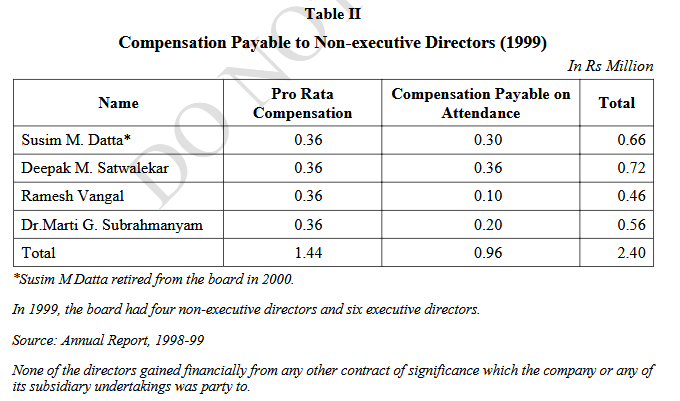
The compensation of the non-executive directors was approved at a meeting of the full board. The components were a fixed amount, and a variable amount based on their attendance of the board and committee meetings. The total compensation payable to all the non-executive directors together was limited to a fixed sum per year determined by the board. This sum was within the limit of 0.5% of the net profits of the company for the year calculated, as per the provisions of the Companies Act and as approved by the shareholders. The compensation payable to the non-executive directors (and the method of calculation) was disclosed in the financial statements. Since 1999, the non-executive directors were eligible for stock options. Of the compensation payable for the year 1999, 60% was paid for being on the board and the balance 40% was paid in proportion to the board/committee meetings attended (Refer Table II for compensation payable to non-executive directors in 1999).
The audit committee was responsible for effective supervision of the financial reporting process, ensuring financial and accounting controls and compliance with the financial policies of the company. The committee periodically interacted with the statutory auditors and the internal auditors to ascertain the quality of the company’s transactions; to review the manner in which they were performing their responsibilities; and to discuss auditing, internal control and financial reporting issues. The committee provided overall direction on the risk management policies and also indicated the areas that internal and management audits should focus on. The committee had full access to financial data. The committee reviewed the annual and half yearly financial statements before they were submitted to the board. The committee also monitored proposed changes in the accounting policy, reviewed the internal audit functions and discussed the accounting implications of major transactions.
As per the recommendations of the Kumar Mangalam Committee, Infosys included a separate section on corporate governance in its annual report, which disclosed the remuneration paid to directors in all forms, including salary, benefits, bonuses, stock options. The annual report also carried a compliance certificate from the auditors.
Infosys also laid emphasis on succession planning and management development. The chairman reviewed succession planning and management development with the board from time to time. The chairman and CEO also managed all interaction with the investors, media, and the government. Where necessary, he took advice and help from the managing director, president, and COO as well as the CFO. The managing director and COO managed all interactions with the clients, taking the advice and the help of the CEO. Both the CEO and the COO handled employee communication.
Some analysts felt that Infosys’ corporate governance practices offered many lessons to corporate India. Infosys had shown that increasing shareholder wealth and safeguarding the interests of other stakeholders was not incompatible. Infosys had given its non-executive directors the mandate to pass judgement on the efficacy of its business plans. Every non-executive director not only played an active role in decision making, but also led or served on at least one of the three (Nomination, Compensation and Audit) committees. Infosys’ founders had set very high standards, in a country where malpractices by founders were rampant. The founders only took salaries and dividends and derived no other financial benefits from the company.
Commenting on the strengths and weaknesses of Infosys’ corporate governance, Nandan M Nilekani, Managing Director, Chief Operating Officer and President of Infosys, said, “The strengths are that we have been very successful in creating a value based system with a very strong focus on ethics, and strong division between personal and professional funds etc. That has translated into brand equity, shareholder value etc. Obviously, we can do things better. We believe that we can never stand still. We will keep looking at global best practices, what the world is saying on this front. We keep trying to improve the way we manage to be on par with it.” It remained to be seen whether other Indian companies could emulate Infosys form of corporate governance.
1. Infosys deserves the credit for setting the role model for rest of corporate India as far as corporate governance is concerned. It has not only taken to governance but also benchmarked it with the global practices. Explain the salient features of Infosys corporate governance practices and comment on the same.
2. The Securities and Exchange Board of India (SEBI) has decided to incorporate the corporate governance norms as part of the requirements for listing. Do you think implementation of corporate governance norms will make corporate India more professional in its approach to doing business?
Exhibit I
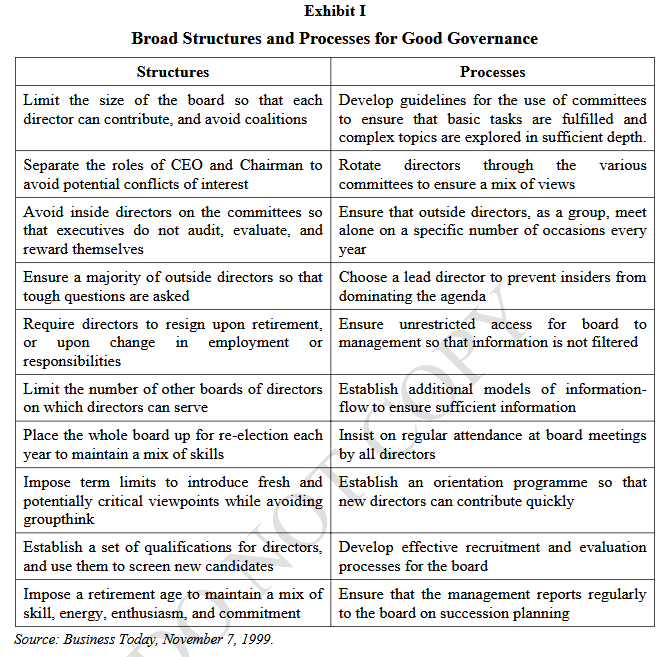
Exhibit II:
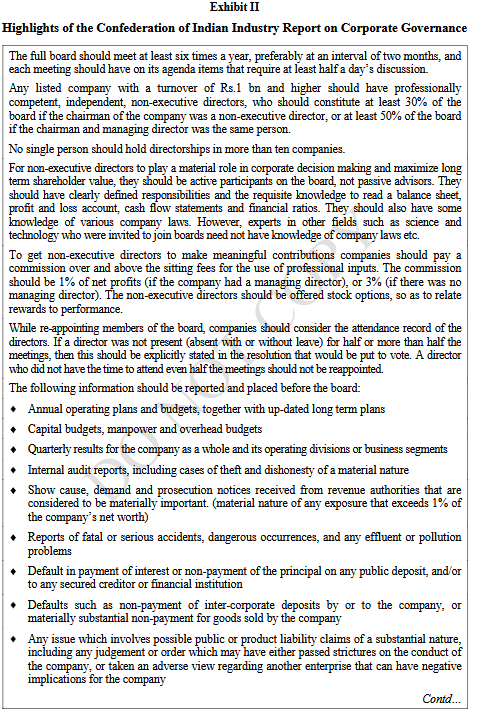
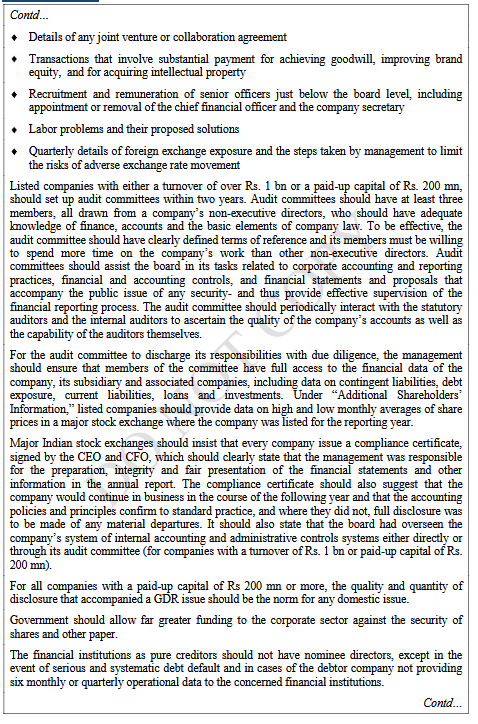
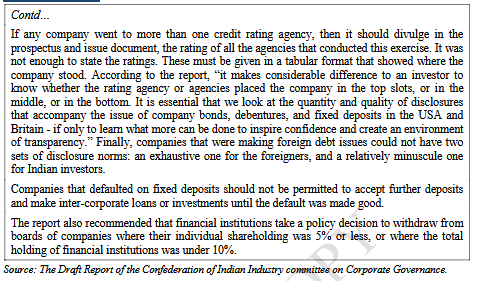

Exhibit III
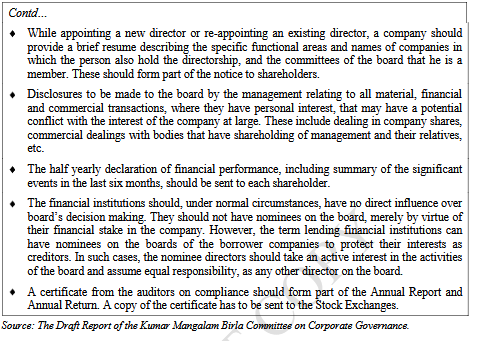

Keywords
Corporate Governance, Infosys, practices, largest software companies, 1990s, significance, India,1999, Confederation of Indian Industries, CII, Kumar Mangalam Birla Committee, good governance norms, several recommendations, mandatory, 2001
Related Case Studies
| Case Title | Details | Price | Add to Cart |
|---|---|---|---|
|
Case Title The Tech Phoenix: Satyam’s 100-Day TurnaroundCase Code: BSTR703 |
Details | 600 | Add to Cart |
|
Case Title Vizag Gas Leak Tragedy: Is LG Polymers to be blamed for Negligence?Case Code: BECG182 |
Details | 400 | Add to Cart |
|
Case Title Leadership Communication and Employee LayoffsCase Code: HROB231 |
Details | 400 | Add to Cart |
|
Case Title Company Valuation vs. Leadership Values: The Better.com ExperienceCase Code: LDEN191 |
Details | 400 | Add to Cart |
|
Case Title Governance Issues at BharatPeCase Code: BECG180 |
Details | 300 | Add to Cart |