
Fairness Wars
🌐 International Buyers — Pay via PayPal
Details
MKTG009
6
2001
YES
0
Hindustan Unilever Ltd.
Home Appliances & Consumer Products
India
Advertising & Promotion,Market Segmentation, Product Launch
Abstract
The case ‘Fairness Wars’ focuses on the fierce competition among the major players in the fairness segment of the personal care market. The case explores the rivalry of the three major players, HLL (Fair & Lovely), CavinKare Ltd. (Fairever), and Godrej (FairGlow). The case also highlights the fact that the fairness formula was no longer restricted to creams, but had extended to soaps and talcum powders also.
Learning Objectives
The case is structured to achieve the following Learning Objectives:
- Fairness products market in India.
Contents
“The saffron and milk combination in Fairever clicked with the people because they were familiar with the goodness of the products. And we changed the rules by introducing saffron which had never been used in fairness creams in the past.”
- C.K. Ranganathan, CEO & MD, CavinKare Ltd.
“Fair & Lovely continues to grow in a healthy manner. Only two out of ten Indians use face creams. That means strong growth prospects for all brands.”
- A HLL Spokesperson.
In June 1999, the FMCG major Hindustan Lever Ltd. (HLL)1 announced that it would offer 50% extra volume on its Fair & Lovely (F&L) fairness cream at the same price to the consumers. This ve was seen by industry analysts as a combative initiative to prevent CavinKare's Fairever from gaining popularity in retail markets. HLL's scheme led to increased sales of F&L and encouraged consumers to stay with F&L and not shift to the rival brand.
In December 1999, Godrej Soaps4 created a new product category – fairness soaps – by launching its FairGlow Fairness Soap. The product was successful and reported sales of more than Rs. 700 million in the first year of its launch. Godrej extended the brand to fairness cream by launching FairGlow Fairness Cream in July 2000.
By 2001, CavinKare's Fairever fairness cream, with the USP of 'a fairness cream with saffron' acquired a 15% share, and F&L's share fell from 93% (in 1998) to 76%. Within a year of its launch, Godrej's FairGlow cream became the third largest fairness cream brand, with a 4% share in the Rs. 6 billion fairness cream market in India. The other players, including J.L. Morrison's Nivea Visage fairness cream and Emami Group's Emami Naturally Fair cream, had the remaining 5% share. Clearly, the fairness cream and soaps market was witnessing a fierce battle among the three major players – HLL, CavinKare, and Godrej – each trying to woo the consumer with their attractive schemes.
In 1975, HLL launched its first fairness cream under the F&L brand. With the launch of F&L, the market, which was dominated by Ponds (Vanishing Cream and Cold Cream) and Lakme (Sunscreen Lotion), lost their dominant position. The dominance of HLL's F&L continued till 1998, when CavinKare launched its Fairever cream in direct competition with F&L. Within six months of its launch, Fairever captured more than 6% of market share. The success of Fairever attracted other players. Every product in this segment was witnessing growth higher than the overall personal care product category growth. The fairness cream market was growing at 25% p.a., as compared to the overall cosmetic products market?s growth of 15% p.a. In 2000, there were 7 main brands in the fairness product market across the country.
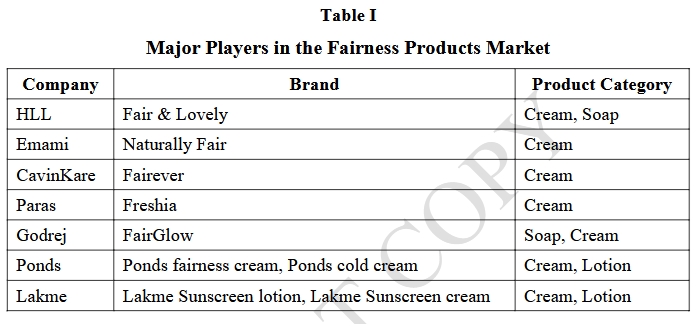
In 1998, CavinKare launched Fairever fairness cream. The company took care to stick to the herbal platform that its consumers had come to associate with all CavinKare products. Fairever seemed to be an instant success. Fairever's market share jumped from 1.23% in 1998 to 8.13% in 1999. The brand was expected to grow from Rs 160 million 1999 to Rs 560 million in 2000. Its success attracted many players, including Godrej (FairGlow) and Paras Chemicals (Freshia). Existing products like Emami Naturally Fair and F&L were promoted with renewed vigor.
In December 1999, Godrej launched FairGlow fairness soap and created a new product category. The soap claimed to remove blemishes to give the user a smooth and glowing complexion. FairGlow was positioned as a twin advantage soap – a clean fresh bath and the added benefit of fairness. In early 2000, Godrej Soaps launched Nikhar, which was based on the ancient Indian formula of milk, besan and turmeric. Though Nikhar and FairGlow were positioned differently – Nikhar targeted fairness and FairGlow claimed to protect skin naturally – the objective of both was the same, get more of a stagnating market.
In April 2000, HLL introduced Lux Skincare soap, positioned on the sunscreen platform. Priced at Rs.14 for a 75gm cake, it was able to garner only a 0.5% share by 2000 end. In comparison, the mother brand Lux had a share of 14%. Retailers claimed that sales for the Lux variant were poor as it promised only protection from ultraviolet rays. While this soap prevented one from growing darker, it did not promise to enhance the complexion.
By 2000 end, F&L cream seemed to be losing ground not only to other creams but also to FairGlow soap. The switch from cream to soap was largely because soaps were perceived to be less harmful to the skin than cream. HLL did not have a product in its soap portfolio for this segment, and this was where Godrej seemed to have gained. However, in 2001, HLL followed Godrej's footsteps and launched Fair & Lovely Fairness Soap. This intensified the competition. F&L's extension into soaps was in tune with HLL's strategy to develop and grow the premium segment of the market. Since the growth in the toilet soap market had slowed down, the industry felt that premium soaps would re-energise the market. Sangeeta Pendurkar, Marketing Manager, HLL, said, “ We are targeting the 50,000 tonne premium soaps market with F&L. We believe F&L soap will synergise with F&L cream as research reveals that the usage of both will deliver better fairness.” Analysts felt that though FairGlow had the first mover advantage, F&L soap's growth potential could not be underestimated given the strong equity of the mother brand.
In 1999, HLL and CavinKare hiked the price of F&L and Fairever by Re. 1 from Rs.25 and Rs.26 respectively. In 2000, Fairever was back to its original price to maintain price parity. Many stockists said that this was done to push the product against F&L. A stockist commented, “The company was trying out this price to compete with F&L and other new brands that have come in. But we did not see higher sales due to this and the company reverted to its original price.” F&L too followed suit. During 2000-01, while the fairness cream market was growing at an average of 15% Fairever's growth had slowed down. Analysts felt that this was mainly because Fairever was priced higher than competing products.
Meanwhile, in January 2000, HLL filed a patent infringement suit for Rs.100 million in the Kolkata High Court against CavinKare Ltd. HLL alleged that CavinKare was using its patented F&L formula without its knowledge or permission. HLL obtained an ex-parte stay on CavinKare, but CavinKare got the stay vacated in a week?s time. It also filed a patent revocation application in the Chennai High Court and defended the suit on the grounds that HLL?s patent was not valid. CavinKare further claimed that the ingredients contained in the composition were 'prior art' and that the new patent was not an improvement of the earlier patent, which had expired in 1988.
In September 2000, the companies suddenly opted for an out-of-court settlement. CavinKare gave an undertaking to the court that the company would not manufacture and/or market either by themselves or by their agents any fairness cream by using silicone compound in combination with other ingredients covered in patent no. 169917 of the plaintiff (HLL), namely Niacinamide, Parsol MCX, Parsol 1789, with effect from September 15, 2000.” HLL also gave an undertaking that it would not interfere with the sale of the cream manufactured on or before September 15, 2000, lying with the wholesalers, re-distribution stockists, and retailers.
During 2000-01, with major players entering the market, the existing products were promoted with renewed vigor through price reductions, extra volumes, etc. Many products were marketed aggressively. While F&L advertisements projected fairness comparable to the moon's silvery glow, FairGlow offered the added benefit of a blemish-free complexion.
But Fairever, which sold at a higher price, did not initiate any promotional activities. B. Nandakumar, President (Marketing) CavinKare, explained, “We will not tailor our product to the competition. We?ll do so for the consumer. Freebies are not the only way to garner sales.” However, analysts believed that CavinKare did not undertake any promotional activities due to lack of financial muscle.
On February 14, 2000, as a part of its promotional activities, Godrej Soaps announced the 'Godrej FairGlow Friendship Funda' in various colleges in Maharashtra. In August 2000, it launched the 'FairGlow Express,' the first branded local train in India, in Mumbai, in partnership with Western Railways. In December 2000, Godrej took its FairGlow brand to the web by launching www.fairglow.com. Later, it launched a unique online promotional scheme – 'the FairGlow Face of the Fortnight.' Every fortnight, one winner was selected and showcased on the website. The winner also won prizes like perfume hampers, gold and pearl jewellery, holiday for two etc. In early 2001, Godrej Soaps also launched its FairGlow cream in an affordable sachet (pouch pack). The 9gm sachet was priced at Rs. 5, and claimed to give around 15-20 applications per pack. It was initially launched in South India, and was expected to enter other markets very soon.
In early 2001, three major players – HLL, CavinKare and Godrej – competed fiercely to penetrate the market further with their attractive schemes. A growing number of pharma and OTC drug companies like Emami, Ayurvedic Concepts, Paras etc. also entered this segment. Companies were also facing competition from Amway, Avon, Modicare etc., which were into direct selling. The market was seeing a major convergence of product categories with the emergence of more and more variants to fill every conceivable niche.
This heightened competition forced companies to increase their advertisement spends. HLL re-launched F&L and quadrupled its advertising expenditure. CavinKare more than doubled its ad spends from Rs.215 million in 1999 to Rs.500 million in 2001. Godrej and Emami too planned to raise their ad spends. But even as ad spends increased, fakes entered the market. Fair & Lovely's fakes were rampant with names like Pure & Lovely and Fare & Lovely. Fairever's copies were Four Ever, For Ever or Fare Ever.
In early 2001, HLL launched Nutririch Fair & Lovely Fairness Reviving Lotion to protect its brand from any threat in the premium segment. The new product was claimed to be scientifically formulated to protect the skin from harmful ultraviolet rays and enhance natural fairness. The new formula, containing Triple UV Guard Sun protection system and the fairness ingredients Vitamin B3 and milk proteins, promised to restore and protect the natural skin colours from the sun's darkening effects. The product was also claimed to contain Niacinamide making it the only patented formula fairness cream. It was targeted at women in the age group of 18-35 and was priced at a premium. A 50ml pack was priced at Rs.38 and a 100ml pack at Rs.68. HLL also launched 'Pears Naturals Fairness cream' at the same time.
By mid 2001, the fairness concept was no longer restricted to creams and soaps, but had expanded to talcs also. Emami was test marketing a herbal fairness talc in the South. The rapid expansion of the fairness business had two consequences: cutthroat competition and a flurry of copycats. Every company - from the market leader to the new entrants – was forced to rethink its marketing strategies, spend lavishly on advertisements, and even seek legal action against unfair claims.
Even though there was no scientific backing for the manufacturer's claims that their products enhanced fairness, prevented darkening of skin, or removed blemishes, sales of fairness products continued to gallop. Dr R.K. Pandhi, Head of the Department of Dermatology, AIIMS, Delhi, said, “I have never come across a medical study that substantiated such claims. No externally applied cream can change your skin colour. Indeed, the amount of melanin in an individual's skin cannot be reduced by applying fairness creams, bathing with sun-blocking soaps or using fairness talc.”
In 2001, the organised market of branded fairness cream products was worth about Rs 6 billion. The unbranded and fakes market was estimated to be Rs 1.5 billion. The market was big and the potential was even bigger. In India, beauty seemed to be associated with fairness more than with anything else. With such an attitude firmly entrenched in the minds of millions of people, the fairness products market would see fair days ahead.
1. Though CavinKare's Fairever was an instant success, its market share stagnated after two years of its launch. How can CavinKare increase Fairever's market share?
2. “In the early 1970s, fairness products were offered in the form of creams. By 2000-01, the fairness concept was no longer restricted to creams, but had expanded to soaps and talcs also.” Discuss.
3. HLL's Fair & Lovely was the pioneer in the fairness products segment, and ruled the market until 1998. After 1998 it started losing its share to new entrants and direct selling companies. Explain the steps taken by HLL to regain its position in the fairness products market.
Keywords
Fairness Wars, competition, fairness segment, personal care market, three, major players, HLL, Fair & Lovely, CavinKare Ltd., Fairever, Godrej ,FairGlow, fairness formula, restricted, creams, soaps, talcum powders
Related Case Studies
| Case Title | Details | Price | Add to Cart |
|---|---|---|---|
|
Case Title Coca Cola’s Christmas AI-ad campaigns: Appeal with Algorithms or Emotions?Case Code: MKTG495 |
Details | 400 | Add to Cart |
|
Case Title The Nirma StoryCase Code: MKTG008 |
Details | 300 | Add to Cart |
|
Case Title IKEA’s ‘Punch’ Moment: Using Reactive Marketing to Build Brand ConnectionCase Code: MKTG493 |
Details | 300 | Add to Cart |
|
Case Title FreeWater: Business Model Innovation Built on a Negatively Priced ProductCase Code: BSTR715 |
Details | 300 | Add to Cart |
|
Case Title Advanced Thermovoltaic Systems: Transforming Industrial Waste Heat into Clean PowerCase Code: MKTG490 |
Details | 300 | Add to Cart |