
Amul’s Diversification Strategy
🌐 International Buyers — Pay via PayPal
Details
MKTG014
7
2001
YES
0
Gujarat Co-operative Milk Marketing Federation (GCMMF)
Food & Beverage
India
Diversification Strategy
Abstract
The case ‘Amul’s Diversification Strategy’ focuses on the entry of GCMMF into the fast food segment. In 2001, GCMMF launched pizzas in the Indian market in the Rs.20-25 price range. The price was significantly lower than those of Pizza Hut and Domino’s Pizzas. The case provides an insight into GCMMF’s diversification strategy. The case is intended for MBA/PGDBM students as a part of the Business Strategy curriculum. The case is so structured as to help students understand why GCMMF diversified into the fast food segment. Students are also expected to understand why GCMMF did not launch pizzas under the Amul brand name.
Learning Objectives
The case is structured to achieve the following Learning Objectives:
- Diversification strategy, New market entry.
Contents
“You’ve got to think big.”
-Verghese Kurien, Chairman, GCMMF, Commenting on Amul’s diversification, 2001.
“This dairy, non-dairy thing is a producer’s distinction.”
-B M Vyas, Managing Director, GCMMF, 2001.
In early 2001, Gujarat Cooperative Milk Marketing Federation (GCMMF) planned to leverage its brand equity and distribution network to turn Amul into India's biggest food brand. Verghese Kurien, Chairman of GCMMF, set a sales target of Rs.10 bn by 2006 as against sales of Rs 2.3 bn in 2001. In 2001, GCMMF entered the fast food market in India with the launch of vegetable pizzas under the brand name SnowCap in Ahmedabad, Gujarat. GCMMF was also planning to launch its pizzas in other western Indian cities like Mumbai, Surat, and Baroda. Depending on the response in these cities, GCMMF would decide to introduce its pizzas in other cities in India. The pizzas were offered in four flavours: plain tomato-onion-capsicum, fruit pizza (pineapple-topped), mushroom and 'Jain pizzas' (pizzas without onion or garlic).
GCMMF launched the pizzas in the Rs.20-25 price range. The existing players in the pizza market, like Domino's, Pizza Hut and Nirula's offered pizzas at nothing less than Rs.39. (Refer Exhibit I). Analysts felt that GCMMF's move would force the existing players to reduce their prices in the long run.
GCMMF planned to open 3,000 pizza retail franchise outlets all over the country by 2005. The pizzas would be made at the retail outlets. The technical training and the recipe for the pizza would be provided by GCMMF. It would also negotiate with bulk suppliers of vegetables to get these at wholesale rates. These would be provided to the retailers. The main cost component of the pizza is the mozarella cheese. GCMMF would offer the cheese at a bulk rate of Rs.140 per kg, compared to the market price of Rs 146 per kg, thus saving the retailers Rs.6 per kg. GCMMF on its part would have a ready market for its cheese products.
Analysts felt that the supply of cheese products by GCMMF at a cheaper price would enable the retailers to price pizzas lower than that of the competitors. R S Khanna, General Manager -North zone, said that GCMMF intended to do to pizza what it had already done to ice cream. He said, “We want pizzas to become a mass consumption item. And as in the case of ice cream, we will force pizza manufacturers to slash prices. Eventually, this would expand the market for cheese.”
In 1996, B M Vyas, Managing Director, GCMMF, commissioned the Indian Market Research Bureau (IMRB) to conduct a consumer survey to identify the products consumers wanted from Amul. Based on the findings, Amul entered into the following areas: ice cream, curd, paneer, cheese, and condensed milk. (Refer Exhibit II for Amul's product portfolio).
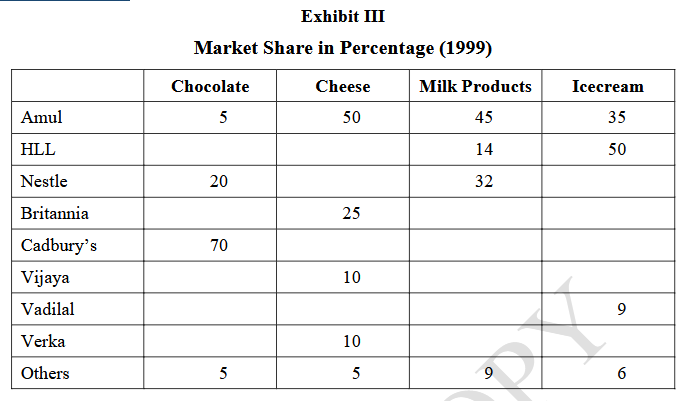
In 1997, Amul launched ice creams after Hindustan Lever acquired Kwality, Milkfood and Dollops. Positioned as the 'Real Ice-cream,' Amul Ice cream was one of the few milk-based ice creams in the market. With GCMMF gradually expanding its distribution reach, Amul was all set to strengthen its share in the ice cream segment. (Refer Exhibit III for market share). In August 1999, Amul launched branded yoghurt in India for the first time, when it test marketed 'Masti Dahi' in Ahmedabad first and then introduced it all over the country. 'Masti Dahi' was plain yoghurt sold in plastic cups. Each 400 gm cup was priced at Rs 12.
In January 2000, Amul re-entered5 the carton milk market with the launch of 'Amul Taaza' in Mumbai. Amul Taaza was non-sweetened, plain, low fat milk. The product was positioned as a lifestyle as well as functional product. It was targeted at the upper middle class housewife who could use it for different occasions. Amul was targeting sales of about 0.1 mn litres per day. In November 2000, Amul decided to promote mozzarella cheese, which was used in pizza. The growing demand for mozzarella cheese from pizza making companies like Pizza Hut and Domino's Pizza was expected to give Amul's cheese sale an additional push.
In July 2001, Amul planned to enter the instant coffee market through a tie-up with Tata Coffee. GCMMF had a strong national distribution network while Tata Coffee had expertise in manufacturing and marketing coffee. As a part of the tie-up, Amul was to source the instant coffee from Tata Coffee and distribute it. The domestic coffee market was estimated at Rs.11bn, with the instant coffee segment being around Rs.4.5bn.
In August 2001, Amul decided to enter the ready-to-eat stuffed paratha, cheeseburger, cheese and paneer pakoda, and cheese sandwich segments. The products were to be marketed under the SnowCap brand. The SnowCap brand would also include tomato sauce and ketchup. Amul was also restructuring its chocolates business9. Seven of its brands that were withdrawn from the market were to be relaunched soon. Amul tied up with Campco, the cocoa and arecanuts farmers' cooperative in Karnataka and Kerala, for the supply of cocoa beans.10 Amul marketed Milklairs, which was manufactured by Campco. This tie-up was expected to help Amul in the expansion of its chocolate business.
With the liberalization of the Indian economy in the early 1990s, and the subsequent entry of new players, there was a change in lifestyles and the food tastes of people. The new team that took over the management of the GCMMF in the mid-1990s hoped to take advantage of the change.
The management adopted Total Quality Management (TQM) and set for itself higher benchmarks (in terms of growth). They also diversified the Amul portfolio, offering a range of food stuffs such as ketchup, jam, ice-cream, confectionaries, cheese, and shrikhand.
According to some analysts, this diversification was probably not entirely demand-driven. Being a cooperative, GCMMF was compelled to buy all the milk that was produced in Gujarat. And with milk production having increased since the mid 1990s, GCMMF had to make use of additional milk, and hence the pressure to make and market more and more processed-milk products. Amul had to expand the consumption base of milk-based products in India. It planned to make its products (butter and cheese) a part of the regular diet in most households.
Amul launched its new products with the intention of increasing the offtake of its basic milk products, including cheese. This in turn was expected to increase the earnings of the farmers. The pizzas were expected to increase the sale of its cheese. The entry into the confectioneries market was another avenue for increasing milk consumption.
This flurry of launches helped Amul broaden its appeal across all segments. Price was an advantage that Amul enjoyed over its competitors. Amul?s products were priced 20-40 % less than those of its competitors. Analysts felt that Amul could price its products low because of the economies of scale it enjoyed.
Amul created two new distribution set-ups: a cold chain for ice-cream, and another for limited life fresh foods like curd. Expecting the demand for ready-to- eat foods to grow, Amul prepared to leverage the ice-cream cold chain for a new range of frozen foods, beginning with pizza.
However, some analysts felt that as the pizza's would be made by the retailers, Amul would have little control over the quality of the pizzas. That was why Amul was marketing the pizzas under the brand name SnowCap. Said S K Bhalla, Chief of Quality Control, “The product has received premature hype. Meeting consumer expectations will be a challenge, until we make the frozen pizza in our own facilities.”
According to some analysts, Amul's obsession with keeping down manpower costs and dealer commissions could be a weakness. In ice-creams for example, Amul?s retail commission in Ahmedabad city was 17.5% which was 10% lower than what competitors offered. They also pointed out that Amul might not have the financial muscle that multinationals had to achieve rapid growth.
However, all said and done, Amul seemed to be all set to make steady progress in the coming years with its products having become quite popular in both rural and urban households. Said Vyas, “We've handled liberalisation and globalisation far better than our transnational rivals. It has made us fitter than ever.”
1. Why do you think Amul was diversifying into pizzas, cheeseburger, tomato sauce, ketchup, and other eatables?
2. What are the distribution channels that Amul can make use of for marketing new products like pizzas and other eatables?
3. Why do you think GCMMF used the brand name SnowCap for its pizzas and not Amul?
Exhibit I:
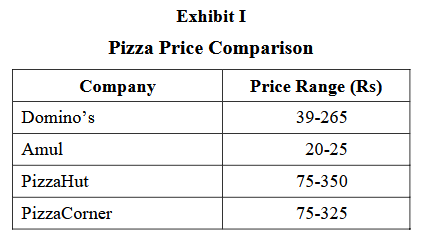
Exhibit II:
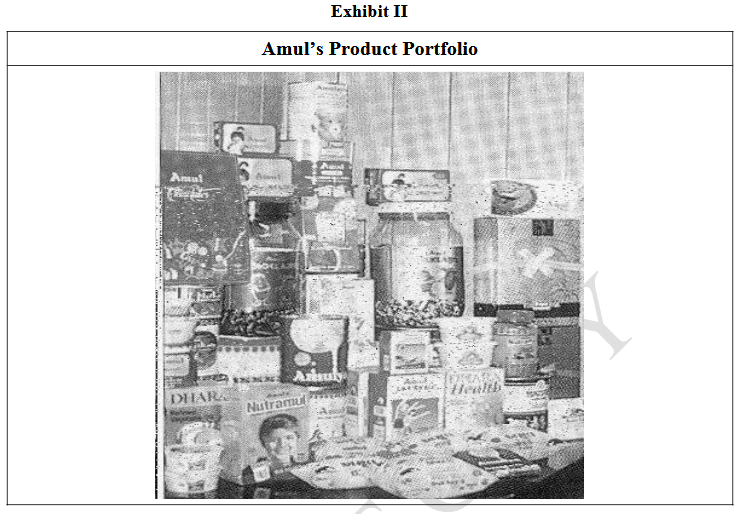
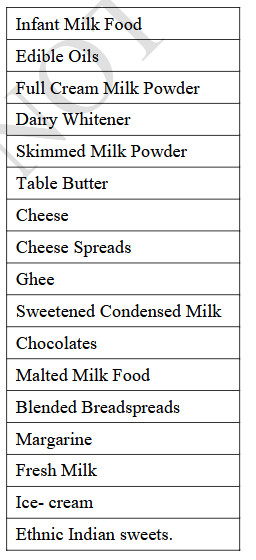
Exhibit III:
Keywords
Gujarat Cooperative Milk Marketing Federation, SnowCap, Pizza Hut, Hindustan Lever, Amul, distribution network, Total Quality Management, Diversification Strategy