
The Tasty Bite Story
🌐 International Buyers — Pay via PayPal
Details
MKTG015
6
2001
YES
0
Tasty Bite Eatables Limited
Food & Beverage
India
Turnaround Strategy,Marketing Strategy
Abstract
The case ‘The Tasty Bite Story’ is intended to give insight into how a small ready-to-serve food company, Tasty Bite, was able to achieve a turnaround by focusing on its marketing efforts. Tasty Bite was running into huge losses and its products were not being acce-pted in Indian markets. The case examines how the company managed to overcome its problems with the help of a 4 ‘C’ strategy and other marketing initiatives. The case is so structured as to enable students to understand how TBEL was able to achieve a turnaround and emerge as a major food brand in the US market. The students should understand the 4 ‘C’ strategy and its implementation, as well as the company’s other initiatives for increasing customer focus.
Learning Objectives
The case is structured to achieve the following Learning Objectives:
- Marketing strategies for food products, turnaround strategies.
Contents
“Tasty Bite is a company that has virtually risen from the dead.”
- A & M, in October 2000.
In September 1998, stock market followers were surprised when the scrip of Tasty Bite Eatables Limited (TBEL), a small Ready-to-Serve (RTS) food company, reached Rs 36. This was a 930% increase over its 1996 price of Rs 3.50. What was even more surprising was the fact that till September 1998, TBEL was a Board for Industrial and Financial Reconstruction (BIFR) case.
Launched in the early 1990s, TBEL products were rejected by Indian consumers. Analysts said that the products had been launched 'ahead of their time' in the Indian markets. (TBEL products were made available in a pouch, which had to be boiled before serving.) Moreover, the fact that the products were priced very high added to their lackluster performance.
However, TBEL not only became the first Indian company to get itself de-registered from BIFR within a year, it also emerged as the largest brand in the US ethnic foods market. In 1999, the company posted its first ever profit of Rs 4.71 million. By the end of 2000, TBEL had become a $ 5 million brand in the US retail market and its products were available in 6,000 stores across the US.
TBEL was formed in 1986 by Ravi Ghai (Ghai) and Ravi Kiran Aggarwal. Ghai was also the owner of the ice-cream brand Kwality, which was the market leader with a market share of over 50%. TBEL set up a unit to process 10,000 tonnes per annum (tpa) of frozen vegetables and 5000 tpa of RTS foods at Khutbao and Bhandgoan villages of Maharashtra at a cost of Rs 55.5 million. In February 1987, TBEL brought a public issue of Rs 7.5 million. The company commenced production in February 1989 and launched its first RTS products in 1990. Following a lukewarm response in the Indian markets, in 1991, TBEL introduced its products in the Middle East, Russia, and the US. The company did not fare well in these markets either. The lack of a focussed marketing approach was considered to be the main reason for its failure.
In 1992, TBEL entered into a collaboration with the beverage company Pepsi. Pepsi was interested in collaborating with TBEL because government regulations required it to generate one dollar in export sales for every dollar it earned in India. Pepsi agreed to distribute TBEL's RTS products abroad and help TBEL upgrade its facilities. In 1994, when the government abolished the export requirement norms for MNCs, Pepsi decided to walk out on TBEL, claiming that it would rather concentrate on its core business of soft drinks.
In 1995, ex-Pepsi executives Ashok Vasudevan (Vasudevan) and Kartik Kilachand (Kilachand), who had been involved with TBEL earlier while they were in Pepsi, decided to market TBEL's products in the US. Their US based natural food marketing and distribution company, Preferred Brands International (PBI), acquired the exclusive marketing rights for TBEL?s products. In 1995, PBI launched five TBEL products in Southern California, and later expanded the business to other parts of the country also.
By the end of 1995, TBEL was in serious financial trouble due to excessive borrowings. Poor response to its products and poor capacity utilization took a heavy toll on the company's financial health. In 1996, HLL acquired the Kwality ice-cream brand and took over Grand Foods, the holding company of Kwality Frozen Foods. Grand Foods happened to be the holding company of TBEL as well, so TBEL now became an HLL company. However, TBEL continued to perform badly and by March 1997, the accumulated losses touched Rs 96 million. TBEL was declared a sick unit and referred to BIFR.
Vasudevan, who had worked with HLL for about a decade before joining Pepsi, convinced HLL's management to get TBEL de-registered from BIFR by providing financial assistance. While TBEL's equity capital remained Rs 20 million, the HLL group turned its Rs 120 million unsecured loans into preference capital at a premium of Rs 19.50 per share. As a result, TBEL's net worth turned positive and the company was de-registered from BIFR. HLL began using TBEL's idle capacity to process its own products and also initiated efforts to make TBEL more market savvy to survive in the competitive markets.
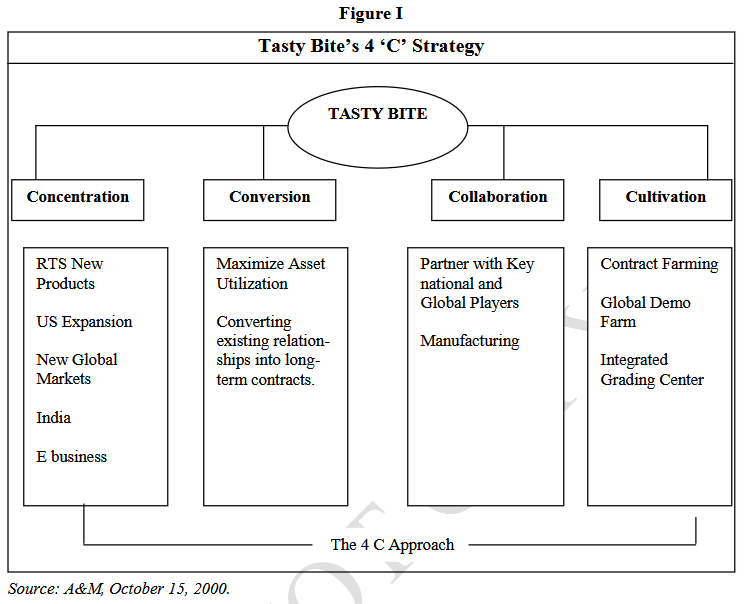
In 1997, HLL decided against venturing into the frozen foods business. Consequently, it sold TBEL to PBI. PBI appointed Ravi Nigam (Nigam) of Britannia Industries as the President. The new management worked out a strategic initiative, which was named the '4C approach,' for reviving the company and turning the business around (Refer Figure I). The four Cs strategy divided the core business into areas that needed to be focused on: Concentration, Conversion, Collaboration and Cultivation. As part of “Concentration, TBEL decided to invest in intensive research for its RTS products. The company also planned to expand its business globally as well as in India. A decision to enhance the business through e-business was also taken. The second 'C' of the strategy - conversion - concerned entering into conversion contracts with the National Dairy Development Board (NDDB) and the Maharashtra Agricultural Development and Fertilizer Promotion Corporation (MAFCO) for utilizing TBEL's individual quick freezing (IQF) facility at its plant.
The third 'C'- collaboration – addressed the necessity of attaining optimum utilization of TBEL plant capacities through collaborations. TBEL's 2,000-tonne cold storage facility for storing ice cream, pulp and vegetables was leased out to HLL and Tropicana (a juice brand from Pepsi). As a result of this, capacity utilization of the plant reached 90% in 1998-99. The fourth 'C' - cultivation – was reflected in the initiatives taken at Bhandgaon, Maharashtra, where the company's 25-acre farm was situated. TBEL employed the local farmers and trained them in hi-tech methods of cultivation for producing high quality vegetables. This in-house sourcing of raw material enabled TBEL to maintain quality standards besides reducing its dependence on others.
The company's expansion plans required a considerable amount of money. Payments for placing a product in just one store of a chain in US ranged between $ 5000 and $ 10,000. Even with a narrower base of natural food store chains, it was difficult for PBI to pay $ 10,000 to each of the 200 stores it had shortlisted. To overcome this problem, the company undertook a cluster analysis study in various US cities and generated a demographic profile6 of the customers they needed to concentrate on. The company found that its potential customer's age group was between 25-54, with average earnings of $ 75,000 a year. This helped the company narrow its focus and reduce its list of stores from 200 to 80. This reduced the amount of payments to be made to stores from $ 2 million to a more manageable $ 800,000. A smaller list of stores also led to a more focussed distribution strategy.
Unlike other Indian food companies, PBI worked very hard to offer its customers products beyond pickles, spices and papads. The company thus decided to launch a wider range of products specifically targeted towards local US customers. After some intensive research, it decided to launch the Tasty Bite range in the $5 billion natural food category through mainstream retail chains in the US.
PBI also began advertising through sweepstakes at the retail level and in-store demonstrations, thus enhancing awareness and encouraging customers to experiment. This also helped in lowering advertising costs significantly. The company also focussed on increasing the Americans' understanding of Indian food. PBI realized that the average American customer was not able to understand the products being offered and their Hindi language names did not make sense to the customers. The company thus decided to slash the product portfolio from 25 to 8 and retained only those products that were familiar to the American consumer. Also, products were renamed in English for instant identification and easy understanding. Thus, 'Palak Paneer' became 'Kashmir Spinach,' 'Navratan Korma' became 'Jaipur Vegetables' and 'Alu Chole' became 'Bombay Potatoes,' and so on. The recipes were also modified to suit the western palate.
PBI also modified the packaging to suit customer requirements. Earlier, products were sold in pack sizes that ranged from 200 gms to 1 Kg. This was replaced with a standard size of 300 gms, as unlike mainstream food in the US, Indian food was not consumed in large quantities. The smaller pack size motivated the consumers to give the products a try. By August 2001, the pack size was changed to 285 gms (10 ounces) to bring it in line with American standards of measurement. This also meant that a store shelf now accommodated nine packs as compared to the seven earlier.
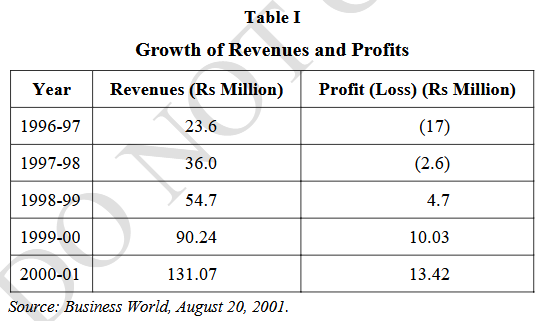
By 1998-99, TBEL began reaping the benefits of its turnaround efforts and recorded a net profit of Rs 4.7 million. By the end of 2000, its products were available in 27 US states through 33 leading natural food stores and mainstream supermarkets. By 2001, TBEL?s profits increased nearly three fold to Rs 13.42 million (Refer Table I). According to SPINS, an agency that tracked the market shares and consumer preferences of natural food brands in the US, TBEL was the largest brand in the category. Bombay Potatoes (Alu Chole) had become a common side dish for many Americans. TBEL's entry into Holland, Switzerland and UK was also showing positive results.
In September 2000, TBEL began working towards repeating its export market success in the domestic market. TBEL divided the Indian market into two broad segments: the domestic segment focussing on working women, and the institutional segment comprising fast food restaurants, hotel chains, airline flight kitchens and the Indian Army and Navy. Nigam said, “Although Tasty Bite is the No. 1 selling Indian food brand in the US, the task in India is daunting. The challenge, therefore, is to first establish the category and then associate it with the brand.”
TBEL was optimistic that its earlier dismal performance in the domestic market would not be repeated. A national study on the food and grocery sector GROFAST (Grocery and Food Advantage Study), conducted by KSA Technopak,10 showed that 73% of Indian consumers preferred to have traditional Indian meals in the RTS format rather than western food. This attitude was mainly attributed to the shift in the preferences of consumers and readiness of Indian consumers to experiment with food. A TBEL source remarked, “In India there is a paradigm shift among women. The Indian woman is no longer just a housewife, but is more the manager of the household. Also, the working woman is not guilty about eating outside food at home. Tasty Bite products, therefore, are designed to collaborate and not compete with the new Indian woman.” TBEL management felt that the Indian market had become mature enough to appreciate the convenience and value of RTS foods.
TBEL launched its products in Pune, Mumbai, Bangalore, Chennai and Hyderabad without much advertisement and promotion support. Encouraged by the good sales reports, TBEL decided to launch the products nationally by the end of 2001. The company also decided to spend 40% of its domestic revenues to launch a billion brand-building campaign during 2001-02. TBEL also started conducting research for launching RTS sweets and non-vegetarian food.
By 2001, HLL, Dabur Foods, MTR and Amul had also entered the Rs 10 billion Indian RTS food market. TBEL planned to increase its turnover to Rs 1 billion by 2003. The company seemed to be working hard to fulfil Kilachand's vision of becoming 'the most respected food company in India.'
1. Examine Pepsi's and HLL's involvement with TBEL. Do you think that their fleeting interest in TBEL was disadvantageous for the company? Give reasons to support your answer.
2. A renewed focus on customer service was one of the key components in TBEL's turnaround. Prepare a detailed note outlining the major components of TBEL's turnaround strategy and comment on their efficacy.
Keywords
The Tasty Bite Story, ready-to-serve, food company, Tasty Bite, marketing efforts, huge losses, Indian markets, 4 'C', TBEL, turnaround, major food brand, customer focus
Related Case Studies
| Case Title | Details | Price | Add to Cart |
|---|---|---|---|
|
Case Title Reliance Jio’s Next Act: Monetizing a Mass Brand without Breaking TrustCase Code: MKTG494 |
Details | 500 | Add to Cart |
|
Case Title The Nirma StoryCase Code: MKTG008 |
Details | 300 | Add to Cart |
|
Case Title IKEA’s ‘Punch’ Moment: Using Reactive Marketing to Build Brand ConnectionCase Code: MKTG493 |
Details | 300 | Add to Cart |
|
Case Title Amul and the D2C Dairy Challenge in IndiaCase Code: MKTG492 |
Details | 400 | Add to Cart |
|
Case Title Ulta Beauty under CEO Kecia Steelman: Unleashing Growth in a Slowdown?Case Code: BSTR713 |
Details | 500 | Add to Cart |