
The LML - Piaggio Break-Up
Details
BSTR006
7
2002
NO
200
LML Ltd
Automotive
India; Italy
Strategic Alliances,Growth Strategy
Abstract
The case focuses on the break up of the joint venture agreement between LML Ltd., and the Italian automobile major, Piaggio. The case deals with the various developments that led to the break-up, and claims and counter-claims made by LML and Piaggio. After a yearlong bitter dispute with petitions pending in the ICA, CLB, and the Kanpur Civil Court, the companies finally opted for a 'good-faith out of court' settlement in November 1999. The case is intended for MBA/PGDBM level students as part of the Business Environment curriculum. At the end of the discussion, the students are expected to give their opinion on whether Singhania did right to break up the joint venture. They are also expected to discuss the future of both the companies after the break up.
Learning Objectives
The case is structured to achieve the following Learning Objectives:
- Influence of external and internal environments in the Joint venture
- Personal relationships influence on the venture.
Contents
INTRODUCTION
"The structure called LML was created by me. I brought Piaggio into the joint venture by giving them equity."
- Deepak Singhania’s (Managing Director, LML Ltd.) comment on Piaggio’s attempt to purchase LML’s stake in the joint venture.
“The agreement had been wrongly understood. We will fight the case since we have no inclination of selling our stake in LML.”
- Mario Emprin Gilandin, Resident Manger, Piaggio India
On June 23, 1998, Deepak Singhania (Singhania), managing director, LML Ltd., received letters from two companies of the Piaggio Group. The letters curtly informed him that four of the group companies would be merged with Piaggio & C SpA1 on July 1, 1998, under a restructuring plan. There had also been a change in the shareholding pattern. Singhania immediately sensed that the reorganization and the changing shareholding pattern of Piaggio & C SpA would strengthen the anti-Singhania faction in Piaggio.
Proactively, Singhania invoked certain articles of the joint venture agreement with Piaggio. He contended that he had the right to buy out Piaggio's stake in LML. According to him, the demise of Giovanni Alberto Agnelli (Giovanni) triggered an event that gave LML the right to purchase Piaggio's stake. He took the matter to the court of the civil judge (Senior Division) Kanpur. Singhania's petition contended that Piaggio should be forced to sell its stake. During the same time, Piaggio moved the International Court of Arbitration (ICA), Paris, contesting Singhania's claim.
The Kanpur court gave an interim order restraining both LML and Piaggio from selling their holdings. This sequence of claims and counter-claims by LML and Piaggio continued for more than a year. In November 1999, the partners finally entered into a „good-faith out-of-court settlement? under which LML bought Piaggio's stake.
PIAGGIO - LML - A PROFILE
Piaggio, established in 1884 in Pontedera, (Pisa, Italy), was one of the world's leading producers of motorized two-wheeled vehicles. A leader in the European two-wheeler market, the company was also a manufacturer of three- and four-wheeled light transport vehicles and engines. The Piaggio family owned the company until December 1999, after which Morgan Grenfell Private Equity, a member of the Deutsche Bank Group, acquired 81.5% stake. The remaining 18.5% stake was held by Umberto Agnelli3 (10%), and Texas Pacific Group (8.5%). Piaggio entered the Indian automobile market in 1948, by launching its two-and three-wheelers in Mumbai. Very soon, the company signed a licensing agreement with Bajaj Auto for the production of two- and three-wheelers locally.
Piaggio had many firsts to its credit. It was the first European manufacturer to launch a 4-stroke scooter in 1995. In 1997, the company produced the first and only scooter in the world with an injected 2-storke engine, - Vespa ET2 Injection. This scooter, it was claimed to reduce emissions by up to 70% and fuel consumption by up to 30%, as compared to other scooters. In 2000, Piaggio was the first European manufacturer to introduce a 50cc 4-stroke engine. It also developed the innovative range of four stroke LEADER (Low Emission Advanced Engine Range) engines, which included engines of 125 to 180 cc with air or liquid cooling and two or four valves.
Lohia Machinery Ltd. (LML), established in 1975 in Kanpur, was a manufacturer of textile machinery. The company later started processing and dyeing synthetic yarn. In an unrelated diversification move, the company entered into a technical collaboration, for the production of Vespa, with Piaggio in 1984. Over the years, LML became the second largest scooter manufacturer in India. Eventually, it had become a strong competitor to the market leader, Bajaj Auto Ltd. LML was also into the manufacture of scoterettes. When sales of scooters began to fall in India, the company entered the highly competitive motorcycle segment, by entering into collaboration with Daelim of Korea.
THE BUILDING OF A RELATIONSHIP
The LML-Piaggio relationship started with a licensing agreement in 1984, for the production of Vespa. The contract was later converted into a technical and financial joint venture in 1990, with Piaggio taking up a 23.6% equity stake in LML. In the same year, LML was spun off as a separate company. The Indian promoters had a 23.6% equity stake in the new company. Two of these were Singhania, and his brother Lalit Singhania, who held the stake through a holding company, Suryodaya Trading and Investment Co.
The third Indian promoter was Sanjiv Shreya, a cousin of the Singhanias, who held the stake through Gold Rock Investments. Piaggio held the stake through Piaggio Vespa BV5 and Piaggio & C SpA. However, Singhania believed that Giovanni personally held the stake.
The new company had two managing directors – Singhania, and P. Pelligrini, a Piaggio representative. Both the companies had three representatives each, on the board, with demarcated areas of responsibility. While the Singhanias were responsible for production, finance, sales and external relations, Piaggio was in charge of technology transfer and quality control. In 1995, the joint venture was restructured, and a new joint venture agreement was signed by Singhania and Giovanni.
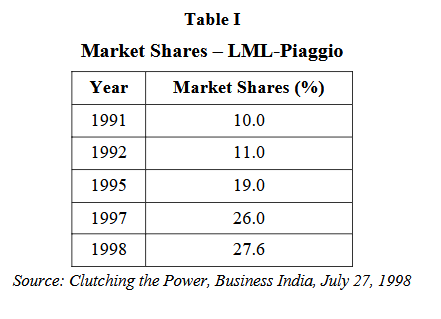
The new agreement gave complete management control to the Indian promoters. The Italians were divested of functional or executive responsibilities. The number of Indian representatives on the board was also increased to four as against three of Piaggio. The partnership seemed to be working perfectly. The market share of LML increased to 27.6% in April-June 1998, from 19% in 1995 for the same period. (Refer Table I). In 1997, the partners also announced their decision to enter the Indian motorcycle market.
MARRIAGE OF CONVENIENCE?
On December 13, 1997, Giovanni, the heir to the Agnelli family, died of cancer. His death made Singhania apprehensive. In 1995, the joint venture agreement had been signed with the support of only Giovanni. Giovanni's family had been planning to form a joint venture with Bajaj Auto. The family had also planned to acquire LML, through a partnership with Escorts, in 1993. They had cancelled an MoU signed with LML to set up a 400-crore (1 crore = 10 million) venture to manufacture 75,000 three-wheelers per annum and entered into an agreement with Greaves to manufacture the same.
Singhania felt that the Agnelli family could create problems for him and LML. “Our relationship was with Giovanni. We had tremendous faith and confidence in each other,” he commented. Added to this, he received letters from two group companies, briefly informing him about Piaggio's restructuring plan. Under the plan, four of the group companies were being merged with Piaggio & C SpA on July 1, 1998. There was also a change in the shareholding pattern of Piaggio & C SpA. Singhania felt that both these developments would strengthen the anti-Singhania faction.
Acting immediately, Singhania invoked the “Indian Promoters Triggering Events” under Article 5.47 and Article 5.58 of the Joint Venture Agreement (JVA) - 1995. According to Singhania, these articles9 allowed the Indian promoters to buy out Piaggio?s stake in case Giovanni died. Singhania filed a petition in the court of the civil judge (Senior Division) Kanpur, on July 13, 1998. The petition contended that after Giovanni's death, the Indian promoters had not been informed about the beneficiaries of the former?s stake in Piaggio & C SpA. If, for instance, the stake had been transferred to Giovanni's wife and child, Article 5.4 would get triggered off as there was no mention of the two in the list of “reference and the largest shareholder” in Article 5.4. Singhania was only aware of the fact that Giovanni?s mother, Antonella Bechi Piaggio Viscounti di (Antonella), held a 12% stake in Piaggio & C SpA, while another 11% was held by Umberto Agnelli SpA, whose shareholding pattern was not known to him. Singhania also had no clue about the holding structures of other trusts, which owned the remaining stake in Piaggio & C SpA.
Given the above facts, Singhania believed that Giovanni's father, mother, and sister had ceased to be the largest shareholders of Piaggio & C SpA. Therefore, on July 6, 1998, he wrote a letter to Piaggio, stating that he would like to buy Piaggio's stake in LML. As Piaggio refused to sell the stake, Singhania filed the above petition. He commented, “It's a partnership between individuals. If any of the individuals were to leave the partnership for any reason whatsoever, the other partner has the right to buy his stake. If any of the Indian promoters had left, Piaggio could have done exactly the same thing.”
Piaggio opposed this move by stating that the interpretation of the JVA was erroneous. A statement issued then said, “Piaggio will oppose such interpretation of the joint venture agreement in all the necessary forums to safeguard its position, as India continues to represent a strategically important country in the ambit of Piaggio?s international presence.”
LML then moved the Supreme Court. Piaggio, in turn approached the Company Law Board (CLB) seeking the removal of Singhania as the managing director of LML. The charges against Singhania included mismanagement and manipulation of accounts, among others. The CLB rejected Piaggio's demand that Singhania be removed from the managing director?s post. Subsequently, Piaggio approached the ICA seeking certain injunctions against LML. The injunctions included prohibiting LML from procuring and utilizing technology from Benelli of Italy and Daelim Motors of Korea or any other third party. Piaggio also wanted LML to stop using technology supplied for certain vehicles and sought an audit of the company?s books of accounts. However, Piaggio later withdrew its pleas for two injunctions including the procurement of technology from others and the audit.
THE BREAK-UP
Analysts felt that Singhania's initial move of filing a petition for buying Piaggio's stake in LML was a bolt from the blue. The company had gained market share and its profits were also improving steadily. Also, in 1997, two months before the death of Giovanni, the partners had announced their decision to enter the motorcycle segment. Moreover, the fact that LML's stylish scooters were more stylish when compared to Bajaj's stodgy models was attributed to LML's partnership with Piaggio. Above all, as Piaggio was also LML's technology partner, the fight could put on hold Singhania's plans of launching the Gilera10 range of motorcycles through LML.
However, Singhania felt that Piaggio's contribution had become insignificant. He said, “Piaggio has become redundant to the joint venture. They have no technology to offer either for scooters or for motorcycles. All vehicles which we have developed since 1993 use technology from sources other than Piaggio.” Singhania claimed that their partnership had been dysfunctional from 1984, and that the JVA-1990 was a total failure due to “cultural differences and a completely different ways of working.” A senior LML executive said, “We had no idea of what a successful joint venture entailed.” LML also claimed that the turnaround of the company during 1991-1994 was not because of any contributions from Piaggio. Singhania said that the real benefits of the financial and technology agreements were not accruing to LML.
The technology transfer contracts were also running 24 to 30 months behind schedule. This forced LML to design products on its own. The JVA allowed LML to source technology from third parties. Thus, over the years, Singhania had been reducing LML?s dependence on Piaggio. In May 1998, LML had entered into a 5-year technology transfer agreement with Daelim of South Korea to manufacture 100-cc motorcycles. However, the claims by Singhania and LML contradicted the JVA-95. In a statement about the JVA, Singhania told Business India in 1995, “Each side is concentrating on what it does best. Piaggio will support us as technology supplier, with its manufacturing experience and experience in international marketing. We will actually run the company because we know local conditions.” This statement seemed to contradict his claims that Piaggio had no technology to offer.
In the late 1990s, Piaggio also demanded a hike in royalty and technical knowhow fees. Piaggio demanded 50 billion lire (Rs. 120 crore) as fee for the period 1997-2005. It had initially demanded 9 billion lire for 1997-98, which was increased to 11 billion lire, despite a reduction in the number of products that would be provided to LML. The new management of Piaggio had also demanded that all LML products should be branded as Piaggio only.
Finally, on May 31, 1999, Piaggio decided to exit the joint venture and terminated the JVA and all other related agreements with LML. It also filed a petition with the CLB under Sections 397, 398 and 402 of the Indian Company?s Act – 1956, alleging company mismanagement. It also alleged that Piaggio was 'forced' to terminate the JVA, due to 'breach of trust by the Singhania family.' In August 1999, LML rejected the termination of the JVA by Piaggio stating that it was invalid, as Piaggio had not gone through the proper route. According to LML, only an arbitration tribunal or a civil court could terminate the agreement.
THE SETTLEMENT
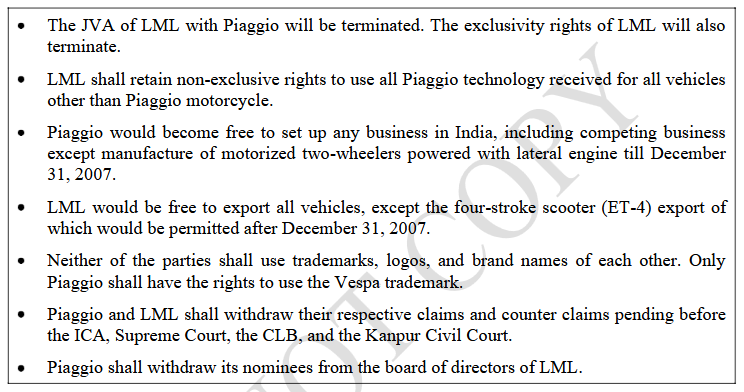
On November 15, 1999, LML and the Piaggio group resolved their long-pending disputes and differences in an out-of-court settlement agreement. As per the agreement, LML had to purchase the entire 23.6% stake in the company at the rate of Rs.14.06 per share. Some of the other terms of the agreement are shown in the box.
For Piaggio, this break-up was history repeating itself. Piaggio earlier had a partnership with Bajaj Auto, which had ended bitterly. After its settlement with LML, Piaggio started looking for a new partner. Alternatively, the company also had plans of establishing a wholly owned subsidiary in India, for which the company approached the Foreign Investment Promotion Board (FIPB). The company also attempted to come back through the acquisition of the State-owned three-wheeler manufacturer, Scooters India Ltd. (SIL).
After the settlement, LML planned to concentrate on motorcycles. It had rolled out two models of four-stroke motorcycles with engine capacities in the range of 125-200cc – Energy and Adrena. The company had already entered into technical collaborations with Daelim of South Korea and Benelli of Italy. LML also forayed into the Scooterette segment with its non-Piaggio product –Trendy, a 60cc automatic transmission model priced at Rs. 17,500.
QUESTIONS FOR DISCUSSION
1. Briefly outline the developments that led to the break up of the joint venture between LML and Piaggio.
2. By trying to break up the joint venture agreement with Piaggio, Singhania was forcing LML onto a new path. Do you think LML was right in breaking the joint venture in view of its future prospects in the Indian two-wheeler market?
3. Post-breakup, what is the future of Piaggio in India, in view of the highly competitive two-wheeler market?
Keywords
Joint venture, LML Ltd., Italian automobile, Piaggio, break-up, yearlong, petitions, ICA, CLB, Kanpur Civil Court, good-faith out of court, November 1999, Business Environment, Singhania
Related Case Studies
| Case Title | Details |
|---|---|
|
Case Title IBM in 2004: The Linux OptionCase Code: BSTA110 |
Details |
|
Case Title Oracle’s PeopleSoft Bid (Part C)Case Code: BSTA106 |
Details |
|
Case Title Oracle’s PeopleSoft Bid (Part B)Case Code: BSTA105 |
Details |
|
Case Title Oracle’s PeopleSoft Bid (Part A)Case Code: BSTA104 |
Details |
|
Case Title Ispat: Sidbec: Entering North AmericaCase Code: BSTA006 |
Details |