
DS Group’s Entry into Food and Beverages Sector
Details
BSTR024
10
2002
NO
300
DS Group
Food & Beverage
India
Diversification Strategy,New Product Development, Product Management, Brand Strategy
Abstract
The case describes the diversification strategy of DS Group into the food and beverages market. The Delhi-based DS Group was a market leader in tobacco-based products like gutka, zarda and pan masalas. It entered the food market with its innovative Catch salt and peppershakers in the late 1980s. By mid 1990s, these products were quite a success in the premium segment. Soon, the DS Group established a subsidiary DS Foods. The Catch brand was extended to spices and natural spring water. DS Foods also launched the branded mouth freshener Pass Pass. DS Foods adopted aggressive marketing and promotional strategies for its products, including in-movie placements. Catch mineral water was the only brand in India to be certified by the National Sanitation Foundation. Within two years of its launch, Pass Pass had grown to a Rs.350 million brand. The Catch spices were also launched in lined cartons. By 2006, DS Foods aimed to be Rs 5 billion company.
Learning Objectives
The case is structured to achieve the following Learning Objectives:
- Strategies in the food and beverage business.
Contents
INTRODUCTION
"We want to be a dominant player in the foods sector and increase our growth rates in the tobacco business. We hope to grow by Rs.5 billion in the next three years."
- Rajiv Kumar, Managing Director, DS Group (Businessworld, November 8, 1999).
“Flavoured water and iced tea are examples of niches in the market but the fact remains there is no market in these niches.”
- Jagdeep Kapoor, Managing Director, Samsika Marketing Consultants, Mumbai.
In 1998, the DS Group1 set up a subsidiary, DS Foods, to enter the food and beverages market and transferred its flagship brand =Catch‘2 (See Exhibit I on DS Foods product list) to DS Foods. In October 1999, DS Foods launched bottled natural spring water under the 'Catch' brand. The group announced that it would invest Rs 1 billion in the next three years, in its foods venture.
In 1999, DS Foods launched the Pass Pass (Closeness) mouth freshener. This was the first branded Indian' mouth freshener. By mid 2001, Pass Pass was a Rs 350 million brand. Pass Pass aimed at becoming a Rs 500 million brand by the end of 2001. Similar products like Aas Paas, and Saath Saath4 soon appeared in the market.
DS Foods also planned to enter other 'untapped' markets like Club soda, flavored water, and iced tea. While some analysts felt that DS Foods might not be able to leverage the brand equity of Catch in the new categories, DS Foods thought otherwise.
BACKGROUND
Dharampalji Sugandhi (Dharampalji) set up the Dharmapal Satyapal Group (DS Group) in 1929, as a manufacturer of fragrances. In 1935, it diversified into flavored chewing tobacco. By 1950, Dharampalji's sons had introduced many varieties of chewing tobacco. In 1965, they launched the first branded chewing tobacco in India. This was the first saffron flavored chewing tobacco in the world. In 1979, the DS Group launched Tulsi Zafrani Zarda (tobacco powder) and Rajnigandha gutka (tobacco powder mixed with beetle-nut powder). By the mid 1980s, the DS Group became a leader in tobacco-based products with brands like Baba, Tulsi and Rajnigandha.
In 1983, the DS Group entered the food and beverages market when it acquired the Noida-based Hi Tech Foods Ltd., (Hi Tech). In 1987, Hi Tech created a niche market for tabletop salt with its 'Catch Salt Shaker.' Satyapal, the then proprietor of the DS Group, felt that branded free-flowing table salt was exactly what many Indian homes were looking for. Getting cooking salt out of a 1-kg bag, and putting a portion into a shaker, was an inconvenience for the workingwomen.
By the early 1990s, Catch, as a brand, had achieved the distinction of having made it to the up market Indian dining tables. In 1991, 100 gms shaker packs of Catch black salt, garlic salt, chat masala, garam masala, and turmeric powder were introduced. In 1998, Hi Tech launched sambhar powder. The costlier commodities such as pepper, garlic salt and chat masala were launched in 50-gm shaker packs (See Table I for price). In the same year, white pepper was also launched at Rs 93 per 100gm shaker pack. However, of the total Catch brand sales of Rs.250 million in 1998-99, Catch salt alone accounted for Rs 100 million (See Exhibit II). In late 1998, with the launch of DS Foods, the Catch brand was transferred to it from Hi Tech.

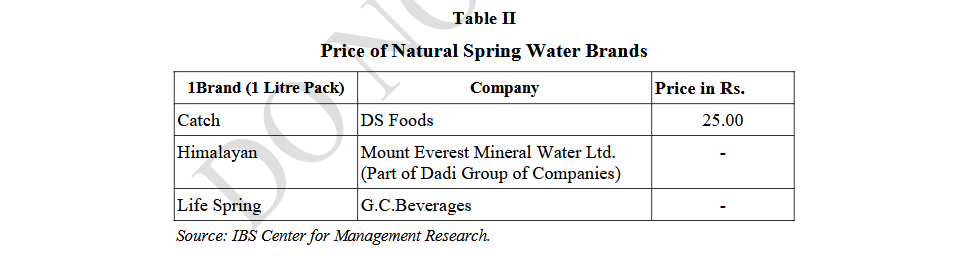
In October 1999, DS Foods launched Catch mineral water. Within a year, the product generated sales of Rs 100 million in volume, of which Rs 50 million was accounted for by exports. Exports were mainly to the US, Europe and West Asian countries. Catch was the only Indian 'natural spring water' and was positioned in the premium segment (See Table II for various brands in the segment). It was the only brand in India to get National Sanitation Foundation (NSF) certification for meeting the quality and safety standards set by the US Food and Drug Administration (USFDA).
CATCHING UP WITH 'CATCH'
According to analysts, Hi Tech's willingness to take risks was largely responsible for the success of the Catch brand. Prior to the launch of Catch salt, Hi Tech carried out a random survey of the urban Indian market. Based on the findings of this survey, the company targeted Catch at two segments – upper class Indian households in the metros, hotel, and restaurants, which would use the product in large volumes. The company built a national distribution network covering 1,600 premium outlets in India‘s A and B class cities.
Catch Salt was launched with a price of Rs.6 for a 200 gm pack. At that time, Tata iodized salt, the market leader, was priced at Re1 per 1 kg pack and loose salt was priced at less that Re1. Analysts felt that there were bigger risks than what the price ratio would suggest at first glance. In India salt had always been a low-priced commodity, and many analysts felt that not many people would be willing to pay higher prices for it.
However, the DS Group seemed to be sure of success. Ashok Aggarwal (Aggarwal), Vice President, DS Group said, "We did not have any competitors, as the brand was a high-priced commodity packaged for convenience." Manufacturers of other leading brands of salt seemed to be agree. Said Rajesh Srivastava, Vice President (Marketing), DCW Home Products, "We do not view Catch as a competitor as volume-wise it is insignificant."
But, according to analysts Catch salt did find acceptance among urban Indian women. This was rather surprising they thought considering that the salt was being sold at thirty times the price of other salts. In 1989, the company launched ground black pepper in 100 gm shakers. A 100 gm pack of salt was also launched (See Exhibit III for prices of 100 gm packs).
In spices too, Catch was priced higher than other leading brands like Everest and Badshah. As different regions in India used their own distinctive mix of spices, the branded spices market was dominated by regional players. DS Foods hoped that its superior packaging would give Catch spices an edge over other brands in the market. Said L. Vinayak, Deputy General Manager (Marketing), DS Foods, "Our packaging ensures that we have a better quality."
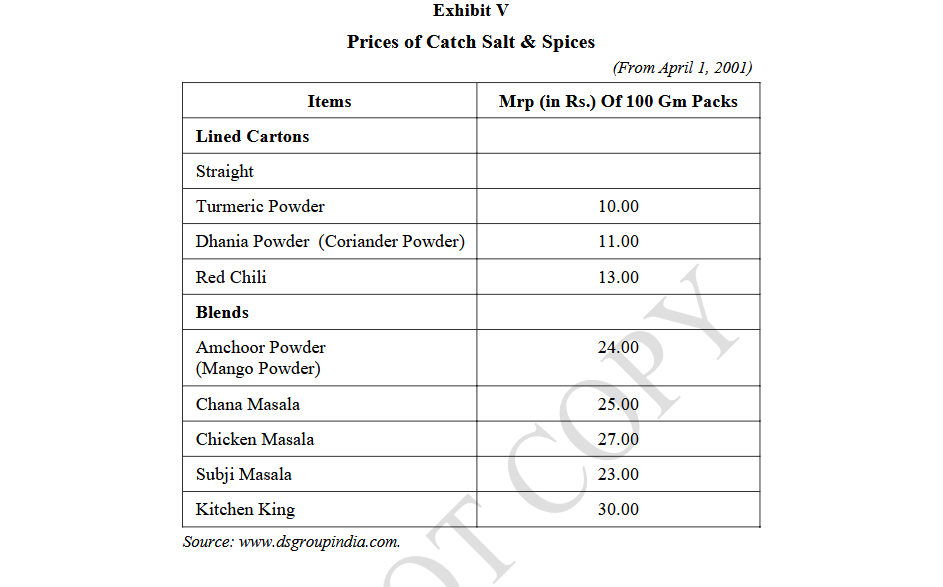
In April 2000, the spices were introduced in lined carton packs at lower prices. Analysts felt that the move was aimed at generating volumes by bringing the product into the popular pricing range. The company could then compete with Everest, Badshah and others. Said Aggarwal, "The idea is to increase penetration. These are more consumer friendly packs and the aim is to extend the usage of the product from table tops to the kitchen." So while the dispenser pack (100 gm) of red chili powder retailed at Rs 26, the price of the lined carton pack (100gm) was Rs 18. Similarly, turmeric powder (100 grams) priced at Rs 20.05 in dispensers was available at Rs 12.00 in lined cartons. By April 2001, the prices were further slashed – the red chili powder lined carton pack was priced at Rs 13.00 and turmeric powder at Rs. 10.00 (See Exhibit V).
THE PASS PASS GAMEPLAN
In India, saunff (aniseed) or elaichi (cardamom) were commonly used as mouth fresheners. However, a yearlong research conducted by DS Foods prior to the launch of Pass Pass, revealed that while younger people consumed chewing gum, adults had paan masala, gutka and paan. Explained Aggarwal, "Results showed that there was a need for a non-toxic, natural, herbal mouth freshener, since there was a vacuum in the market for that kind of product."
DS Foods saw an opportunity in this segment and came up with Pass Pass, which they claimed did not have the health hazards of gutka (considered to be carcinogenic) or candy (bad for teeth). The ingredients included dried dates, dried-and-shredded coconut, saffron, silver-coated cardamom seeds, saunff and a herbal sweetener. The sweetener was imported and did not contain sugar or saccharine. Pass Pass was conceived as a product that would appeal to both adults and young people. The USP of Pass Pass was the health aspect and absence of synthetic essences or flavoring. It was offered in two flavours – mint and katha (tobacco). The katha Pass Pass was targeted at consumers who wanted to shed the paan masala/gutka chewing habit. It tasted like paan masala, but was claimed to be harmless.
As Pass Pass was an impulse buy, positioning would be a key determinant of success. The ad campaign for Pass Pass was targeted at the 15 to 40 age group. Said Ashish Dabral, Vice President, Accounts Manager, Contract, "It was positioned as 'time-pass' shared fun kind of brand, one that would be bought over the counter on impulse." The brand personality, therefore, had to be peppy and youthful. The name Pass Pass also seemed to convey the right kind of attitude - casual, trendy, catchy and, at one level, romantic.
According to analysts, packaging was another important factor for the success. Pass Pass was launched in a poly-pouch and the colour schemes used were eye-catching. The mint flavour came in a bright green pack, and the katha flavour, in a yellow pack. Analysts felt that the pricing also worked in the brand's flavour. At Re 1, it was both convenient and affordable.
DS Foods had 12 depots, from which supplies were sent to 300 distributors. These distributors, in turn sent the product to the retailers. The distribution network for Pass Pass was not restricted to paanwallahs and cigarette-shop owners. General stores were also made key retail outlets and accounted for 20% of the sales. Analysts felt that this was probably done to make the product accessible to women. In mid 2000, DS Foods also launched a new flavour of Pass Pass – Meetha (Sweet) Paan. The launch was based on a survey that revealed that women were the largest consumers of Pass Pass and that the meetha paan flavour would welcomed by them.
In 2001, DS Foods also tried in-movie placement of Pass Pass, first time in 'Yaadein', a movie by Mukta Arts. Though the movie was not successful, DS Foods seemed happy with the exposure the brand got. Commented Aggarwal, "Can anyone predict the fate of a movie? In any case, we were very happy with Pass Pass' placement in Yaadein." The company planned to enter into agreements with other major banners for in-movie placements. Explained Aggarwal, "We have identified two platforms for in-film placement of Pass Pass - either it has to be a love story or a script which can be integrated with our brand."
In November 2001, in a bid to increase the visibility of Pass Pass, particularly among the youth, DS Foods set aside a budget of Rs 10 million for exploring new branding initiatives. The company entered into an exclusive tie-up with Appu Ghar, a popular amusement park in Delhi. Under the agreement, Pass Pass would be associated with two major events at Appu Ghar in a year. DS Foods was also negotiating with Essel World, an amusement park in Mumbai (Maharashtra).
DS FOODS – SPICING UP STRATEGIES
DS Foods aimed to become a Rs.5 billion company by 2002. To achieve this, DS Foods launched many variants under the Catch brand name. Aggarwal said, "Catch enjoys high brand equity but negligible volumes when compared to kitchen salt brands such as Tata Salt and Captain Cook." DS Foods planned to launch Catch salt in lined cartons for the kitchen segment and hoped the product would exploit the suburban markets.
DS Foods also planned to launch tea and edible oil in different pack sizes, sachets and pouches to cater to all market segments – larger packs for middle and upper classes and affordable, small pouches for daily wage earners. Aggarwal said, "Neither branded tea nor edible oil is available in small packs for the daily wager. They buy loose tea and oil." The company was also working on a two-fold sales and distribution strategy. It planned to use regular kirana stores and general merchants. It would also employ its traditional retail channel – the neighbourhood paan shops. Said Aggarwal, "Even the rural areas have a neighbouring paan shop. The concept will work beautifully even in villages and upcountry markets." Also, since most paan shops sold soft drinks, DS Foods planned to use their cold chain for the natural spring water and the proposed iced tea and flavoured water.
However, some analysts felt that the strategy might not be successful. A few years back, Nestlé had failed to push its Paloma brand of iced tea.15 Some analysts also felt that DS Foods' natural spring water, at Rs 25 per litre was unlikely to find a market. Although they claimed that the product was different from bottled mineral water, Catch was likely to face a stiff competition from Parle's Bisleri, a Rs.3 billion brand in a Rs.5 billion market. DS Foods was looking at hotels, embassies, clubs and restaurants to begin with, and hoped for sales of Rs 250 million in the next two years.
In December 2001, DS Foods announced plans to enter the ready-to-eat snacks market by the end of the month. Six varieties of Catch snacks were to be initially available – jumbo corns (in two variants) chana dal, cashew etc. The products were claimed to have a shelf life of a minimum of six months as compared to other brands, which had a shelf life of around two to three months. The USP of the newly launched products was that no oil was used to prepare it.
The company, which had a growth rate of 10% during 1999 had set an internal growth target of 35% in the next three years. Analysts felt that if it achieved the target that it had set itself, the foods and beverages venture will be highly successful. By 2006, the group aimed to achieve a target of Rs.5 billion in the Food and Beverages business alone.
QUESTIONS FOR DISCUSSION
1. In the late 1980s, DS Group launched branded salt and pepper under the Catch brand. Soon it extended the brand to other products like spices and mineral water. What are the factors, which attributed to the success of these products?
2. "Analysts felt that with Pass Pass, DS Foods was launching a branded product in a market that required changing old habits." How did DS Foods create a market for mouth fresheners with its branded product?
3. To fulfill its aim of becoming a Rs. 5 billion company by 2002, DS Foods is launching various products like iced tea, flavored water etc. Keeping in view the Indian food and beverages market, do you think DS Foods‘ strategy would be successful? Justify your answer.
EXHIBITS
Exhibit I
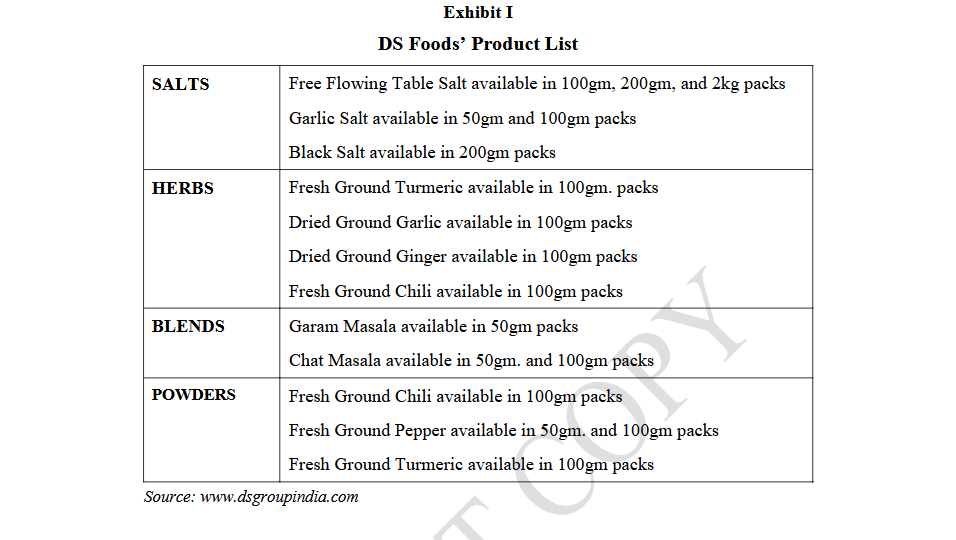
Exhibit II
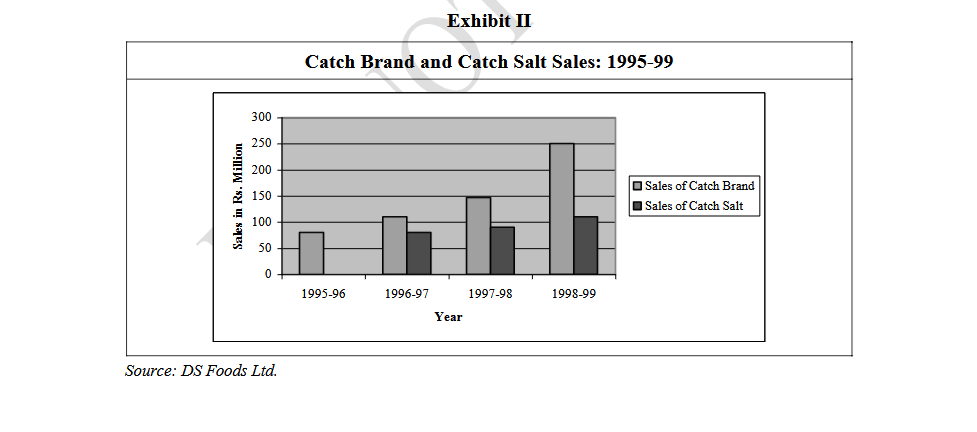
Exhibit III
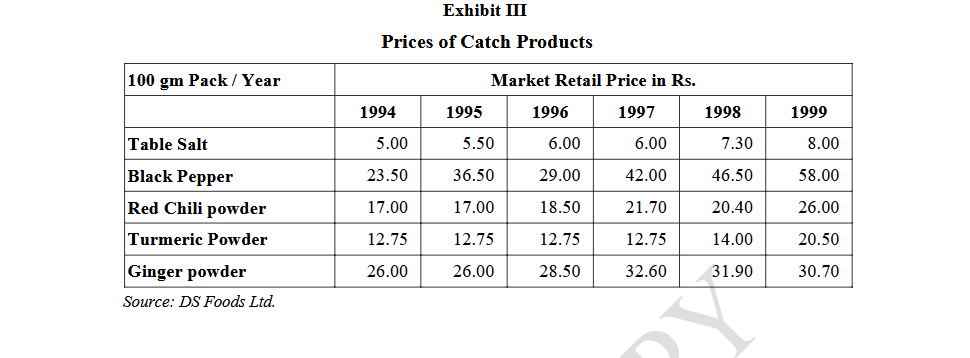
Exhibit IV
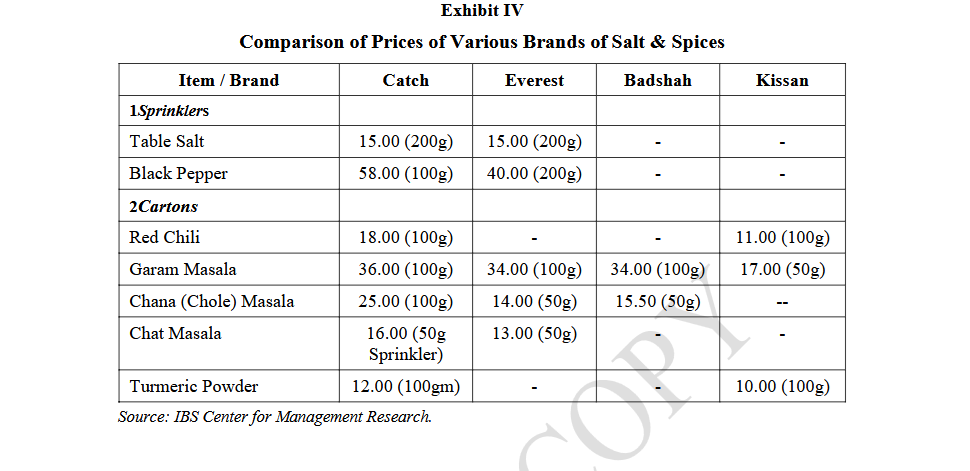
Exhibit V
Keywords
Diversification strategy, DS Group, food and beverages, Delhi-based, market leader, tobacco-based, gutka, zarda, pan masalas, food market, Catch salt, peppershakers, 1980, 1990, premium segment, DS Foods, spices, natural spring water, mouth freshener, Pass Pass, agressive marketing, promotional strategies, in-movie placements, Catch mineral water, National Sanitation Foundation, Pass Pass, Rs.350 million, lined cartons, 2006, Rs 5 billion, company