
Yahoo! in Trouble
Details
BSTR025
9
2002
NO
300
Yahoo!, Inc.
Technology & Communications
US
Strategic Planning
Abstract
The case study 'Yahoo! in Trouble' discusses the problems faced by one of the most successful Internet companies in the world. The case discusses the mistakes Yahoo made and how they eventually led to a reshuffling of the top management.
Learning Objectives
The case is structured to achieve the following Learning Objectives:
- Internet portals
- dotcoms
- revenue models of dotcoms.
Contents
THE PROBLEMS
“At the height of the dot-com frenzy in 1999, it would have been impossible to imagine the humbled Yahoo! of today.”
- BusinessWeek, May 14, 2001
In November 2000, the top management at the world's most successful Internet portal Yahoo! (Yahoo) was shocked to notice that advertisers on its site were not willing to pay the same rates for the banner advertisements as before. Tension mounted further when sources at Morgan Stanley (an investment banking firm and Yahoo's erstwhile supporter) released a report predicting bleak prospects for the company. In the report, Morgan Stanley downgraded Yahoo's stock from 'buy' to 'outperform' and hinted that the portal badly needed to tone up its management. The same day, Yahoo's share price fell by 15%.
By January 2001, Yahoo's board of directors started contemplating a change in leadership in order to tackle the company's problems. However, things only got worse. Yahoo's main source of revenue i.e. advertisement sales were dropping so quickly that Yahoo eventually had to cut its first-quarter forecast from $ 230 million to $ 175 million. Yahoo also began losing key international executives in quick succession. Within weeks six international executives left the company. Prominent among these were European chief Fabiola Arredondo and Savio Chow, the director of Yahoo Asia.
In the board meeting of February 27, 2001, Yahoo's board of directors unanimously decided that CEO Timothy A. Koogle (Koogle) must step down. However, they agreed to let him stay on as the chairman of the company. On March 7, 2001, Koogle announced his resignation. Soon, more bad news followed. On April 11, 2001, Yahoo announced that its first quarter (quarter ended March 30, 2001) revenues had fallen by 42% to $ 180 million (Refer Table I). On the same day, Heather Killen, head of international operations put in her papers.
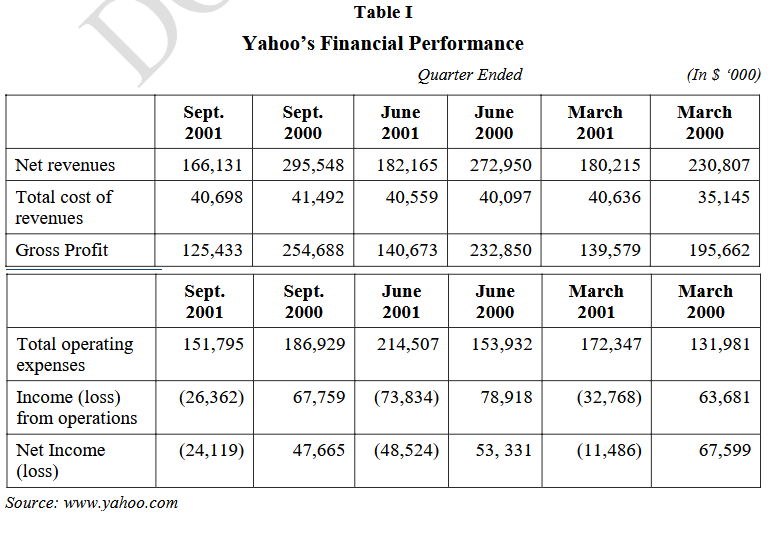
By mid May 2001, Yahoo's (once the most sought-after stock at Wall Street) share price had fallen 92% from its all time high of $237.50 on January 3, 2000. To make things worse, the company announced to lay-off 400 people from its 3,500 strong workforce. Investors across the globe wondered what went wrong with Yahoo, which once had a market capitalization of $128 billion - almost double that of media giant Walt Disney.
BACKGROUND NOTE
Yahoo was started by Jerry Yang (Yang) and David Filo (Filo) (Ph.D. in electrical engineering from Stanford University), who began exploring the Internet as a hobby after finishing their doctoral thesis. In April 1994, they created a directory to keep track of their personal interests on the Internet. Gradually, they began to spend more and more time on their directory.
Later, Yang and Filo started categorizing websites as a way to keep track of all the sites they had visited. They posted this list on the web as “Jerry and David?s Guide to the Worldwide Web.” The guide became very popular and it became the first choice for people browsing the web to find sites intelligently. It helped people to find useful, interesting and entertaining content on the Internet.
In late 1994, the duo changed the name of the guide to Yahoo, positioning it as a customized database designed to serve different users. They developed customized software to help locate, identify and edit material stored on the Internet. Yahoo rapidly became popular and attracted a lot of media attention. To strengthen its competitive position, Yahoo formed partnerships with leading companies such as Microsoft, AOL and Prodigy. Yahoo was formally incorporated in March 1995 and by mid-1995, it had implemented a business plan modeled on traditional broadcast media companies. In early 1996, Yahoo paid Netscape $5 million to become one of the five search engines which visitors could use to conduct a search from the Netscape site. During the same year, Yahoo strengthened its management team by appointing Koogle as the CEO. Koogle was an engineering graduate from Stanford University and had spent 9 years in Motorola before joining Yahoo.
Yahoo was the first company to set up an online navigational guide on the Internet. It offered media content, communication, personalized information and commerce services on its website. Yahoo generated its revenues mainly through advertisements, promotions, sponsorships, direct advertising and merchandising. The company offered many forms of advertising at different prices. These included placement fees, banner ads, promotions, sponsorships and direct marketing4. Yahoo also generated revenues from monthly hosting fees and commission on online sales from its merchant partners. These included transaction fees generated from the sale of merchandise on its site.
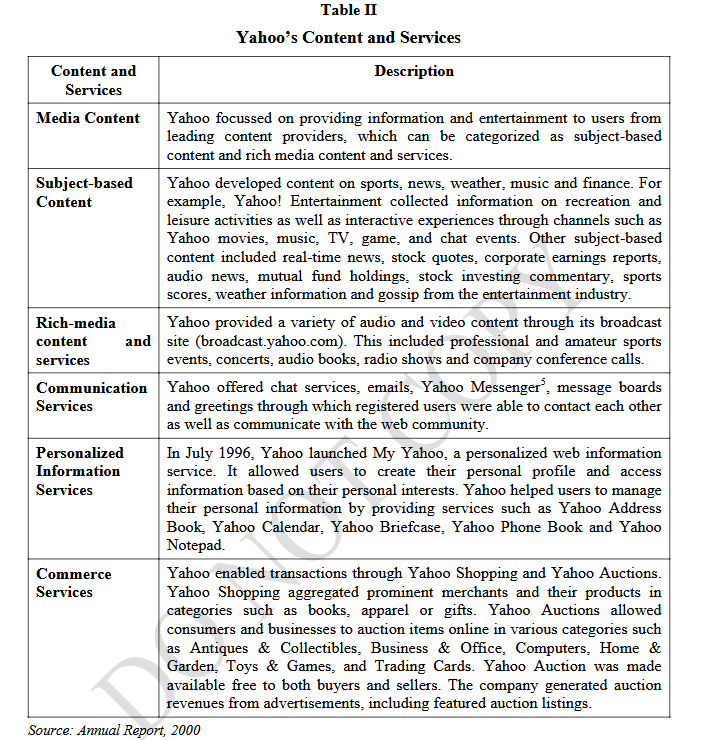
By January 2001, Yahoo had attracted more than 180 million unique visitors6, which made Yahoo leading Internet brand. For the financial year ended December 31, 2000, the company had revenues of $1,110.18 million as compared to $591.786 million in 1999 (Refer Exhibit I). More than 85% of its revenues came from the sale of banners and sponsorship advertising while the rest came from business services and electronic commerce transactions.
WHAT WENT WRONG?
Yahoo blamed the weak advertising market and low spending on marketing by dotcom companies due to the US economic slowdown, for its poor first quarter results in 2001. However, analysts feel that the real problem had started way back in January 2000, when Yahoo's major competitor America Online announced plans to buy media giant Time Warner. The deal ultimately went through for $ 85 billion in stock.
Soon there were rumors in the market that Yahoo with the help of its huge market capitalization was also planning to acquire a traditional media company. Yahoo's board comprising Koogle, President Jeffrey Mallett and Yang discussed the acquisition issue. However, they reached a consensus that Yahoo would not follow AOL's footsteps. Media reports however revealed that though Koogle was interested in acquisitions, Mallet had opposed the move and convinced Yang as well. The incident led to widespread rumors of infighting within the top management of the portal.
According to a source in the company, Mallett who was in charge of running daily operations fancied the CEO position. Those who went against Mallett were reportedly removed from important posts. As a result, friction heightened between Mallett and Koogle. What seemed on paper a good match – of a visionary CEO and technically sound president – did not seem to be working out well in reality. Even Koogle was reportedly becoming increasingly unpopular at Yahoo because of his consensus-style of management and his lack of involvement. According to a former executive at Yahoo, employees were disgruntled with Koogle, and this slowed down the decision making process considerably. He said, “Every time we went into a meeting, we'd ask, "Is this going to be a T.K. [Tim Koogle] meeting? Or is this not going to be a T.K. meeting? We wanted to know if we were actually going to get anything done.”
Three months after the AOL's acquisition of Time Warner, Yahoo got an opportunity to acquire eBay. However, while acquisition talks were going on, Yahoo's management seemed to be divided on the issue. According to sources at eBay, Koogle wanted to acquire eBay while Mallett was only interested in having eBay?s CEO Margaret C. Whitman in Yahoo?s management. There was also a disagreement regarding the reporting relationship of Whitman. While Whitman wanted to report directly to Koogle, Mallett wanted her to report through him.
According to the sources dealing with the negotiations, Mallett again managed to convince Yang and Filo that eBay's culture would be a misfit for Yahoo. The founders decided that Koogle must back away from the deal. Rich Rygg, a former Yahoo manager commented on the potential acquisition and management clashes, “This was Yahoo's most fundamental problem. It was always management by persuasion, not management by dictation.”
Apart from the clashes within the management, there were a host of other problems affecting Yahoo. According to analysts, Yahoo's management had become so complacent with its easy-money ad strategy that it was unable to adapt to the changing environment. The company was riding successfully on the dotcom wave with phenomenal results in financial year 1999 and 2000. Cash rich dotcom startups were coming in hordes to advertise on Yahoo?s site. However, the dependence on advertising revenues, particularly from dotcoms became a negative factor for the company. With the dot-com wave subsiding, startups reduced their marketing budgets and as they went out of business, the ad revenues for Yahoo dried up.
Analysts blamed Yahoo for not attempting to expand its market by going beyond online retailers. Traditional retailers could have been a huge source of revenue for the company, but Yahoo's management was uncertain how best to use the Internet for marketing. It seemed that the company made no special efforts to make traditional retailers see the value of creating an online presence. The company appeared to be focussing more on getting the rates it asked for and closing a deal rather then making an attempt to expand its customer-base. In an interview with BusinessWeek in January 2001, Mallett said, “We ran Yahoo to optimize marketshare. I make no apologies for that. If there was a company that did not get it (Internet advertising), we moved on very quickly.”
Analysts felt that Yahoo was unable to understand the fundamental changes occurring in the Net advertising market. In mid-2000, some of the leading traditional advertisers started exploring other online marketing ideas beyond the banner ads offered by Yahoo. Moreover, the popularity of banner ads was declining among online consumers. The advertisers wanted ad campaigns integrating the Internet, TV and radio. Yahoo had not attempted to offer this capability whereas its major competitor AOL-Time Warner had started offering the same.
It seemed that Yahoo had even bypassed big potential clients. For example, OgilvyInteractive, which handled online media buying for very big customers such as IBM, held a meeting with Yahoo in early 2000 to explore an advertising relationship. Ogilvy was interested in advertising on Yahoo's site after six months, but things did not materialize as Yahoo wanted an immediate deal. Jeannette McClennan, president of OgilvyInteractive, North America explained the reasons, “Yahoo executives were more interested in the here and now.”
According to some executives from reputed ad agencies, there was a rising discontent regarding the effectiveness of Yahoo's services. The content and e-commerce companies were unhappy with Yahoo, as it was more interested in selling space on its site without guaranteeing any tangible results. Moreover, the deals with Yahoo were very expensive for these companies. The cost of acquiring a new customer ran into hundreds of dollars and Yahoo?s high marketing fees even resulted in bankruptcy for most of its customers.
Analysts said that the company did not bother to understand the kind of online advertising would that would work best for its customers and the ways to develop other aspects of its business. Yahoo believed in 'playing safe,' and was more interested in grabbing easy money from dotcoms, rather than improving its business models.
Considering all the above drawbacks, it was not surprising that Yahoo was not able to maintain its success. The departure of the company's key personnel was expected to hamper the portal's growth prospects. However, analysts commented that Yahoo badly needed a major management reshuffle to put it back on the growth track.
THE FUTURE
The Yahoo board had agreed not to make Mallett the CEO as he was 'generally viewed as not being ready for the job.' On April 6, 2001, Yahoo's board voted unanimously to offer the job of CEO and Chairman to former Warner Brothers? Chairman and co-CEO Terry Semel. Semel agreed to take the job with the condition that Koogle should leave the Chairman post.
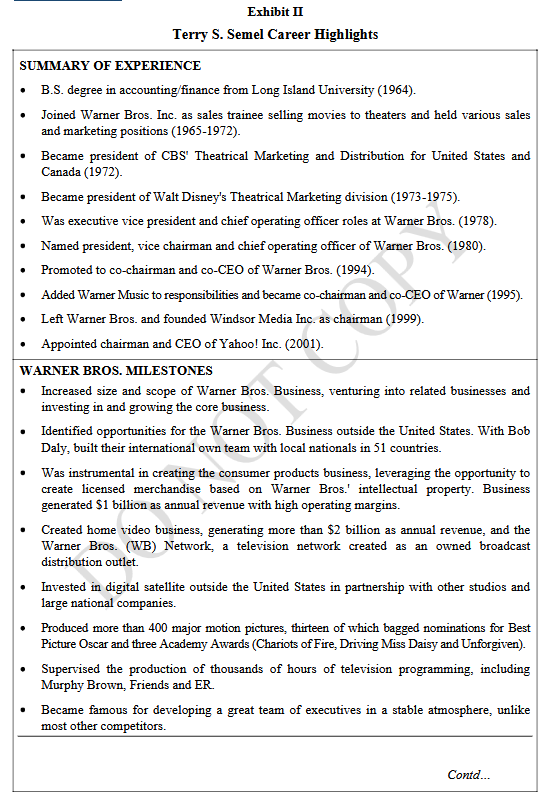
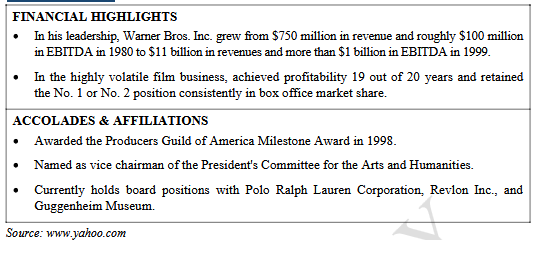
Semel joined Yahoo on May 1, 2001, bringing with him an experience of over 24 years at Warner Brothers (Refer Exhibit II). Analysts seemed to be divided on Semel's selection as Yahoo's CEO. Though he was very successful in running Warner?s movie business, he failed to deliver when his duties were expanded to include music and amusement park businesses. He was unable to turn Warner's websites into moneymakers and had little experience with advertising. According to an analyst Scott Reamer of SG Cowen Securities Corp, “Semel's not a turnaround expert. And he doesn't know how to sell to large advertisers. He has extensive experience running a media company and that's what matters.”
However, Lanny Baker, Managing Director of Salomon Smith Barney remarked, “Semel has little experience courting big-name, traditional advertisers – the very folks Yahoo desperately needs to rejuvenate its business. The movie business is not the media business. The media business is all about selling ads. The movie business is all about spending money.” What remained to be seen was whether Semel would be able to bring Yahoo out of its troubles and return to its glorious past.
QUESTIONS FOR DISCUSSION
1. Do you think that Yahoo made a strategic mistake by missing the opportunity to acquire eBay? What advantages could eBay have brought for Yahoo?
2. One of the prime reasons for Yahoo's poor performance was its over reliance on advertising revenues. What can be the possible new sources of revenue in its existing business model? Explain.
3. CEO Terry Semel has joined Yahoo! when the company is going through a bad phase. What steps according to you should he take to turn around Yahoo?
EXHIBITS
Exhibit I
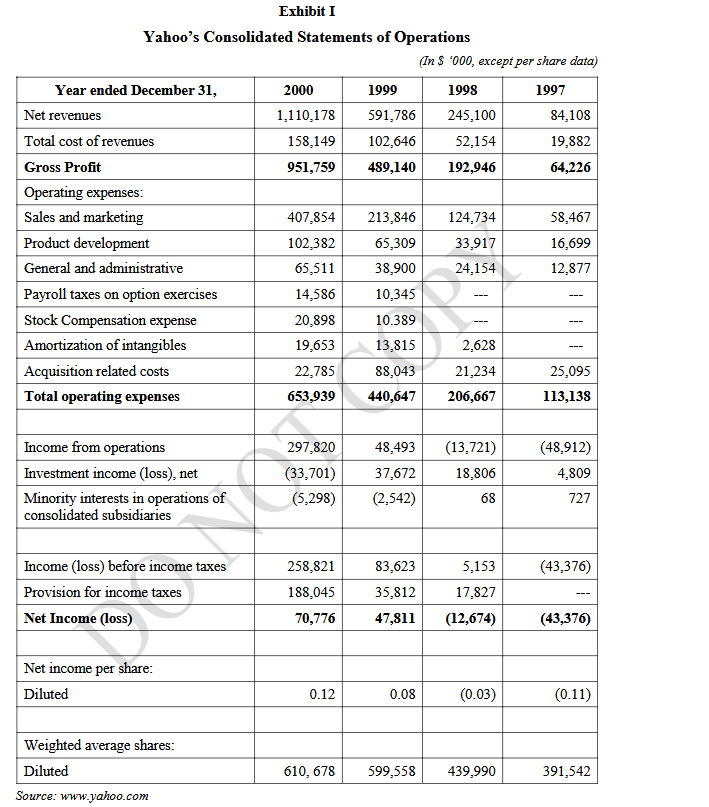
Exhibit II
Keywords
Yahoo! in Trouble', problems, Internet companies, Yahoo, reshuffling, top management, Case study, Business strategy
Related Case Studies
| Case Title | Details |
|---|---|
|
Case Title WebVan: A Disaster on the WebCase Code: BSTR090 |
Details |
|
Case Title The Hindu: 125 Years in the Media IndustryCase Code: BSTA078 |
Details |
|
Case Title From Philip Morris to AltriaCase Code: BSTA077 |
Details |
|
Case Title Reuters in 2004: Fast Forward and BeyondCase Code: BSTA051 |
Details |
|
Case Title KKR in 2004: Looking for the Second ActCase Code: BSTA050 |
Details |