
Flooding the Indian Motorcycle Market
Details
BSTR026
8
2002
NO
300
Hero Honda Motors Ltd.
Automotive
India
Market Analysis,Consumer Behavior, Consumer Marketing
Abstract
The case explores reasons for the increased rush of motorcycle launches in the late 1990s in the Indian market. It discusses in detail, the growth of the two-wheeler market, the demand shift from scooters to motorcycles and the issue of sustainability of this high growth.
Learning Objectives
The case is structured to achieve the following Learning Objectives:
- Industry structure
- entry of MNCs in LDC markets
- product launches.
Contents
A SPREE OF LAUNCHES
“Whatever happened to ignite the market for motorcycles in India is one of those mysteries which will never be explained satisfactorily.”
- Business Line, January 2001.
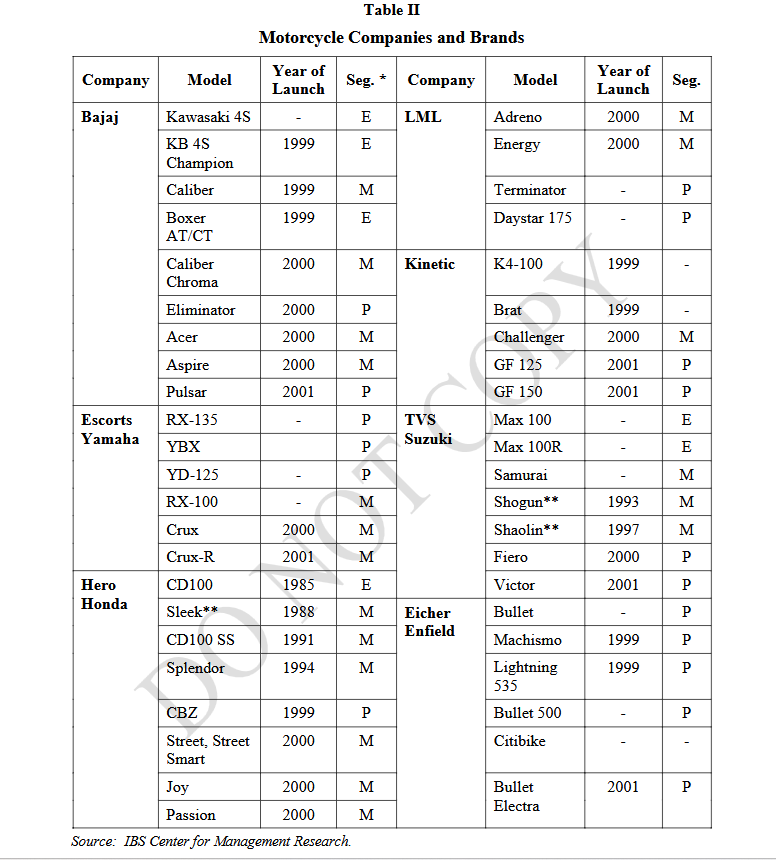
In 1999, Hero Honda, the leading motorcycle manufacturer in India, launched the CBZ 156-cc motorcycle - and the Indian motorcycle market was never the same again. Following this, all major players went on a ‘motorcycle-launching spree.’ Bajaj Auto, the second largest player, launched Bajaj Kawasaki (BK) Boxer AT and CT. This was followed by Machismo A350 and Lightning 535 from Royal Enfield, Brat (March 1999) and Kinetic Challenger (September 1999) from Kinetic Engineering Ltd.
The launches continued unabated in 2000. Hero Honda launched Joy, Passion and a remodeled Street. Bajaj launched KB Eliminator, KB Caliber Chroma, KB Aspire and KB Acer in October 2000. Lohia Motors Limited (LML), known for its scooters, launched two motorcycles Energy and Adreno in August 2000. Escorts Yamaha launched Crux and TVS group launched Fiero in 2000.
In August 2001, Yamaha Motors released Crux R. In September 2001, Kinetic Engineering launched the GF 125 and GF 150. In October 2001, Bajaj launched the Pulsar and TVS launched the TVS Victor 110-cc. The unusual aspect about these launches was the frequency - just two years after CBZ, over 15 brands had been introduced. This was equal to the total number of brands launched in the 4-year period prior to 1999. While in 1992, only one out of every five vehicles sold in India was a motorcycle, in 2001, one out of every two vehicles sold was a motorcycle.
During 2001, motorcycle sales crossed the two million mark, leading the two-wheeler industry sales for the eighth consecutive year, recording a compound growth of 25% (1993-2001). The unprecedented hectic activity in the Indian motorcycle market between 1999-2001 had taken even auto analysts by surprise, with the players revealing plans to launch more bikes in the next few years.
BACKGROUND NOTE
The two-wheeler segment was the fastest growing segment in the Indian automobile industry. India is the second largest user and third largest manufacturer of two-wheelers in the world. The restrictive policy of the government towards the passenger car industry in the pre-liberalization era, the rising demand for personal transport and the inefficiency of the public transportation system were some factors responsible for the strong growth in the two-wheeler segment.
The Indian two-wheeler market is broadly classified into three major segments - scooters, motorcycles and mopeds. Bajaj Auto laid the foundations of the Indian two-wheeler industry in 1948 by trading in imported Vespa scooters. In 1952, Enfield India Ltd. started manufacturing motorcycles, followed by Ideal Jawa and Escorts in the 1960s. The motorcycle segment registered a healthy growth during the 1960s and accounted for 36% of the total two-wheeler sector sales in 1971-72. For over two decades, the industry operated in a seller’s market with Bajaj Auto and Automobile Products of India (API) being the only leading players. During this period, little attempt was made to control costs or offer new, innovative products, which restricted the choice of the consumer.
However the scenario changed with the de-licensing of the sector in the 1980s. The number of manufacturers increased drastically and the focus shifted to branding and product features. Scooters dominated the two-wheeler market until 1990, accounting for an estimated 60% of the market. Bajaj Auto was the undisputed leader in the scooter market, followed by LML and Kinetic. The healthy growth of the 1980s continued through to the 1990s, and the two-wheeler segment registered a growth of 14%.
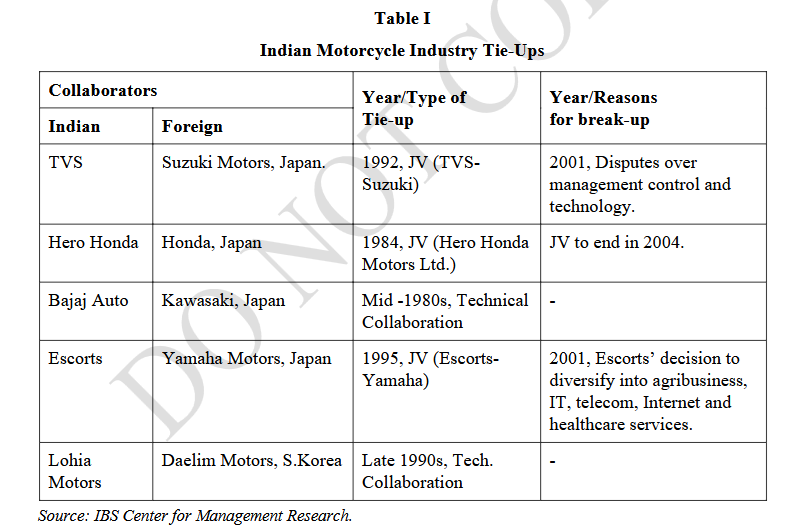
Till the 1980s, Enfield, Escorts and Ideal Jawa were the only major players in the motorcycle segment. From the mid 1980s, the segment gradually picked up momentum and its high growth potential forced all the major two-wheeler players to focus on the segment. Almost all leading players entered into joint ventures and technical collaboration agreements with various foreign companies - mainly Japanese two-wheeler giants like Honda, Suzuki, Yamaha and Kawasaki Heavy Industries Ltd..
In 2000, the motorcycle market was characterized by the presence of sub-segments based on price - the premium segment (Rs 45,000 and above), the mid-segment (Rs 40,001-45,000) and the entry segment (upto Rs 40,000). Major players in the premium segment were Hero Honda, Enfield, Escorts Yamaha, TVS-Suzuki and Bajaj. In the mid-segment, the activity zone with high competition, Hero Honda was the market leader with a 35% share, followed by Bajaj and TVS Suzuki. In the entry segment, Bajaj Auto was the leading player followed by Hero Honda and Escorts and TVS-Suzuki (Refer Table II).
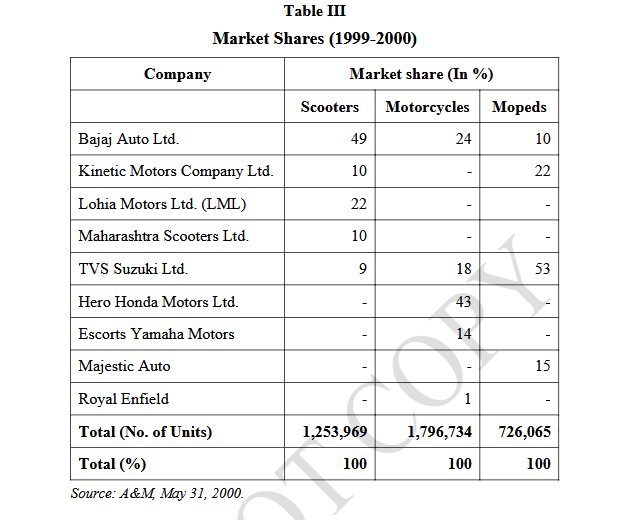
All the segments in motorcycle market, specifically the high-growth mid-segment were characterized by intense competition. In terms of marketshare in 1999-00, Hero Honda was the leader (43%), followed by Bajaj Auto (24%), TVS-Suzuki (19%), Yamaha (14%) and Royal Enfield (1%) (Refer Table III).
THE MOTORCYCLE STORY
In the early 1980s, the motorcycle segment reported a sharp decline in growth on account of factors such as high running and maintenance costs, perception that motorcycles were more suitable for the rural roads, high price of motorcycles in comparison with scooters or mopeds and the availability of fairly new models of scooters. With the de-licensing of the automobile sector in the mid-1980s, the motorcycle sales registered a healthy growth during the late 1980s.
In 1990, due to the rise in fuel prices, high input costs and reduced purchasing power due to significant rise in general price level and credit crunch in consumer financing, the industry witnessed a recession. Added to that, factors like increased production in 1992 due to the entry of new players resulted in companies either reporting losses or a fall in profits.
In 1993, the recession began to ease off and the growth in the motorcycles segment began. The two-wheeler industry saw large-scale structural changes. With the launch of lighter, 100-cc motorcycles, a significant inter-segment shift began to take place and motorcycles sales began to grow. The popularity of Hero Honda motorcycles during this period accelerated the demand for motorcycles.
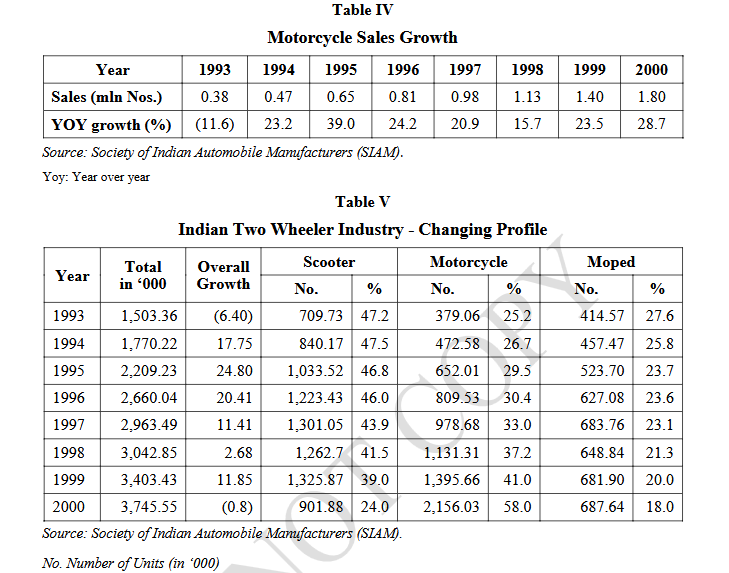
Soon, the motorcycle segment garnered the largest share of the total two-wheeler sales. The two-wheeler industry grew at a CAGR of 14.6% between 1993 and 99, aided largely by the above average performance of the motorcycle segment, which grew at a CAGR of 24.3% compared to 11% and 8.6% for scooters and mopeds respectively. Until 1997, all three segments grew in size, however from the fiscal 1999, motorcycles started directly eating into scooter sales.
The demand shift from scooters to motorcycles in the 1990s was without parallel in any comparable product category in India. This was mainly attributed to the change in customers' preference towards fuel-efficient and aesthetically appealing models, which scooter manufacturers failed to provide. The delayed launch of new, advanced scooter models, fear of four stroke scooters being prone to increased skidding risks and vibrations and the difficulty of maintenance also contributed to this shift.
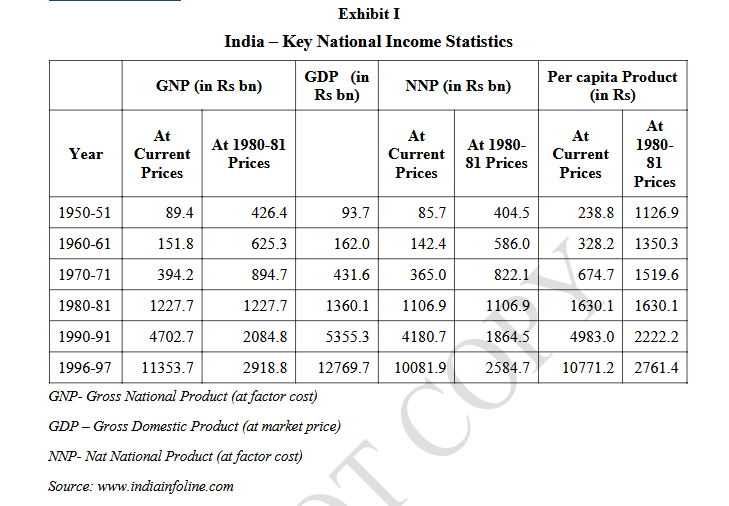
Interestingly, the growth in the motorcycle segment was mainly driven by the demand from rural and semi-urban consumers. An estimated 60% of the demand for motorcycles came from rural and semi-urban customers. The rise in their disposable incomes on account of good monsoons in the 1990s provided the normally conservative rural and semi-urban customers with extra money that induced them to experiment with new, innovative products (Refer Exhibit I). Advanced technology, larger wheelbase, higher ground clearance and the ability to ride on bad roads with less effort and less danger of skidding and decreased maintenance cost were the other factors that encouraged customers to choose motorbikes over other two-wheelers.
Besides the brand launches, the other major development in the motorcycle segment during 1998-2001 was the break-up of the various joint ventures. By the end of 2001, Escorts and TVS ended their agreements with Yamaha and Suzuki respectively. The joint venture agreement (Hero Honda) between Hero Motors and Honda Motors was also scheduled to end in 2004. The reasons for these break-ups were varied and included differences over issues such as launch of new models, ad spend, marketing strategies, the foreign counterparts’ inability to offer fuel-efficient and innovative technology etc. As a result of these break-ups, Indian companies were forced to invest heavily in research and development for manufacturing indigenously developed models. Analysts remarked that this was just the beginning of a turbulent phase for Indian motorcycle manufacturers.
THE FUTURE
Although the avalanche of motorcycles offered Indian consumers a wide variety of models to choose from, it also resulted in increased pressure on the companies to concentrate on cost-cuts, technology enhancements and upgradations and styling. Their margins came under pressure as marketing costs escalated. The companies were forced to reduce prices and offer discounts to survive the competition. Moreover, analysts were skeptical about the segment’s ability to maintain the growth rate in the years to come.
One of the major assumptions underlying the motorcycles rush was that if the market was considerably large and was growing at a constant pace, there was room for a profitable existence for all brands. In 2001, there were over 30 motorcycle brands in the market. However, with the top five brands accounting for more than 60% of the market, only 40% of the market was available for all other new brands put together. Despite the launch of more vehicles, the survival prospects of many of the individual brands were deemed to be rather bleak.
Further, the growth in the motorcycle segment was dependant on continuing favourable market conditions. Analysts claimed that to sustain this growth rate, the segment would have to completely cannibalize the market for scooters and a considerable part of the market for scooterettes and mopeds. Considering the fast growing scooterettes segment, with high demand from female customers, followed by the moderately growing moped segment and the restructuring in the scooter segment with major national and foreign players reinforcing their presence, it was unlikely that the entire growth in the two-wheeler sector would be due to motorcycles.
Analysts also commented that as the two-wheeler industry had grown steadily for eight years, stages in the product life cycle would apply to the field sooner, rather than later and the decline stage would invariably come some day.3 There was little differentiation between the brands being launched apart from styling as most companies had introduced their four-stroke vehicles. With the failure of the joint ventures, the expected introduction of cheaper Chinese brands, stringent emission norms and threat from major international players, the survival of indigenous brands looked uncertain. Constrained with the ruling price levels in the market place, limited infrastructure and lack of technological innovations when compared to their foreign counterparts, whether the Indian companies would succeed in generating the kind of volumes needed to sustain in the competitive motorcycle market, remains to be seen.
QUESTIONS FOR DISCUSSION
1. Analyze the growth of the Indian two-wheeler industry and comment on the environmental factors that contributed to its growth?
2. Discuss the segmentation of the two-wheeler industry and identify the reasons that accounted for the growth of the motorcycle segment?
3. Analyze the future of the motorcycle segment in terms of its ability to sustain the growth rate and the possibility of Indian players maintaining their marketshares in competitive conditions.
EXHIBITS
Exhibit I
Keywords
motorcycle industry, launches, 1990, Indian market, two-wheeler, demand shift, scooters, motorcycles, sustainability, high growth
Related Case Studies
| Case Title | Details |
|---|---|
|
Case Title Health Insurance, Cashless ‘Juggernaut’!Case Code: INS054 |
Details |
|
Case Title Demand Estimation for a Call CenterCase Code: OPER035 |
Details |
|
Case Title LVMH - Building Star BrandsCase Code: MKTA016 |
Details |
|
Case Title Unilever in India - Building the Ice creams businessCase Code: MKTA004 |
Details |
|
Case Title The Global Car Industry in 2004Case Code: ECOA126 |
Details |