
The TVS-Suzuki Break-Up
Details
BSTR028
11
2002
NO
300
TVS Suzuki Limited
Automotive
India; Japan
Strategic Alliances,Growth Strategy
Abstract
The case examines in detail the causes behind the break up of the joint venture between TVS Suzuki Limited and Suzuki Motor Corporation during the period 1992 to 2000. Providing the rationale behind the split from a strategic perspective, it throws light on the post break-up prospects of the Suzuki Limited in the Indian two-wheeler industry.
Learning Objectives
The case is structured to achieve the following Learning Objectives:
- Joint Venture between T V S- Suzuki, Problems in the J V, Launch of Victor, Evolution of Indian Two-Wheeler Market.
Contents
THE BREAKUP
“A joint venture is a special purpose vehicle set up by two entities for the purpose of learning. It will work as long as both want to learn different things. Once this is achieved by either or both partners, it is time for disengagement.”
- Venu Srinivasan, Managing Director, TVS, in October 2001.
In September 2001, Sundaram Clayton (of the TVS group of companies) and Japanese automobile major Suzuki Motor Corporation (SMC), partners in the joint venture TVS Suzuki (TVS Suzuki), India's second largest motorcycle company, announced their decision to break-up. TVS bought the 25.97% stake of Suzuki for Rs 90 million, increasing its stake to 58.43%1. Suzuki signed an agreement with TVS, according to which the existing licensing arrangement was to continue for 30 months. TVS agreed to pay royalty to Suzuki for this period.
The break up did not come as a surprise to industry observers, as rumors about the straining relations between TVS and Suzuki had surfaced in the early 1990s itself. Though both TVS and Suzuki refused to comment, their differences over the issues of management control and ownership had become well-known.
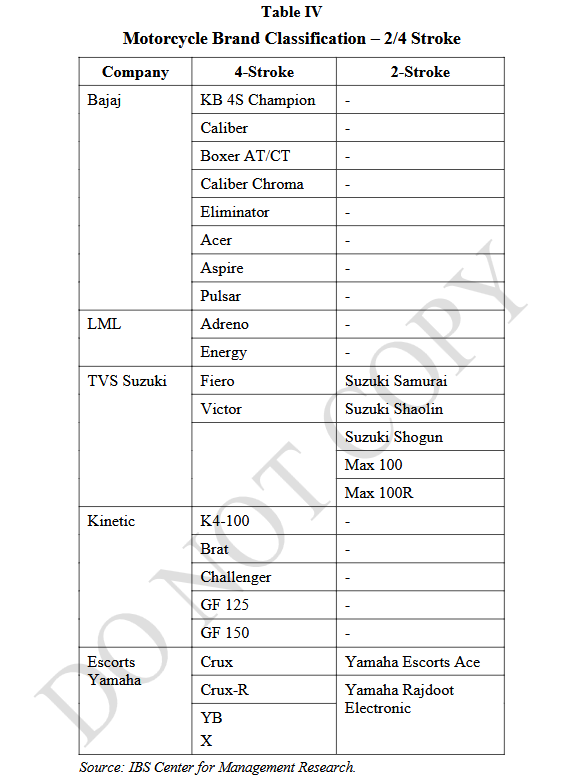
Suzuki's departure evoked mixed reactions from industry watchers about the future of TVS Suzuki. Analysts commented that TVS? in-house product development was not good. Moreover, it had a string of failures between 1994 and 2001 such as the Shogun, Shoalin, Supra and Spectra SS. With competition being extremely fierce in the Indian motorcycle market, the fact that TVS did not have any successful four-stroke models besides the Fiero did not augur too well.
Analysts claimed that the breakup had severely eroded the brand equity of TVS Suzuki's products. Leading two-wheeler manufacturer Kinetic's Joint Managing Director, Sulajja Firodia Motwani said, “The new TVS will be weaker both in motorbikes and scooters.”
BACKGROUND NOTE
T.V. Sundaram started the TVS Group with a small transport business in Chennai in 1911. Over the years, the group diversified into two-wheelers, automotive components, automotive spares, computer peripherals and financial services. However, the group was particularly successful in its automotive component and two-wheeler businesses. By 2001, with around 25 companies in its fold, TVS emerged as one of India?s leading two-wheeler manufacturers. Sundaram Clayton was the flagship company of the group and owned a controlling stake in TVS.
Suzuki's history dates back to 1903, when Michio Suzuki founded Suzuki Loom Works in Hamamatsu in Shizuoka, Japan. For the first 30 years, the company focused on the development and production of complex machines for Japan?s silk industry. In 1937, the company diversified into manufacturing cars for the Japanese market. It stopped the production of cars and concentrated on the manufacture of the looms during the Second World War. The end of the war and the collapse of the cotton market in 1951 drove the company back to automobiles. In 1952, it manufactured its first motorized bicycle called 'Power Free.' By 1954, the company was producing around 6,000 cars per month and in the same year its name was changed to Suzuki Motor Co. Ltd. By March 2001, Suzuki's net sales were ¥ 1,600 trillion and it was one of the top 5 automobile manufacturers of the world. The company had 57 production centres spread over 26 countries all over the world and its vehicles were sold through 134 distributors in 175 countries.
Suzuki entered India through the TVS Suzuki joint venture, originally incorporated as Indian Motorcycles Pvt. Ltd in 19823. The company came out with a public issue in 1984 and was named as TVS Suzuki. In the same year, the company launched its first 100-cc motorcycle, Ind Suzuki, which was received well by the market. However, the company failed to turn this initial success into sustainable profits due to the high import content of the vehicle, and it posted losses up to 1986. However, the merger with Sundaram Clayton?s moped division provided temporary respite to the company. In 1987, the company launched TVS-Champ the moped for the urban segment.
TVS Suzuki was doing well in the moped segment, although the motorcycle business was not picking up. According to automobile analysts, compared to other motorcycles in the market, TVS-Suzuki's products lagged behind in performance and fuel efficiency. Moreover, the company could not match the marketing aggressiveness of rivals like Hero Honda, Kawasaki Bajaj and Escorts Yamaha, who garnered significant marketshares. TVS Suzuki posted losses consecutively for three years - 1989-91. In 1990-91, due to labor problems, the company had to declare a lock out for 3 months. TVS-Suzuki's competitors as well as analysts went to the extent of writing off the company's chances of survival. The managing director of a rival company remarked, “It was practically a sick company.”
Alarmed by its dismal performance, TVS-Suzuki decided to put in place measures to turn the company around. By 1991-92, a turnaround strategy was formulated and TVS-Suzuki decided to become a product-led company with strong focus on R&D and production engineering. Commenting on the turnaround, Venu Srinivasan said, “We embarked on an exercise of cost cutting, slashed manpower and controlled inventory.” The total number of employees came down from 1855 in 1992-93 to 1272 in 1994-95.
The efforts paid off as the company launched five new products in 1992-93. These included the Suzuki Samurai, Suzuki Shogun, Suzuki Max 100, Suzuki Max 100R. The product launches were accompanied by a aggressive marketing revamp. The company paid special attention to the skill development of managers, sales officers and service engineers. Dealerships were also transformed and their number was reduced to 250 from 400. TVS Suzuki interacted closely with the dealers to keep their motivation levels high and also conducted customer-retention programs. The new vehicles were received well by the market and by 1994, the company had sold 0.27 million two-wheelers, recording a turnover of Rs 4.1 billion and a Rs 330 million net profit. TVS-Suzuki's turnover increased to Rs 6.2 billion in 1995 and in the same year it became India's second largest two-wheeler company.
In 1996, TVS Suzuki initiated 'Project Neon', to indigenously produce a four-stroke scooter, Spectra. The project was completed in 32 months and the Spectra was launched in 1998, priced at Rs 38,000. However, Bajaj the market leader in scooters launched its own four-stroke scooter - Legend priced at Rs 34,000 ahead of Spectra. Spectra failed to take off and managed to sell only around only 520 units per month.
In 1997, TVS Suzuki launched India's first 5 speed motorcycle Suzuki Shoalin and introduced the Suzuki Shogun with a catalytic converter.5 However, Shoalin and Shogun failed to generate adequate sales for the company. Moreover, as the company could not meet the new emission norms in a cost-effective manner, these models were discontinued. In 1997-98, TVS Suzuki set up its second manufacturing plant at Mysore (Karnataka) with a production capacity of 1,50,000 units per year.
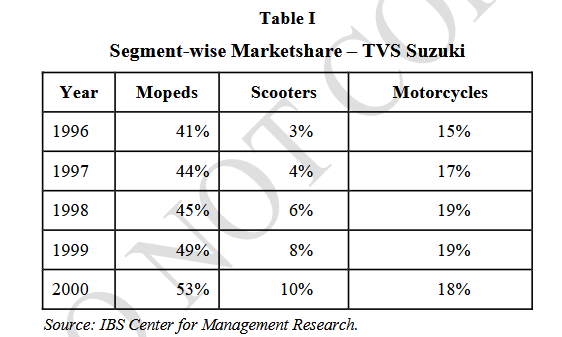
In April 2000, TVS Suzuki became the first Indian company to launch a 150-cc four-stroke motorcycle, the Suzuki Fiero. The vehicle was received well in the market and gained a 3% market share in just one year. However, the Rs 1.8 billion investment for the Spectra affected the bottomline and the stagnant market share in motorcycles resulted in a decline in profits for the fiscal year 2000-01.
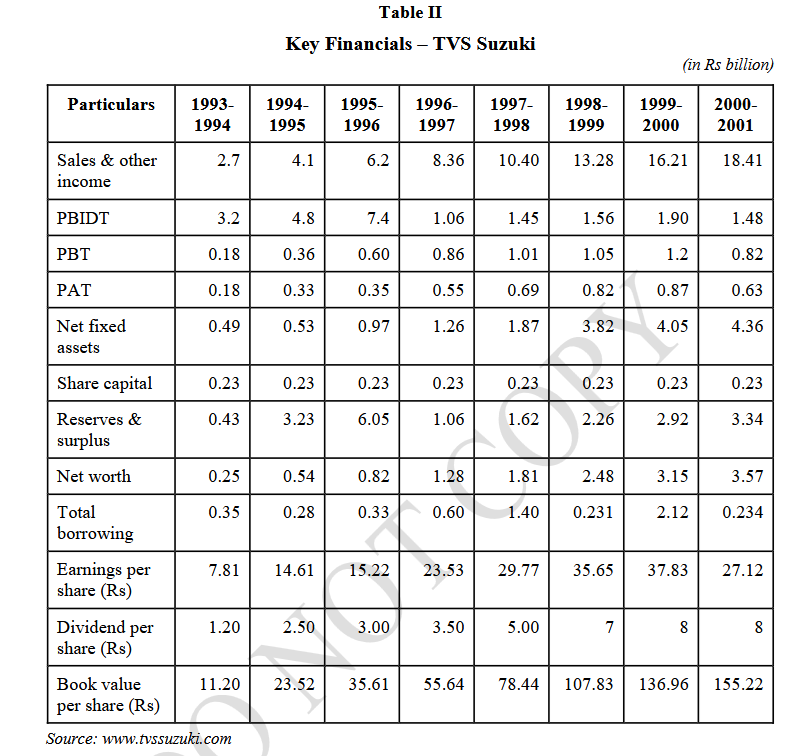
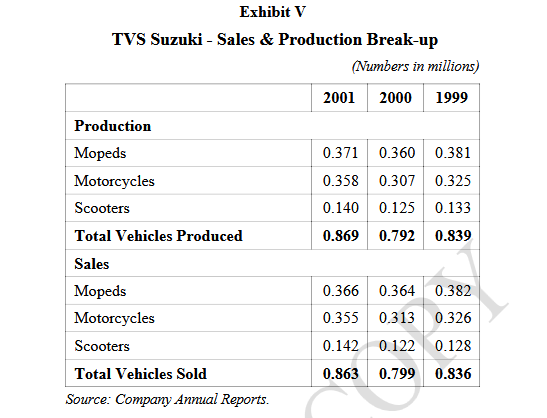
TVS Suzuki did well in the moped segment although it didn't fare too well in the motorcycle and scooter segments. Mopeds, motorcycles and ungeared scooter/scooterettes accounted for 45%, 39% and 16% of the company?s total volumes in 2000-01. In value terms, the figures were 25%, 52% and 15% respectively. For the year ending March 31, 2001, TVS Suzuki declared a net profit of Rs 630 million on sales of Rs 18.41 billion. By 2001, the company was the market leader in the moped segment with 66% marketshare, 18% marketshare in the motorcycle segment and 14% marketshare in the scooter segment.
Undeterred by the Spectra's failure, TVS Suzuki decided to indigenously launch a motorcycle on its own in 2000. For this, the company took help of the engineering skills of Austria's AVL. The result was the launch of the four-stroke motorcycle- TVS Victor in August 2001. TVS Suzuki was reportedly banking on Victor to offset the decline in sales of its top two brands, Max 100 and Samurai, (a drop of 4% and 15% respectively) in the first nine months of the financial year 2001.
Though Victor managed to sell 6000 vehicles during November-December 2001, analysts were rather skeptical about the vehicle's performance in the future. They added that Suzuki's departure was going to prove costly to TVS sooner or later. Though Suzuki and TVS still maintained that their split had nothing to do with their differences, industry observers remarked that this was far from the truth.
THE DIFFERENCES
Differences between TVS and Suzuki first surfaced in 1992, when TVS approached Suzuki for more funds and technology for new models, to meet the intensifying competition in the motorcycle segment. Reportedly, Suzuki not only refused to provide funds and technology for the new models, but also created road blocks to the management instead of helping them. A company watcher said, “Everything without exception had to be approved by Suzuki.” TVS Suzuki was thus left with no option but to use its internal accruals for putting in place the turnaround strategy. Instead of getting new technology from Suzuki, TVS Suzuki had to re-engineer the basic Suzuki models, which led to the launch of the Samurai and the Shogun.
The next major dispute between the two parties arose in the mid 1990s, when Suzuki, which had around 26% stake in the company's equity holding, expressed its desire to increase the equity holding. According to analysts, Suzuki wanted to play a pivotal role in TVS Suzuki, similar to the one it played in MUL, by gaining sufficient management control. Suzuki's demands included:
- Veto rights over all aspects of day-to-day management as well as in the strategic decision-making process.
- Restrictions on exports and high commissions on the exports made.
- Stringent conditions to restrict indigenisation of components for future models.
- Compulsory imports of all dyes and capital equipment by TVS from Suzuki and
- The minimum royalties to be paid for an indefinite period.
Suzuki's efforts were not successful as Venu Srinivasan refused to agree to any change in the equity holding pattern. Soon the differences took a serious dimension when the TVS group approached the Prime Minister?s Office (PMO) to stall Suzuki's efforts to gain control of the venture. In his letter to the PMO, Srinivasan claimed that Suzuki's demands were motivated by a desperate desire to seize control of the company. He said, “It will not only cause huge loss of foreign exchange to the country but also jeopardize the ability of TVS to develop an Indian brand nationally – a skill assiduously developed by the Indian management till now.”
However, the government of India decided not to interfere in the matter. Both partners decided to bury their differences as neither could have afforded to breakup at that point of time. While Suzuki's sales in Japan and Europe were on the decline, India emerged as a major market for its vehicles. Moreover, finding another partner or setting up its own business would have entailed a significant time-lag as well as funds. TVS also realized that developing new products on its own would require significant time and funds. Further, it needed the Suzuki brand name to strengthen its hold in the Indian motorcycle market.
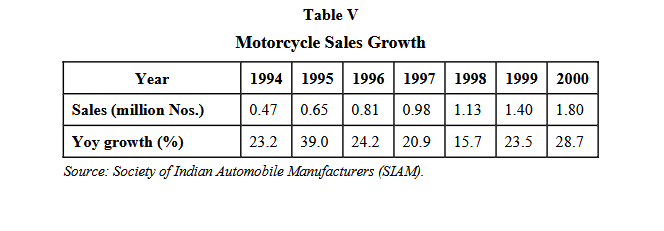
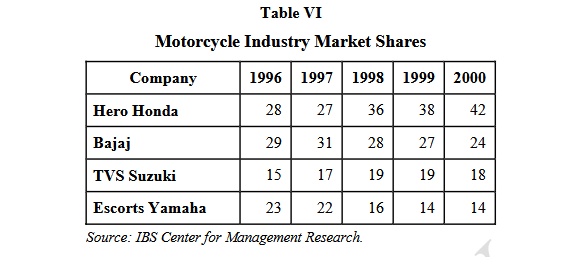
Over the next few years, Suzuki's contribution gradually declined. Other than the two-stroke Suzuki Max 100R, none of the company's fast selling products received any contribution from Suzuki. Meanwhile, the Indian motorcycle market had almost completely shifted towards four-stroke motorcycles (Refer Table IV and Exhibit III). As Suzuki was not known for successful four-stroke models, it could not offer any to TVS Suzuki either. As a result, TVS Suzuki lost out on the huge demand for four-stroke motorcycles in the 1990s (Refer Table V & VI). Though TVS-Suzuki had to rely on Suzuki for the technology and the kits for the Fiero as well, more or less all successful products from TVS Suzuki were non-Suzuki products.
In early 2001, industry observers were surprised to see Suzuki and TVS separately bidding to buy the public sector firm Scooters India Ltd8. According to media reports, Suzuki was interested in acquiring the readymade manufacturing base of SIL. In August 2001, Suzuki entered into an agreement with Japanese automobile major Kawasaki for collaborating on product development, design engineering and manufacturing. TVS saw this move as a direct conflict of interest, since Kawasaki already had a successful motorcycle joint venture with Bajaj in India.
However, the absence of Suzuki's representatives at TVS-Suzuki's annual general meeting on September 21, 2001 was a definite proof of the fact that 'all was not well' with the partners. Soon after this, TVS and Suzuki announced the break up.
As much as the breakup, the price at which TVS bought Suzuki's stake attracted media attention. Suzuki sold its stake to TVS for Rs 15 per share when the share was quoting approximately Rs 90 in the stock market. If the book value of Rs 165 was taken into consideration, the discount worked out to as high as Rs 150.
Suzuki's decision to sell its stake at such a low price was not difficult to understand. Suzuki realized that it would not be able to get a majority holding in TVS Suzuki and that it had only two options – either remain in the joint venture as a passive partner or move out to explore other options. Suzuki opted for the latter. Moreover, since the joint venture's inception, Suzuki had invested only around Rs 60 million, whereas it had received around Rs 900 million in royalties and dividends over the years. The stake sell-off thus did not seem to be a bad move.
However, apart from having got the Suzuki stake at a cheap price, there seemed to be little going right for TVS Suzuki. While the moped business had always helped maintain its profitability in the early 21st century, the lowering of excise duty on scooters and motorcycles narrowed down the price difference between them and mopeds.
In the motorcycle segment, TVS was now on its own to compete with the technical and financial might of other Indo-Japanese joint ventures. TVS's over-dependence on two-stroke technology was a definite handicap as the market had almost completely switched over to four-stroke engines. Moreover, it was estimated that TVS would have to spend around Rs 2 billion to convert to four-stroke technology.
Analysts also felt that the company would find it extremely difficult to change consumer mindset that a totally indigenously built vehicle was not as reliable. Moreover, when consumers could choose from vehicles developed and produced by Japanese companies which had superior brand image, TVS was seen as a company all set to fight a losing battle.
THE ROAD AHEAD
Many industry watchers claimed that it was too far-fetched to think about writing TVS off. They pointed out that the company could still think of sourcing the design and development from abroad. Analysts also opined that other than the Fiero, Max 100 and the Samurai, there was no technological collaboration from Suzuki and the transition period of 30 months was long enough for TVS to become technologically self-reliant.
Meanwhile, the company's name was changed to TVS Motor Company Limited in November 2001. In December 2001, TVS Motor Company opted for an early end to the licensing agreement with Suzuki and asked for expiry of the agreement by the end of April 2002. According to reports, the early end of the agreement would result in substantial savings for the company in the form of royalty, which it would have had to pay Suzuki.
In early 2002, with the company having secured around 33,000 bookings for the Victor, analysts claimed that it was just a matter of time before TVS was accepted to have mastered the four-stroke technology. TVS Motor Company was reportedly banking on its R&D to help it sustain in the two-wheeler market. The company had plans to launch two new motorcycle ranges, two scooters and mopeds by 2005.
Besides building TVS as a brand, TVS Motor Company decided to reduce the product development time from 24 months to 12 months and to improve the sales and service programs at the dealers' end. TVS also planned to expand to Malaysia, Vietnam, Thailand, Indonesia and the Philippines by 2005. The fact that the company's market capitalization had more than trebled to Rs 57.52 billion in January 2002 from Rs 18.44 billion three months earlier seemed to indicate that the markets were ready to accept the company without Suzuki.
QUESTIONS FOR DISCUSSION
1. TVS Suzuki is often described as an 'illustration of the way the Indian two-wheeler market has evolved.' Briefly discuss the performance of TVS Suzuki over the years in the two-wheeler market.
2. The TVS Suzuki break up was viewed as a predictable end to a long, uneasy relationship. Critically comment on the above statement and analyze the reasons for the breakup between TVS and Suzuki.
3. “Suzuki's exit raised questions about TVS? performance and even its survival in the future.” Discuss the post-break up alternatives available to TVS to stage a comeback
EXHIBITS
Exhibit I
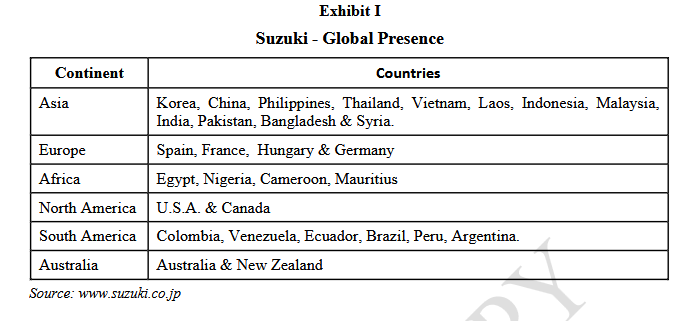
Exhibit II
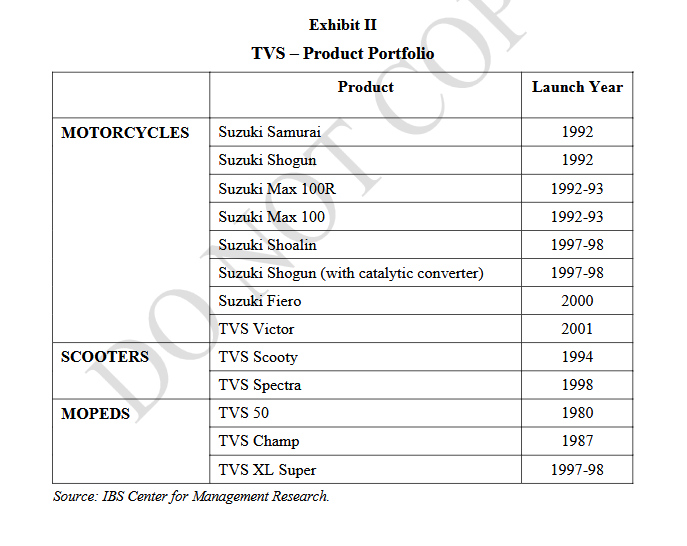
Exhibit III
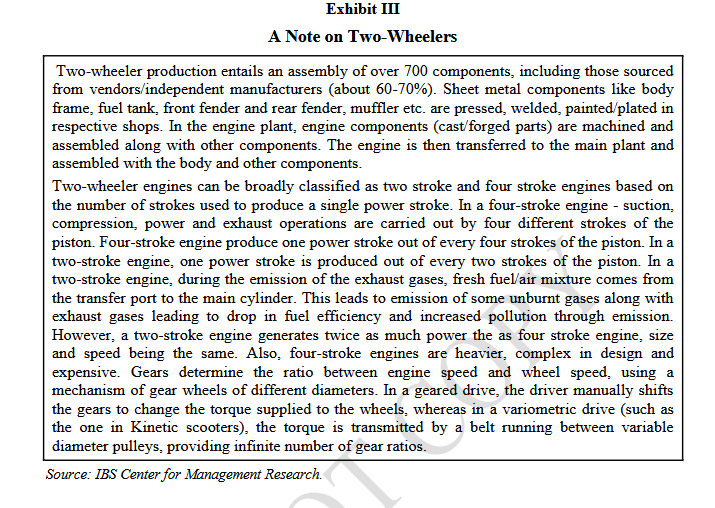
Exhibit IV
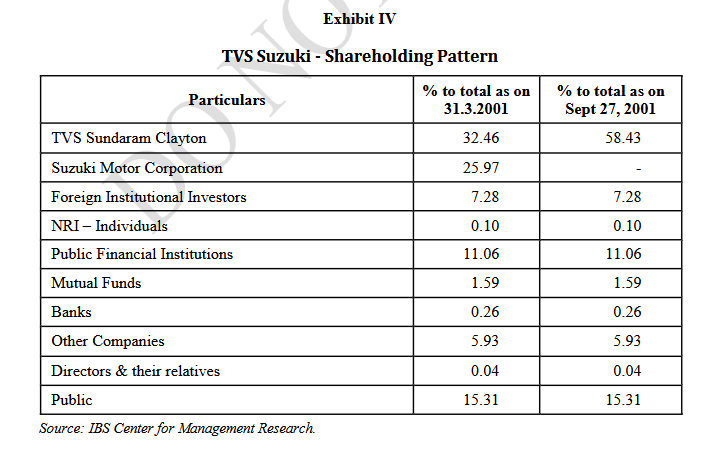
Exhibit V
Keywords
break up, joint venture, TVS Suzuki Limited, Suzuki Motor Corporation, 1992, 2000, split, strategic perspective, post, break-up prospects, Indian two-wheeler industry
Related Case Studies
| Case Title | Details |
|---|---|
|
Case Title IBM in 2004: The Linux OptionCase Code: BSTA110 |
Details |
|
Case Title Oracle’s PeopleSoft Bid (Part C)Case Code: BSTA106 |
Details |
|
Case Title Oracle’s PeopleSoft Bid (Part B)Case Code: BSTA105 |
Details |
|
Case Title Oracle’s PeopleSoft Bid (Part A)Case Code: BSTA104 |
Details |
|
Case Title Ispat: Sidbec: Entering North AmericaCase Code: BSTA006 |
Details |