
The Fall of Barings Bank
Details
FINC025
12
2004
NO
300
Barings Bank
Banking
UK
Financial Options & Derivatives,Regulatory Environment, Risk Management
Abstract
The case discusses how Nicholas William Leeson’s (Leeson) unauthorized trading in derivatives led to the fall of Barings Bank, the oldest and one of the most reputed banks in the UK. It describes the complete sequence of events leading to the fall of the bank. The case also highlights the reasons for the fall, including the lack of proper managerial supervision and operational control systems, and the mismanagement of the bank’s derivatives operations.
Learning Objectives
The case is structured to achieve the following Learning Objectives:
- Importance of proper supervision and control systems in a bank.
Contents
The Fall of Barings Bank
“I think it shows the financial markets world is a good deal less efficient than we believe. If we look at our bank statements, we can see computer errors, for example. And at the same time, there’s negligence. A lot of people turned a Nelsonic blind eye to what he (Leeson) was doing because he seemed to be bringing in the profits.”
- David Frost, Executive Producer, Rogue Trader.
“It could happen again because the incentives are the same, if not greater. The rewards are very great and that’s a temptation for people.”
- Neil Wilson, Editor of Futures and Options Week.
INTRODUCTION
On February 26, 1995, Barings Bank (Barings) – the United Kingdom's (UK) oldest and one of its most reputed banks - declared it was bankrupt. The bank with a total net worth of $900 mn had suffered losses in excess of $1 bn. These losses were result of the gross mismanagement of the bank's derivatives trading operations by Nicholas William Leeson (Leeson), the General Manager of Barings Future in Singapore (BFS). BFS had been established to look after the bank's Singapore International Monetary Exchange (SIMEX) trading operations.
Leeson's job was to make arbitrage profits by taking the advantage of price differences of similar contracts on the SIMEX (Singapore) and Osaka stock exchanges. In spite of not having the authority, he traded in options and maintained un-hedged positions. He acted beyond the scope of his job, and was able to conceal his unauthorized derivatives trading activities. Due to the senior management's carelessness and lack of knowledge of derivatives trading, the bank landed up in a major financial mess.
When Barings finally went into receivership3 on February 27, 1995, it had an outstanding notional futures position on Japanese equities and bonds of US$ 27 bn (US$ 7 bn on Nikkei 225 equity contracts and US$ 20 bn on Japanese government bond (JGB) and Euroyen contracts)4. Analysts said that the situation demanded that banks the world over must tighten their internal control procedures.
BACKGROUND NOTE
Barings was founded in 1762, by Francis Baring who set up a merchant banking business in Mincing Lane in London, UK. The business grew rapidly during the period 1798 to 1814. It became one of the most influential financial houses during the 1830s and 1840s. The British government paid Barings commissions to raise money to finance wars against the US and France during the mid 1800s.
During 1860–1890, Barings raised $500 mn for the US and Canadian governments and was regarded as London's biggest 'American House.' Barings was also involved in providing loans to Argentina during this period. In 1890, Barings was on the verge of bankruptcy when Argentina defaulted on bond payments. However, the Bank of England and several other major banks in London came forward to bail out the bank. This crisis had a major impact on Barings and led the bank to withdraw all its business on the North American continent.
Barings then took up the business of providing consultancy to small firms and wealthy people, including the British royal family. Barings advised the royal family on the management of their assets, and also gave advice to small British firms on investing in stocks and bonds. For the next several decades, the bank grew well and earned significant profits. In the 1980s, the bank started operating in the US again. In 1984, Barings acquired the stock broking arm of Henderson Crosthwaite, which later became BSL. Prior to its merger with the banking business (Baring Brothers & Company) in 1993, BSL was run as a separate company (Refer Exhibit I & II for Barings' Organization Chart Pre- and Post-Merger).
Incorporated in September 1986, BFS held a non-clearing membership6 of SIMEX. In February 1992, BFS applied for clearing membership7 of SIMEX. This was granted and BFS commenced trading on SIMEX in July 1992.
Before joining Barings, Leeson had worked for few years at Coutts Bank.8 He then moved to Morgan Stanley9 in 1987. In Morgan Stanley, he learnt about financial markets, and about derivatives trading, in particular. In 1989, Leeson joined the settlements department of BSL.
EVENTS LEADING TO THE FALL
Soon after joining BSL, Leeson applied and got a transfer to Jakarta, Indonesia. Due to his excellent performance, Barings management promoted Leeson to General Manager of BFS in Singapore in April 1992.
In BFS, Leeson's job was to leverage on the arbitrage10 opportunities on similar equity derivatives between SIMEX and the Osaka stock exchange (OSE). To take the advantage of the arbitrage opportunity, Leeson had to adopt the following strategy – if Leeson was long on the OSE, he had to be short twice the number of contracts on SIMEX11. The arbitrage trading strategy required Leeson to buy at a lower price on one exchange and sell simultaneously at a higher price on the other, reversing the trade when the price difference had narrowed or become zero. The market risk12 in arbitrage was minimal because positions were always matched. Leeson was not given any authority to trade in options or maintain any overnight un-hedged positions. However, Leeson acted beyond his authority. He traded on derivatives that were of different types and in some cases were of mismatched amounts.
Leeson was able to conceal all his trading activities because in his capacity as a GM, he was made responsible for both the trading and back office operations of BFS. He was also given authority to hire traders and back office staff. Leeson took unauthorized trading positions primarily in futures and options with Japanese Nikkei 225 and Japanese government bonds (JGB) as the underlying securities. He used an error account13 88888 to conceal the trading losses, and made cross trades14 to deceive the management. As per the records, Leeson had entered into a significant volume of cross transactions between the accounts 88888 and 92000 (Barings Securities Japan – Nikkei and JGB Arbitrage), account 98007 (Barings London – JGB Arbitrage) and account 98008 (Barings London – Euroyen Arbitrage).
Leeson gave instructions to the settlements staff at BFS to break down the total number of contracts into several different trades and alter the trade prices in such a way that all profits were credited to the accounts – 92000, 98007 and 98008, while losses were charged to account 88888. All the transactions appeared to be genuine and within the rules of the exchange. In effect, Leeson bought and sold to himself, and in doing so did not hedge any of the bank's market risk, but went on accumulating substantial open positions.
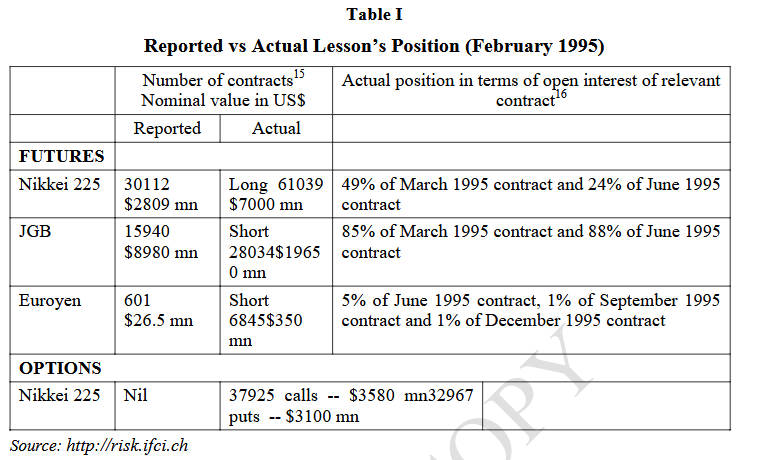
Leeson used the account 88888 to execute all his unauthorized trades in JGB, Euroyen futures and Nikkei 225 options (Refer Table I for Leeson's actual unauthorized trades compared to the trades he reported). The income statement of the account represented the actual results of Leeson's trading activities. However, this account went unnoticed by the Barings management in London since it mentioned only the margin amounts.
Leeson's trading activities faced a major setback after the Kobe earthquake on January 17, 1995. Since Leeson had adopted a short straddle strategy (Refer Exhibit III for graphical representation and payoff table of a short straddle strategy), to make profits he would have ideally wanted the Nikkei 225 to trade at the options strike price so that the options expired without being exercised. The exercise prices at which Leeson took short straddle positions ranged between 18500 to 20000 points on the stock index. However, the earthquake shattered Leeson's expectations.
On the day of the quake, the Nikkei 225 which was trading at 19,350 started declining following high selling pressure and ended that week at 18,950. Following the decline, the call options written by Leeson became useless since it would be unprofitable for a buyer to exercise the option if the spot price was less than the exercise price. At the same time, the put options sold became valuable to their buyers since the value of the Nikkei 225 continued to decline. Thus, while the upside potential on the calls was limited to the premium earned, the downside risks on the puts were unlimited and depended totally on the level of the Nikkei at expiry.
 |
Soon after the earthquake, Leeson started buying derivatives aggressively. On January 20, Leeson bought 10,814 March 1995 contracts. However by January 23, the Nikkei had dropped by 1000 points to 17,950 with Leeson under huge cumulative losses. Leeson did not give up but he tried single-handedly to reverse the negative market sentiment and doubled his long positions over the following three weeks17. Ultimately, Barings collapsed, as it could not meet the enormous trading obligations established by Leeson in the name of the bank.
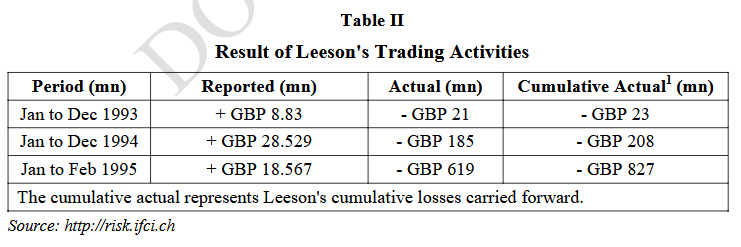
After the incident, the House of Commons in the UK ordered an enquiry to find out the circumstances that led to the fall of Barings. A report submitted by the Banking Supervision Inquiry on July 18, 1995 presented the true picture of the actual cumulative losses (Refer Table II). Out of the total loss of £827 mn, Leeson was responsible for a loss of £619 mn during January 01 to February 24, 1995.
 |
WHY DID IT HAPPEN?
Industry analysts felt that the fall of Barings served as a classic example of poor risk management practices. The bank had completely failed to institute a proper managerial, financial and operational control system. Due to the lack of effective control and supervision, Leeson got an opportunity to conduct his unauthorized trading activities and was able to reduce the likelihood of their detection. Analysts felt that this disaster happened for the following reasons.
SEPERATION OF FRONT AND BACK OFFICE DUTIES
The back office is responsible for recording and settling trades transacted by the front office, by accepting/releasing securities and payments for trades, and reconciling them with details sent by the bank's counterparties and assessing the accuracy of prices. Thus, the back office usually provides the necessary checks and measures to prevent unauthorized trading and minimizes the possibility for any frauds and embezzlements. Leeson in his capacity as a GM was given charge of both front and back office duties and consequently, was well placed to manipulate the accounts and mislead the management.
Moreover, the management overlooked the recommendation of an internal audit report in July/August 1994. It specifically recommended that Leeson be relieved of the duties such as cheque signing, supervision of the back-office team, and signing of SIMEX reconciliations and bank reconciliations. However, Leeson was never debarred from any of these activities.
LACK OF SUPERVISION/INVOLVEMENT OF SENIOR MANAGEMENT
There was a lack of effective monitoring and supervision on all trading, settlement and transaction recording activities of Leeson. Moreover, the failure on the part of Simon Jones (Jones), regional operations manager of South Asia and chief operating officer of Barings Securities (Singapore), to deal satisfactorily with the two letters of SIMEX to BFS on January 11, 1995 (mailed to Jones) and January 27, 1995 reflected the careless attitude of the senior management.
The first letter queried the accuracy of information provided by BFS relating to certain margin requirements in account 88888. It complained about the margin shortfall of US$ 116 mn in this account and referred to the violation of SIMEX rule 822 by BFS (maintaining adequate margin requirements by the client). Reportedly, Jones did not take up this matter with Barings in London, and instead of investigating himself, asked Leeson to give the response. In the second letter, SIMEX asked for an assurance from BFS about its ability to meet its margin requirements. In this case, Jones sent a copy to the senior management at London, but did not conduct any investigation as to why such letter had been sent, raising doubts about BFS's ability to meet its obligations. Analysts felt that one of the major reasons for the lack of involvement by the senior management, who primarily came from merchant banking backgrounds, was their limited knowledge of derivatives. The trading results reported by Leeson made them believe that the bank was making healthy profits.
A few analysts felt that Leeson took major risks on Barings' finances because of the huge financial incentives attached to it. For instance, the management proposed to pay Leeson a bonus of US$ 7,20,000 since he had reported profits of US$46 mn in 1994. Analysts said that if the senior managements of banks were careless in monitoring, supervision and control, just because a trader was reporting profits, there was every possibility that this type of disasters would recur.
PROPER CONTROL PROCEDURES
As Leeson lost money on his trading positions, he was asked to pay for these losses in the form of margins. To arrange for the cash required to meet the margin calls, Leeson made various misrepresentations and through manipulation of accounts, he was able to secure funding from various companies within the Barings organization and from its clients. Most of the funds came from three companies within the organization, namely BSL, Baring Securities (London) Limited and Baring Securities (Japan) Limited.
Some analysts felt that the misrepresentations and arguments given by Leeson were not water-tight, and could have been easily probed into with a little vigilance. For instance, one of the reasons Leeson gave for his requirement of extra funds, was to make margin payments on behalf of BSL's Singapore clients to the SIMEX. However, SIMEX's rules clearly disallowed a broker from putting up money as a margin on behalf of its client. Even if Leeson's claims were taken as true, the funds requirements would have been of a temporary nature until the clients made their payments. Moreover, by using a simple software program, the senior management could have easily calculated the margins required in Leeson's trading operations, and could have arrived at the conclusion that he was asking for significantly more money.
THE END RESULT
The fall of Barings not only shocked the financial markets world over, it also exposed their vulnerability. On February 26, 1995, Barings was declared insolvent under the UK Insolvency Act, 1986. Administrators were appointed to take control of the assets of the bank and its subsidiaries. A week later, all the assets and liabilities of Barings Bank and its subsidiaries (except BFS) were acquired by the Internationale Nederlanden Groep NV (ING).
ING was looking to expand its investment banking business especially in Asia, where Barings had an extensive business network involving merchant banking activities such as investment banking, corporate banking, venture capital and capital markets operations, together with securities trading and asset management. ING paid one pound for Barings and took on the responsibility of paying the entire $1 bn debts that Barings had accumulated. In addition, ING also paid $677 mn to the holders of subordinated debt19 that was issued by Barings.
The decision to acquire Barings proved to be a disaster for ING. ING's conservative work culture did not matched with the risk taking culture of Barings. By 2000, ING's management had started exploring options for selling off or closing the US operations of ING Barings. Finally, in January 2001, an agreement was reached with ABN AMRO Holding NV who bought the US investment banking operations of ING Barings for $275 mn. Under the deal, ABN AMRO also acquired the Barings brokerage, equities, corporate finance and futures & options businesses in the US. However, the UK operations of Barings still continued to be a part of the ING Group under the name “Baring Asset Management.”
QUESTIONS FOR DISCUSSION
1. Analyze the reasons that led to the downfall of Barings Bank? Discuss the importance of proper supervision and control systems in risk management for banks. What steps could Barings have taken to avoid reaching a point of collapse?
2. Discuss in detail how Leeson's unauthorized trading activities led to the fall of Barings. What would have been the ideal trading strategy for Leeson to follow after the Kobe earthquake?
3. Calculate the payoffs for the following straddle strategy for different market prices on the expiration date from the point of view of both the buyer and the writer of the option? When should an option buyer adopt a straddle strategy?
| Buy a March 310 call | Premium Rs.21 per share |
| Buy a March 310 put | Premium Rs.42 per share |
EXHIBITS
Exhibit I
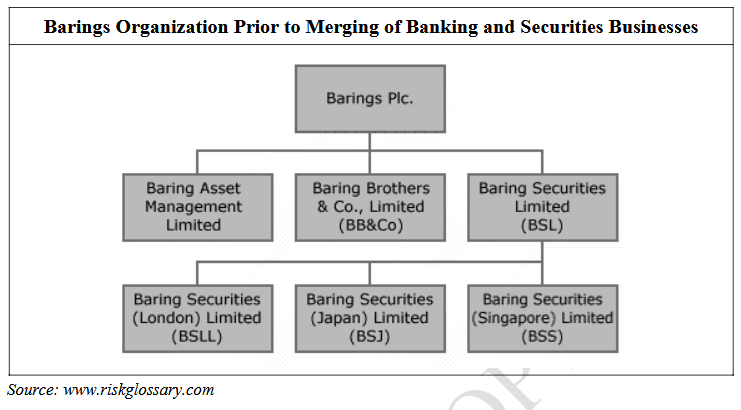 |
Exhibit II
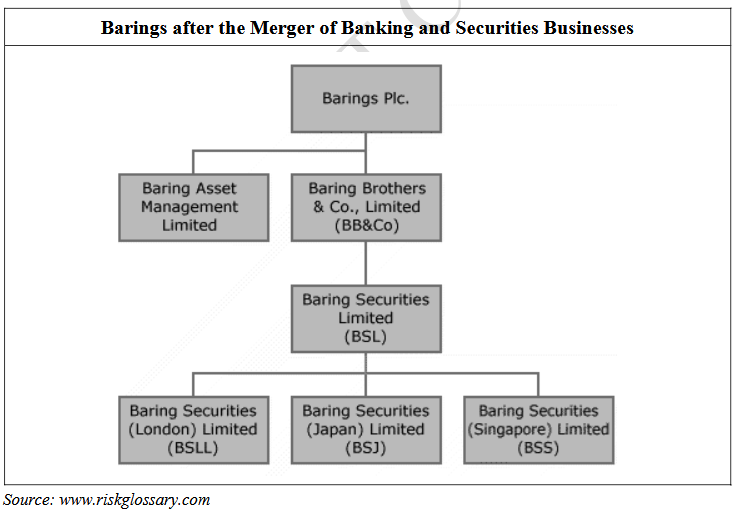 |
Exhibit III
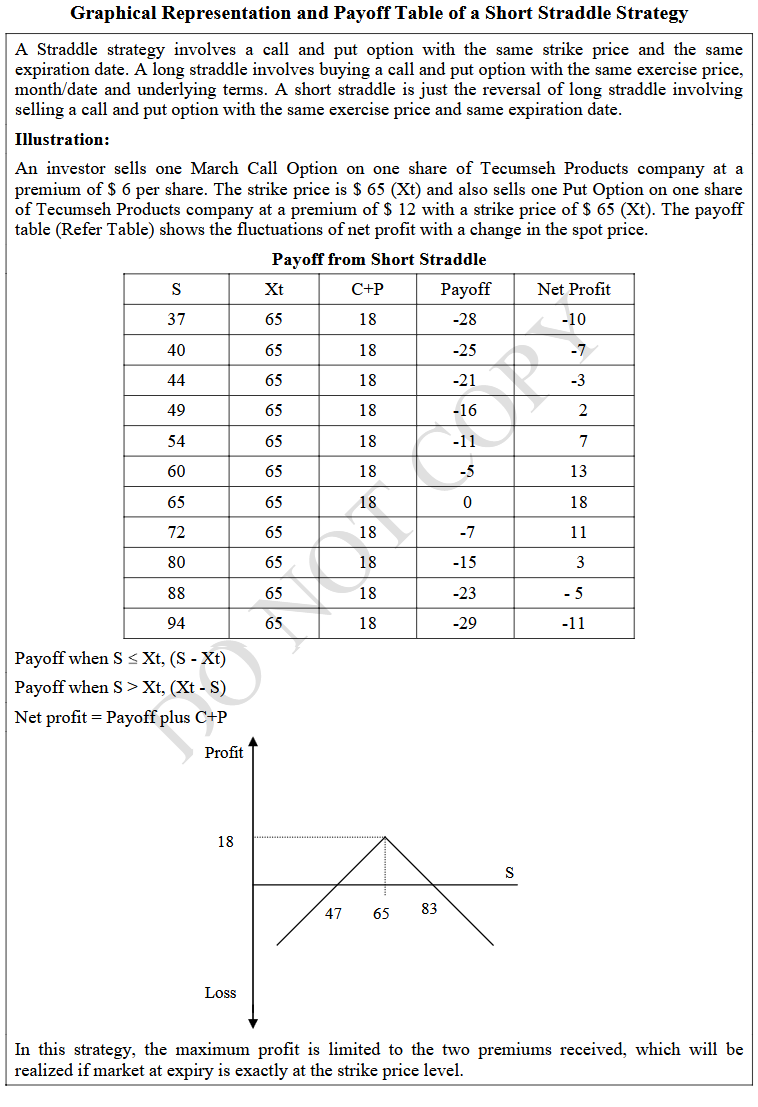 |
Keywords
Nicholas William Leeson's, unauthorized trading, derivatives, Barings Bank, UK, managerial supervision, operational control systems, mismanagement, derivatives operations
Related Case Studies
| Case Title | Details |
|---|---|
|
Case Title Financial Risk Management at BPCase Code: ERMT029 |
Details |
|
Case Title Enterprise Risk Management at Deutsche Post DHLCase Code: ERMT028 |
Details |
|
Case Title Oracle’s PeopleSoft Bid (Part C)Case Code: BSTA106 |
Details |
|
Case Title Oracle’s PeopleSoft Bid (Part B)Case Code: BSTA105 |
Details |
|
Case Title Oracle’s PeopleSoft Bid (Part A)Case Code: BSTA104 |
Details |