
Mercedes Benz’s e-Biz Solution: The Factory Delivery Reservation System.
Details
ITSY009
9
2002
YES
300
Daimler AG
Automotive
US
Management of Information Systems ,Systems Design, Operations and Supply Chain Management
Abstract
The case ‘gives an overview of the factory delivery program for Mercedes M-Class Sports Utility Vehicles of MBUSI. The program was designed and implemented with IBM Global Services as the consultants. The case deals with the features of the web based solution for factory delivery, the problems in implementing the solution and also the benefits MBUSI derived from the implementation of the FDRS.
Learning Objectives
The case is structured to achieve the following Learning Objectives:
- Web-Based Solution for FDRS program.
Contents
Mercedes Benz's e-Biz Solution: The Factory Delivery Reservation System
"One of our most fundamental goals in developing the system was to strengthen and market the Mercedes-Benz brand in the United States. The fact that we would be one of the first car manufacturers in the United States to have a factory delivery program would be seen as a very positive thing in this regard."
- William Engelke, Assistant Manager, IT Systems, Mercedes Benz US International, commenting on the FDRS.
LINKING CUSTOMERS
By 2000, Mercedes Benz United States International (MBUSI), builder of the high-quality M-Class sports utility vehicle (SUV), established itself as a company that also delivered superior customer services. One such service was the delivery option where by the customer could take delivery of the vehicle at the factory in Alabama, US.
The program called the Factory Delivery Reservation System (FDRS), enabled MBUSI to create and validate 1800 orders per hour. FDRS also automatically generated material requirements and Bills of Material1 for 35,000 vehicles per hour. The Customer Relationship Management (CRM) solution that made FDRS possible was based on Lotus Domino and IBM Netfinity server. Analysts felt that with its innovative use of the new program, MBUSI not only managed to improve its customer relations by providing the best service, but also demonstrated its commitment to customers by making them an integral part of the process. Customers were, in a way linked directly to the factory floor – which was a powerful sales tool.
BACKGROUND: MBUSI AND ITS BUSINESS CHALLENGES
MBUSI was a wholly-owned subsidiary of DaimlerChrylser AG5. In 1993, Daimler Benz realized that the 'Benz' brand could be extended to wider market segments. Traditionally, Mercedes Benz appealed to older and sophisticated customers only. Daimler Benz wanted to attract customers below 40 years of age, who wanted a rugged vehicle with all the safety and luxury features of a Mercedes.
Daimler Benz decided to develop a SUV known as the M-Class. It expected strong demand for the new vehicle and therefore planned to build its first car-manufacturing facility – MBUSI – in the (Tuscaloosa, Alabama) US. The MBUSI facility had many advantages. First, labor costs in the US were almost half that of in Germany. Second, the US was the leading geographic market for SUVs. Third, as the vehicles were assembled in the US, they could be distributed to Canada and Mexico more efficiently.
In January 1997, the factory started production at partial capacity and by the end of the year, it was producing at full capacity. By 2000, the factory was rolling out around 380 vehicles per day. The new M-Class ‘all-activity’ vehicle represented a new concept for the company. Also, mass customization required that each vehicle be treated as a separate project, with its own Bill of Material. To deal with these challenges, Daimler Benz decided to implement an enterprise wide Information Technology (IT) system, with the help of IBM Global Services.
To further strengthen the image of Mercedes Benz in the US, MBUSI planned to deliver vehicles at the factory, becoming the first international automobile manufacturer in the US to do so. MBUSI also wanted to enrich the customers’ experience. Commented William Engelke, “The factory delivery option gives Mercedes-Benz customers something that they do not get from other automobile manufacturers which is why we think the program will resonate with our customers. We think that having the factory delivery program available to Mercedes customers adds to the overall experience of the customer.”
THE DESIGN OF FDRS
The FDRS program was proposed in the first quarter of 1998. In the third quarter of 1998, MBUSI entered into a contract with IBM. A development team was constituted with IBM Global Solutions specialists and IBM e-commerce developers, who worked closely with MBUSI. The program became operational by the first quarter of 1999. The IT team at MBUSI had a clear set of functional specifications for FDRS. However, they relied on IBM to transform the concept into an e-business solution.
The FDRS was designed in such a way that customers buying the M-Class SUV could specify that will take delivery of their new vehicle at the factory. They could place the order at any of the 355 Mercedes Benz dealers in the US. An authorized employee at the dealership entered the factory delivery order the web interface. Timing was the most important aspect of the FDRS’ functionality, as it was closely linked with MBUSI’s vehicle production schedule.
Mercedes Benz United States of America (MBUSA), based in Montvale, NJ, was the first link in the FDRS program. It was the point where the dealer actually placed the order. MBUSA’s role was to coordinate the distribution of vehicles to dealers across the country. Later, it had to add the order to the company’s Baan Enterprise Resource Planning (ERP)9 system, which scheduled the order for production. About three months before the production date, the dealer could schedule in a window, the date and time of arrival of the customer at the factory for delivery. The window was then automatically computed by the FDRS to give the dealer, the possible delivery dates. Apart from the delivery date, the customer could also specify the accessories for the car and also request a factory tour.
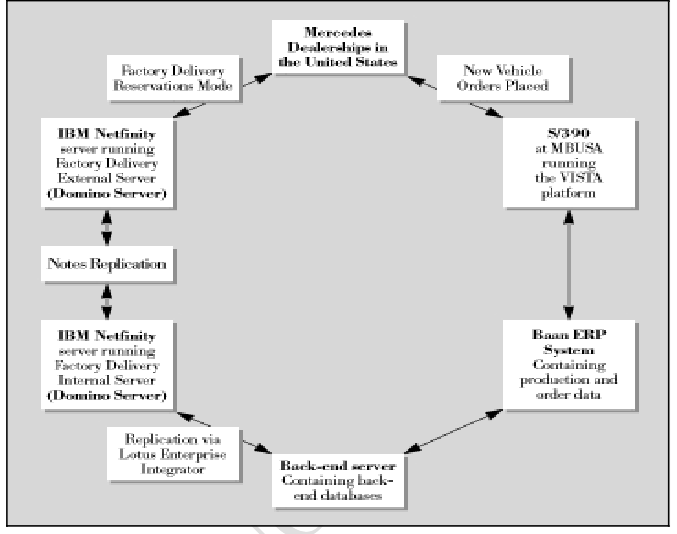
FDRS was based on Lotus Domino (Refer Exhibit I), Lotus Enterprise Integrator10 and IBM Netfinity servers. It also interfaced with IBM S/390 Parallel Enterprise Server, Model 9672-R45 located in Montvale, NJ (Refer Figure I).
Figure I
| System Architecture of FDRs |
 |
Source: MBUSI
There were two Domino servers – an IBM Netfinity 5500 and an IBM Netfinity 3000. The former that acted as the ‘internal Domino server’ was placed behind a firewall11. It replicated databases through the firewall to the external server. The replication, which was encrypted, represented the primary means by which the FDRS system achieved security. Netfinity 3000 acted as an ‘external Domino server.’ It had public information and was also the primary communication linkage for dealers.
The back-end of the FDRS was equipped with an Oracle database that updated the internal Domino server database with order information. The updation was done using Lotus Enterprise Integrator. The data which was replicated to the internal Domino server included lists of valid dealers and lists of order numbers. When an order was placed by the dealer on the FDRS system, the data was first stored on the external Domino server, after which it was replicated to the internal Domino server. Then it was replicated to the back-end database via the Lotus Enterprise Integrator. Data replication between the Lotus Notes servers happened every 15 minutes and data exchange with the back-end database three times per day.
There was also a link between the back end database and an IBM S/39012 mainframe based system located at MBUSA via a T113 line. MBUSA managed the flow of vehicles to Mercedes dealers across the United States. This mainframe based system, received new vehicle orders (as opposed to factory delivery reservation requests) from individual dealers. The orders were then sent to MBUSI's Baan system and also to the back-end database. The vehicle ordering and factory reservation data were coordinated with each other when the back-end database uploaded the data to the internal Domino server. This coordinated the production and delivery information.
FDRS IMPLEMENTATION
One of the most challenging aspects of the implementation seemed to be the complexity of the Lotus and Domino scripts. The development team had to group all the information from diverse systems. Commented William Engelke, “There was a substantial amount of very complex coding involved in the FDRS solution. This application involves a lot more than having our dealers fill out a form and submitting it. There are many things the servers have to do for the system to function properly, such as looking at calendars and production schedules. We built a solution with some very advanced communication linkages.”
IBM faced many technical challenges during the implementation of the program. One of them was the different timing schemes of the Lotus Notes databases and backend databases (ERP). This led to discrepancies in the data. Domino server was a Near Real Time (NRT) Server14, and MBUSI’s backend activities were both real time and batch processing. Also, to get the best results, the Domino server was an optimised subset of the ERP table set. However, the development team achieved a balance between the two ‘sides’ of the solution by focusing on issues of timing, error detection schemes, and alerts.
CUSTOMER SATISFACTION: FDRS’ PRIMARY BENEFIT
MBUSI seemed to measure FDRS’ success in terms of increased satisfaction of its customers. The company also believed that the marketing and customer satisfaction aspects outweighed the significance of more traditional cost-based benefits. Apart from the factory delivery experience, the program also offered the customer a factory tour and ride on the off-road course at a low cost. The company also seemed to gain strategic marketing benefits from the FDRS program, as it was able to establish Mercedes-Benz as a premium brand. (Refer Table I for advantages of FDRS in different areas). Customers could also visit the various tourist spots in Alabama after picking up their M-class vehicles.
Table I
Advantages of the FDRs Program
| Area | Advantages |
| Strategic Marketing Benefits |
FDRS was expected to improve customer satisfaction and brand The program also strengthened the brand image of Mercedes in the |
| Cost Savings | Development of a web-based solution enabled MBUSI to offer the factory delivery program at substantially lower costs, due to less reliance on administrative personnel. |
| Regional Economic Development |
“Package Marketing” the FDRS program with a ride to tourist sites, enhanced the image of Alabama as a tourist destination. |
| DaimlerChrysler AG | The creation of a similar – albeit smaller – factory delivery system to the European Customer Delivery Center in Sindelfingen, Germany, reflected favorably on the MBUSI business unit. |
Source: MBUSI
FUTURE OF FDRS
In 2000, MBUSI planned to leverage FDRS’ platform by adding a range of other services. MBUSI built an advanced platform to create communication links to its suppliers. Through the link, MBUSI provided them feedback on the quality of supplies it received. The dealers and suppliers had a user-ID and password, which the system recognized. It then routed them into the appropriate stage of the FDRS.
The company also planned to extend the innovative system to include transactional applications such as ordering materials and checking order status on the Web. The company expected that the new system based on FDRS, would be more cost-effective than the Electronic Data Interchange (EDI) system.
QUESTIONS FOR DISCUSSION
1. “The factory delivery option gives Mercedes-Benz customers something that they do not get from other automobile manufacturers.” Briefly discuss the salient features of the Factory Delivery Reservation System of MBUSI.
2. The case mentions that one of the most challenging aspects of the implementation of the FDRS program was the complexity of the Lotus and Domino scripts. Discuss the problems faced by IBM Global Services during the implementation of FDRS at MBUSI.
3. “One of the most fundamental goals in developing the FDRS was to strengthen and market the Mercedes-Benz brand in the United States.” Discuss the other benefits of the FDRS program.
EXHIBIT
Exhibit I
Lotus Domino
|
Enterprise Resource Planning (ERP) aims at making companies more competitive and Lotus Domino enables access to the system. Combined with ERP, Domino creates a powerful |
Source: www.itmanagement.earthweb.com
Keywords
Factory delivery program, Mercedes, M-Class, Sports Utility Vehicles, MBUSI, IBM Global Services, web based solution, factory delivery, solution, FDRS
Related Case Studies
| Case Title | Details |
|---|---|
|
Case Title Inventory Problems at NikeCase Code: OPER030 |
Details |
|
Case Title Sears Logistics Management PracticesCase Code: OPER026 |
Details |
|
Case Title ITC: Going Rural with e-ChoupalCase Code: CLBS036 |
Details |
|
Case Title Motorola in 2004: Zander’s ChallengeCase Code: BSTA101 |
Details |
|
Case Title The Need for Business Intelligence in Insurance OrganizationsCase Code: INS048 |
Details |