
Instinet - The First Electronic Communication Network
Details
ITSY018
9
2002
YES
300
Not Applicable
Technology & Communications
US
Technology in Capital Markets
Abstract
The case describes the evolution of electronic communication networks in general, and Instinet in particular. The case deals with the functioning of ECNs, the advantages of ECNs, the role of ECNs in equity markets, and the competition in the ECN market. Instinet was the first ECN and soon became a leader in the ECN market. Slowly competition increased in the market, and Instinet was considering other areas of operations to maintain its leadership position. The case also describes the strategies adopted by Instinet to deal with the growing competition in the ECN market.
Learning Objectives
The case is structured to achieve the following Learning Objectives:
- Operation of electronic trading systems and ECNs.
Contents
Instinet – The First Electronic Communication Network
“One of the biggest challenges they've (Instinet) got is their competition is getting stronger, I think that they are struggling a bit to come to terms with their position in the market.”
- Antonia Ness, senior research associate at brokerage Raymond James & Associates.
INTRODUCTION
On January 25, 2002, Instinet announced that it laid off 150 employees, i.e., about 7% of its staff, to cut costs. The move seemed to have come amid increased competition for share orders. Earlier, in 2001, Instinet laid off 240 employees. The two-year old Wall Street slump, and increasing competition among Electronic Communication Networks (ECNs) – Instinet seemed to be in problems from all sides.
In November 2001, Island ECN, one of Instinet‘s competitors, reported that its Nasdaq trading volume surpassed Instinet's for the first time ever. In December 2001, while Island garnered 10.1% of the Nasdaq share volume, Instinet managed 9.2%. The companies that ran ECNs, generated most of their business from matching Nasdaq shares for customers. ECNs accounted for about one-third of Nasdaq‘s trading volume.
Instinet was also expected to face more competition from the planned merger of its competitors –Archipelago and RediBook. In December 2001, Archipelago and RediBook had a combined share volume of 8.6% of Nasdaq share volume. Analysts felt that the merger will allow the two companies to cut down costs apart from increasing their share volume.
BACKGROUND NOTE
Instinet, then known as Institutional Networks Corporation, was founded in 1969 in the US, and it pioneered the concept of electronic stock trading. Initially, Instinet ECN was designed to enable institutional money managers to trade in listed stocks directly with each other with the objective of reducing the trading or transaction costs.
Instinet aimed at offering its services and tools that increased its clients‘ investment performance (Refer Table I). In 1987, Instinet was acquired by UK-based Reuters Holding Plc. (Reuters), and was operated as a separate division. In November 1999, Instinet acquired Lynch Jones & Ryan (LJR). LJR specialized in institutional trading and research. The acquisition gave Instinet a part ownership in LJR‘s NYSE floor brokerage unit.
By 2000, Instinet was trading in 40 global markets and was a member of 20 exchanges around the world. With 5,400 terminals around the world, Instinet had a share of more than 60% of the ECN market during 1999-2000. In May 2001, Reuters made an IPO and sold about 15% of its ownership interest in Instinet and retaining the remaining 85% stake. Instinet functioned as an agency broker. It remained neutral and neither bought nor sold securities in its own account.
Table I
Services Offered by Instinet
| Trading in Global Equities and Fixed Income instruments, and access to critical services including Clearing and Settlement; |
| Access to proprietary and third-party research, news, and information to help improve the quality of investments; |
| Access to analytic and transaction cost tools to aid investment performance; |
| Strategic investments that were designed to help improve market efficiency, and change the rules of engagement to benefit investors. |
Source: www.instinet.com
ECN: THE VIRTUAL STOCK EXCHANGE
An ECN is an electronic trading system4 that matches customer buy and sell orders with direct electronic access. With the influx of new technologies, markets around the world seemed to be undergoing a rapid transformation. Innovations in networking technology and the growing popularity of the Internet has led to a boom in the ECN market. In 2000, ECNs accounted for about 30% of the total share volume in Nasdaq stocks and 3% of exchange-listed stocks. The term 'ECN' was coined by the Securities Exchange Commission (SEC) to describe a broker-dealer company offering order matching services outside the NYSE floor and the Nasdaq. ECNs focused on the Nasdaq for the most part. However, those listed on NYSE could also be traded through the ECNs. (Refer Table II for some of the common features of ECNs). Investors could send their buy and sell orders over the network to an 'order book.' These orders were matched using mathematical algorithms5 with different levels of sophistication. The more sophisticated the algorithm, the more powerful the computer required to run it.
Table II
Features of ECNs
| The trading process is order-driven; buy and sell orders are allowed to directly interact with each other. |
| Direct interaction means that there is no need for human intervention to match these orders. Computerized algorithms — and not specialists, floor traders, or market makers — are used to execute trades. |
| These systems allow investors to trade anonymously. Orders can be placed directly with the order book where the identity of the investor is not revealed to other traders in the market. |
| Some systems allow investors to directly submit their orders to the market; others (and this normally applies to smaller investors) require orders to be routed through brokers. |
Source: www.cism.bus.utexas.edu
The subscriber base of an ECN comprised of institutional and retail investors, market makers and other broker dealers. Until 1997, individuals couldn‘t access the ECNs. Later, the SEC made regulatory changes that enabled individuals also to access ECNs. Some of the popular ECNs included Instinet, The Island ECN, Bloomberg Tradebook LLC, and MarketXT, Inc. ECNs offered several advantages over traditional exchanges. ECNs were faster, cheaper, offered additional information, and also operated round the clock. On the other hand, traditional exchanges offered the advantages of larger volumes of stocks, buyers and sellers. However, analysts felt that
with the evolution of ECNs, this advantage was slowly disappearing.
ECNs took just about a few seconds to process a transaction. The transaction time was much higher when an individual investor traded through a broker. The broker routed an order through a dealer and was paid for the order flow. Per-transaction costs were also low at the ECNs. For instance, at some ECNs, it cost less than a dollar to sell 10,000 shares. ECNs also eliminated hidden costs. Since payment for order flow often slowed down the transaction, it added up to the costs of either the seller or the buyer. This cost was eliminated since ECNs did not have any middlemen.
ECNs also offered more information – the sale prices were available to all and, the last sale price as well as the waiting sales prices were in the open. This information could be used to estimate the current price of a stock, and to collect information on short-term market trends. In theory, a sharp- eyed trader could enter the network, buy a stock at a favorable price, and instantly force everyone else to buy at a higher price. Above all, as there is no trading floor and intermediary between the buyer and seller, ECNs functioned throughout the clock.
These advantages seemed to have increased the trading on ECNs. By 2000, ECNs accounted for 30% of average daily transaction volume on the Nasdaq. Instinet accounted for the largest share of the total transactions on the Nasdaq. Commented Steve Tompsett, CEO of Execution Services, Instinet Corp., "In some of those stocks, we're over 50 percent of the trading volume today. So what we do is very demanding from a capacity perspective, very demanding from a reliability perspective."
As the volume of trading increases, it becomes difficult to match buyers with sellers. To handle this huge volume of trading, ECNs opted for advanced software algorithms. Some ECNs developed software that did not require expensive hardware. Some ECNs also collaborated with others to solve problems related to technology. For instance, Instinet supported a standard called the Financial Information Exchange (FIX), which enabled an ECN to interconnect and deliver services to multiple online brokerages.
Initially, ECNs acted as a private club. With Nasdaq's new order handling rules, ECNs evolved into a broader market. Nasdaq announced that ECNs should publicize their quotes over the Nasdaq quote montage via SelectNet. The highest bids and offers on every ECN were displayed over Nasdaq level II screens. ECNs also had the choice of sending their top quotes for display.
Analysts however felt that all the advantages of ECNs were overshadowed by a big disadvantage –low volume of shares and less number of buyers and sellers. Also, ECNs were cut off from each other. And a buyer and seller could not strike a deal if they were operating on different ECNs. It was easier for the NYSE to find buyers or sellers due to its size. As a result, trades were more frequent and prices were also more stable. For instance, the average spread11 of heavily traded stocks was about 24 cents during the day. The spread increased to 50 cents during the night, when an ECN was the only way to trade. This meant that if a stock was bought during the day and sold at night, there could be a loss, even if the stock prices did not change.
To overcome this disadvantage, ECNs started collaborating with each other. A trading network was formed comprising eight ECNs. The ECNs were trying to become stock exchanges, or buying existing stock exchanges. This meant that there would be more volume. Analysts remarked that if ECNs became stock exchanges, NYSE would lose its advantage. The listed stocks would also be traded on ECNs. These changes might create problems for the NYSE. Therefore, the NYSE proposed to allow an automated trading system for small orders. It would also give investors a window into its order book, a facility which the ECNs were already offering.
INSTINET – A HYBRID TRADING MODEL
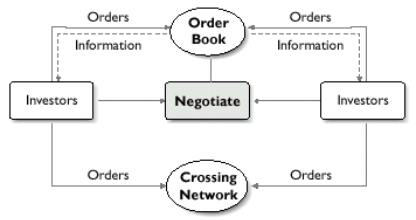
Instinet offered two different trading options – a standard crossing arrangement and a continuous trading system (Refer Figure I). There was a central order book in which investors entered orders. The book was accessible through Instinet‘s proprietary terminal, supplied free of cost to brokers and institutional investors.
Instinet‘s trading system was different from other ECNs in that it did not offer automated matching facility. It offered an interface which enabled investors to view different trading interests and negotiate electronically. If an investor was interested in a particular entry in the order book, he could hit the order, strike a deal, or even negotiate anonymously through a special window. Also, if a transaction on Instinet was the highest bid or the lowest offer, they were posted on the Nasdaq quote montage. Traders who were not part of Instinet could also see these quotes.
Instinet also operated a trading desk, which kept track of the orders entered into the order book, which interested its customers. When a suitable order was entered into the book by another trader, the desk informed the interested customer. Instinet also offered superior order routing service. For instance, a client could place an order on Instinet to route it to multiple markets simultaneously. This service was used by Instinet to attract more order flow. Clients could also specify the manner in which they wanted Instinet to handle their order.
Figure I
| Instinet’s Trading System |
 |
Source: www.cism.bus.utexas.edu
Nasdaq institutional investors seemed to prefer trading on Instinet. Its volume had grown from less than 10 million shares in 1987 to more than 150 million in 1998. Analysts felt that Instinet attracted more Nasdaq traders as it allowed anonymous trading. OTC market makers also preferred Instinet to SelectNet, as Instinet offered more information on the market for Nasdaq listed stocks. In addition, traders could either negotiate directly or use the crossing network.
However, Instinet also faced some problems. SEC legislation required traders to quote the same price that they quoted on ECNs publicly. This affected the 'privateness' promised by Instinet. Instinet also seemed to be taking business away from broker dealers on exchanges. As a result, the dealers were fighting to keep Instinet‘s terminals out of their towns. In London, there was a stock exchange rule which protected its brokers and kept Instinet as a small player in the European markets. However, in 1997, the rule was rescinded. Regulators in Canada were not very keen on Instinet. For instance, in 1989, Instinet Canada was not allowed to offer electronic trading services in Canadian stocks to Canadian clients, when it planned to acquire a seat in Toronto Stock Exchange. Instinet‘s entry was opposed by every major Canadian broker. Though the Toronto Stock Exchange granted permission, Instinet was not able to establish terminals due to the resistance from brokers. In late 1995, the Ontario Securities Commission permitted Instinet to set up terminals and act as an international dealer. Slowly, the competitive pressures on exchanges changed. In November 1999, the Toronto Stock Exchange helped Instinet to overcome the opposition from broker.
THE FUTURE OF INSTINET
By late 1990s, competition in the ECN market had intensified. By early 1999, there were 9 ECNs registered with the SEC and Nasdaq. These new entrants gave a tough competition to Instinet. Instinet's competitors like Island and Archipelago took advantage of the latest networking technologies and reduced transaction costs and attracted more order flow. Moreover, competition in Nasdaq trading also increased. Therefore, Instinet was looking at other markets to increase order flow. It was collaborating with other ECNs, expanding services, and to enter international markets. In 1998, Instinet planned to collaborate with the Chicago Stock Exchange and gain access to the Intermarket Trading System (ITS).13 However, in December 1999, the SEC decided to open up the ITS to both the Nasdaq and the ECNs. The new rule made it more difficult for Instinet to compete with other ECNs.
In response to the increasing competition, Instinet started focusing on research and analytics. It also started expanding its competitive position abroad. In late 1999, Instinet announced that it acquired a stake in a London based electronic stock exchange Tradepoint Financial Networks. Tradepoint is a member of the group comprising broker dealer firms such as Morgan Stanley, Dean Writer and JP Morgan Fund Management. The group also included fund management companies like American Century and Archipalego ECN.
In 1999, to increase the order flow, Instinet opened its after trading hours service to retail or small individual investors also. Initially, the service was open only to registered and institutional investors. Instinet also entered into an alliance with E*Trade, a brokerage firm. Under the alliance, E*Trade would route its after-hours order flow to Instinet. Instinet also acquired a stake in W.R. Hambrecht Co., which offered investors wider exposure to the IPO process. This enabled issuers to generate capital more efficiently.
In March 2000, Instinet bought an interest in Vencast.com, a solutions provider for the private equity industry. It also purchased a minority stake in Belgium based Tradeware S.A. which was involved in developing trading strategies to offer real-time order routing to electronic stock exchanges.
In October 2001, Instinet acquired ProTrader Group, LP, a firm that offered advanced trading technologies and electronic brokerage services primarily for retail active traders and hedge funds. The deal was expected to expand Instinet's reach into the retail active trader and hedge fund market segments. Analysts remarked that Instinet was trying all possible ways to counter competition and maintain its leadership position in the ECN market.
QUESTIONS FOR DISCUSSION
1. Innovations in networking technology in general and the phenomenal growth of the Internet in particular led to a boom in the electronic trading systems business. What are the advantages of ECNs over traditional exchanges?
2. By late 1990s, competition in the ECN market had intensified. The market also seemed to be consolidating. What do you think is the future of ECNs, with special reference to Instinet? How can Instinet counter the increasing competition?
Keywords
Evolution, electronic communication, networks, Instinet, ECN, equity markets, leader, operations, strategies
Related Case Studies
| Case Title | Details |
|---|---|
|
Case Title NASDAQ’s Securing Security TransactionCase Code: ITSY013 |
Details |