
The Hotel Corporation of India Story
🌐 International Buyers — Pay via PayPal
Details
BSTR015
7
2002
NO
0
Hotel Corporation of India Ltd.
Travel & Tourism
India
Strategic Planning,Growth Strategy
Abstract
The case provides insights into the dismal performance of HCI. The company had been performing badly due to internal as well as external problems. The case examines these problems and also briefly comments on the status of the company's disinvestment plan. The case is so structured as to enable students to see how mistakes at the planning stage can lead to major problems for a company. The students should understand how HCI had to pay heavily for its mistakes. They should also be able to comment on the role of AI in HCI's poor performance.
Learning Objectives
The case is structured to achieve the following Learning Objectives:
- Performance of public sector firms
- divestment
- hurdles to divestment.
Contents
“We are in no hurry to push through the process.”
- A Civil Aviation Ministry Official, commenting on the sale of HCI, in May 2001
In July 2001, the government of India decided to separate the sale of Hotel Corporation of India (HCI) from the privatization of Air-India (AI), posing the latest roadblock in the much-delayed sale of HCI. HCI, a wholly owned subsidiary of the state owned international airline AI, operated the Centaur range of hotels and the Chefair flight kitchens in India.
The government's decision to separate HCI's sale from AI's disinvestment was primarily due the fact that HCI's sale was taking much longer than anticipated. If HCI were considered a part of AI, then disinvestment of the airline would be delayed further. Since AI?s disinvestment was reportedly proceeding at a much faster pace at this point in time, the government did not want to delay it.
According to the original plans for AI?s disinvestment, the revenue realized from the sale of HCI was to be given back to the airline. However, the separation of HCI and AI changed the situation. Earlier, the prospective buyers of AI would have had to pay for HCI as well, but now they could leave HCI out of the deal.
The absence of bidders for HCI's property in Srinagar was another hurdle in its sale. Though many hospitality majors had shown interest in acquiring the other Centaur properties, the Srinagar hotel had no takers. The Jammu & Kashmir state government was willing to buy the hotel, but the terms and conditions laid down by the government were not acceptable to HCI.
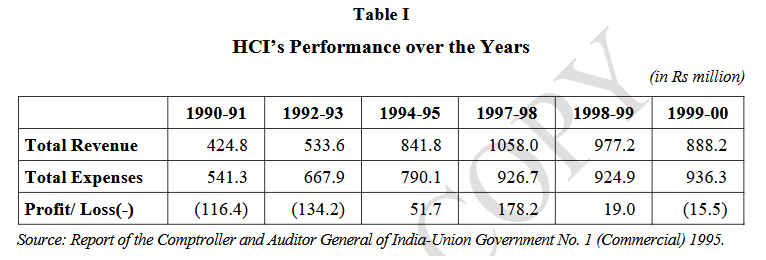
The disinvestment hurdles were only indications of major problems. The company was mired in a host of internal and external problems. HCI was in deep financial trouble, with its paid up capital of Rs 406 million completely eroded by accumulated losses of Rs 790 million by March 1995. For the financial year 2000-01, HCI posted losses of Rs 15 million on total revenues of Rs 888 million. Media reports attributed HCI's dismal performance over the years largely to the way the company was mismanaged by the government, and, more importantly, by its parent company, AI.
HCI was set up in July 1971 as a wholly owned subsidiary of AI, following the latter's decision to enter the hotel business. AI wanted to offer its passengers better hotels, both at the international airports and at other places of tourist interest. Thus, HCI?s main objectives were identified as carrying on the business of hotels, motels and flight kitchens as well as other activities to assist AI's business.
In April 1973, HCI was handed over the assets of two flight kitchen units at the Mumbai (Chefair Flight Catering Bombay – CFCB) and Delhi (Chefair Flight Catering Delhi – CFCD) airports. These units, originally owned by AI, were set up in 1969 and 1970, respectively, for catering to AI's requirements. Later, they began offering services to Indian Airlines (IA) and some international airlines like Air France, Lufthansa, Singapore Airlines and Aeroflot. The first hotel of the company, the Centaur Hotel at Bombay Airport (CHBA), was commissioned in May 1975. The hotel was well received by the airlines, travel agents and business travelers. The Centaur Hotel at Delhi Airport (CHDA) was commissioned in November 1982 and soon became popular with airline transit passengers and airlines crew. The Centaur Lake View Hotel at Srinagar (CLVH) was commissioned in December 1983. The last addition to the Centaur Hotel Chain was the Centaur Hotel at Juhu Beach, Mumbai, (CHJB) which was commissioned in October 1986. Situated on the Juhu Beach, the hotel became extremely popular for its food and theme parties. While CHBA was a profitable venture from the very beginning, CLVH incurred losses continually due to disturbed conditions in the Kashmir Valley. CHJB and CHDA, which were making losses till 1993-94, made marginal profits in 1994-95. Table I gives a summary of HCI's financial performance from 1990 to 2000.
Apart from operating the above hotels, HCI also operated a small hotel at Rajgir (Bihar), which was commissioned in November 1984. The hotel was operated through Indo Hokke Hotels Limited (a 55.81% HCI subsidiary), in collaboration with a Japanese hotel chain, the Hokke Club. The hotel's business suffered because its operations were seasonal in nature. The average occupancy levels were very poor and the property ran into losses by the mid 1990s.
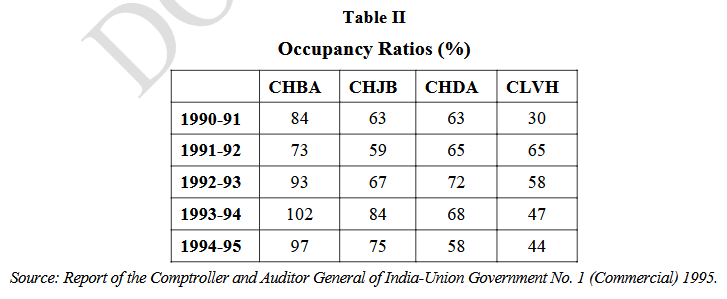
Occupancy levels in all the other HCI hotels were also quite low (Refer Table II) over the years due to various reasons. The low occupancy ratios2 in CHDA were attributed to industrial unrest among the employees and intense competition from other hotels. Occupancy in CLVH was affected by the political unrest in Kashmir, which had resulted in the tourist traffic getting significantly reduced. Also, the hotel was occupied by officials of various government departments, banks and border security forces, who were charged much lower than the normal tariff.
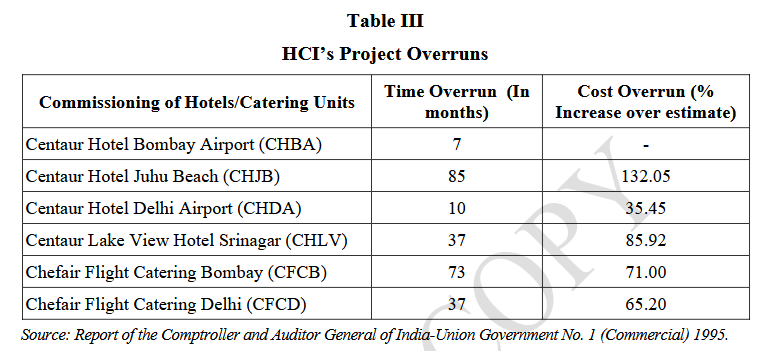
Analysts attributed a majority of HCI?s problems to poor planning. Most of the company's hotel projects ran into huge cost and time overruns, because of faulty planning and implementation. Between 1975-1986, projects worth Rs 527.6 million were completed at a total cost of Rs 881.9 million (Refer Table III).
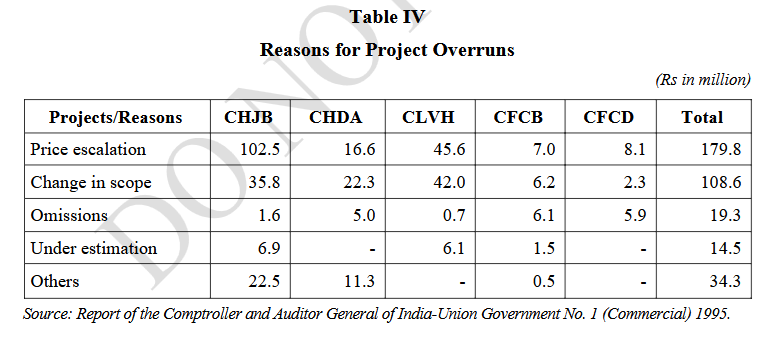
While a major part of the increase in the cost of the projects was primarily due to price escalation arising from time overruns, there was also a sizeable increase in the costs on account of changes in the scope of the project, indicating a lack of proper planning (Refer Table IV).
In many cases, HCI's resources had been mismanaged. Some of them are as follows:
* HCI had begun the construction of the CHJB in 1980, without getting the plans approved from the Bombay Metropolitan Regional Development Authority (BMRDA) and the Municipal Corporation of Greater Bombay. Later, the authorities made changes in the plans and HCI had to alter its construction plans. HCI got final clearances in June 1982. However, the implementation of the project was delayed due to revision of related drawings, designs, etc. Due to the design revisions, the consultants demanded a higher fee. This demand had to be acceded to, as any change in consultants at this stage would have delayed the project further. In spite of this increase in fees, the consultants failed to deliver the required drawings in time. This delay resulted in the contractors for air conditioning and electrical works claiming higher fees as well.
* HCI faced similar problems with its contractors and architects during the construction of CHLV. The contractors who had completed the structural work of the hotel asked for more money and pleaded their inability to proceed further, citing the lack of adequate resources. There were even reports of contractors stealing a huge amount of material belonging to HCI. In most of these cases, HCI had to deal with prolonged litigation or had to settle for damages awarded through arbitration.
* The CHLV had imported laundry equipment in December 1983 at a cost of Rs 7.2 million. After May 1985, due to poor occupancy, low voltage power supply and the absence of trained staff, the equipment was used only to a limited extent. While on one hand the laundry equipment was not fully utilized, on the other hand, between April 1984 and November 1986, the laundry services were entrusted to a private firm at Srinagar, involving an expenditure of Rs 0.37 million. During the period 1984-85 to 1987-88 the revenue earned by the hotel from laundry services was a mere Rs 0.63 million. The interest charges alone for these four years on the investment (at 18% per annum) amounted to Rs 5.2 million. The equipment was then transferred to CHJB in July 1991. However, the equipment could be installed only partly at CHJB, as some parts of the machine could not be transported to Bombay due to reasons stated to be beyond HCI's control.
* HCI had begun the construction of CHDA on land belonging to the International Airport Authority of India, without getting the building plans approved by the Municipal Corporation of Delhi (MCD). Following this, the MCD imposed a penalty of Rs 3.12 million on HCI. This was reduced later to a token penalty of Rs 0.31 million, after extensive deliberations, and at the instance of the Ministry of Tourism and Civil Aviation.
* HCI contracted for supply of 4161 kW of electricity from Delhi Electricity Supply Undertaking (DESU), effective from September 1982, for CHDA. The contracted load was based on the requirements originally planned, which also included electricity requirements for laundry equipment and for a discotheque. However, as the laundry and the discotheque were not constructed, the actual usage of power was less than the contracted demand. HCI thus approached DESU in February 1984 for reducing the contracted demand to 2100 kW. However, DESU did not agree to this, as according to the agreement between HCI and DESU, the demand level could not be altered till 1987. But even after 1987, the company did not approach DESU to have the contracted demand reduced. Consequently, the minimum billing, which was 60% of the contracted demand and which was higher than recorded consumption every month, was paid by HCI, resulting in avoidable expenditure of Rs 5.4 million during 1982-90.
* In September 1986, HCI procured 23 cold storage units at a total cost of Rs 3.6 million and installed them at CFCB. The units were not operated during the first year. Only five cold storage units were in use, two had been given on hire to ITDC, three were kept as standby, and the remaining were kept idle. Thus, the investment of Rs 2.81 million in the 13 remaining cold storage units not put in operation was lying unused. The company justified the buying of extra units by citing faulty capacity utilization estimates.
AI's flights from Bombay were catered exclusively by HCI?s flight kitchens till June 1981. However, the upliftment of meals came down to as low as 21.72% in 1994-95. This resulted in poor capacity utilization at the units and both of the flight kitchen units ran into huge losses. In spite of this, the units went in for a major expansion of their operations. Meal upliftment by AI meanwhile declined further as the airline found the meals served by HCI to be of poor quality, not upto international standards and not competitively priced. High staff costs at the flight kitchens further compounded their problems.
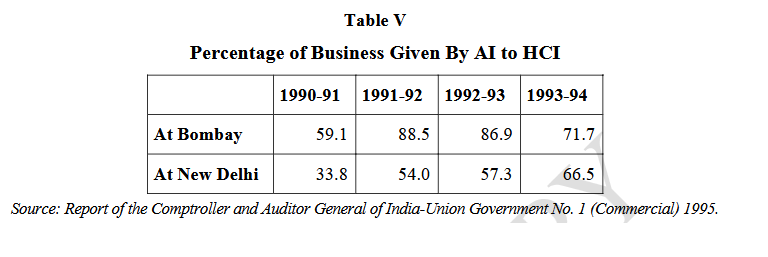
Even though HCI was AI's wholly owned subsidiary, the business given by AI to HCI's hotels in Delhi ranged from only 34-66% and in Bombay from 59-88% (Refer Table V). Also, room tariff offered by AI to HCI was quite low compared to the rest of the hotel industry. Even after new rates were set (following HCI?s request to AI to revise the room tariff) for AI passengers, crew and officials in October 1992, the charges were only 45% of the normal HCI tariff. Similarly, after the rate increase in October 1994, the fares were just 42% of the normal tariff.
With the government's decision to disinvest its stake in AI, HCI was also put up for sale. The government invited bids for individual HCI properties as well as the entire company. Indian Hotels, the Oberoi group and the ITC group were reported to be interested. As the government had allowed foreign hotel chains to bid for HCI properties through the 51% automatic approval route from the Foreign Investment Promotion Board (FIPB), a number of international hotel chains also showed interest in HCI. These included the Carlson Group, Bass Hotels, and the Rassel Group from Singapore, among others.
By November 2000, the government claimed to have received a very good response to the HCI sale. A total of 37 parties showed interest in bidding for HCI, of which 28 were shortlisted. Of these, 13 were selected for putting in the financial bids. At this point, the Ministry of Civil Aviation and the Disinvestment Commission decided to keep the foreign investors away from the HCI sale.
There were no further significant developments in the sale of HCI till May 2001, when the government announced that the HCI disinvestment completion deadline had been postponed to the third week of June. Attributing this delay to certain unavoidable 'procedural problems,' a government official said, “The government is keen on doing a good job, rather than rush through with the process and face the music later.” In June 2001, the government announced that it would soon be inviting financial bids for HCI after completing the legal documentation.
After the disinvestment was started, HCI undertook a major revamp exercise to prepare itself for the 'sale.' Managing Director R C Aggarwal said, “We are sprucing up our facilities at a cost of Rs 100 million in the first phase, so that the government can mop up a maximum consideration out of its disinvestment.”
In the first phase of this revamp, 60 rooms in the CHBA were renovated and made more spacious and equipped with facilities like a ready-to-use Internet connection. The lobby, coffee shop and health club were renovated with special attention to the ambience, finish and decor. A similar renovation exercise was carried out for 84 rooms at the CHJB. By June 2001, the first phase of renovation at the Juhu Beach hotel was completed and the second phase was started. The renovations helped increase occupancy at HCI?s properties, with the Juhu and Mumbai airport hotels reporting 60% occupancy, up from 35% in the pre-renovation period. Following this, HCI began an aggressive marketing exercise, urging families in the Delhi and Mumbai region to host functions like birthday and marriage parties at its properties. The company also wrote to various public sector undertakings (PSUs), offering a 40% discount on bulk bookings. Huge discounts (50%) were offered to senior citizens also. The company gave its customers an option of staying at HCI properties for either four or eight hours, at a tariff of Rs 1,500 for the shorter duration and Rs 2,290 for the longer duration. This 'Pay for the stay and not the day' scheme was well received, leading to substantial improvements in the occupancy rate.
Even by the end of September 2001, the disinvestment of HCI had not been completed. The fact that the sale of HCI had been separated from AI and the AI disinvestment itself was not getting anywhere, did not seem to be helping HCI in any way.
1. Analyze the problems faced by HCI. To what extent was the company itself responsible for these problems? Do you think that AI's attitude toward HCI also contributed to HCI's problems? Give reasons to support your answer.
2. HCI's disinvestment seemed to be following the pattern of other PSU disinvestment programs, which seemed to drag on forever. Critically comment on the above statement. Do you think the separation of AI/HCI disinvestment would negatively affect the latter?
Keywords
HCI, internal, external, status, company, disinvestment, plan, planning stage, AI, poor performance, business strategy