
Reorganizing AT&T: From Vertically Integrated to Customer-Centric Organization (B)
🌐 International Buyers — Pay via PayPal
Details
BSTR078
15
2003
YES
400
AT&T Inc.
Technology & Communications
US
Restructuring,Organizational Design
Abstract
The case discusses the voluntary breakup of AT&T in 1995 (the largest in corporate history) and its implications on the company and the telecommunication industry in the US. It examines the organizational structure of AT&T after the break-up. The case then explores the events that led to another restructuring of the company in 2000 in which the company was split into four entities - AT&T Wireless, AT&T Broadband, AT&T Consumer and AT&T Business. The organizational structure of AT&T in 2001 is discussed in detail. The case then describes the problems faced by AT&T after the break-ups. Finally, the case discusses the issues before the new CEO - David Dormann and his restructuring plan in 2003 to make AT&T a more customer-centric company.
Learning Objectives
The case is structured to achieve the following Learning Objectives:
- Break-up of AT&T and its strategic implications.
Contents
“Changes in customer needs, technology and public policy are radically transforming our industry. We now see this restructuring as the next logical turn in AT&T’s journey since divestiture (1984). It will make AT&T’s businesses more valuable to our share owners, even more responsive to their customers, and better able to focus on the growth opportunities in their individual markets.”
- Robert Allen, former Chairman and CEO, AT&T, justifying the 1995 break-up.
“In breaking it up, AT&T wanted to increase its share value, which may work in the short run, but the company has set itself up for more trouble in the long run by separating the operations. AT&T never really worked out a way to be a vertically integrated company.”
- G. Anandalingam, Professor of Telecommunications Management, Wharton School, commenting on the 1995 break-up.
In September 1995, Robert Allen (Allen) announced the biggest voluntary break-up in corporate history. The erstwhile AT&T was split into three stand-alone companies – the New AT&T, Lucent Technologies and NCR. Explaining the reasons for this move, Allen said, “It has become clear that for AT&T's business to take advantage of the incredible growth opportunities...it has to separate into smaller and more focused businesses. We have reached the point where the advantages of our size and scope will be offset by the time and cost of coordinating and integrating sometimes conflicting business strategies.” The management said that this restructuring was aimed at making AT&T's businesses more responsive to customers and the competition.
Analysts commented that apparently the management of AT&T had realized that the strategies and the organizational structure of the company that made sense in the 1980s were not effective at all in the mid-1990s. Moreover, analysts felt, there were no real synergies between the company's equipment manufacturing and long distance telecom businesses. On the contrary, they were acting as impediments to each other's growth.
Analysts felt that Allen was resorting to another breakup due to AT&T's poor stock performance and its inability to face intense competition. The break-up of the Bell System had led to AT&T's market share in the telecom business plummeting from more than 90% in 1984 to around 50% by early 1996. Wall Street reacted favorably to Allen's announcement, with AT&T stock rising from $38 to $50 by late 1995 (Refer Exhibit I).
AT&T appeared to shift from its traditional long distance telephony business to the fast emerging communication and information services business including wireless communication, online services, consulting and e-commerce. Appreciating Allen's move, BusinessWeek reported, “With his bold, unpredictable move, CEO Allen has set AT&T on a clear path toward future. Allen has created a company whose future will depend on its ability to spin out ever-greater numbers of communications products. AT&T customers won't just want long-distance telephony over wires – they will want cellular service, Internet access, electronic commerce and more. Between now and 1997, Allen painstakingly has to divide the company he had run for seven years. When Allen announced the company will split into three parts, AT&T's 302,000 employees have all known that their jobs might be online. This time AT&T needs to move quickly. AT&T's $49 bn communications services business will find itself in a far more competitive industry very quickly.”
According to the break-up plan, the erstwhile AT&T would split into three separate publicly traded companies – a $49 bn-a-year communication services company that would continue to call itself AT&T (new AT&T); a $20 bn-a-year company, Lucent Technologies, which would offer communications systems and technology, and a $8 bn computer company, NCR, that would offer computer systems and services (Refer Exhibit II). Allen commented on the spin off: “We found ourselves always concerned about coordination and were even reluctant to act sometimes for the fear we would hurt the other parts of AT&T. The three units won't need to be so considerate of one another anymore. Each company will have its own board and its own stock; AT&T shareholders received shares in all three.”
The new AT&T aimed at providing the world's best „anytime, anywhere' communications and information services. The new AT&T consisted of AT&T's Communications Services Group, the AT&T Universal Card Services (UCS) Corporation, the newly established AT&T Solutions consulting and systems-integration organization, and AT&T Wireless Services, formerly McCaw Cellular Communications.
Lucent took over the business of designing, developing and manufacturing of telecommunications systems, software and products. It was the global market leader in the sale of public telecommunications network systems, business communications systems and microelectronics components for communication applications. It was also the largest supplier in the US of telecommunications products for consumers. Lucent supported network operators and businesses with engineering, installation, maintenance and operating support services. Its R&D activities were conducted through Bell Labs. Lucent's wide range of communications products included corded, cordless and cellular telephones, telephone answering systems and related accessories. In addition to Bell Laboratories, Lucent had five businesses including:
Network Systems: This division provided public networking systems and software to telecom providers and cable companies.
Microelectronics: This division manufactured integrated circuits, optoelectronic components, power systems and printed circuit boards for the telecom and computing industries.
Business Communications Systems: Formerly known as Global Business Communications Systems, this division manufactured and marketed advanced communications products and systems for business customers
Consumer Products: This division manufactured and sold/leased communications products for consumers.
Multimedia Ventures and Technologies: This division provided advanced technology systems and support services for government and commercial customers.
NCR dealt in information technology products, services, systems and solutions worldwide. NCR also sought to take advantage of its expertise and market presence in the retail, financial and communications industries to provide specific information technology solutions to customers in these targeted industries. NCR operated through five business units – the Computer Systems Group; the Financial Systems Group; the Retail Systems Group; World-wide Services; and Systemedia.
The restructuring of AT&T meant that several jobs became redundant. AT&T organized an elaborate procedure to deal with the layoffs. First, the leaders of various divisions and organizations came up with exact numbers of how many people they needed. Each supervisor then filled out an “employee assessment summary” for every subordinate rating him or her on a scale of 1 to 4 in seven different categories. Finally, bosses gathered in “round tables” of 15 to 20 people to deliberate on the fate of employees. About 300 round tables were conducted company-wide in November and December 1995 resulting in lay-off of several thousands of employees.
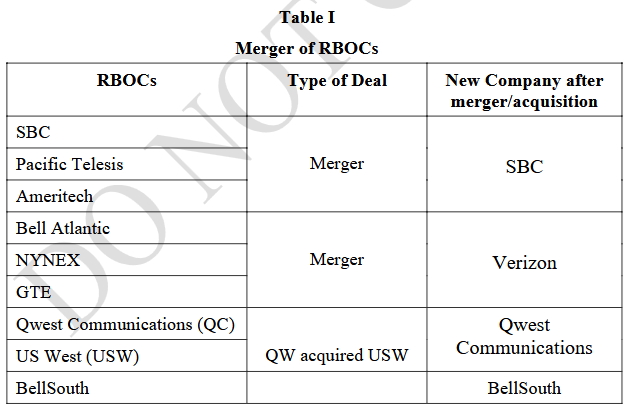
The Telecommunications Act 1996 (Refer Exhibit III) led to the deregulation of local telephone business. The act allowed the local telecom providers offer video services and sell long distance communication services out of their region if the providers allowed other local/long distance exchange carriers to operate in their region. The act also allowed long-distance phone companies and cable companies to sell local phone services.
The deregulation of local phone business meant that AT&T was free to enter any of these markets. In spite of the act, however, the local telephone market continued to be largely controlled by the RBOCs, and GTE.5 Competitors like AT&T found it tough to enter, mainly because the local companies refused to provide interconnections to their networks. On the other hand, the RBOCs and GTE were well positioned to move into long-distance services. In order to gain market share quickly in the local telephone business, AT&T acquired several local phone providers.
In the long-distance business, AT&T faced stiff competition from large players like MCI and US Sprint as they continued to penetrate AT&T's residential markets. The competition was mostly driven by price reductions. MCI had been trying to attract business customers by offering bundled services and wooing consumers with free airlines miles for every dollar they spent. US Sprint was attracting high-end customers with flat pricing and other innovative marketing ideas.
For the fiscal year ended December 1996, one year after the break-up, AT&T's long-distance revenues were virtually stagnant, rising by just 0.5 percent over 1995. However, the volume of calls carried increased by 9.2 percent. Analysts said that AT&T's major problem was that 60 percent of its customer base was in the unprofitable residential segment. At competitor Sprint, the revenues and volume rose percent and 14 percent respectively. An analyst remarked, “Since MCI and Sprint have high-end customers who spend all the time, they can gain market share faster than AT&T.”
Though AT&T's long-distance communication business was stagnant, the company made efforts to gain a strong foothold in other emerging markets. In March 1996, the company launched a successful Internet service – AT&T WorldNet Service. AT&T also bought IBM Global Network, a leading provider of global data networking services. In the same period, AT&T also sold operations that were perceived not to fit the company's goals any more. The two major businesses divested were AT&T Submarine Systems6 and Skynet Satellite Services.
In November 1997, Michael C Armstrong (Armstrong) became the Chairman and CEO of AT&T – the first outsider to head the company in nearly 80 years. Armstrong was quick to understand the problems faced by the company. He remarked, “Time wasn't one of our luxuries; the situation demanded a degree of intensity and focus on the challenges, assessing the alternatives and coming up with a direction.” Armstrong followed an 'invest or divest' strategy that aimed to increase AT&T's focus on its core businesses. He sold AT&T Universal Card Services Corporation to Citibank for $3.5 billion, and AT&T Communication's outsourcing unit to Cincinnati Bell for $625 million. In July 1998, Armstrong paid $11.3 billion to acquire Teleport Communications Group (Teleport), a local-exchange carrier based in New York. Owned by leading cable companies like TCI, Comcast and Cox, Teleport had 490,000 lines in 65 cities.
Industry analysts felt that buying Teleport was a first major step towards AT&T's goal of getting back into the $110 billion per annum local telephone market. Teleport gave AT&T access to local networks in 65 major markets and could be used to serve the corporations in these markets – a business estimated to be worth $21 billion. The acquisition meant that AT&T would not have to pay RBOCs, which collected a high fee every time a long-distance company used local networks to complete a call.
Armstrong also made efforts to get the consumers to use AT&T's nationwide wireless network for local calls. To attract more consumers, the company introduced a wireless phone that would work anywhere in the US. Armstrong also changed the way wireless calls were billed, so that cell phone owners would not have to pay for incoming calls. Armstrong also changed the positioning of AT&T, promoting it as an 'any distance' company. In AT&T's 1998 annual report, Armstrong wrote, “We're transforming AT&T from a long-distance company to an 'any distance' company. From a company that handles mostly voice calls to a company that connects you to information in any form that is useful to you – voice, data, and video. From a primarily domestic company to a truly global company.”
Concurrently, Armstrong moved to prune AT&T's bureaucracy and placed greater emphasis on execution. He tied bonuses of top executives to quantitative goals and stepped up the pressure to making quick decisions. Top executives were given stock-owning targets to align their interests with those of shareholders. Armstrong also sought to remove much of the formality AT&T had under the reserved and aloof Allen. Employees were allowed to meet the CEO without the need for prior appointments. Armstrong announced plans to streamline the duties of his top lieutenants to improve accountability. He created the post of chief marketing officer, to take on the country-wide responsibility for promoting the AT&T brand. Promotional responsibilities were earlier handled by the head of each operating unit.
In March 1999 and June 2000 respectively, AT&T bought TCI and MediaOne – two large cable providers. The company also tied up with other local cable TV companies, using their cables for phone services. This enabled AT&T to access more than 50% of US households with connections, bypassing the RBOCs. These acquisitions made AT&T the largest cable TV operator in the US. Armstrong invested $35 billion during the period 1998-2000 in acquisitions and infrastructure development. However, some analysts felt that Armstrong did little to salvage AT&T's long-distance communication business whose market share fell to 41% by late 1999 amidst intense competition from MCI and US Sprint. They also said that Armstrong had not formulated any concrete strategies to deal effectively with AT&T's excessive dependence on its core long distance business. He had not indicated clear plans for strengthening AT&T's international presence.
Commenting on the above concerns and its effect on AT&T's stock price, Asian Wall Street Journal reported, “Armstrong has an aggressive plan to expand via investments and acquisitions; to refocus AT&T on high volume, more profitable phone users and to make AT&T the dominant Internet player – all high growth efforts. Yet AT&T's stock price has dropped precipitously in recent weeks, indicating that investors are running out of patience. The company has lost nearly $18 bn in market capitalization in the past few months (March to September 2000).” Industry analysts felt that with the significant changes in the telecom industry after the implementation of Telecommunications Act, Armstrong had to prepare AT&T face competition in the emerging businesses including the wireless and broadband Internet. In an attempt to address these concerns, Armstrong announced a restructuring plan in October 2000.
According to the plan, AT&T would be reorganized into four independent publicly-held companies – AT&T Wireless, AT&T Broadband, AT&T Consumer and AT&T Business. Each company would function under the “AT&T” brand name. AT&T Wireless would be among the rapidly growing wireless companies in the US; AT&T Broadband would be the largest cable TV and broadband services company; AT&T Consumer would function as a leading consumer communications company; and AT&T Business would be a major enterprise communications and networking company.
According to Armstrong, the new companies would be more responsive to customer needs, while still providing the benefits of one-stop shopping and bundled services through inter-company agreements. Justifying the restructuring move, Armstrong commented, “We believe that we have announced the foundation and the path for creating long-term shareholder value and will enable these companies to be even more performance, market and customer-focused, faster in their response and more competitive in their offerings. Fundamentally, it's not only the next logical step, but the next necessary step in the transformation of this company.”
As per the plan, by 2002, AT&T Wireless and AT&T Broadband would trade as independent common stocks. AT&T Consumer, which included the residential long-distance and WorldNet businesses, would be represented by a tracking stock,9 leaving the company's business services, AT&T Business, as its principal unit.
The restructuring changed the organization structure of AT&T significantly. Before the break-up of the Bell System, AT&T was highly vertically integrated. After the break-up in 1984, AT&T adopted a matrix organization structure. The latest restructuring transformed AT&T's organization structure from a matrix to a divisional one. Each division was organized along markets (Refer Exhibit IV).
Analysts felt that at this point, AT&T had little choice but to opt for restructuring. They said that since the Internet and wireless communication had gained significant popularity in the late 1990s there had been a major change in the telecom industry environment. AT&T lost many customers as they shifted from traditional telephone lines communication to other modes like wireless and broadband Internet. The change in the industry environment not only led to market segregation but
also forced companies like AT&T to reorganize in order to satisfy consumer demands effectively. By adopting the new divisional structure, AT&T aimed at segregating these markets and catering them separately.
Most analysts felt that the restructuring was a step in the right direction. Russ McGuire, vice president of TeleChoice, a consulting firm in Boston (US) said, “The restructuring sends a message that the business segment is the core of AT&T. This hasn't been clear, and it hasn't been true in the past.” However, some analysts also cautioned that the success of Armstrong's move would depend largely on AT&T's ability to weave the services from the four companies together and create a unified bundling experience for its customers.
By July 2001, AT&T completed the split-off of AT&T Wireless, which became a separate, independent company. In December 2001, AT&T announced a $72 billion agreement to sell AT&T's Broadband business to Comcast Corporation10 (Comcast). The spin-off of AT&T Broadband was finally completed in November 2002. After the merger, Comcast emerged as the leading broadband communications company with global employee strength of 59,000 across 41 nations. The company had approximately 6.3 million customers in digital video, 3.3 million in high-speed data and 1.3 million in cable telephony. Media reports however pointed out that AT&T
had booked heavy losses by selling its broadband business in which Armstrong had invested $110 billion.
In November 2002, David Dorman (Dorman)11 took over as the new Chairman & CEO of AT&T. Dorman had joined AT&T as President in December 2000, and had served on top posts at long- distance carrier Sprint and at SBC before joining AT&T.
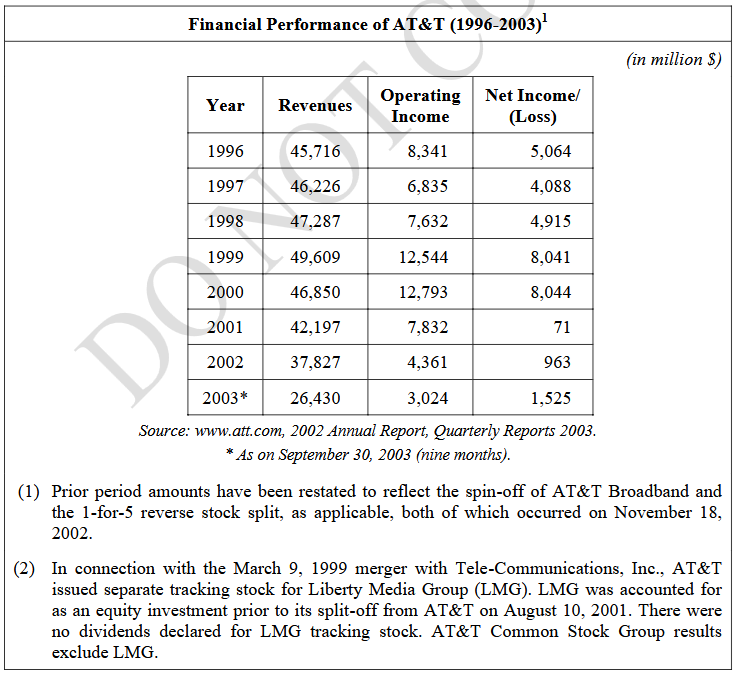
Occupying the top position at AT&T, Dorman faced several challenges. The major one was to stop the company's declining revenues and bring AT&T back onto the growth path. AT&T's revenues had fallen by 10.4% to $37.8 billion in the fiscal ending December 2002. The company's operating income had nosedived 44% to $4.36 billion for the same period (Refer Exhibit V).
By early 2003, AT&T faced fierce competition from local exchange carriers – the RBOCs that were quickly entering into the long distance communication business. The RBOCs provided 'all- distance' services in 35 states in early 2003, and planned to offer the same service in all the 50 states in the US by 2003-end. In the voice services that constituted 80% of AT&T's operating income, the company faced aggressive price competition from RBOCs, resulting in loss of market share. According to industry analysts estimates, the RBOCs were expected to capture 28 million residential long-distance customers constituting 40% of the market by the end of 2003.
Though the Telecommunications Act allowed AT&T to enter the local telecom business, the company had been extremely slow to do so. By the end of 2003, AT&T planned to offer 'all distance' service in just 16 states in the US. Moreover, as the competition increased, the prices a company could charge in the local telephone business began to fall rapidly. In order to increase its presence in the local telecom business, AT&T started offering a flat $5 discount on its long-distance service for those customers who also subscribed to the company's local telecom service. By selling the combined package, AT&T was able to capture 2.2 million local service customers by the end of 2002. The company had a total of 7.3 million local customers in the states in which operated in the same period.
AT&T's fixed line business had been badly hurt for several reasons. The company's corporate customers were not giving it more business due to the slowdown in the economy and increasing use of e-mail and mobile phones. It was also expected that AT&T would be severely affected by FCC's12 plans to disallow the company inexpensive access to the local telecom service market. AT&T had been serving its customers by reselling local services it purchased at a wholesale price from the RBOCs. Revamped regulations were likely to come into effect, curtailing AT&T's right to purchase local services at wholesale prices and making it pay much more for accessing them.
With all these problems in hand, Dorman had very few options left. Patrick Comack, a telecom analyst at Miami-based Guzman & Co. said, “The evolution of the industry is turning AT&T into a dinosaur.” The increasing financial problems even raised questions about AT&T's survival in the long term. Susan Kalla, a telecom analyst at Freidman Billings & Ramsey in Arlington in the US said “I don't think anyone believes they'll survive as a stand-alone company. The question is how, and how quickly, it [disappears].”
Against the backdrop of all these concerns, in April 2003, Dorman announced the reorganization of AT&T. The reorganization aimed at serving the company's customers quickly by expediting decision-making process (Refer Table I). After the spin-off of AT&T Wireless and AT&T Broadband, the company had only two divisions left – AT&T Business and AT&T Consumer. The reorganization would reduce the layers of management between the CEO and the line workers from 14 to 7. Dorman felt that several layers of management had made AT&T lethargic and unresponsive to the needs of customers.
Table I
Steps Taken for Reorganizing AT&T (2003)
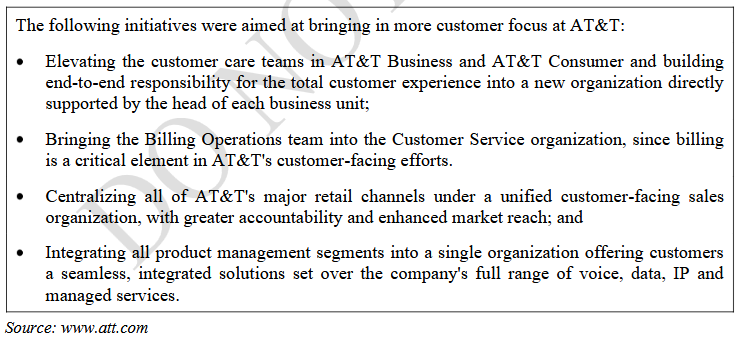 |
Dorman described the reorganization as a long-term exercise, and said it was not just prompted by AT&T's poor financial condition. He said that it was a part of the holistic organizational strategy of AT&T to transform its culture by laying less emphasis on business functions and designing a unique horizontal leadership structure. Dorman said, “We've benchmarked ourselves against the best companies in the world and aligned our resources squarely against our top priorities. This streamlined structure helps us get even closer to our customers. We're determined to keep leading the telecom pack today, and we're preparing now to lengthen that lead when the economy improves.”
The latest reorganization appeared to reflect AT&T's transformation from a holding company to a more customer- and market-centric, single-company organizational structure. Under the new structure, a few management layers were to be completely eliminated. Analysts felt that though this measure would result in retrenchment and reallocation of job positions, it would also assist the top management in faster decision-making, helping to meet customer needs in a shorter span of time. Analysts described Dorman's strategy as conventional rather than risky. Dorman said the company would sell AT&T's non-performing units and cut jobs to pay the company's huge debt. Dormann aimed to reduce AT&T's $65 billion debt at the beginning of 2003 to $10 billion by the year-end. Many media reports however indicated that if Dormann succeeded in reducing AT&T's debt significantly, he had one option – to sell AT&T to any of the four RBOCs.
1. Critically examine the break-up of AT&T in 1995 and the changes in its organizational structure. Do you think the breakup was successful in achieving the management's objectives? Why or why not? Take a stand and justify it, giving reasons.
2. What were the reasons that led to the restructuring of AT&T in October 2000? Examine the organizational structure of AT&T after the restructuring, and compare it with the previous structure.
3. In the early years of the new millennium, AT&T's financial performance deteriorated significantly. What issues did the new CEO Dormann face in 2003? What steps should Dormann take to revive AT&T's business and bring the company back into growth? Do you think the sale of AT&T to any of the RBOCs will be a right move for Dormann? Take a stand and justify giving reasons.
Exhibit 1
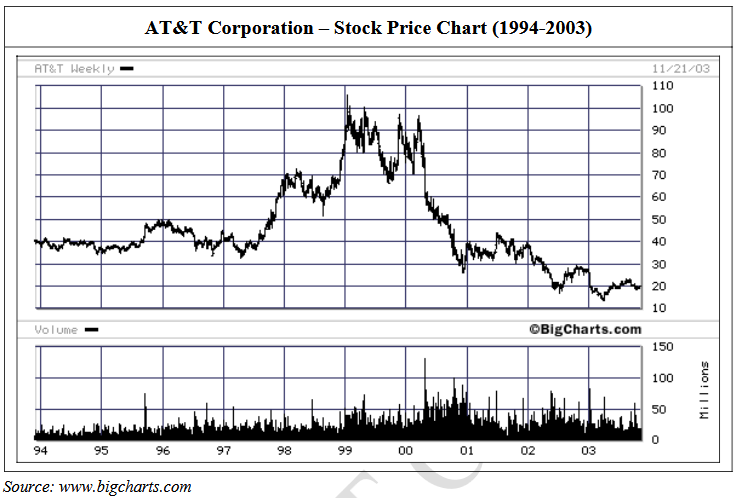 |
Exhibit II
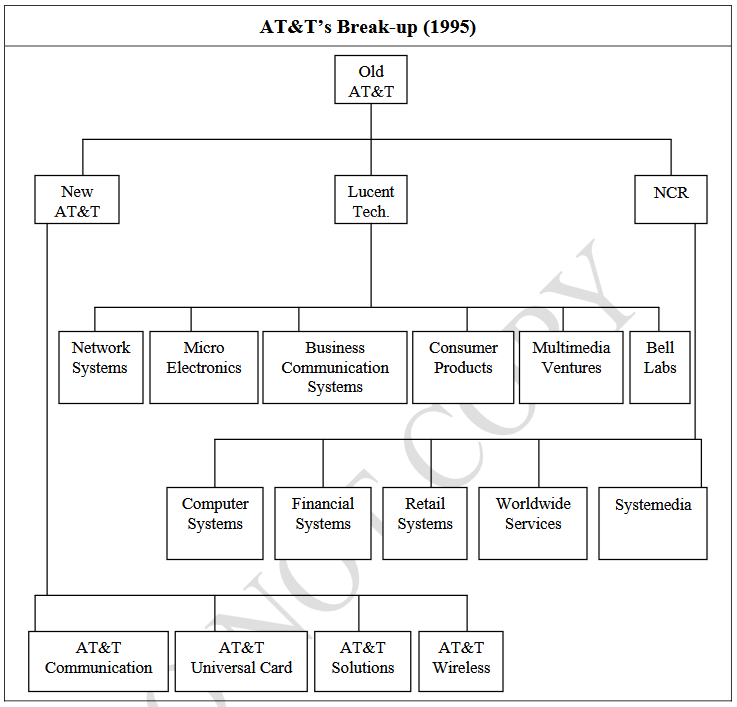 |
Exhibit III
|
After AT&T's 1984 breakup, telecom and broadcasting technologies made rapid progress. Mobile
After the Act, the US telecom industry was transformed from a vertical industry structure (each |
Adapted from “Telecommunications Industry Structure in the Future: Horizontal or Vertical?” by Tom
Carroll, Ranjini Srikantiah, and James Wolters, posted on www.mit.edu, May 11, 2000 and other sources.
Exhibit IV
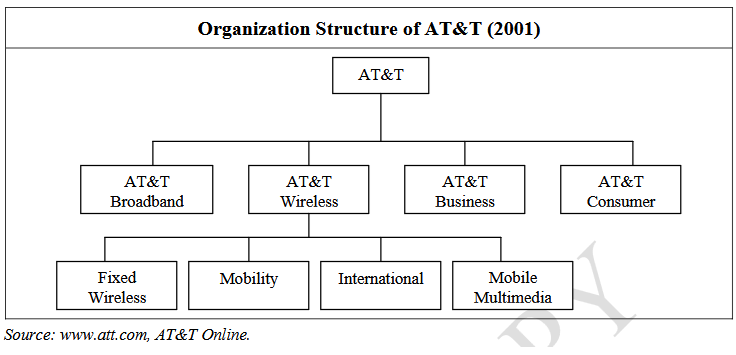 |
Exhibit V
 |
Keywords
Voluntary breakup, AT&T, 1995, telecommunication industry, US, organizational structure, AT&T, break-up, restructuring, 2000, four entities, AT&T, Wireless, AT&T Broadband, AT&T Consumer, AT&T Business, 2001, CEO, David Dormann, 2003, AT&T, customer-centric company
Related Case Studies
| Case Title | Details | Price | Add to Cart |
|---|---|---|---|
|
Case Title Spotify: Can Aligned Autonomy Survive Global Scale?Case Code: HROB299 |
Details | 400 | Add to Cart |
|
Case Title Restructuring Levi Strauss & Co.: Challenges Ahead for Michelle GassCase Code: BSTR706 |
Details | 500 | Add to Cart |
|
Case Title The Tech Phoenix: Satyam’s 100-Day TurnaroundCase Code: BSTR703 |
Details | 600 | Add to Cart |
|
Case Title Zomato: Downsizing to Remain CompetitiveCase Code: CLBS152 |
Details | 200 | Add to Cart |
|
Case Title Holacracy at ZapposCase Code: HROB178 |
Details | 600 | Add to Cart |