
Intel : Managing Working Capital
🌐 International Buyers — Pay via PayPal
Details
FINA010
8
2005
NO
300
Intel Corporation
Technology & Communications
US
Working Capital Management
Abstract
Intel is the undisputed leader in the microprocessor industry with about a 90% market share. Since 1968 when it was founded, Intel has launched many ground-breaking products. Many analysts attribute Intel''s success to its technology, innovation and management. It has also attempted to become a disciplined company that maximises operational efficiency, one important dimension of which is working capital management. The case outlines various aspects of working capital management at Intel.
Learning Objectives
The case is structured to achieve the following Learning Objectives:
- 0
Contents
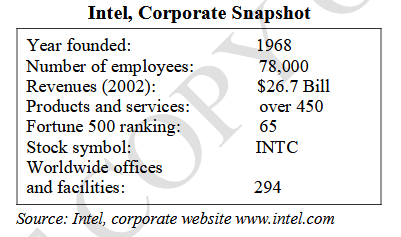
In early 2004, Intel was the undisputed leader in the microprocessor industry with about 90% market share. Since 1968 when it was founded, Intel had launched many groundbreaking products. By 2004, it had 450 products and services ranging from the ubiquitous PC microprocessors like Pentium, the 64-bit high-end Itanium 2 to mobile computing chipsets such as Centrino. Intel ended 2002 with revenues of $ 26.7 billion. Many analysts believed Intel’s success was as much about technology as about management. They attributed the success of Intel to its unbroken leadership chain. As one great leader retired, another took over. While Intel was well known for innovation, it had also attempted to be a disciplined company that maximized operational efficiency. Intel realized that as competition intensified, working capital management would become increasingly important.
Exhibit: I
 |
A popular story which went around in Intel was that one weekend afternoon in the spring of 1968, Gordon Moore (Moore) dropped by Robert Noyce's (Noyce) home. The two decided to launch a new company to pursue large-scale integrated (LSI) memory. That was the moment when Intel (abbreviation of Integrated Electronics) was born though the company was officially launched in the month of July that year. Little did they know that their new venture would define contemporary electronics and change the way the world worked, lived and played.
Andrew Grove (Grove), a first generation immigrant from Hungary, soon joined Noyce and Moore. Moore handled long-range planning and Grove was responsible for manufacturing. Noyce and Moore had an aura about them owing to their earlier association with Fairchild Semiconductors. Career aspirants perceived Intel as a hot new company. Intel’s revenues grew rapidly driven by sales of semiconductor memory to large computers.
In 1971, Intel introduced the world’s first microprocessor1, the 4004, a development that marked a turning point in the PC industry. Also that year, Intel introduced the world's first erasable programmable memory, the EPROM. The powerful combination of the microprocessor and the EPROM laid the foundation for the personal computing revolution. Later, Intel introduced the successors to the 4004, the 8008, 8080, and 8088. Intel’s fortunes were boosted considerably when its 8088 chip was chosen for the IBM PC in 1981. Soon, Intel emerged as the most widely accepted supplier of microprocessors. Computer manufacturers and operating system suppliers found it safer and more economical to build their products around Intel chips.
During 1985 and 1986, Grove, who succeeded Noyce as CEO, closed seven factories, abandoned several businesses, and cut head count by one-third. Intel, however, maintained its commitment to research activities. R&D and capital expenditures together accounted for 30 percent of revenues in 1986. To recover the heavy investments, Grove focused on the development of proprietary PC chips. Intel licensed technology to competitors like Advanced Micro Devices (AMD) to make their own versions of the 80286 chip. When AMD had captured 52 percent of that market by 1990, Intel made attempts to protect the technology of its highly successful 386 (1985) and 486 (1989) chips. This prompted AMD to sue Intel for breach of contract. Later, the two companies patched up and settled several court cases. AMD got the micro code license and Intel was awarded $58 mn in damages.
In 1996, Intel announced that it would stop making supercomputers by the end of the year. It also joined hands with MCI to produce a new line of servers for use by small and medium-sized businesses in Internet commerce. Intel also announced plans to introduce a new modem that would allow PCs to send and receive videophone calls over standard phone lines. Intel launched its MMS (multimedia extension) Pentium and Pentium II microprocessors in 1997.
In early 1999, Intel announced the launch of Pentium III, a speedier Pentium with turbo-charged multimedia processors. Intel also strengthened its position in the memory chip market with a $100 million investment in Samsung (the world's largest DRAM chips producer) to tie up supplies for next generation DRAM chips. A string of other problems beset Intel in 2000. The company recalled hundreds of thousands of its motherboards that were distributed with a defective chip, and later cancelled the development of a low-cost microprocessor for budget PCs. Also in 2000, Intel began introducing its line of consumer Web appliances and interactive toys. The company later released the long-awaited Pentium 4 processor.
By the end of 2000, Intel seemed to be leveraging the Internet boom and its stock price rose to unprecedented levels. As IT spending across the world increased, the sales of Intel’s chips also soared. The company generated revenues of $ 33.7 billion in 2000. But by 2002 as the Internet bubble had burst and technology spending was cut sharply, Intel’s net revenues decreased to about $ 26 billion in 2001 and 2002. In 2002, Intel shifted its focus to wireless computing. It started working on the new mobile technology, Centrino. Centrino was ideally suited for a range of thinner, lighter notebooks that delivered outstanding performance to satisfy the needs of mobile computing.
Intel's major products included microprocessors; chipsets; boards; flash memory; application processors used in cellular handsets and hand-held computing devices; cellular chipsets; networking and communications products, such as Ethernet connectivity products, optical components and network processing components, and embedded control chips (micro controllers). The Intel Architecture business provided the advanced technologies necessary to support the desktop, mobile and enterprise platforms. The Wireless Communications and Computing Group focused on component-level products and solutions for the wireless hand-held communications market. The Intel Communications Group focused on wired and wireless connectivity products and provided key components for networking and communications infrastructure devices. Though best known for its microprocessors such as Pentium and Celeron (about four-fifths of all new PCs had them), Intel also made flash memories where it was the global leader and embedded semiconductors for the communications and industrial equipment markets. Most computer makers used Intel processors. PC giant Dell was the company's largest customer while most wireless cell phones and handheld devices manufacturers used Intel’s flash memory. Intel also offered a variety of flash memory hardware, software and packaging solutions designed to meet the diverse needs of embedded system designers.
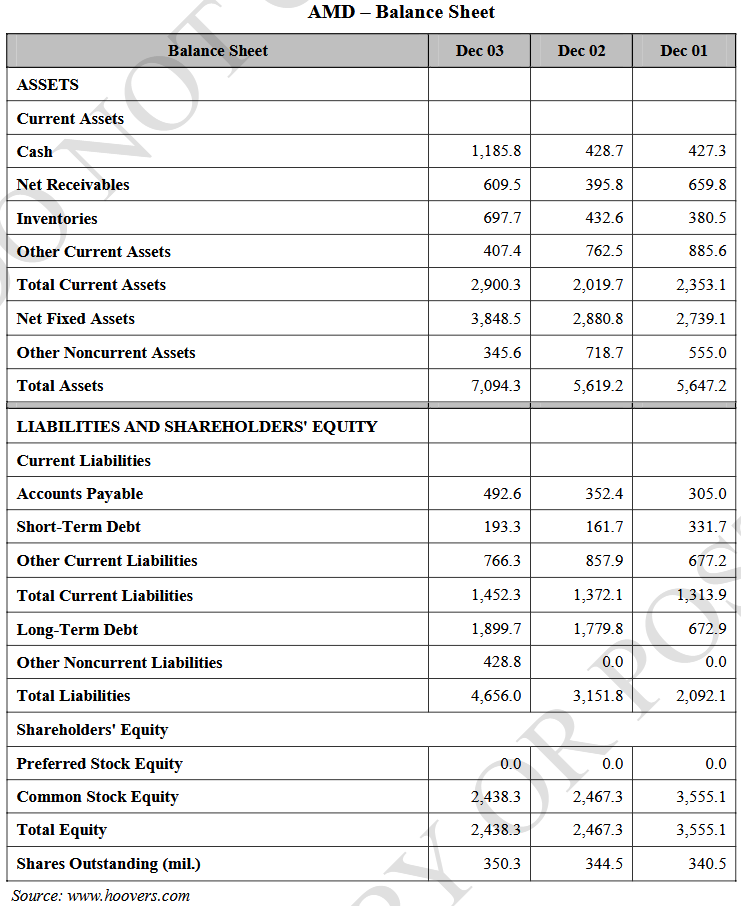
John Mathew, a young MBA had joined Intel in its Corporate Finance Department. His supervisors asked him to understand and analyze the financials of the company and make suggestions on improving Intel’s working capital management and compare it with that of rival AMD.
Exhibit: II
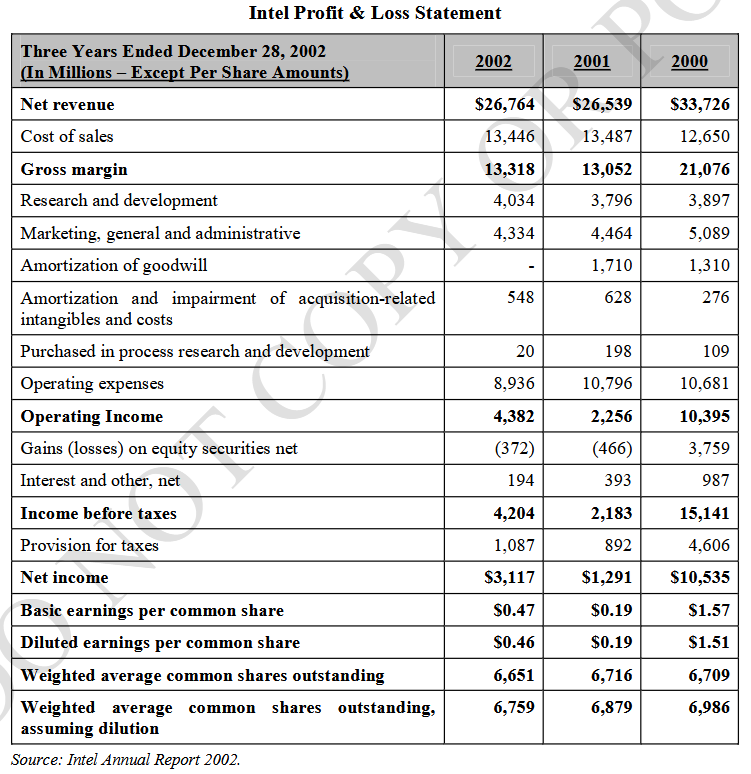 |
EXHIBIT III
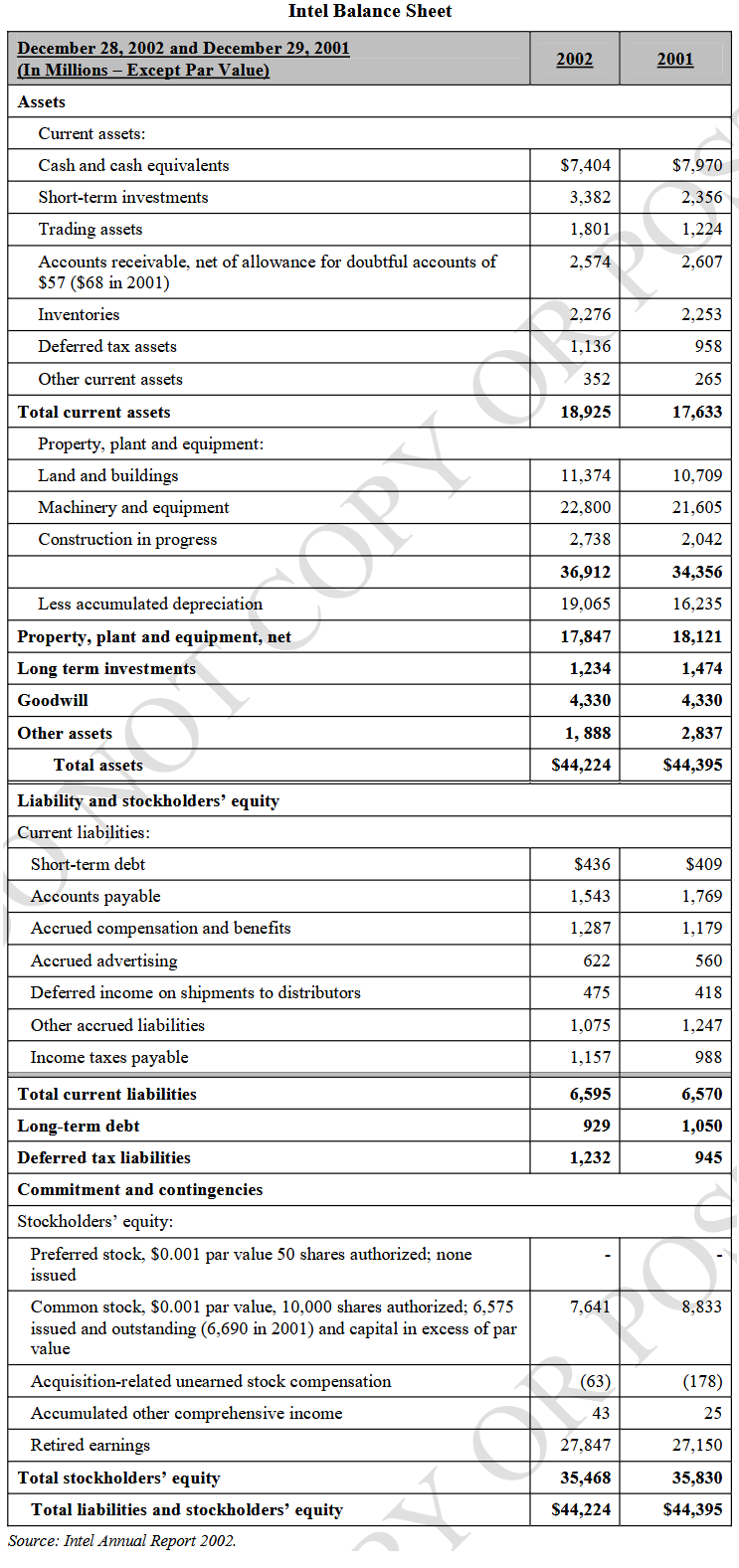 |
Exhibit IV
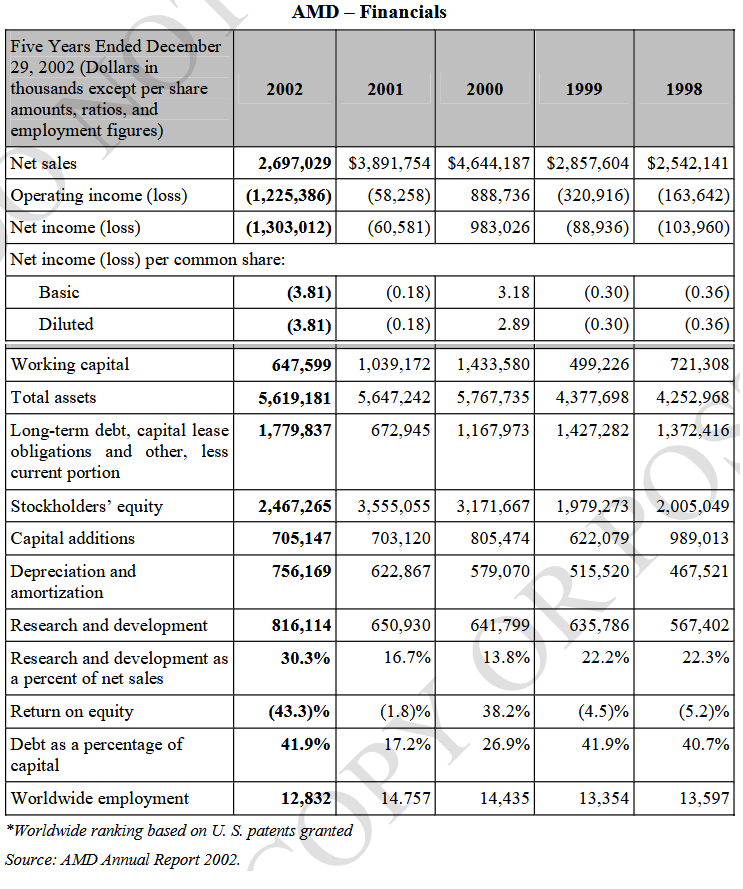 |
Exhibit V
 |
Keywords
Intel, Working capital, Microprocessor, Balance sheet, Advanced micro devices, AMD, Finance statement, Finance, Working capital management, Intel Communication Group, Centrino, Profit and loss statement, Operational efficiency, Innovation, Technology
Related Case Studies
| Case Title | Details | Price | Add to Cart |
|---|---|---|---|
|
Case Title Implementing a Zero Debtor Policy through Channel Financing in an MNCCase Code: FINC089 |
Details | 400 | Add to Cart |
|
Case Title Liquidity Assessment of Infosys LimitedCase Code: FINC164 |
Details | 300 | Add to Cart |
|
Case Title Operational Performance of Cipla Limited - An OverviewCase Code: FINC153 |
Details | 350 | Add to Cart |
|
Case Title Dr. Reddy Laboratories’ Profitability – An OverviewCase Code: FINC152 |
Details | 350 | Add to Cart |
|
Case Title Short-term Liquidity – An Insight of Hero Motor Corporation LimitedCase Code: FINC151 |
Details | 350 | Add to Cart |