
Microsoft’s Dividend Policy
🌐 International Buyers — Pay via PayPal
Details
FINA011
16
2003
NO
500
Microsoft Corporation
Technology & Communications
Global
Corporate Finance,Cost of Capital
Abstract
By early 2004, Microsoft’s cash balance had crossed $50 billion. One persistent investor complaint against Microsoft has been its zero dividend policy. Microsoft has not paid dividends for 17 years. It believes in ploughing money back into its R&D (research and development). In part, due to increasing pressure from shareholders, in 2003 the company declared its first ever dividend for common stock. More recently, Microsoft has announced plans to pay back up to $75 billion of its cash to investors over a period of four years. This includes a one-time special dividend of $30 billion. The case outlines the evolution of Microsoft’s dividend policy and the circumstances leading to the huge dividend payment in July 2004. The case also outlines the possible repercussions of this payment for other tech companies such as Dell, Cisco, and Oracle.
Learning Objectives
The case is structured to achieve the following Learning Objectives:
- 0
Contents
Cash is shareholder’s money, so we need to either invest in new opportunities or return it to them.
- Steve Ballmer, CEO, Microsoft
Microsoft, the world's number one software company, provided a variety of products and services including the ubiquitous Windows operating systems and Office software suite. The company had expanded into markets such as video game consoles, interactive television, and Internet access. With its core markets maturing, Microsoft was targeting services for growth, looking to transform its software applications into Web-based services for enterprises and consumers. While desktop applications and platforms remained the bread and butter business, Microsoft had moved into video game consoles, enterprise software, computer peripherals, software development tools, and Internet access services.
The US government had charged Microsoft with antitrust violations in 1998. An initial ruling to split Microsoft into two companies was struck down. Under a tentative settlement between the company and the US Justice Department, Microsoft agreed to uniformly license its Windows operating systems, not to offer exclusive contracts to manufacturers, and to allow competing software to be included with its operating systems. Microsoft had also reached settlements with long-time rivals Netscape (paying the company about $750 million) and Sun (agreeing to pay the company about $1.6 billion in addition to royalty payments on certain technologies).
Exhibit I
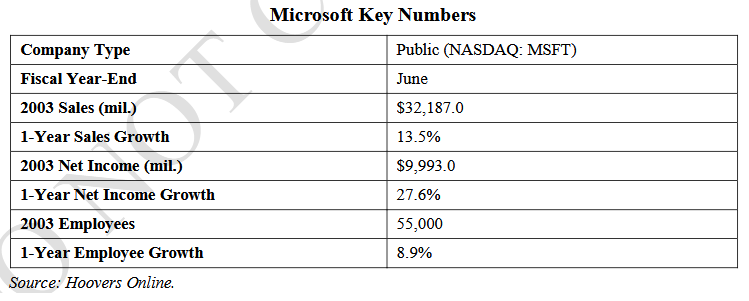 |
One of the most profitable companies in the software industry, Microsoft’s sustained levels of financial performance had been unmatched. By early 2004, Microsoft’s cash balance had crossed $50 billion. One persistent investor complaint against Microsoft was its zero dividend policy. Microsoft had not paid dividends for 17 years. It believed in ploughing the money back in its R&D. In part, due to increasing pressure from shareholders to explore alternatives for its ever- growing cash hoard, in 2003 the company declared its first ever dividend for common stock. The announcement seemed to mark a turning point in Microsoft’s financial history. More recently, Microsoft announced plans to pay back up to $65 billion of cash to investors over a period of four years. This included a one-time special dividend of $30 billion.
Bill Gates (Gates) founded Microsoft (originally Micro-soft) in 1975 after dropping out of Harvard at the age of 19. Gates teamed up with high school friend Paul Allen (Allen) to sell a version of the programming language BASIC. While Gates was at Harvard, the pair wrote the language for Altair, the first commercial microcomputer. Microsoft started off by modifying BASIC for other computers. In the mid-1980s, Microsoft introduced Windows, a graphics-based version of MS- DOS that borrowed heavily from rival Apple's Macintosh system. The company went public in 1986, and Gates became the industry's first billionaire a year later. Microsoft introduced Windows NT in 1993 to compete with the UNIX operating system, popular on mainframes and large networks. In the early 1990s, many complained about the unfair advantages Microsoft was reaping as a monopoly. In 1995, antitrust concerns blocked a $1.5 billion acquisition of personal finance software maker Intuit.
In 1998, the US Justice Department, backed by 18 states, filed antitrust charges against the software giant, claiming that it stifled competition in the Internet browser market and limited consumer choice. A federal judge ruled in 2001 that Microsoft had used its monopoly powers to violate antitrust laws. This led to the prospect of two (smaller) Microsofts, a decision against which the company aggressively appealed. A federal appeals court struck down the initial ruling to break up Microsoft. A tentative settlement between the company and the US Justice Department left Microsoft intact but imposed broad restrictions on the company's licensing policies for its operating systems.
Microsoft responded to the challenges it faced through some major internal restructuring. Gates turned over the president's job to long time friend and Microsoft executive Steve Ballmer (Ballmer). Gates, who had been the CEO since the company's founding, remained chairman. As Microsoft’s chief software architect, Gates indicated he would focus on technology related issues where it was widely acknowledged that few matched his skills, vision and expertise. By the early 2000s, possibly the biggest challenge Microsoft faced was growth. After 29 years, there had been a perceptible slowdown in growth. A Wall Street forecast of Microsoft’s growth for the 2000s was cut back from the 90s figures of 30% to 11% growth over the next few years. But Gates believed that it was unfair to compare Microsoft with smaller players.
"If growth is your metric, we're not your guy."
- commented Gates, adding that the company's focus was on innovation.
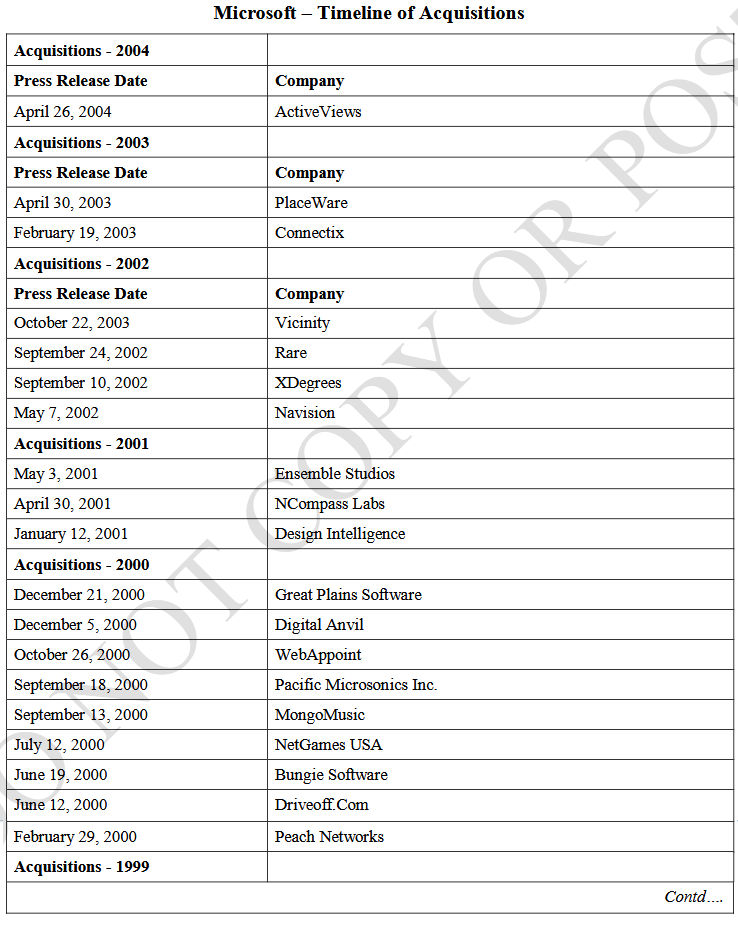
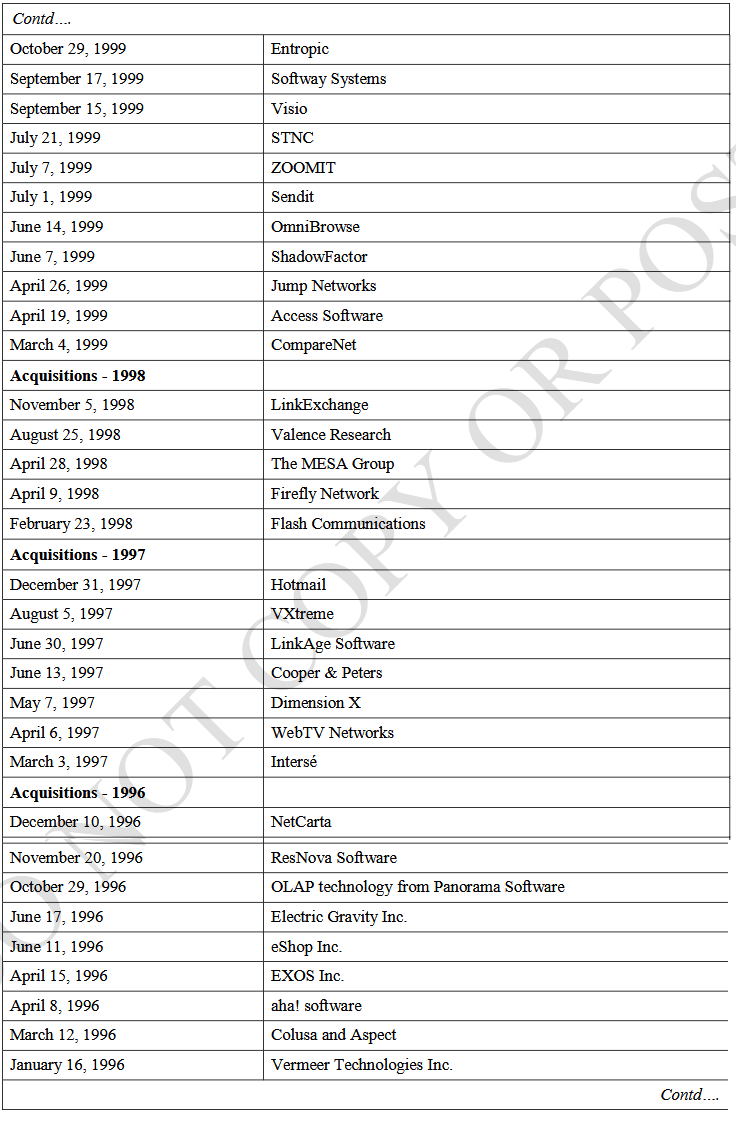
Microsoft had $53 billion of free cash by 2004. One way to generate faster growth was through acquisitions. Microsoft had already been moving in that direction, spending $2.5 billion since 2001 to move into the market for business applications for small to midsize companies. It could follow that up with acquisitions in other promising areas, such as security, collaboration, and game software. But most analysts expected Microsoft to keep away from large deals due to anti-trust considerations. At the same time, Microsoft felt it needed the cash as an insurance policy against various legal battles it faced such as the European Commission antitrust probe and an antitrust suit brought by Sun Microsystems (Sun). On April 2, 2004, Microsoft settled the case with Sun, paying its long time rival nearly $2 billion.
The open source software Linux was a big threat to Microsoft. Shared freely by developers around the world, Linux had become so popular that it was challenging Microsoft's core business as no rival ever had before. The downturn in the US economy had put corporations under intense pressure to reduce their computing bills and look for low-cost alternatives. Corporations got all the computing power they wanted at a fraction of the price. Linux was attractive to tech companies and corporations alike because it gave them a viable alternative to Microsoft's products that they could modify at will. In a recent survey of corporate tech purchasers by Merrill Lynch, 48% said they planned to increase their use of open-source software in 2004. 34% of that subgroup was targeting applications that traditionally ran on Windows.
But it was in the developing countries, that Microsoft faced the prospect of losing out on attractive growth opportunities. Tech companies in China and India, major growth markets, were actively using Linux. To counter the threat of Linux, Microsoft had pledged to spend more than $750 million on cooperative research, technology for schools, and other investments in China.
Till 2002, Microsoft had not paid a dividend. Until its dividend announcement in 2003, Microsoft was the only corporation among the Dow 30 that had not paid a dividend. (See Exhibit: II)
Exhibit II
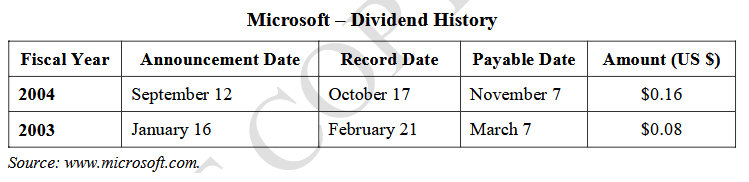 |
Although the payment announced in 2003, constituted a relatively small percentage of Microsoft's overall profits, the decision came as welcome news to some analysts.
"It's a good small step, and it will put substantial pressure on Silicon Valley companies like Cisco and Oracle to do the same,"
-said Ralph Nader, who co-authored a letter to Gates in 2002 urging the company to consider paying a dividend.
The dividend payout cost Microsoft $856 million. Various motives were attributed to Microsoft's decision. Investors' interest in technology stocks that did not pay dividends was declining. Low interest rates had shrunk the profits Microsoft could make out of its hoard of cash and short-term investments. The Bush administration was pushing a tax-cut package that would eliminate the income tax on such payments to shareholders. The Bush proposal, which was not yet law, would end the so-called "double taxation" that companies often cited as a reason for not paying dividends. Under current law, dividends were taxed twice: first as profit by the company and then as income received by the shareholder.
Microsoft maintained that its decision to pay the dividend was not related to Bush's proposal. The company added that the resolution of long pending legal issues and its strong financial performance convinced its board to approve the dividend.
"Declaring a dividend demonstrates the board's confidence in the company's long-term growth opportunities and financial strength .We are especially pleased to be able to return
profits to our shareholders while maintaining our significant investment in research and development and satisfying our long-term capital requirements."
- commented Microsoft Chief Financial Officer John Connors
Microsoft believed that an annual dividend would make its stock even more attractive to a broader range of investors.
"We see enormous potential for growth in the software and technology sector, and remain committed to attracting investors who share this enthusiasm and take a long-term view of
the company's growth opportunities,"
- Connors noted.
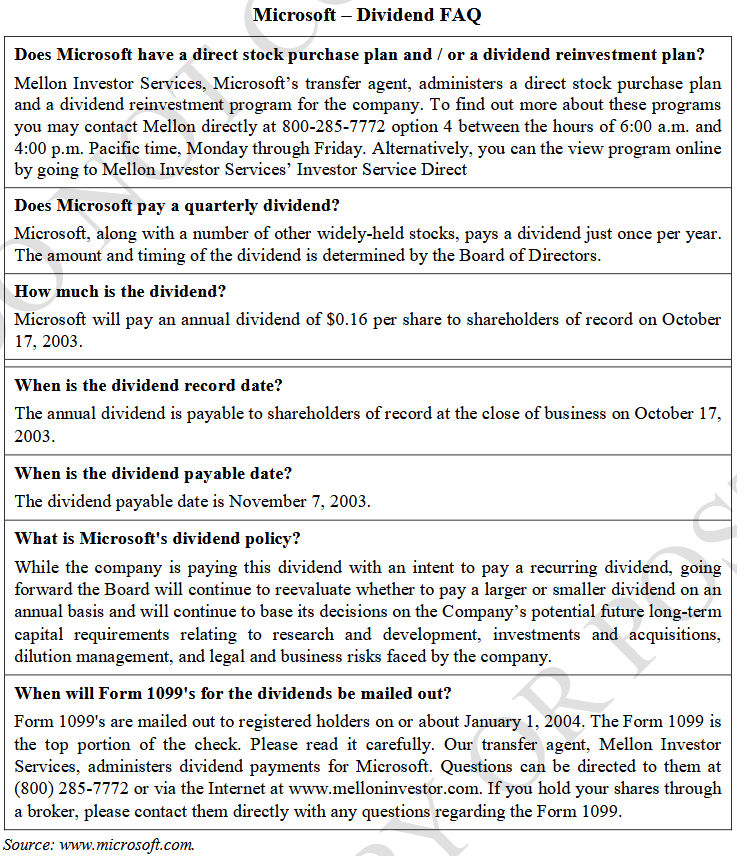
Microsoft also announced that it was introducing a direct stock purchase program and a dividend reinvestment program, offering both new investors and current stockholders the option of receiving Microsoft's annual dividend in cash or having it automatically reinvested. Gates, the single largest shareholder would reap nearly $100 million (tax-free) if President Bush’s tax-cut package passed. Likewise, Chief Executive Steve Ballmer would gain about $40 million (tax-free) from the move.
In September 2003, with its cash reserve approaching $ 50 billion, Microsoft announced that it was doubling its dividend payment. The new dividend would cost the company about $1.73bn. The dividend amounting to 16 cents ($ 0.16) a share for the fiscal year ending June 2004, was paid on 7 November 2003.
Exhibit III
 |
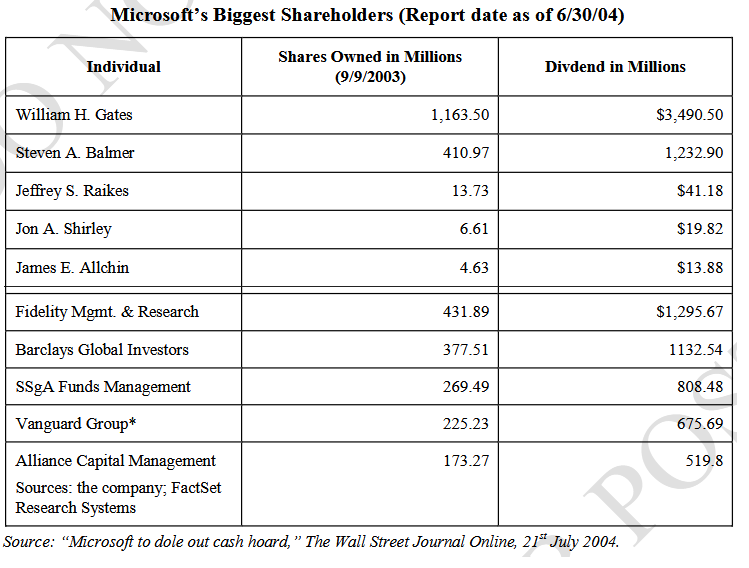
More recently, in what many termed as an extraordinary move, Microsoft announced that it was making a one-time dividend payment of $32 billion for the year 2004. The July 21st announcement also indicated plans for a massive buyback of up to $30 billion of its stock over a period of four years. Gates, who was the single largest shareholder of the company, was set to collect about $3.6 billion from the one-time dividend and $384 million from the stock's annual payout.
On the same day, Gates announced plans to donate his share of one-time dividends to the philanthropic organization, Bill & Melinda Gates Foundation, albeit over a period of time. The company also announced that it was once again doubling its dividend payout from 16 cents to 32 cents a share or about $3.5 billion a year.
Exhibit IV
 |
Reactions to Microsoft’s announcement were varied:
One portfolio manager commented,
“In my opinion that (one-time dividend) doesn’t do anything for anybody. I would rather
have seen them buy back more shares more quickly than do the special dividend”.
A fund manager at U.S. Bancorp Asset Management, which owned Microsoft stock commented,
“I think they are being good stewards of capital, returning the money if they do not have a
better way to invest the money themselves. In this market, a $30-billion dividend - who
won't take it? I think people are pleased but it is largely anticipated."
The huge one-time dividend payment by Microsoft was expected to have strong repercussions for the technology industry. Historically, tech companies had shied away from paying dividends, assuming that shareholders would gain from massive capital gains from their appreciating stocks. As growth companies, they argued that they needed to plough back most of their earnings. But analysts opined that Microsoft’s move would make other companies, especially Intel, Dell and Cisco dole out more cash to shareholders.
"They're going to experience more pressure to share that pot of gold, not just with their
executives and employees on stock options, but to share it with their shareholders," said
one analyst, adding "When you're in a flat market as we have been all year, it's nice to get
paid while you're waiting for the stock market to resume its rise."
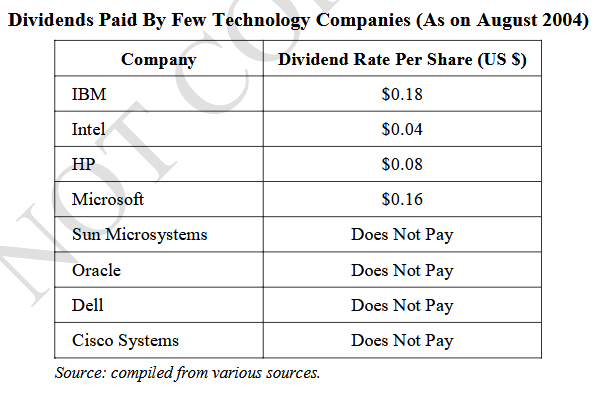
Although some well-known tech companies such as IBM, HP and Intel paid dividends, others such as Cisco, Oracle, Sun and Dell did not.
Exhibit V
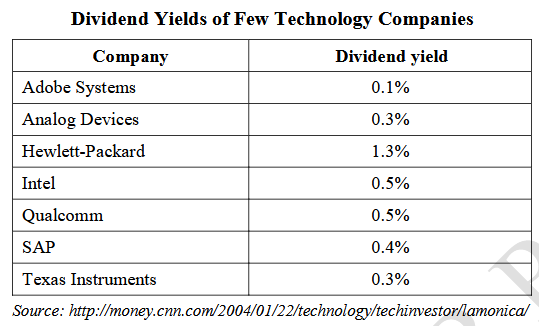 |
By 2004, Intel had about $17 billion in cash reserves but paid a dividend of only 4 cents a share. But the company had historically spent around $1 billion per quarter repurchasing its own stock. In the first two quarters of 2004, it had accelerated that spending to $1.5 billion per quarter. Intel maintained that it did not intend to change its policies because of Microsoft.
An Intel spokesperson commented,
"We have had a dividend in place since 1992. About a year ago it was doubled to 4 cents"
a quarter. Intel is also in a very capital-intensive and R&D-intensive business, and those
are other major areas where we're spending cash."
Computer hardware giant, Dell had about $5 billion in cash and cash equivalents but had no plans to issue a dividend, according to reports. Dell remained adamant about ploughing back the cash into the company.
The Chief Financial Officer of Dell commented,
But a majority of large, institutional investors prefer that we return money to
shareholders, but they prefer we do it by buying more stock".
Reports indicated that Dell had repurchased about $1.5 billion in shares in its first three quarters of fiscal year 2003-2004.
Cisco had about $9 billion in cash and some $11 billion in long-term investments but completely stayed away from paying dividends. A spokesperson for Cisco commented,
"We believe our share repurchase program, combined with ongoing strategic investments
in our business and maintaining a strong cash balance, are in the best interest of our
shareholders. Our board has and will continue to evaluate if, when and in what amount a
dividend will be paid."
Reports indicated that Cisco had repurchased about $2 billion in shares during early 2004. Likewise, Oracle, which had about $8 billion in cash, declined any of it to its shareholders.
Many analysts had predicted that Microsoft would give out a higher dividend, do a stock buyback or make a one-time payout. A stock buyback seemed the most likely possibility. In the end, Microsoft chose to offer all three methods.
Curt Anderson, Microsoft senior director of investor relations commented,
"It's a pretty close call to try and figure out what's the best way to distribute this kind of
value to shareholders. We tried to offer a plan that was as balanced as possible and
viewed as acceptable by a wide range of [people]."
Exhibit: VI
 |
 |
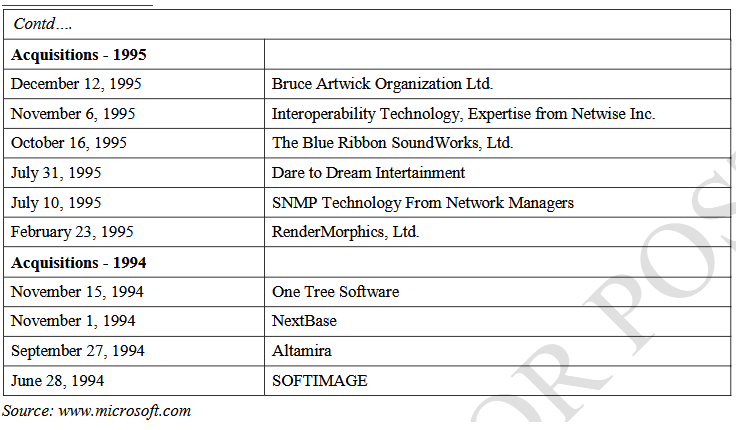 |
Exhibit: VII
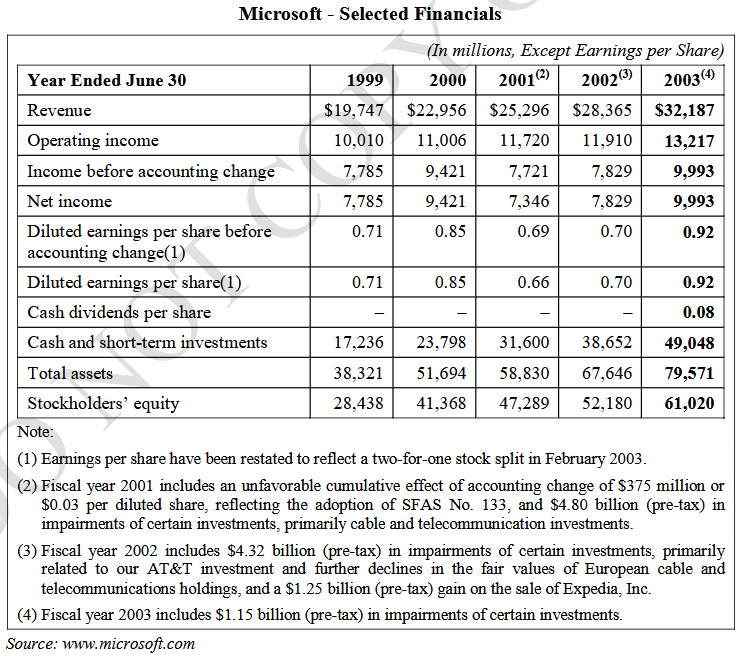 |
Exhibit VIII
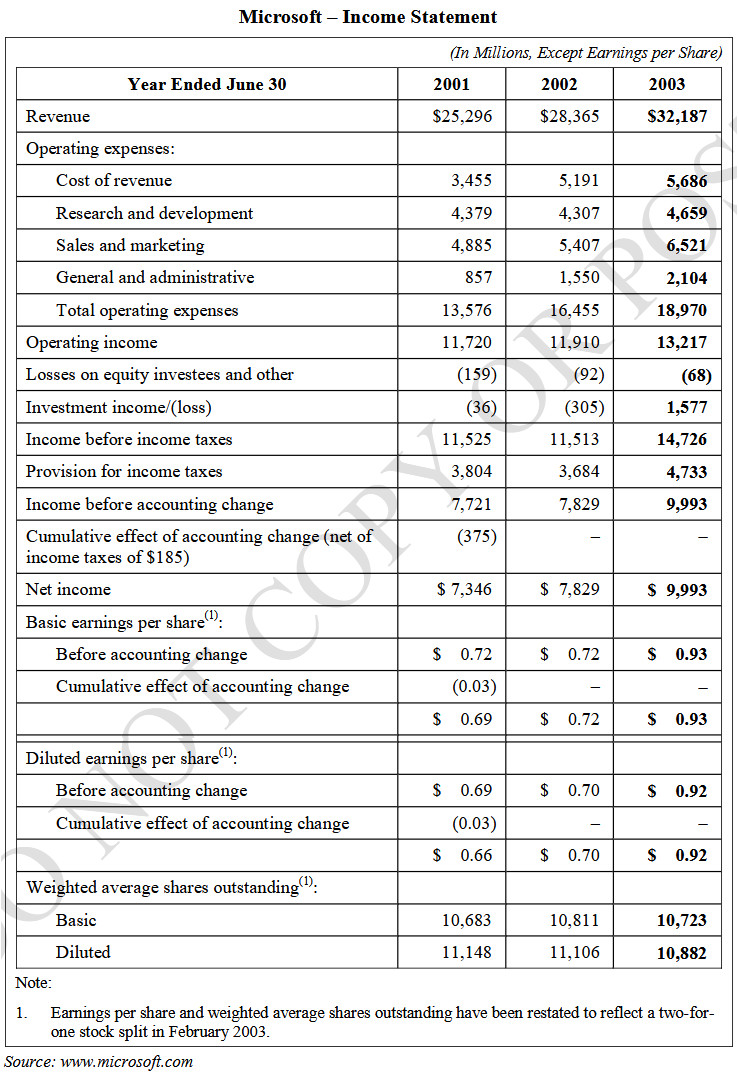 |
Exhibit IX
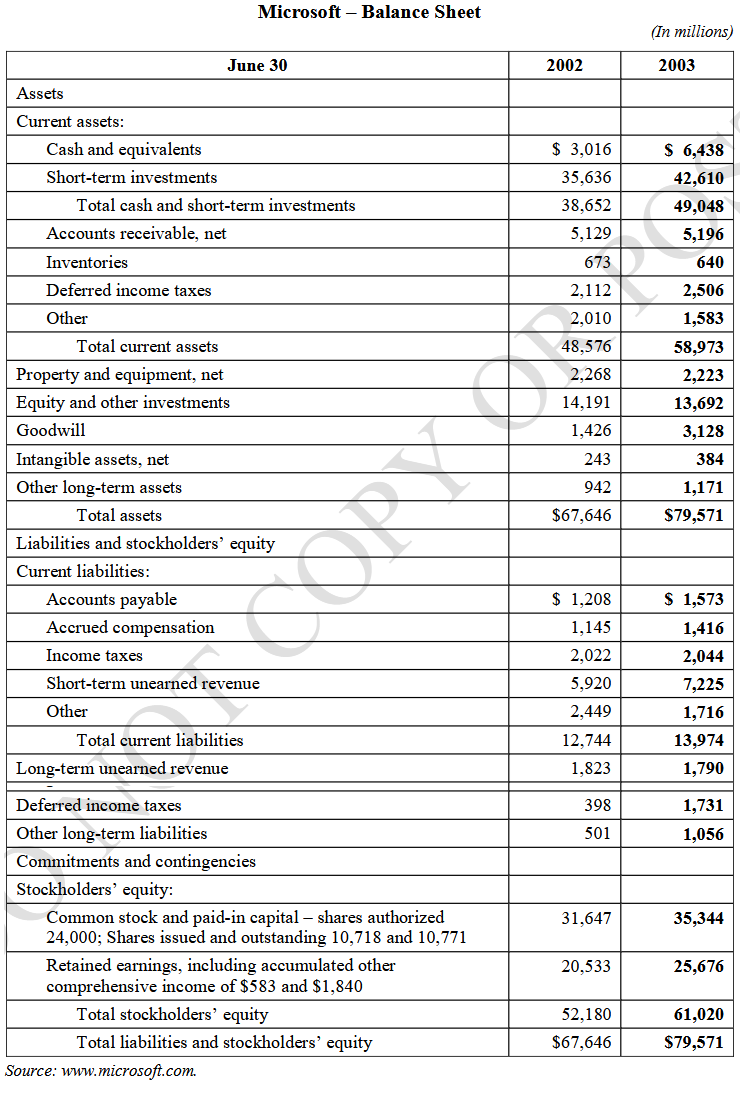 |
Figure (i)
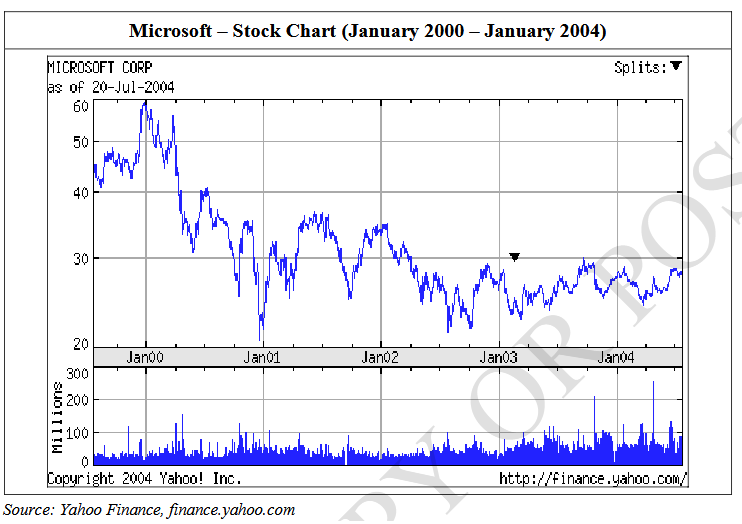 |
Exhibit X
 |
Keywords
Microsoft, IBM, International Business Machines Corporation, Bill Gates, Steve Ballmer, HP, Hewlett-Packard, CISCO, Computer Information System Company, Annual dividend, Stock purchase programme, Dividend reinvestment, Form 1099, Buy back, Bill and Melinda Gates Foundation, US Bancorp asset management, Intel, Dividend policy
Related Case Studies
| Case Title | Details | Price | Add to Cart |
|---|---|---|---|
|
Case Title Nykaa IPO: Will It Translate the Beauty and Personal Care Market Opportunity into Big Profits?Case Code: FINC200 |
Details | 400 | Add to Cart |
|
Case Title Apple`s Green BondsCase Code: FINC199 |
Details | 300 | Add to Cart |
|
Case Title The Evergrande Crisis in ChinaCase Code: FINC197 |
Details | 500 | Add to Cart |
|
Case Title Stock Split: A Case of IRCTCCase Code: FINC189 |
Details | 400 | Add to Cart |
|
Case Title Krishna Institute of Medical Sciences IPO: Should You Invest or Not?Case Code: FINC187 |
Details | 500 | Add to Cart |