
Coimbatore Bypass Road Project
🌐 International Buyers — Pay via PayPal
Details
FINC010
6
2002
YES
0
Larsen & Toubro Limited
Engineering & Construction
India
Financing,Project Management
Abstract
The case introduces the students to the problems confronting the investors in the road sector projects in the country. Without the support and cooperation of the government, and the users of the facility, investments would not be forthcoming in the infrastructure sector. It introduces the student to the various issues in infrastructure financing. From the case, students are expected to understand the importance of the road sector in the country’s socio-economic development. The case also points out the presence of world-class project construction companies in the country.
Learning Objectives
The case is structured to achieve the following Learning Objectives:
- Infrastructure projects
- BOT projects
- Financing infrastructure projects.
Contents
The Coimbatore Bypass was the first road project to be implemented in South India on BOT (build, operate and transfer) basis. The project was a pioneering initiative, which incorporated private sector participation and levy of toll on users to ensure sustainability in the long run. The road ran between Neelambur on the Salem side of NH-47 Tamilnadu and in Kerala2, Madukkarai on the Palghat side.
The project involved construction of a 28-km long two-lane bypass road, the 32.2m new Athupalam bridge across the river Noyal, the railway overbridge at Chettipalayam Tamilnadu and the maintenance of the old bridge at Athupalam, all in the state of Tamilnadu. Larsen & Toubro (L&T)3 was authorized to collect and retain the fee from users of the new and old Athupalam bridges. The bypass was expected to ease the traffic congestion in Coimbatore city, Tamilnadu and the Salem-Cochin national highway running between Tamilnadu and Kerala. The shippers, mostly export-oriented units relying on the Cochin port for shipments, were other major beneficiaries as transportation time could be saved using the new road.
Construction was started in January 1998 and completed in 22 months4 time. The Athupalam bridge was opened for traffic in December 1998 and the bypass became operative from January 19, 2000. The project cost was about Rs.1.04 bn. The project concession period was for 12 years, and was expected to set a precedent for assessment of traffic risk patterns in the country for toll-based roads.
However, the project ran into problems when users refused to pay the toll for the old Athupalam bridge. They argued that the old bridge was already in existence. As for the bypass and the new Athupalam bridge, they felt that the toll rates were on the higher side. They also complained that L&T had not taken them into confidence before coming out with the toll rates.
In the 1970s, the Tamilnadu government planned the Coimbatore bypass road to ease the traffic congestion in Coimbatore and the NH-47 between Salem and Cochin. However, due to paucity of funds, the project had to be dropped.
In 1995, the Government of India (GoI) liberalized its policies and opened up the road sector for private investments. In September 1995, the GoI through its Ministry of Surface Transport (MoST) invited tenders from the private sector to finance and implement the construction, operation and maintenance of the Coimbatore bypass road project on BOT (build, operate and transfer) scheme. As the project was not viable on its own, the GoI after studying the various options, widened the scope by including the construction of an additional two-lane bridge on river Noyal on the NH-47.
A concession agreement for the integrated project of bypass and a bridge at Athupalam on NH-47 was signed on October 3, 1997 between the MoST, the government of Tamilnadu and L&T. L&T set up a special purpose vehicle (SPV) - L&T Transportation Infrastructure Ltd. (LTTIL), to implement the project. L&T held 100% equity in LTTIL. LTTIL implemented the project on BOT basis, with the revenue accruing directly to it.
The project was constructed by L&T-ECC (Engineering Construction Corporation) group, the largest construction organization in India. L&T-Ramboll Consulting Engineers, a joint venture between L&T and Ramboll of Denmark, was employed for quality control supervision and review of the critical pavement design.
The project was financed by share capital of Rs 416 mn and term loan of Rs 620 mn, with a debt-equity ratio of 1.5:1. As per the agreement with the Tamilnadu government, L&T had to hold a minimum equity of 26% at the end of 30 years.
The debt financing was done by State Bank of India (SBI), L&T Finance, Housing and Urban Development Corporation (HUDCO), Housing Development Finance Corporation (HDFC), and Industrial Development Bank of India (IDBI). IDBI had sanctioned Rs.300 mn for the project in the form of infrastructure bonds. The loan was given in two tranches of Rs.150 mn each at 15% interest each. Principal repayment was to begin from the eighth year onwards.
SBI loaned Rs.300 mn to the project. Infrastructure Development Finance Corporation (IDFC) had structured a “liquidity support” arrangement to help SBI in emergency situation. This support enabled SBI to approach IDFC for refinancing in case it failed to raise the money from other sources. For IDFC, liquidity support was different from the take-out financing since it was lending on condition that the bank was unable to raise the money. Moreover, IDFC would not take the project risk even if it lends to the bank. IDFC would only be carrying the bank risk as it had given the money to the bank and not the SPV.
L&T pointed out that the project helped vehicles save fuel and vehicle operating costs due to reduction of distance by 2.5 km and free flow traffic, besides time. Other benefits to the bypass users included less pollution, pleasant drive, good wayside amenities and lastly, safety. L&T gave special emphasis to safety aspect of the road. Crash barriers were provided on the high
embankment of the road, along with thermo plastic road markings. Traffic signals were erected at the junctions of Neelambur (Tamilnadu), Madukkarai (Kerala), Trichy Road (Tamilnadu), and Pollachi Road (Kerala). Speed breakers were erected at suitable locations on the major district roads crossing the bypass to regulate the speed of vehicles. Retro reflective signboards were also provided to illuminate junctions for better visibility at nights. L&T also set up trauma care with ambulance facility at the bypass.
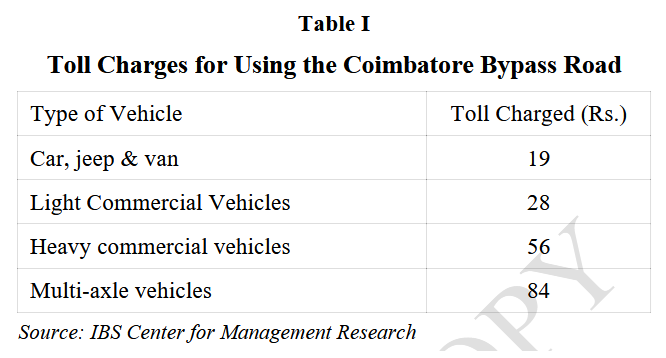
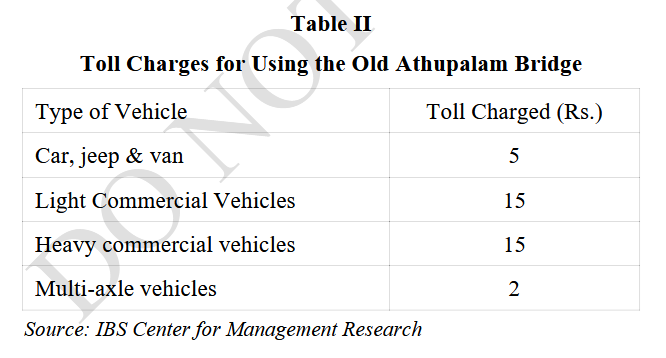
The Indian Railways asked L&T to build a rail overbridge instead of a crossing for the bypass. However, L&T successfully argued that it was not part of the original project. In order to recover the additional costs, an alternative funding method had to be selected to keep the fixed costs to be recovered from the project at low. Hence, with the consent of the state government, L&T decided to toll the old Athupalam Bridge, which did not come within the route of the bypass (Refer Table II).
L&T also intended to provide necessary amenities for travelers such as petrol pumps, parking facilities, service stations, restaurants, drinking water facility, public telephone booths etc. The development of the real estate was to be taken up soon. Toll plazas of international standards were another attraction.
L&T faced problems with the tolling of the old Athupalam bridge, which did not come within the route of the bypass. This bridge was an already existing facility being used by the incoming traffic from Kerala to Tamilnadu. Transport operators had initially refused to pay the tolls. The bulk users of the bridge including the state transport corporations of Tamilnadu and Kerala had refused to pay the tolls.
The Tamilnadu state government too backtracked and sought concessional tariff for state transport buses on the plea that the transport department was in the red. The Tamilnadu government was willing to pay only Rs.50 per bus for making more than three trips a day instead of the originally planned Rs.15 per bus per trip. L&T agreed to the subsidized toll rate on the condition that the state government compensated the revenue losses sustained by the company.
The Coimbatore District Bus Owners Association (CDBOA) and the Lorry Owners Association refused to pay even the subsidized tariff. The CDBOA had even taken the issue to Madras High Court against the tariff but the Court directed the private operators to pay the toll charges. However, they refused to comply with the court’s orders.
Since December 1998, L&T was unable to collect the tolls from road users and this resulted in a loss of Rs.74.1 mn as of June 2000. This included Rs.11.4 mn due from the Tamilnadu government towards reimbursement of losses incurred out of the subsidized toll payment for the state transport buses.
N R Naramsimhan, GM (developmental projects)- L&T felt that unless the state government gave L&T powers to deal strictly with the non-payers, it would be impossible to recover the investment. He felt L&T might even request the state government to take over the project. L&T contemplated on invoking the force majeure clause11 and pulling out of the project. L&T was also under tremendous pressure from the financial institutions, which had lent money, to create additional securities. MoST had asked the state government to take a quick decision as a delay would have an adverse impact on other BOT projects in the state.
1. Discuss the implications of the state government’s poor support to the project, on the future investment in the concerned state? Give reasons.
2. What is the role of innovative financial instruments like takeout financing in the infrastructure sector?
Keywords
Problems, confronting, investors, road sector, projects, country, support, cooperation, government, facility, investments, infrastructure sector, Finance elective, socio-economic development, world-class, project construction, companies, country
Related Case Studies
| Case Title | Details | Price | Add to Cart |
|---|---|---|---|
|
Case Title Namaami Gange: Rejuvenating the Holy RiverCase Code: BENV029 |
Details | 500 | Add to Cart |
|
Case Title Dr. Jim Yong Kim’s Dilemma: International Finance Corporation and the Tata Mundra Power PlantCase Code: FINC097 |
Details | 700 | Add to Cart |
|
Case Title Anandi Resorts` Happy Land Construction Project – Risk Management and Earned Value AnalysisCase Code: OPER159 |
Details | 400 | Add to Cart |
|
Case Title Syska Participating in India`s Carbon Finance based Rural Lighting SchemeCase Code: BSTR641 |
Details | 400 | Add to Cart |
|
Case Title Apple`s Green BondsCase Code: FINC199 |
Details | 300 | Add to Cart |