
Arvind Mills’ Restructuring Plan
🌐 International Buyers — Pay via PayPal
Details
FINC011
8
2002
YES
0
Arvind Limited
Textiles & Apparel
India
Cost of Capital,Growth Strategy
Abstract
The case provides an overview of the Arvind Mills’ expansion strategy, which resulted in the company’s poor financial health in the late 1990s. In the mid 1990s, Arvind Mills’ undertook a massive expansion of its denim capacity in spite of the fact that other cotton fabrics were slowly replacing the demand for denim. The expansion plan was funded by loans from both Indian and overseas financial institutions. With the demand for denim slowing down, Arvind Mills found it difficult to repay the loans, and thus the interest burden on the loans shot up. In the late 1990s, Arvind Mills ran into deep financial problems because of its debt burden. As a result, it incurred huge losses in the late 1990s. The case also discusses in detail the Arvind Mills debt-restructuring plan for the long-term debts being taken up in February 2001.
Learning Objectives
The case is structured to achieve the following Learning Objectives:
- Expansion plans
- Debt driven expansion
- Financial restructuring.
Contents
Arvind’s expansion and diversification projects have suffered from substantial time and cost overruns as well as stabilisation problems, which have coincided with the ongoing downturn in the denim industry.”
-Credit Rating Information Services of India Limited (CRISIL), in 1999.
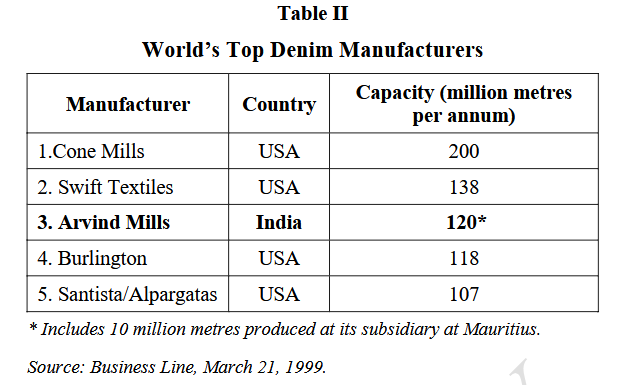
In the early 1990s, Arvind Mills1 initiated massive expansion of its denim capacity. By the late 1990s, Arvind Mills was the third largest manufacturer of denim in the world, with a capacity of 120 million metres. However, in the late 1990s, due to global as well as domestic overcapacity in denim and the shift in fashion to gabardine and corduroy, denim prices crashed and Arvind Mills was hit hard. The expansion had been financed mostly by loans from domestic and overseas institutional lenders. As the denim business continued to decline in the late 1990s and early 2000, Arvind Mills defaulted on interest payments on every loan, debt burden kept on increasing. In 2000, the company had a total debt of Rs 27 billion, of which 9.29 billion was owed to overseas lenders.
In 2000, Arvind Mills, once the darling of the bourses was in deep trouble. Its share price was hovering between a 52 week high of Rs 20 and low a of Rs 9 (in the mid 1990s, the share price was closer to Rs 150). Leading financial analysts no longer tracked the Arvind Mills scrip. The company’s credit rating had also come down. CRISIL downgraded it to “default” in October 2000 from “highest safety” in 1997.
In early 2001, Arvind Mills announced a restructuring proposal to improve its financial health and reduce its debt burden. The proposal was born out of several meetings and negotiations between the company and a steering committee of lenders.
Arvind Mills was promoted in June 1931, by Sanjay Lalbhai’s grandfather, Kasturbhai Lalbhai, and his two brothers, Narottam and Chimanbhai, in Ahmedabad. When Sanjay Lalbhai took over the reins in 1975, Arvind Mills was at the crossroads. A high wage structure, low productivity and surplus labor in the textile mills rendered its businesses unviable in most the products categories in which it competed. The emergence of power looms in the 1970s further aggravated the problems of Arvind Mills. The government’s indirect tax system at that time also reduced the profitability of its product lines.
In the mid-80s, to survive the onslaught of the small-scale power loom sector, the composite mills, with their higher overheads had to change their strategies. It became imperative for them to switch to areas in which the power loom sector could not compete, viz, value added products. In the mid 1980s, Arvind Mills switched to high-quality fabrics requiring technical superiority that the power looms could not hope to match.
Until 1987, like any other textile company, Arvind Mills had a presence only in conventional products like sarees, suitings and low value shirting, and dress materials. Realizing the bleak growth prospects for textiles in general, Arvind Mills identified denim as a niche area and set up India’s first denim manufacturing unit in 1986 at Naroda Road, Ahmedabad. To deal with competition from the power loom sector, which rolled out vast quantities of inexpensive fabrics, and to cope with the rising cost of raw materials, Arvind Mills diversified into indigo-dyed blue denim; high quality, cotton-rich, two-ply5 shirting, and Swiss voiles6. Arvind Mills decided to
select product segments on the basis of high and growing global demand, low fashion content in the product, and high entry barriers in terms of the large investments required to manufacture and market the product. It also pioneered the use of denim into non-traditional areas like Indian outfits, corporate gift articles, upholstery and furnishings, stationery, and even briefcases.
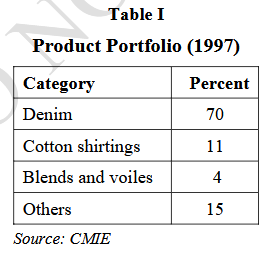
In 1987, Arvind Mills recorded the lowest profits, Rs 7.6 million, in its 56 years of history. The company felt that there was an urgent need to arrest the decline. Sanjay Lalbhai, Managing Director of Arvind Mills, asked the management to review the business thoroughly. The management felt that there was vast opportunity for growth in the denim business. Thus, a denim focussed business policy was developed and in the next ten years, Arvind Mills invested aggressively in this fabric. Between 1991 and 1997, Arvind Mills raised Rs 10.54 billion to finance its expansion into denim, which included a Euro issue of Rs 3.92 billion. From a five million meter denim producer in 1987, Arvind Mills went on to become a 120 million meter denim producer in 1997. By the late 1990s, the denim business constituted nearly 70% of Arvind Mills’ portfolio (Refer Table I). By 1997, Arvind Mills became the third largest denim producer in the world (Refer Table II). Analysts felt that this high concentration in denim, which contributed to Arvind Mills’ success was also its weakness.
In the mid-1990s, the world of fashion turned topsy-turvy. Global trends began moving away from denim to gabardine and corduroy, and Arvind Mills started feeling the pinch. From a robust growth of 25% in the early 90s, the growth in denim came down to 3-4% in the mid 1990s. At the same time, the Asian meltdown led to a virtual flooding of cheap denim from Asian manufacturers, at prices that were uneconomical even for players like Arvind Mills to match.
In the mid 1990s, Arvind Mills appointed consulting major McKinsey for a strategic overhaul of its business. However, McKinsey advised the company to concentrate on its core competence, denim. Subsequently, huge capacities were built up in denim. A state-of-the-art integrated textile facility was built up at Santej, near Ahmedabad, in Gujarat at an investment of Rs 15 billion. Analysts felt that Arvind Mills failed to realise that denim was facing a downturn. According to one, “It seems McKinsey’s strategic inputs were way off target. After all they should have been able to predict a downturn in denim. And more importantly, as a defensive measure, they should have advised Arvind to invest in other products as well.”
In 1995, Arvind Lalbhai, Chairman of Arvind Mills, announced that the company would expand into other lines of cotton fabrics. It would add 20 million metres more in high value shirtings, 40 million metres more in denim, and 3,600 tonnes per year in high cost knitted fabrics. It would also invest in a captive power plant. The capital expenditure was estimated at Rs 8.5 billion. In 1996, when the management reviewed its product portfolio, it felt that the excessive emphasis on denim was risky. The cotton content of denim was very high in comparison to that of other fabrics. So Arvind Mills’ bottomline was susceptible to fluctuations in cotton prices. To deal with this problem, Arvind Mills rolled back its investments in denim by scaling down its denim capacity addition programme from 40 million meters to only 20 million meters. Arvind Mills also diversified its portfolio by including a gabardine capacity of 20 million metres in its expansion plan. The capacity addition for shirtings was revised to 30 million meters up from the 20 million metres in the original plan. The investment expenditure was also revised from the earlier Rs 8.5 billion to Rs 11 billion. Out of this, Rs 7 billion would be financed by debt.
However, when Arvind Mills embarked on these investments, denim prices came down from Rs 97 per metre to around Rs 70 per metre. This was because of the shift in fashion from denim to gabardine in the global market. At the same time, cotton prices went up playing havoc with Arvind Mills’ cash flows. A weakening rupee further complicated the matter. Since 1999, its debt had piled up because of the continued downward slide of the Indian rupee and its inability to pay interest on its loans.
Analysts felt that Arvind Mills was too ambitious in its expansion plans. Said an analyst, “To be a global player there is a critical mass below which nothing works and overshooting this exposes it to the dangers of global fashion changes.” Analysts felt that fabric being an intermediate product competes as commodities. There were niche segments, but these required smaller lengths. Arvind Mills, with its mass production scales, was vulnerable, as its maneuverability to switch production to smaller lengths was limited. The fall in the prices of standard denim adversely affected its cash flows.
By the late 1990s, Arvind Mills was in deep financial trouble (Refer Table III) because of its increasing debt and interest burden. Its total long-term debt was estimated at Rs 27 billion, out of which the total overseas debt was Rs 9.29 billion and debt to Indian institutional lenders was Rs 17.71 billion. However, how much of the debt to Indian financial institutions was secured was not known. Arvind Mills had defaulted on interest payments on every loan. ICICI was the largest Indian institutional lender, with a loan of over Rs 5 billion to Arvind Mills. (Refer Table IV for a list of lenders to whom Arvind Mills was indebted).
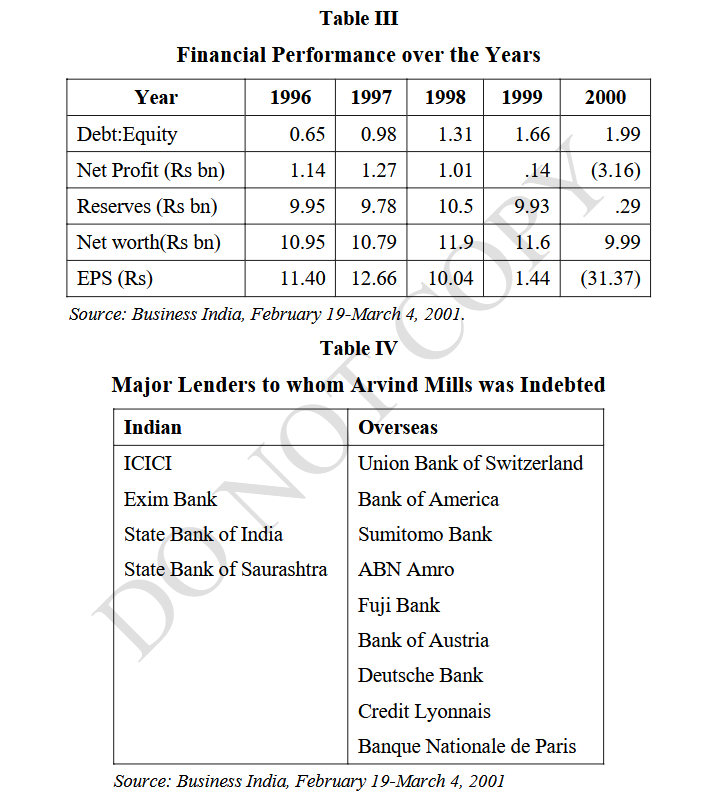
In 2000, the company reported a net loss of Rs 3.16 billion against a profit of Rs .14 billion in 1999. The company slipped into the red on account of depreciation costs and significant rise in the interest burden. Arvind Mills’ interest burden increased by nearly 542.2% to Rs 2.64 billion in 2000, while depreciation costs increased by 101% to Rs 1.65 billion. Analysts estimated that Arvind Mills incurred Rs 16.7 of interest for every Rs 100 of sales.
In February 2001, Arvind Mills announced a debt-restructuring plan for its long-term debt (Refer Box). While the company set itself a minimum debt buyback target of Rs 5.5 billion, the management was hopeful of a larger amount, possibly Rs 7.5 billion. In mid-2001, Arvind Mills got the approval of a majority of the lenders for its debt-restructuring scheme. Forty-three out of fifty-four lenders approved the plan. As part of the restructuring, lenders offered over Rs 7.5 billion under the company’s various debt buyback schemes. Some of the banks agreed to the buyback at a 55% discount on the principal amount, while some agreed to a five-year rollover for
which they would be entitled to interest plus the principal. Some banks also agreed to a ten-year rollover for which they would be paid a higher rate of interest plus principal. The debt revamp was expected to reduce Arvind Mills’ interest burden by 50%.
|
Arvind Mills offered three choices to its consortium of 60 lenders, comprising overseas and Indian institutional lenders and banks. The first was a debt buyback offer, under which the company would buy back a minimum of Rs 5.5 billion of its debt at a 55 percent discount. This would be in full settlement of the principal amount and all overdue interest would be waived. The second was a variant of the first in that the lender would be paid 52 percent of the principal in full settlement on agreeing to reinvest 6.42 percent of the principal in rupee denominated reinvestment debt. Arvind Mills hoped to raise between Rs 500 million and Rs 1 billion towards The third option was the debt-rescheduling offer that extended the tenure from the current seven years to ten at a lower interest of 9 percent. Higher interest, a maximum of 12.5 percent would be paid to these lenders in years when the cash flows exceeded the forecast. The scheme also offered equity warrants, 2.5 percent of the principal amount, as an incentive to those opting for the second and third options. The company hoped to bring down its overall interest burden from Rs 3.4 billion to Rs 1.6 billion |
After the debt restructuring was complete, the management control of Arvind Mills would be in the hands of its lenders. The lenders would influence the appointment of eight out of 12 members, including the Chairman Their representatives would appoint four directors and would chose another four, including the chairman and finance director, from a list of three names given by Arvind Mills for each position. Lenders would also have the right to change the management.
Meanwhile in May 2001, Arvind Mills approved a rights issue aggregating Rs 754.10 million. The company would issue shares at par (Rs 10) in the ratio of 3:4 (three equity shares for every four held). In addition to raising equity through the rights issue, Arvind Mills would also issue warrants to existing lenders who opted to stay with the company for ten years. Of the outstanding loans, 2.5% would be converted into equity within 18 months, at Rs 15 a share. Again, as the buyback was effective from April 1, 2000, interest of approximately Rs 1.5 billion already charged to the profit and loss account for the year ended March 31, 2001, would be written back thus increasing the networth by about Rs 5.5 billion. Jayesh Shah, CFO of Arvind Mills felt that the current networth which was Rs 5 billion would more than double after the restructuring was given effect in the books of accounts. Commented, Sanjay Lalbhai, “The debt restructuring has yielded satisfactory results, thus correcting the debt-equity structure and reducing the interest burden by almost half. Further, there has been a revival in the global denim market, with prices having gone up by about 10 percent in the last six months.”
However, in August 2001, many analysts advised against investing in Arvind Mills, as the debt restructuring was not yet over. Said one analyst, “Arvind Mills seems to have some kind of a recovery to around Rs 10 level and that the denim sector is also looking up slightly. But there is some sort of a debt-restructuring happening. I still don’t think it’s a good pick because despite restructuring, there is a question mark on the management and its past. I would not suggest entering the stock at the moment.” However, some analysts felt that Arvind Mills would make a comeback as there was an increase in the denim price and there was no longer an oversupply of
denim in the global markets. Said an analyst, “This is big news and the same thing that has proved to be a big handicap in the past, may prove to be a big winner, especially if they adjust the product profile in time.”
Arvind Mills seemed to have learned a hard lesson from its expansion plans. Said Sanjay Lalbhai, “Leveraging is a never-never strategy in textiles.” However, analysts questioned the role of lenders in Arvind Mills’ expansion plans. Asked one, “Agreed that Arvind’s vision was blurred, but where was the collective wisdom of its 60 high profile lenders?”
1. In the mid 1990s, Arvind Mills was the darling of the bourses with its shares hovering around Rs 150. However, in early 2000, Arvind Mills went into the red and its share price tumbled down to Rs 9. What were the reasons for this decline?
2. In early 2001, Arvind Mills announced a debt-restructuring plan to improve its financial health and reduce its debt burden. Do you think the debt-restructuring plan will improve Arvind Mills’ financial health?
3. In the mid-1990s, Arvind Mills’ product profile was skewed towards denim. Some analysts feel that it was because of the over dependence on denim that Arvind Mills landed in trouble. What adjustments can you suggest to Arvind Mills’ product profile? (Make valid assumptions).
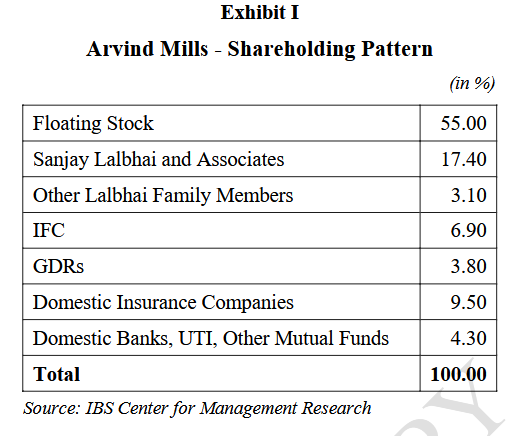
Exhibit I
Keywords
Arvind Mills, expansion strategy, company's, poor financial health, late 1990, massive expansion, denim capacity, cotton fabrics, slowly, denim, funded, loans, Indian, overseas, financial institutions, repay, interest burden, financial problems, debt-restructuring plan, February 2001