
Film Insurance & Financing in India
🌐 International Buyers — Pay via PayPal
Details
FINC012
7
2002
YES
0
United India Insurance Company
Insurance
India
Market Analysis,Regulatory Environment
Abstract
The case examines the developments in the film insurance industry in India in the late 1990s. Studying the experience of the United India Insurance (UII) company, which pioneered film insurance in India, it explores in detail the hurdles faced by the film industry in dealing with the banks/financial institutions (FIs) and insurance companies. While the success of UII’s film insurance service encouraged more film producers to adopt transparency and corporate practices, the industry hoped that the recommendations of the Joint Institutional Committee for Financing Entertainment Industry made in December 2000 would herald a new saga for it.
Learning Objectives
The case is structured to achieve the following Learning Objectives:
- Film insurance
- Film financing in India
- Hurdles in film financing.
Contents
“As the investment required for making a good quality film is high it is essential that Film Insurance becomes a defacto standard for the film industry.”
- A report from www.indiainfoline.com, in 2001.
In June 2000, when popular Hindi film actress and former Miss World Aishwarya Rai (Rai) met with an accident, there was another casualty – United India Insurance (UII). Though the accident cost the insurance company a sum of only Rs 1.6 million, it attracted substantial media coverage. The reason was that it was the first instance of the Hindi film industry availing the benefits of film insurance – a practice followed in the US film industry since the era of silent movies.
The credit for pioneering the film insurance business in India however goes to the successful Hindi film producer-director Subhash Ghai (Ghai). Ghai was the first Indian filmmaker to have his film 'Taal' insured for a sum of Rs 110 million with UII in 1998. The move was welcomed by both media and film personalities as opening of a new chapter in the Indian film industry. UII Asst. General Manager, Bhandari said, “'Taal' being the first Hindi film to be insured, the policy had to be formulated from scratch.” UII even honored Ghai with naming the policy 'The Cine Mukta Policy' after his company Mukta Arts Pvt. Ltd.
By July 2001, UII had insured around 8-10 films, for sums varying from Rs 25 million to Rs 220 million, with many more in the pipeline. The insured films included YashRaj Films' 'Mohabbatein,' Aamir Khan Productions' 'Lagaan,' Farhan Akhtar's 'Dil Chahta Hai,' Karan Johar's 'Kabhi Khushi Kabhi Gham' and Dreamz Unlimited's 'Asoka' among others. Industry watchers were happy to note that the hitherto highly unorganized Hindi film business was finally adopting 'corporate' practices. The fact that the industry had not opted for film insurance till the late 1990s was however not because of the producers' ignorance. A host of other problems that plagued the film industry were responsible for this. The fact remained that the problems with the industry's mode of operations had rendered the standard global practice of getting a film insured taboo.
Cinema entered India in 1896 with the screening of six soundless short films in Bombay. Dada Saheb Phalke, considered to be the father of Indian cinema, made the first fully indigenous feature film 'Raja Harishchandra' in 1913. The first film with sound 'Alam Ara,' was released in 1931, and the first color film, 'Kisan Kanya,' was released in 1937.
The industry followed the 'studio culture' of Hollywood in the initial days, wherein big movie production houses (called studios) hired stars, music directors and film directors as salaried employees for four to five years. However, over the years, the studio system gradually gave way to independent producers. The decades that followed saw Indian cinema flourishing and becoming an integral part of every Indian's life. Film stars, producers, directors, music directors, lyricists and playback singers became immensely popular celebrities.
The industry was broadly classified into four segments – software (films, music and programs), hardware (studios and other infrastructure services that support the creation of entertainment software) and services (distribution, exhibition, film procurement and banking services) and the front-end media segment (which film magazines, video cassettes and promotional tools). By 2001, the Indian film industry had produced about 27,000 feature films and thousands of documented short films. With around 800 films being produced every year, in over 52 languages, India was undoubtedly the world's largest film producing country. In March 2000, a FICCI-Arthur Andersen report revealed that the Indian film industry was expected to grow from Rs 84 billion in 2000 to Rs 340 billion by 2005.
However, all was not well with the Indian film industry. The success rate of Indian films was extremely low. A majority of the films could not even recover the investments made. Even after nine decades, the number of 'blockbuster' movies was very low when compared to the US film industry. Analysts claimed that the most significant problem was the lack of quality and the mediocre production values often resulted in films sinking without a trace in the market. The need for insuring films arose from the basic principle of getting protection against financial loss arising on the happening of an unexpected event. Table I gives the various categories for film insurance:
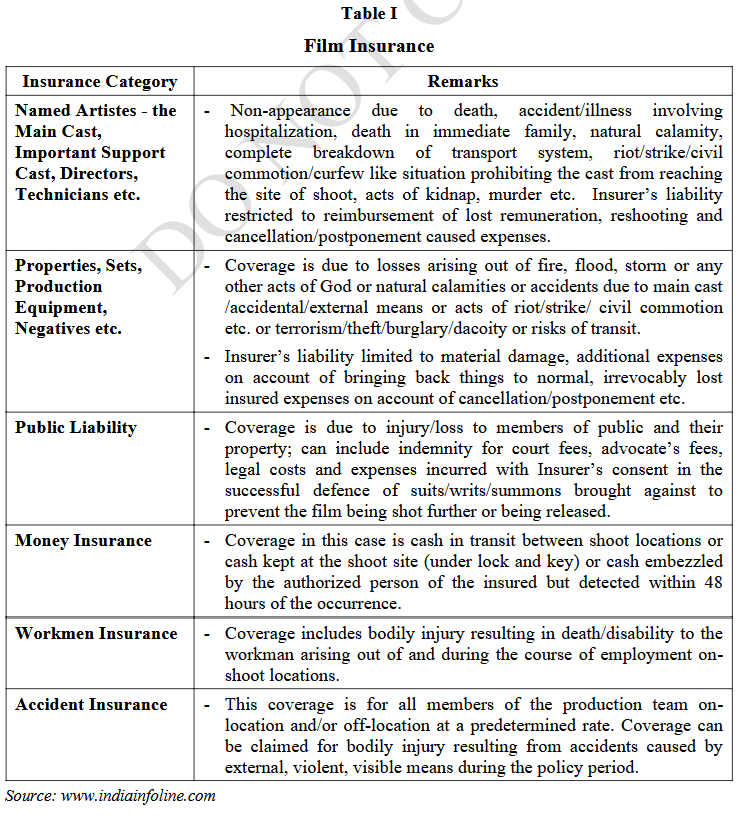
Depending on the type of movie being made, a producer took one or all of the above coverages as a part of the policy. For instance, a movie where large sets had to be put up, the policy would be heavy on insurance for properties and sets. On the other hand, for a movie shot in a single room/bungalow etc., this kind of insurance could be completely avoided. Also, for a movie where the actors performed dangerous stunts, extra insurance had to be taken. The insuring companies did not cover pre and post-production problems and the loss of profits.
By insuring just 10 odd films, UII had done business worth around Rs 1 billion. Considering the fact that India produced 700-800 films per year, the Indian film insurance market was quite significant. However, the business was not expanding as expected by the analysts. This was primarily attributed to the fact that though films as a business outsized many other industries in India, the government had not given it an industry status. The main reason for this was the highly unorganized nature of the business. Even the future of film insurance seemed to be clouded because of this.
In December 1998, after signing the deal for 'Taal,' UII had approached a few London and Tokyo based insurance companies to re-insure2 the film. These companies refused to re-insure Indian movies, citing the complete lack of accountability in film production in India as the reason behind their decision. An UII official said, “They sent us many questionnaires on the movie business in India and about Ghai's project. Finally, they decided that they will not be able to re-insure a movie produced in India.”
Analysts remarked that the hesitance of the foreign insurance companies was completely justified. The functioning of the Indian film industry was completely unorganized. To insure (or re-insure) a film project, any insurance company would naturally look for a commercially viable project, backed by detailed reports regarding the risks involved, the financing of the project and completion schedule etc. However, the issue of financing was found to be the biggest stumbling block for the development of the film insurance industry.
The three major sources of funds for the film industry were the distributors, music companies and financiers. It was comparatively easier to get finance from the distributors for producers with a good track record. However, in case of a lesser known producer, the distributors frequently asked to see the under-production movie, and forced the producers to make some changes (such as adding or deleting a song/dance/action sequence etc.) to improve the film's success prospects. The music companies, who bought the rights for selling a film's music also provided funds to the producers. However, here also the big banners associated with established music directors had easier access to funds as compared to the others.
Thus, the financiers had emerged as the de-facto primary source of funds in India over the years. Financiers – often diamond merchants, brokers, builders and other cash rich businessmen, charged very high interest rates, generally in the range of 36-48% per annum. To get funds at cheaper rates, the film industry gradually moved towards black money, laying the foundations of the underworld mafia and the film industry's association. Industry sources revealed that approximately 30-35% of the films were financed by the underworld.
At various other stages in the course of production of the movie – transactions with the distributors and the music companies for instance – there was always an element of black money involved. Most of the popular stars commanding a high fee, did not take their entire payment in white money in order to escape the taxes. According to estimates, 15-20% of the money paid to stars was always in black money.
By the mid 1990s, the industry was facing serious problems with the underworld mafia demanding increasingly higher payments. Often, producers/stars/directors were threatened to pay 'protection money' or the rights for distributing a potentially successful movie. After some celebrities were murdered, reportedly by the underworld, the government had even begun providing police protection to film personalities.
Another problem plaguing the industry was the issue of piracy. The piracy of films, either in the form of illegally showing the movie on cable networks, or the selling/renting of unauthorized video cassettes, VCDs, LDs and DVDs3, had become a big business in India. In 1995, the industry lost approximately 99% of its total earnings to piracy. Though the figure had come down to 80% in 1998, the threat of piracy was still very significant.
In the late 1990s, the film industry was going through a phase of changes. With increasing concern over removing the underworld influence and the emergence of corporate houses, (such as Mukta Arts, Ajay Devgan Entertainment and Software, Balaji Telefilms, Zee Telefilms, Amitabh Bachchan Corporation Ltd. and Dreamz Unlimited), the demand for the government granting films an industry status intensified. In October 2000, the government finally gave films industry status via notification 2 (C)(XVII) of the IDBI Act 1964. Though the move was welcomed by the industry and banks/FIs in the media, the film financing and insurance business failed to pick up as expected.
Analysts remarked that the financing and piracy problems combined with the issues of lack of transparency in operations, disorganized functioning, frequent cost overruns and no physical assets being offered as collateral, resulted in banks and financial institutions shying away from financing film production.
Ram Gopal Varma, the maker of blockbusters such as 'Rangeela' and 'Satya,' said, “All film makers get financial support from private financiers with whom they have mutually beneficial relationships. Bollywood at the moment is not ready for institutional finance.” Producers claimed that they could not afford to bring in transparency, as it would entail revealing certain secret deals like actual payments to film stars and the amount of profits made per film (most of which usually remained unaccounted). Also, as the producers were used to getting huge sums of money without any documentation and collateral, they seemed to be reluctant to go through the process of preparing reports and other lengthy procedures.
In December 2000, a Joint Institutional Committee on Financing Entertainment Industry submitted an interim report that laid down certain norms for offering financial assistance to the film industry. The committee headed by the Department of Banking-Ministry of Finance, had Industrial Finance Corporation of India (IFCI) and Industrial Development Bank of India (IDBI)4 as its members. The committee's recommendations included:
- Institutions should extend finances only to corporate entities.
- Besides negatives, music rights, satellite TV rights and overseas rights must also be considered as security.
- Insurance companies must extend insurance cover for films and develop more products for the industry.
- When financing a single film, the duration of advance may be restricted to between 6 and 18 months.
- Banks and FIs should work together with producers to evolve standards for financing and insuring films.
- Creating a film industry-rating agency by pooling people from banks/FIs, eminent filmmakers and experts in the media sector to judge a filmmaker's credentials
The increased transparency as a result of film production companies adopting corporate practices was expected to enable the banks/FIs/insurers to deal with the film industry like any other industry. The changed setup was also expected to result in better films being produced with significant improvement in the overall industry performance levels. Besides helping the film industry in breaking away from the underworld, corporatisation of the film industry was expected to result in multiple benefits for the government as well. Film software was expected to become a $ 1 billion industry by 2005, employing around 10 million people. Further, ancillary industries like dubbing, editing, sound recording, web designing, web-casting, merchandising and promotion were expected to flourish as well.
The government was reported to be working towards developing a comprehensive legal structure for insuring all kinds of movies along with institutes like National Film Development Corporation (NFDC)5 and Film & Television Institute of India (FTII).6 This was expected to go a long way in opening up the film finance sector. With transparent accounting practices and assured adherence to targets and time-schedules, a buoyant and flourishing film insurance industry in the country seemed all set to become a reality.
1. The US film industry had begun insuring films in the era of silent movies itself. Why do you think the Indian film industry waited till the 1990s to adopt this practice?
2. Do you think the highly unorganized film industry would be able to transform itself to a corporate setup? What steps need to be taken by the industry as well as the government to ensure that the film insurance business becomes a success in India.
Keywords
Film insurance industry, India, 1990, United India Insurance, UII, company, film insurance, India, hurdles, film industry ,banks/financial institutions, FI, insurance companies, film producers, transparency, corporate practices, Joint Institutional Committee for Financing Entertainment Industry, December 2000
Related Case Studies
| Case Title | Details | Price | Add to Cart |
|---|---|---|---|
|
Case Title The IndiGo Crisis in 2025: Lessons in GovernanceCase Code: BECG201 |
Details | 300 | Add to Cart |
|
Case Title IndiGo Airlines: Business Model Efficiency or Operational Resilience?Case Code: CLBS176 |
Details | 300 | Add to Cart |
|
Case Title Can Kelly Ortberg help Boeing Navigate through its Troubles?Case Code: HROB292 |
Details | 500 | Add to Cart |
|
Case Title PepsiCo India Vs Gujarat Potato FarmersCase Code: ECON074 |
Details | 400 | Add to Cart |
|
Case Title Rolls-Royce: The Turnaround ChallengeCase Code: CLBS154 |
Details | 200 | Add to Cart |