
The Case of insider trading (HLL-BBLIL Merger)
🌐 International Buyers — Pay via PayPal
Details
FINC014
8
2002
YES
0
Hindustan Unilever Ltd.
Home Appliances & Consumer Products
India
Regulatory Environment,Corporate Governance
Abstract
The case study analyses the issues related to the insider trading charges against HLL with regard to its merger with Brooke Bond Lipton India Ltd. The case focuses on the legal controversy surrounding these charges. The controversy involved HLL’s purchase of 8 lakh shares of BBLIL two weeks prior to the public announcement of the merger of the two companies (HLL and BBLIL). SEBI, suspecting insider trading, conducted enquiries, and after about 15 months, in August 1997, SEBI issued a show cause notice to the Chairman, all Executive Directors, the Company Secretary and the then Chairman of HLL. Later in March 1998 SEBI passed an order charging HLL with insider trading. SEBI directed HLL to pay UTI compensation, and also initiated criminal proceedings against the five common directors of HLL and BBLIL. Later HLL filed an appeal with the appellate authority, which ruled in its favour. Through a description of the legal causes surrounding the SEBI’s charges against HLL, this case, is designed to enable students to understand and appreciate the role of the legal framework under organizations function. It also stimulates the students to understand the legal implications of decisions made by an organization and provides an insight into how a typical legal case proceeds. At the end of the case-discussion, students should have grasped the following issues: A general understanding of the legal framework covering the securities market in India. An understanding of the role and importance of a regulating agency in checking financial crimes such as insider trading. An understanding of the responsibilities of organizations. The case is intended for MBA/PGDBM level students as a part of their Business Ethics curriculum.
Learning Objectives
The case is structured to achieve the following Learning Objectives:
- Mergers
- Insider trading
- Role of regulatory bodies.
Contents
“… it can be conclusively said that while entering into the transaction for purchase of 8 lakh shares of BBLIL from UTI, HLL was acting on the basis of the privileged information in its possession, regarding the impending merger of BBLIL with HLL. It also may be stated that, by its very nature, when it comes to motives and intentions, there may not always be any direct evidence. However, the chain of circumstances, the timing of the transaction, and other related factors, as discussed earlier, demonstrates beyond doubt that the transaction was founded upon and effected on the basis of unpublished price sensitive information about the impending merger.’’
- Excerpt from SEBI order that tried to establish an insider trading case against HLL management.
It was battle royale, a unique one at that. In one corner was the capital market regulator SEBI, cracking down with India's first-ever 'guilty' verdict for an insider trading offence. In the other corner was Unilever subsidiary, Hindustan Lever Ltd. (HLL) marshalling its formidable corporate resources to defend itself. On August 4, 1997, SEBI issued a show cause notice to HLL claiming that there was prima facie evidence of the company indulging in insider trading through the use of 'Unpublished price sensitive information' prior to its merger with Brooke Bond Lipton India Ltd. (BBLIL). In March 1998, SEBI passed an exhaustive order, which sent shock waves through the country's corporate sector. SEBI found HLL guilty of insider trading because it bought shares of BBLIL from Unit Trust of India (UTI), knowing that HLL and BBLIL were going to merge. Since it bought the shares before the merger was formally announced, SEBI held that HLL was using unpublished, price-sensitive information to trade, and was therefore guilty of insider trading. SEBI directed HLL to pay UTI Rs 3.4 crore in compensation, and also initiated criminal proceedings against the five common directors of HLL and BBLIL: S.M. Datta, K.V. Dadiseth, R. Gopalakrishnan, A. Lahiri, and M.K. Sharma, who were on the core team which discussed the merger.
Predictably, HLL decided to appeal against the SEBI verdict to the Union Ministry of Finance, the appellate authority in such cases. The question, which lingered in everyone's mind was- Is HLL, guilty of insider trading and would SEBI's charges hold?
The merger of HLL and BBLIL had always been on the cards. The HLL group had started the process of consolidation with mergers of some Tea Estates with Brooke Bond, and then the latter with Lipton India. With the formation of BBLIL, the question was not if HLL and BBLIL would be merged, but when. After these mergers, it was clear that HLL wanted to follow in the footsteps of Unilever, its global parent, in India. As a result of the relaxation of controls after liberalization, the HLL group could operate in India in much the same way as Unilever did globally. Besides, the operations of the two (HLL and BBLIL), when combined bestowed considerable cost advantages.
In April 1996, HLL announced its merger with BBLIL. At the time of the merger, there was market gossip about insider trading. In the days preceding the merger announcement, the BBLIL counter had seen heavy trading and SEBI was known to be making discreet inquiries about the spurt in BBLIL's trading volumes at that time. It was only after about 15 months of detailed analysis that SEBI issued a notice to HLL asking why it shouldn't be slapped with an insider trading charge. And then in March 1998, SEBI announced criminal prosecution of five HLL directors for insider trading and asked it to pay Rs. 3.04 crores to UTI as compensation. (Refer Table I for chronology of events.)
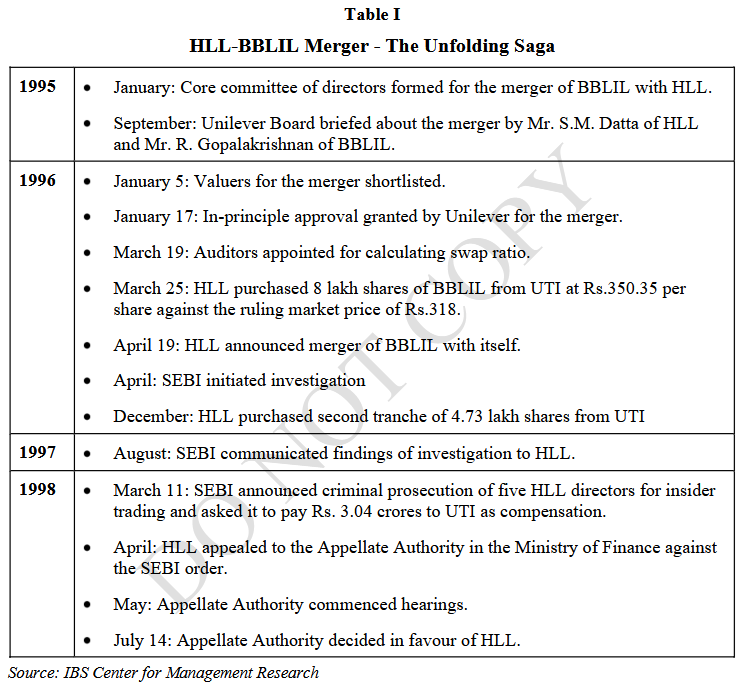
The SEBI's charges were based on HLL's purchase of 8 lakh shares of BBLIL from UTI at Rs 350.35 per share (At a premium of 9.5% of the ruling market price of Rs. 320). This transaction took place on March 25, 1996, just 25 days before the HLL-BBLIL merger was announced on April 19, 1996. UTI was on the verge of closing its accounts for 1995-96 and had been selling shares in the market to fund its dividend payouts.
On 19 April 1996, HLL notified the stock exchanges of its proposal to merge BBLIL. On 22 April, the boards of HLL and BBLIL met in Bangalore and accepted the valuer's share swap ratio of 9:20. On the basis of these facts, SEBI charged HLL of being privy to unpublished price-sensitive information. It said, “It also appears that on the date of the acquisition of shares, HLL had full knowledge of the impending merger and thus was placed in an advantageous position as against the general investing public, including UTI.” Moreover, SEBI claimed that after the merger announcement, the price of BBLIL's scrip shot up to over Rs 400, thereby leading to notional financial gains as a result of the alleged insider information. HLL, however, strongly refuted the charges and insisted that it had acted legally and that it was not guilty of „insider trading.' This controversy raised complex legal issues and the legal fraternity was sharply divided over the strength of SEBI's case. But what were the main legal issues?
The first and most important issue was determining whether HLL was an insider at all. According to regulation 2(e) of the SEBI regulations, “Insider means any person who is or was connected with the company or is deemed to have been connected with the company, and who is reasonably expected to have access, by virtue of such connection, to unpublished price-sensitive information in respect of securities of the company, or who has received or has had access to such unpublished price-sensitive information.”
According to HLL, though it was deemed to be connected to BBLIL, and though it knew about the merger before it bought BBLIL's shares, it received the information only because it was one of the parties to the merger itself and not merely because of its connection to BBLIL. According to HLL this distinction was important because, to be considered an insider, HLL should have received the information “by virtue of such connection” to the other company. HLL's defense revolved around the fact that as an initiator and also the transferee, it was the 'primary party' to the merger. M.K Sharma, Legal director, HLL, said, “Nowhere in the world is the primary party to a merger considered to be an insider from the point of view of insider-trading.” (Refer Box).
| If a company 'A' decides to merge two other companies 'B' (belonging to the same group) and 'C' (Outsider) into itself, in both cases 'A' is the initiator and primary party. SEBI would give a clean chit to any share trade prior to the merger between C and A, as A is neither a connected party nor deemed to be connected and hence, not an insider. But the same would not be permitted between A and B, as both belong to the same group. This raised an important legal issue. Irrespective of the status of C vis-à-vis A, the primary party was expected to examine all the financial and operational data of C prior to the merger, just as it would do with B. A could also be buying shares of C as well as B. As a primary party, it would get exactly the same privileged information in both cases. Therefore, how could one discriminate against the A-B deal but give a clean chit to the qualitatively identical A-C deal? |
SEBI interpreted the rule differently. It said that the phrase “by virtue of such connection” applied only to one kind of insider, the connected or deemed connected person who was expected to have access to information because of his connection. The second part of the clause defined another kind of insider, who might not be connected to the company at all, but “who had received or has had access to such unpublished price sensitive information.” Therefore, it said that even if the other company involved had been unconnected, HLL could still be an insider of the second type. Its order said, “If we were to accept HLL's argument...it would permit a 'connected' or 'deemed connected' person to misuse the price-sensitive information because he has received the information independently.” SEBI also believed that HLL also fell under the first definition of someone “who was reasonably expected to have access by virtue of such connection” because the core team of five common directors discussed the merger, and Unilever, the common parent, granted the in-principle approval, and besides, HLL was free to use the information to further the merger, but not to buy shares.
The second issue in regard to the case was to establish whether or not the information, which HLL had access to, was „unpublished?. According to regulation 2(k), “Unpublished price-sensitive information means any information which is of concern, directly or indirectly, to a company, and is not generally known or published by such company for general information, but which if published or known is likely to materially affect the price of securities of that company in the market.”
HLL contended that before the transaction, the merger was the subject of wide speculation by the market and the media. After the formal announcement, press articles mentioned that the merger was no surprise to anyone. HLL pointed out that the share price of BBLIL moved up from Rs. 242 to Rs. 320 between January and March, before the transaction, indicating that the merger was “generally known information.” HLL also pointed out that UTI was a large institutional player and, given the speculation, how could UTI remain unaware that the merger was in the offing? Perhaps more importantly, UTI did not protest the trade after the formal merger announcement.
UTI was the second largest shareholder in both BBLIL and HLL. Between the transaction and the formal announcement, it was privately told of the merger. UTI also hosted an inter-institutional meeting to discuss it. It did not complain, either formally to SEBI, or informally to HLL. It even sold HLL some more shares nine months later, though at a higher price.
SEBI countered this argument by relying on the concerned UTI official's testimony that he was unaware of the merger as proof that the information was not generally known. Though it had not defined either unpublished or generally known information, SEBI sources were of the view that these could include press reports, even if unconfirmed by the company. Since these reports were speculative, technically HLL's knowledge was qualitatively better, especially since SEBI claimed one of the press reports carried a denial by the company.
The third legal issue concerned the price-sensitive nature of the information regarding the merger. Regulation 2(k) laid down eight examples of price-sensitive information, which included “(v) amalgamations, mergers, or takeovers.”
In this regard, HLL argued that only the information about the swap ratio could be deemed to be price-sensitive and that this ratio was not known to HLL or its directors when the BBLIL shares were purchased in March, 1996. HLL pointed out that the two audit firms who valued the merger, S.S. Billimoria & Co. and M.N. Raiji & Co., recommended the ratio to the HLL board only in mid-April, 1996, which was only after the UTI transaction, i.e. after HLL's purchase of shares from UTI. HLL further argued that the news of the merger was not price-sensitive as it had been announced by the media before the official announcement. HLL also pointed out that BBLIL and
HLL were both subsidiaries of a common parent; operating in the same industry, and were large, profit making companies, having a common pool of management, recruitment and some common directors and had listings on multiple stock exchanges, and were actively traded. Therefore, information of the merger by itself was not enough to induce a reasonable person to buy shares until the share swap ratio was known. Therefore, the merger information in itself had little relevance; the only thing that was price-sensitive was the swap ratio.
SEBI, on the other hand, emphasized that the regulation cited explicitly defined mergers as price-sensitive information. It said, “(the) swap ratio may be price-sensitive information, but that does not mean that information of the overall fact of merger is not price-sensitive.”
The fourth issue, which arose from the controversy, was whether HLL had profited from the deal or gained unfair advantage. In regard to this, neither the act nor the regulations stated that SEBI must prove that a profit was made or a loss was avoided. However, Section 15 of the act prescribed considering “the amount of disproportionate gain or unfair advantage wherever quantifiable” when levying penalties.
HLL defended itself by pointing out that SEBI had to establish the financial benefit from the transaction in order to prove an insider trading charge. It pointed out that though establishing “financial benefit” was not explicit in the law, it was implied, because the act said that it should be taken into account when levying penalties. Said Justice Bhagwati, “though the SEBI regulations did not contain any specific requirement of the presence of any element of making profit or avoiding loss, this factor is inherent in the offence of insider trading.” HLL also argued that it made no profit from the deal. Post-merger, HLL cancelled its BBLIL shareholding, and so made no financial gain. Second, the average market price for the month after the swap ratio was announced, Rs343, was lower than HLL's purchase price of Rs. 350.35. Third, HLL had cheaper options to get the shares, such as a preferential issue by BBLIL either to HLL or to Unilever.
SEBI maintained that the provisions, HLL relied on helped to determine the punishment, not the violation. SEBI's order said, “making profit or avoiding loss is not a legal requirement under the regulation to establish the charge of insider trading. Section 15...(is) only applicable in cases of levy of monetary penalties and has no bearing on determination of the contravention.” SEBI's contention was that HLL did benefit. As HLL couldn't predict how prices would move after the merger announcement, it might well have had to pay more for the BBLIL shares then. In fact, immediately after the merger announcement, BBLIL's share closed at Rs. 405, though it
subsequently fell. Alternatively, if UTI had not sold, it would have got shares worth Rs. 48.83 crore in the merged HLL, Rs. 20.83 crore more than its sale price.
Round two of the battle between SEBI and HLL took place under the aegis of the Appellate Authority of the Finance Ministry. In response to the SEBI's charge, HLL appealed to the Appellate Authority pleading that it be absolved of the charges of insider trading. UTI later filed an appeal with the Appellate authority, claiming a higher compensation of Rs. 75.2 million (7.52 crore). It pleaded that it had to incur a notional loss as it was not aware that a merger of the two Unilever group companies was on the cards.
The two-member Appellate Authority, consisting of the Finance Secretary, Mr. Montek Singh Ahluwalia, and the Special Secretary, (Banking), Mr. C.M. Vasudev, in its judgement on the appeal made by HLL, said, SEBI was not justified in ordering prosecution of the company as the order was not based on conclusive determination of all aspects of insider trading and on specific justification in terms of the gravity of the offence.
The Appellate Authority agreed with SEBI's ruling that HLL was an “insider.” It observed that Unilever was the dominant shareholder in both HLL and BBLIL and that they were “connected” and that the merger was not driven by decision processes entirely internal to HLL. Moreover, the Authority accepted the SEBI's ruling that the information on the merger constituted price-sensitive information available to the company. The Authority also agreed with the SEBI ruling that the share purchase was intended to maintain Unilever's holding in the merged company at 51%. In effect, the Appellate Authority concurred with SEBI that HLL was an “insider” in the transaction; that HLL had privileged price-sensitive information; and that HLL had a motive in pushing through the transaction. However, its ruling was based on the reasoning that the proposal on the merger was generally known.
In support of its ruling, the Appellate Authority cited press reports that indicated “prior market knowledge of the merger.” However, by its own admission, there were only a few reports “prior to the actual purchase (of shares from UTI).” The Authority had cited 21 news reports to support the contention that the prospect of a merger between HLL and BBLIL was widely known. In its judgement, the Appellate Authority said that under Regulation 11B, SEBI was not capable of initiating investigations and then taking recourse to powers under the Act for awarding compensation without passing an order under the above mentioned regulation. It said, “We find it difficult to agree with the view of SEBI that despite the specific provisions in the Act and regulations, it is open to it to use the general powers under the Act. If this were so, the purpose of framing the regulations would be defeated.” The authority criticized SEBI for relying just on the evidence presented by UTI. The Authority said that SEBI should have given “due weightage” to “market reports.” While exonerating HLL of the charges of insider trading, the Appellate Authority said, “At the same time, it would have been desirable if at the time of purchase of shares, HLL had informed UTI that the core committee is considering the proposal of amalgamation.” (In fact, Unilever had already granted in-principle approval for the merger. Moreover, valuers had already been appointed to work out the swap ratio at the time of the share purchase from UTI.)
On the issue of price sensitivity, the Authority had said that Section 2 (k) of the Regulations could have been better drafted to remove ambiguity. On the issue of price sensitivity of the information about the merger, the Authority said that there was merit in the argument that this was a case of merger of two healthy profit-making companies, each having a similar management culture. The Authority also wondered why SEBI had not chosen to use 15 G of the Insider Trading Regulations for imposing a penalty but instead decided to use omnibus powers under Section 11 and 11 B of the Act to adjudicate for awarding compensation. Use of omnibus powers for
imposing a pecuniary burden could not be the intent of law, the Authority felt. It said, “We, therefore, find that the order of SEBI to award compensation to the UTI, apart from suffering from procedural deficiencies, also lacks in jurisdiction. It is surprising that the UTI did not choose to approach SEBI in the first instance soon after it felt that the HLL, because of insider trading, had gained an unfair price advantage in the purchase of BBLIL shares from the UTI.''
The Authority commented that UTI's decision to file an appeal on the quantum of compensation, only after SEBI had suo moto awarded compensation to it, appeared to be an afterthought. “However, given our finding with regard to jurisdictional competence of SEBI to award compensation, we do not consider it necessary to pass any separate order on the appeal filed by UTI,'' it said.
Further, the order said that there was persuasive evidence which pointed toward market knowledge and widespread speculation about the possibility of the merger before the purchase of shares in question by HLL from UTI. This weakened a crucial aspect of the charge of insider trading, that the information involved should not be generally known. The Authority had come down heavily on UTI, suggesting that it was not market-savvy, that it did not know what was generally known in the market.
The charge against HLL had brought to the fore the debate over SEBI's role as a watchdog of the Indian Capital market and its ability to control financial crimes such as insider trading. It also highlighted the inability of the legal machinery to handle such cases.
Though SEBI issued regulations governing this area in 1992, there had been no proven case of insider trading since then. But the question here was: did the market regulator have any system in place to monitor such instances and take suo moto action as provided in the Regulations? The answer to the question seemed to be 'no.' The watchdog was not known to have proved any case of insider trading and actually punish the perpetrators. Nor did it seem that the regulator had any system in place to monitor such practices. The SEBI's style of operations in such matters seemed more as a reaction to press reports than independent action.
It is time that SEBI woke up to the facts because as the market get increasingly sophisticated and institutionalized, the scope for such offences also increases proportionately. It should be understood that SEBI was not the only one at fault. Thanks to the drawbacks in the legal system, in many cases, it seemed to have become a watchdog tied to the post, watching the perpetrators helplessly. Taking advantage of these loopholes in the system were the unscrupulous companies, which cleverly used it as a cloak for financial crimes. To restore the sanctity and credibility of the Indian capital market, there was a crying need for framing regulations that would give the regulating agency the much-needed teeth to 'bite' those who were found guilty of financial crimes such as insider trading. Neither the guilty should go unpunished nor the innocent made to suffer. It would me more equitable if the regulations were so framed to require SEBI to prima facie establish that insider trading has indeed occurred and then shift the onus of proof on to the defendant to establish his bonafides. If concrete action in this direction is not taken, the Indian capital market would continue to lack credibility and the investors, who are the backbone to the system, may well turn away and the result…well… it's anybody's guess.
1. Discuss briefly the SEBI's charges and HLL's defense in regard to the allegations of insider trading.
2. The Appellate Authority's decision to absolve HLL of charges of insider trading on the basis that the information about the merger was 'generally known' raised many eyebrows. Critically examine the decision.
3. “It is a general impression that proving insider trading is not easy.” Discuss, throwing light on the Indian scenario.
4. “It would me more equitable if the regulations were so framed to require SEBI to prima facie establish that insider trading has indeed occurred and then shift the onus of proof on to the defendant to establish his bonafides.” What are the advantages of this approach?
Keywords
Insider trading, HLL, merger, Brooke Bond Lipton India Ltd., legal controversy, 8 lakh shares, BBLIL, two weeks prior, public announcement, merger, SEBI, insider trading, conducted enquiries, 15 months, August 1997, SEBI, show cause notice, Chairman, Executive Directors, Company Secretary, Chairman, March 1998, UTI, compensation, criminal proceedings, five common directors, appellate authority
Related Case Studies
| Case Title | Details | Price | Add to Cart |
|---|---|---|---|
|
Case Title The IndiGo Crisis in 2025: Lessons in GovernanceCase Code: BECG201 |
Details | 300 | Add to Cart |
|
Case Title IndiGo Airlines: Business Model Efficiency or Operational Resilience?Case Code: CLBS176 |
Details | 300 | Add to Cart |
|
Case Title Can Kelly Ortberg help Boeing Navigate through its Troubles?Case Code: HROB292 |
Details | 500 | Add to Cart |
|
Case Title PepsiCo India Vs Gujarat Potato FarmersCase Code: ECON074 |
Details | 400 | Add to Cart |
|
Case Title The Tech Phoenix: Satyam’s 100-Day TurnaroundCase Code: BSTR703 |
Details | 600 | Add to Cart |