
Reliance Petroleum TOCD Issue (A)
🌐 International Buyers — Pay via PayPal
Details
FINC016
7
2002
YES
0
Reliance Petroleum Limited
Energy
India
Investments
Abstract
The case Reliance Petroleum’s TOCD issue analyzes an innovative convertible security TOCDs issued by Reliance Petroleum Limited in September 1993 to finance its grassroot refinery project at Jamnagar, Gujarat. It provides a detailed explanation of the instrument and the various options available to the investor which were evaluated on the basis of their yield to maturity. The case also provides a concept note highlighting the various methods of raising finance from public investors by an organization.
Learning Objectives
The case is structured to achieve the following Learning Objectives:
- Convertible securities
- Public Issues
- Financing.
Contents
“Till the advent of a big-ticket mop-up of investor funds by Reliance, the stock market was confined to brokers, a few high net worth individuals, the UTI and a small set of investors who profited from investing in MNCs when the companies were forced to dilute their stakes in the mid-70s by the Government. Dhirubhai Ambani made investing in the equity markets an acceptable practice in what was essentially a market with a narrow investor base in the 70s and part of the 80s.”
- Business Line, July 2002.
In September 1993, Reliance Petroleum Ltd. (RPL), a part of the Reliance Group made an initial public offering (IPO) to partly finance its Rs 51.42 billion refinery project. RPL planned to establish a 9-million-tonne refinery at Jamnagar, Gujarat. This was the first private sector refinery to be set up in India, pursuant to the oil sector reforms. The total public issue was of Rs. 21.72 billion while the net offer to the Indian public amounted to Rs 8.62 billion. This was the largest issue in India at that time and was made through an innovative financial instrument in the form of Triple Option Convertible Debentures (TOCDs).
The RPL TOCDs were rated BBB+ ('triple B plus') by Crisil and Fitch. Capital market analysts appreciated RPL's move to issue TOCDs to raise capital from the public since they felt that these financial instruments would benefit the company as well as the investors. The TOCDs were not structured as a conventional debt since they did not have to bear the burden of interest costs for the company. Moreover, they also provided with an option to investors to opt for equity shares at the time of TOCD conversion in September 1997 in case the listed price of RPL stocks was higher. Analysts believed that the TOCDs would also ensure that RPL maintained its debt-equity ratio at 1:1. However, some market observers expressed doubts whether this mega issue would be fully subscribed given the depressed stock market conditions during that time. Despite these fears, the RPL TOCD issue was successful. The issue created an investor base exceeding two million, the second largest in the Indian corporate sector next only to Reliance Industries Limited (RIL).
Market analysts attributed this success to the investor friendly image of the RIL Group. The use of convertible securities that reduced the investors' risk and provided them with the option of converting debentures into tradable securities also contributed to its success. They also said that the Reliance Group was among the few Indian business houses, which recognized the importance of public investors, discovered the vast untapped potential of capital markets and channelised it for the growth and development of the industry. Commenting on the success of the RPL TOCDs issue, Business Standard stated, “Reliance's uninterrupted dividends and increasing market value were sure signs for the success of the TOCD issue.”
Reliance Group was among the largest business houses in India with interests in several businesses including textiles, petrochemicals, petroleum products, oil & gas, power, telecom, synthetic fibers, fibre intermediates, financial services, refining & marketing and insurance.
The significant success, which the RIL Group had witnessed over the years, could be mainly attributed to the founder and former chairman of Reliance Group, Dhirubhai H. Ambani. In 1950, at the age of 17 he went to Aden (now part of Yemen) and worked for A Besse & Company Ltd., a distributor for Shell products. In 1958, he returned to Mumbai and started his first company, the Reliance Commercial Corporation (RCC), a commodity trading enterprise and an export house. In 1966, as a first step towards its highly successful strategy of backward integration, he set up a textile mill called Reliance Industries Limited (RIL) in Naroda, Ahmedabad. In 1975, a technical team from the World Bank certified that the Reliance textile plant was “excellent according to developed country standards.” In 1977, RIL went public. For much of the 1980s, Reliance Group's fund-raising was centred on its flagship company RIL, which came out with the public issue of equities as well as convertible debentures. The use of convertible financial instruments to raise finances from public was actively practiced by Reliance to ensure that its debt equity ratio did not exceed 1:1.
Since the first public issue, the RIL Group had made efforts to build an investor friendly image. RIL had a history of paying uninterrupted dividends with the dividend growing from 15 per cent in 1976-77 to 55 percent in 1994-95. Moreover, the dividends paid had been on a much higher equity capital which rose to Rs 3.19 billion in 1993-94 from Rs 59.5 million in 1976-77 due to the bonus and rights issues made during the period. The kind of returns RIL's stock offered over the years seemed to have built shareholders' confidence in the group. The group had been credited with a number of financial innovations in the Indian capital market and emerged as one of the largest family of shareholders in the world with investments of over Rs.360 billion.
In September 1991, RPL was incorporated under the name Reliance Refineries Private Limited in Mumbai. On March 6, 1993, the name of the company was changed to Reliance Refineries Limited. Subsequently, at the extraordinary general meeting of the company held on 26th March, it was renamed Reliance Petroleum Ltd. The company came out with its first public issue in September 1993.
An organization can raise money through public investors by issuing various financial instruments. These can be in the form of equity shares, preference shares, debentures and bonds and can be classified into two broad categories of equity and debt.
EQUITY
Equity refers to the raising of funds from the public by issuing shares from the equity share capital of the company at face value or at a premium. Companies that have a proven track record or new companies promoted by well-known existing companies can issue shares at a premium. In India, the price of the issue is determined in consultation with the Lead Manager5 for the issue. However, the price has to be justified as per the Malegam Committee recommendations6. Though equity is the most common source of raising funds, it involves larger issue expenses including underwriting costs, registration costs, listing fees, lead manager expenses etc. Moreover, equity for an unproven venture may not be considered attractive by investors resulting in lower than expected realizations from the issue.
Organizations can also raise equity capital through a rights issue. A rights issue allows a company to give its current shareholders the opportunity, ahead of the general public, to buy new shares in proportion to the number of shares they already own. These additional shares are usually offered below the prevailing market price and have to be exercised within a relatively short specified period. This method of raising finance is similar to private placement8, with the existing shareholders acting as counter parties in the exchange. This method may reduce the cost of financing substantially. The issue of rights shares in India is governed by Section 81 of the Companies Act of 1956.
Preference shares is another form of shares that fall between pure equity and debt. They do not carry any voting rights and can be issued only after the issue of equity shares. The amount of dividend for these shares is fixed and paid in the event of a profit ahead of equity shares. These shares can be subscribed either through a public issue or can be allotted through a private placement. The claims of preference shareholders are given higher priority than those of equity shareholders but lower than those of debtholders.
A warrant is a certificate that gives its holder the right to purchase equity shares at a specified price. A warrant is usually offered along with a bond. The warrant provides its holder with a right and not an obligation to purchase equity shares.
DEBT
Debt instruments can be broadly classified into debentures and bonds. Debentures are fixed interest debt instruments with varying periods of maturity. They can be listed on the stock exchanges provided they have been rated by a credit rating agency. Debentures can be classified into fully convertible, partially convertible and non-convertible debentures. These together are classified as convertible securities or convertibles. They are instruments with embedded options and give the holder a right to convert a given security into a specified number of equity shares under stated conditions.
A bond is a certificate of intention to pay the holder a specified sum, within a specified date. The fundamental difference between debentures and bonds is that debentures are normally secured against tangible assets of the company whereas bonds are not. Bonds can be of various types including income, infrastructure, and tax savings or deep discount bonds. They can be fixed interest rate, floating rate or deep discount bonds. Fixed rate bonds provide a fixed interest rate to investors, which is specified during the time of issue. In case of floating rate bonds, the interest is usually linked to some benchmark index such as the bank rate. The interest is usually quoted as a mark up of the bank rate and varies as that rate increases or decreases. Both these bonds provide a regular income with the interest being paid at fixed intervals or a cumulative income in which the interest is paid on redemption. However, deep discount bonds are issued at a discount to the face value and an investor is paid the face value on redemption.
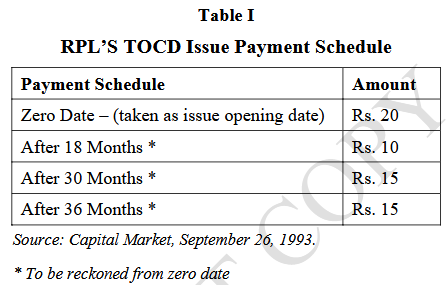
The TOCDs issued by RPL were an innovative variant to the Reliance Group's general policy of raising capital through the issue of convertible securities. Each TOCD was issued for a face value of Rs 60. The TOCDs were made more attractive by allowing the payment to be made in installments of the sum of Rs 60 (Refer Table I) spread over a period of three years. The instrument included two equity shares allotted to the investors at the face value, of Rs 10 each. These two equity shares were allotted as soon as the first installment of Rs.20 was paid. The remaining amount of Rs 40 comprised a non-convertible portion accompanied by two detachable warrants, each of which could be converted into an equity share by paying Rs.20 per share i.e. at a premium of Rs.10. The rights against the warrants could be exercised between the forty seventh and forty ninth months after the opening date of the issue i.e. September 23, 1993.
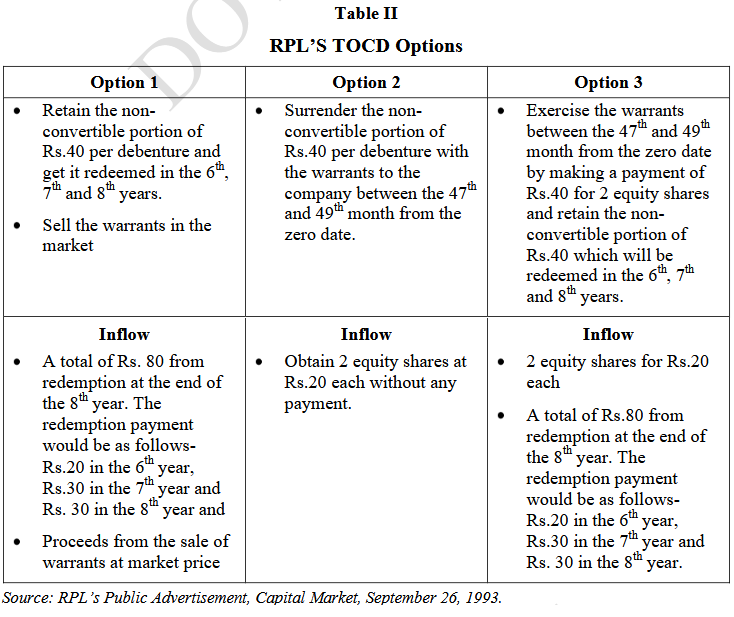
The holders of the TOCD would not be paid any interest for the first five years of the issue but were provided with three options (Refer Table II). The investors were required to exercise their option in September 1997 (between the 47th and 49th month from the date of the issue) when the RPL share was trading at around Rs.22. They were also required to make a choice between converting the non convertible portion and the detachable warrants into equity shares or redeeming the instrument.
1. Subscribing to convertible securities limits the downside risk of investors and provides them with the option of converting debt into tradable securities. Discuss in detail the benefits of convertible securities for the issuing company as well as the investors. Briefly discuss the potential drawbacks of convertible securities for both.
2. Evaluate the three initial options (as given in Table II) provided to the RPL TOCD holders on the basis of yield to maturity. Assume that a TOCD holder sold the RPL shares and each warrant (in the case of Option I) issued in September 1993 at Rs. 22 and Rs. 5 respectively in September 1997. Calculate the YTM on the basis of number of years completed.
3. Determine the RPL share price that would make an investor indifferent towards converting non-convertible debentures and detachable warrants into equity shares in September 1997 or redeeming non-onvertible debentures and selling the detachable warrants Assume that an investor would opt for conversion in September 1997 only when the yield earned is atleast equal to the yield earned on the redemption of non-convertible debentures and sale of the warrants. (Note: The warrants can be sold at Rs.5 in September 1997).
Exhibit I
Exhibit II
Keywords
Reliance Petroleum, TOCD, innovative convertible security, September 1993, refinery project, Jamnagar, Gujarat, instrument, options, investor, yield to maturity, finance, public investors, organization
Related Case Studies
| Case Title | Details | Price | Add to Cart |
|---|---|---|---|
|
Case Title Should Infosys Go Ahead With Share Buyback?Case Code: FINC103 |
Details | 500 | Add to Cart |
|
Case Title Options Strategies on Microsoft and Facebook Stocks (D)Case Code: FINC099 |
Details | 500 | Add to Cart |
|
Case Title Alibaba’s IPO: Father of all IPOsCase Code: FINC094 |
Details | 400 | Add to Cart |
|
Case Title NSEL’s Payment Crises: Jolt to Indian Commodity MarketCase Code: FINC093 |
Details | 600 | Add to Cart |
|
Case Title Krishna Institute of Medical Sciences IPO: Should You Invest or Not?Case Code: FINC187 |
Details | 500 | Add to Cart |