
Reliance Petroleum TOCD Issue (B)
🌐 International Buyers — Pay via PayPal
Details
FINC017
7
2002
YES
0
Reliance Petroleum Limited
Energy
India
Investments
Abstract
The case Reliance Petroleum’s TOCD issue (B) analyzes the new option provided to the TOCD holders after an extra ordinary general meeting of RPL held in April 1998. It provides a detailed explanation of the alternatives and the options available to the investor, which were evaluated on the basis of their yield to maturity. The case is designed to help students critically analyze alternative options available to an investor at the time of exercising an option for conversion. Analyzing various options of conversion available to the investors of RPL TOCD on the basis of yield to maturity and drawing suitable conclusions. To gain an understanding in the mechanics of financial analysis and develop skills in making suitable decisions based on the returns earned on an investment.
Learning Objectives
The case is structured to achieve the following Learning Objectives:
- Convertible securities
- Public issues
- Financing.
Contents
“Finance will never be a constraint in executing projects because Indian investors will provide me with the necessary resources.”
- Dhirubhai Ambani, Former Chairman, RIL Group.
Reliance Petroleum Limited (RPL), a part of the Reliance Group came up with an initial public offering (IPO) in September 1993 to partly finance its Rs 51.42 billion refinery project. The total public issue was of Rs. 21.72 billion while the net offer to the Indian public was Rs. 8.62 billion. The issue was the largest during that time in India and was made available to the public through an innovative financial instrument in the form of Triple Option Convertible Debentures (TOCDs).
The TOCD was not structured as a conventional debt instrument. Each TOCD was issued for a face value of Rs.60. This included two equity shares allotted to the investors at a face value for Rs 10 each. The remaining Rs 40 comprised of a non-convertible accompanied by two detachable warrants. The TOCD holders could exercise the option to convert their instrument into equity shares in September 1997 that is, between the 47th and 49th months from the date on which the TOCD was issued (Refer Exhibit I for complete details of the TOCD issue).
Some market observers expressed doubts as to whether this mega scheme would be fully subscribed to given the depressed condition of the stock market at that time. Belying these fears, RPL’s issuing of TOCD was successful. However, despite the success in obtaining the required finances, the RPL project could not be commenced as scheduled3. The delay was caused mainly due to the scaling up of the proposed capacity from the initial nine million to 18 million tons and eventually to 27 million tons.
With this increase in capacity, RPL became the world’s largest grassroot refinery and seventh largest operating refinery in the world. The project commenced with the acquisition of land, in December 1994. The construction commenced only in the year 1996, with the leveling of land and laying of equipment foundations. The increase in the plant’s capacity from 9 million tons to 18 million tons was officially announced in April 1998, followed by a further increase in capacity in December 1998 to 27 million tons.
The project was eventually commissioned in the financial year 1999-2000. It started commercial production in April 2000. RPL completed its first full year of commercial operations in March 2001, during which it emerged as the largest private sector company in terms of revenues, with sales worth more than Rs 300 billion. The plant utilized 100% of its capacity initially and was expected to increase it to 115%.
By 2002, RPL had emerged as one of the most modern refineries in the world, using the latest technology, and had the ability to use almost any kind of crude oil. The refinery had the capacity to process 80,000 tons of crude oil per day and its capital cost per ton was about 40% lower than existing refineries in India. This translated into substantial cost competitiveness. Some of the products like naphtha, reformate and propylene produced by RPL were captively consumed by Reliance Industries Limited4 ensuring sufficient off take and substantial savings in handling and storage costs. Captive consumption by group companies accounted for approximately 25%-30% of RPL’s production. The main products of the company were liquid petroleum gas (LPG), motor spirit/gasoline (MS), naphtha, high-speed diesel (HSD), superior kerosene oil (SKO) & aviation turbine fuel (ATF), fuel oil (FO), coke and sulphur.
The holders of the RPL’s TOCDs issued in 1993 were not allowed to exercise the option of converting them in September 1997, as promised in the IPO document. This was postponed till May 1998 to provide the investors with a new conversion option. Analysts felt that the need to come up with the new option was due to the fact that the non- convertible debenture was trading at around Rs. 48 (Refer Table I) and the two warrants could be sold for Rs 5 each in the market between September 1997 and April 1998, as against shares worth Rs 40 that would be received if the same were to be surrendered. Moreover, RPL’s stock price was Rs. 22 (Refer Table II).
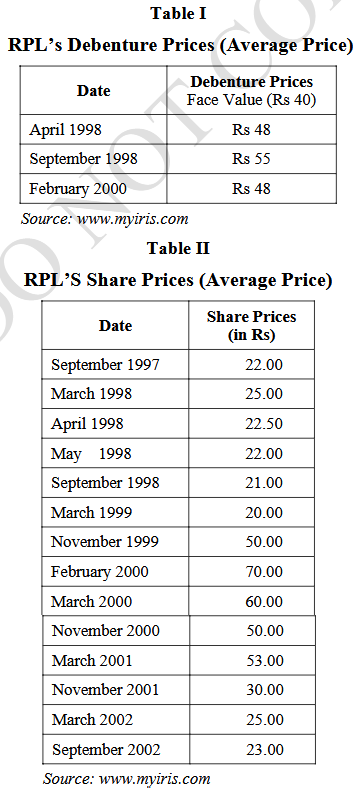
This meant that the market value of the shares held by an investor opting for conversion in accordance with the initial offer (Refer Exhibit I) in September 1997 was Rs. 44 which was much lower than the combined market value of the non-convertible debenture and the detachable warrants. This meant that no investor would have opted to surrender the TOCDs.
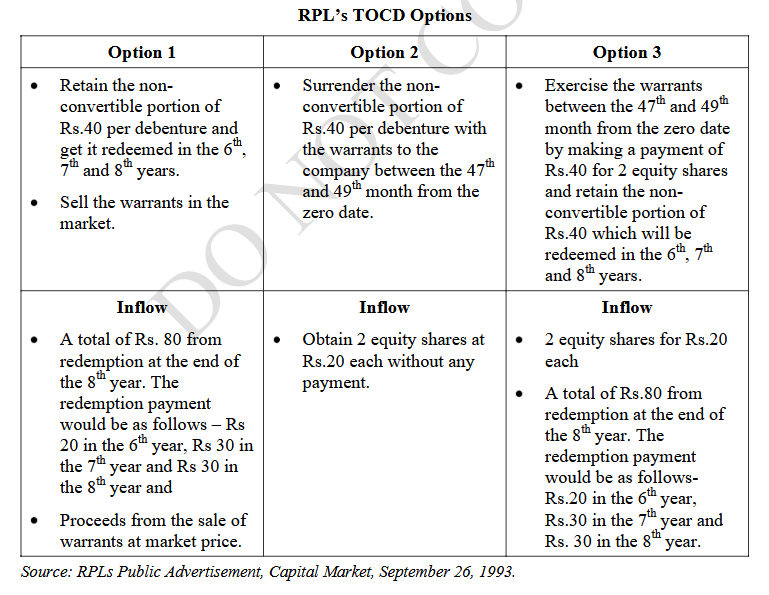
On April 15, 1998, RPL convened an extraordinary general meeting (EGM) to seek shareholders’ approval to hike its authorized share capital from Rs 50 billion to Rs 70 billion. The purpose was to enable investors to use the new conversion option,5 which involved phased allotment of three equity shares with a face value of Rs 10 each, in lieu of Rs 40 paid-up non-convertible debentures along with the detachable warrants. As per the option, the first equity share at par would be allotted in November 1999 (the 6th year), followed by two equity shares at a premium of Rs 5 each in November 2000 (the 7th year) and November 2001 (the 8th year). The period from May 1998 to June 1998 was the period during which the conversion offer would operate.
In case the TOCD holders did not want to opt for the new option, they could get the non-convertible portion of the TOCD redeemed in three installments. The first installment of Rs 20 per TOCD was to be paid in November 1999 (6th year). The second installment of Rs 30 per TOCD, was payable in November 2000 (7th year) and the final installment of Rs 30 (8th year) per TOCD was payable in November 2001.
However, the new option provided by Reliance had its fair share of criticism. A certain set of warrant holders felt that the conversion price of Rs 13.33 for a TOCD was too high for them, since they bought the warrant for Rs 5 in April 1998, and could convert them into shares only at Rs 20. The move, apart from giving an option to about 2.4 million TOCD holders to opt for equity in the company, was also aimed at shoring up the balance sheet of the company by reducing the debt-to-equity ratio. If all the TOCD holders decided to surrender their debentures in return for three equity shares, it would lead to lowering of the debt-to-equity ratio to 0.45:1 from the current 0.80:1. According to sources, this would strengthen the capital base of the company and enable it to participate in the attractive opportunities coming up in the oil sector, pursuant to reforms and deregulation of the refining, marketing and distribution, and energy sectors.
However, in February 2000, RPL exercised its call provision and redeemed the non-convertible portion of its outstanding TOCDs, which aggregated to Rs 9.6 billion at Rs 50.50, a 5% premium compared to the prevalent market price of Rs 48. This redemption parity were provided to over 0.9 million TOCD holders, almost two years in advance. According to RPL sources, the redemption of outstanding TOCDs would improve RPL’s debt-equity ratio to around 0.9:1, and would contribute to substantial reduction in the company’s overall interest costs.
The Reliance Group had always prided itself in creating value for its investors. This was visible through the RPL share prices from the very first year when it began operating. The share price witnessed a sharp rise from around Rs.22 at the beginning of the financial year 1999 to about Rs.60 by the end of it. RPL’s financial performance over the next two financial years had been impressive with a net profit worth Rs 14.64 billion in 2000-2001 and Rs 16.74 billion in 2001- 2002 on revenues amounting to Rs 309.63 billion and Rs.331.17 billion respectively. However, during September 2002, the share price of RPL stood at around Rs.23. The earnings per share (EPS) of the RPL stock remained at three, but there had been a sharp decline in its P/E6 multiple from 18 in 2001 to only 8 in 2002. There was a delay in dismantling the administrative pricing mechanism, which was expected to benefit RPL profits7 significantly. In such a scenario, investors, who had converted their TOCDs into equity shares rather than redeeming them, wondered whether they had made the right decision.
What were the reasons behind RPL offering a new conversion option to its TOCD investors? Evaluate the new option keeping the exercise date for the option as May 1998 (treated as completed year 5).
The choices available under the new option are:
- Surrender the non-convertible portion of Rs.40 per debenture along with the warrants to the company for three equity shares allotted in a phased manner. Assume that the shares are sold as soon as they are received.
- Retain the non-convertible portion of Rs.40 per debenture and get it redeemed in the 6th, 7th and 8th years, and sell the warrants and the two equity shares issued in September 1993 in the market, in May 1998.
- Redeeming the debentures in February 2000 (considered as 6.5 years) as per the call option of the company.
1. Compare the yield earned by an investor who exercised the option of converting the non-convertible debenture plus detachable warrants into three equity shares and sold the equity shares in September 2002 with:
An investor who did not avail the conversion option and redeemed the non convertible debenture of the instrument, sold the warrants in the market and sold the two equity shares allotted in September 1993 in May 1998 (treated as completed year 5).
- An investor who converted the non-convertible debenture and the detachable warrants into shares and sold the shares as soon as they were allotted, that is, in November 1999 (the 6th Year), November 2000 (the 7th Year) and November 2001 (the 8th Year) including the two equity shares allotted in September 1993 and sold in May 1998.
- In May 1998, an investor purchases the non-convertible portion of the TOCD at Rs. 48 along with the two detachable warrants at Rs 5 each. Calculate the yield earned by the investor if he exercises the option for conversion of the non-convertible portion and the detachable warrants into three equity shares, and sells the shares as and when they are allotted.
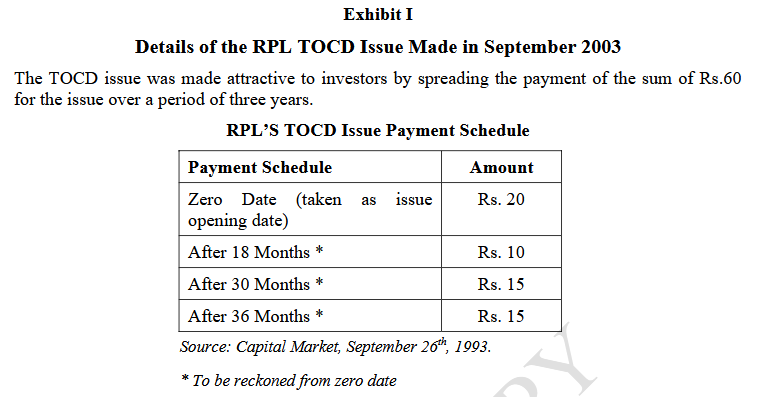
The holders of the TOCD would not be paid any interest for the first five years of the issue, but were provided with three options.
Keywords
Reliance Petroleum, TOCD, innovative convertible security, September 1993, refinery project, Jamnagar, Gujarat, instrument, options, investor, yield to maturity, finance, public investors, organization
Related Case Studies
| Case Title | Details | Price | Add to Cart |
|---|---|---|---|
|
Case Title Should Infosys Go Ahead With Share Buyback?Case Code: FINC103 |
Details | 500 | Add to Cart |
|
Case Title Options Strategies on Microsoft and Facebook Stocks (D)Case Code: FINC099 |
Details | 500 | Add to Cart |
|
Case Title Alibaba’s IPO: Father of all IPOsCase Code: FINC094 |
Details | 400 | Add to Cart |
|
Case Title NSEL’s Payment Crises: Jolt to Indian Commodity MarketCase Code: FINC093 |
Details | 600 | Add to Cart |
|
Case Title Krishna Institute of Medical Sciences IPO: Should You Invest or Not?Case Code: FINC187 |
Details | 500 | Add to Cart |