
Derivatives Trading in India
🌐 International Buyers — Pay via PayPal
Details
FINC026
15
2004
NO
400
Not Applicable
Financial Services
India
Financial Options & Derivatives
Abstract
The case discusses the introduction and growth of the derivatives market in India. It describes in detail the reasons that led to the introduction of derivatives trading in India and why it faced opposition by a section of industry analysts and media. The case then describes the issues that still remain to be addressed by the regulatory authorities to accelerate the long-term growth of the derivatives market. Finally, the case mentions a few steps taken by the concerned authorities in early 2004.
Learning Objectives
The case is structured to achieve the following Learning Objectives:
- Factors that can accelerate/suppress the growth of the derivatives market.
Contents
“The introduction of derivatives trading will separate leveraged positions from the spot markets and make it easier for exchanges to implement rolling settlement. This should reduce volatility in the existing markets, and make risk containment and regulation easier by making markets safer.”
- Ashish Kumar Chauhan, Vice-President, National Stock Exchange (NSE).
“It had to start at one point of time or the other. Just like a plant needs soil, water and minerals to nurture well, for derivatives you need a healthy cash market in place.”
- Alok Churiwala, Member of Bombay Stock Exchange (BSE).
On June 9, 2000, the Bombay Stock Exchange (BSE) introduced India?s first derivative instrument – the BSE-30(Sensex) index futures. It was introduced with three month trading cycle – the near month (one), the next month (two) and the far month (three). The National Stock Exchange (NSE) followed a few days later, by launching the S&P CNX Nifty3 index futures on June 12, 2000.
The plan to introduce derivatives in India was initially mooted by the National Stock Exchange (NSE) in 1995. The main purpose of this plan was to encourage greater participation of foreign institutional investors (FIIs) in the Indian stock exchanges. Their involvement had been very low due to the absence of derivatives for hedging risk. However, there was no consensus of opinion on the issue among industry analysts and the media. The pros and cons of introducing derivatives trading were debated intensely. The lack of transparency and inadequate infrastructure of the Indian stock markets were cited as reasons to avoid derivatives trading. Derivatives were also considered risky for retail investors because of their poor knowledge about their operation. In spite of the opposition, the path for derivatives trading was cleared with the introduction of Securities Laws (Amendment) Bill in Parliament in 1998.
The introduction of derivatives was delayed for some more time as the infrastructure for it had to be set up. Derivatives trading required a computer-based trading system, a depository4 and a clearing house5 facility. In addition, problems such as low market capitalization of the Indian stock markets, the small number of institutional players and the absence of a regulatory framework caused further delays. Derivatives trading eventually started in June 2000.
The introduction of derivatives was well received by stock market players. Trading in derivatives gained substantial popularity, and soon the turnover of the NSE and BSE derivatives markets exceeded the turnover of the NSE and BSE cash markets. For instance, in the month of January 2004, the value of the NSE and BSE derivatives markets was Rs.3278.5 billion (bn) whereas the value of the NSE and BSE cash markets was only Rs.1998.89 bn. (Refer Exhibit I and II).
In spite of these encouraging developments, industry analysts felt that the derivatives market had not yet realized its full potential. Analysts pointed out that the equity derivative markets on the BSE and NSE had been limited to only four products – index futures, index options and individual stock futures and options which were limited to certain select stocks.
The initial steps to launch derivatives were taken in 1995 with the introduction of the Securities Laws (Amendment) Ordinance, 1995 that withdrew the prohibition on trading in options on securities in the Indian stock market. In November 1996, a 24-member committee was set up by the Securities Exchange Board of India (SEBI) under the chairmanship of LC Gupta to develop an appropriate regulatory framework for derivatives trading. The committee recommended that the regulatory framework applicable to the trading of securities would also govern the trading of derivatives. Following the committee?s recommendations, the Securities Contract Regulation Act (SCRA) was amended in 1999 to include derivatives within the scope of securities, and a regulatory framework for administering derivatives trading was laid out. The act granted legality to exchange-traded derivatives, but not OTC (over the counter) derivatives. It allowed derivatives trading either on a separate and independent derivatives exchange or on a separate segment of an existing stock exchange. The derivatives exchange had to function as a self-regulatory organization (SRO) and SEBI acted as its regulator. The responsibility of clearing and settlement of all trades on the exchange was given to the clearing house which was to be governed independently.
Derivatives were introduced in a phased manner. Initially, trading was restricted to index futures contracts based on the S&P CNX Nifty Index and BSE-30 (Sensex) Index. Later, trading was extended to index options (based on the same indices) in June 2001, and options on individual securities in July 2001. SEBI also permitted the launch of futures contracts on individual stocks in November 2001.
Even after trading in derivatives was formally launched, their introduction was vehemently opposed by a section of brokers, media and industry analysts. There was a series of arguments and counter arguments leading to a heated debate between those who favored them and those who were against introduction of derivatives.
Those who opposed the introduction of derivatives argued that these instruments would significantly increase speculation in the market. They said that derivatives could be used for speculation by investors by taking large price positions in the stock market while committing only a small amount of capital as margin. For instance, instead of an investor buying stocks worth Rs.1 million (mn), he could buy futures contracts on Rs.1 mn of stocks by investing a few thousand rupees as margin. Thus, trading in derivatives encouraged investors to speculate - taking on more risk while putting forward less investment. They were quick to point out some of the disasters of the past that had occurred due to the mismanagement of trading in derivatives (Refer Exhibit III).
Analysts also said that the introduction of derivatives required a well functioning and mature spot market, that was absent in India. Another danger they felt was the lack of transparency and counterparty risk since most derivative instruments were traded over the counter (OTC) in the markets in a completely unregulated fashion (Refer Exhibit IV).
Derivatives could also be used as a tax evasion tool by restructuring the cash flows in such a way that income from derivatives was under-reported. Another disadvantage was that FIIs could take large positions in the derivatives market by paying small amounts of margins and might thereby attempt to take control of the equity markets and decide its future movements. Derivatives were considered similar to betting and gambling. Hence, permitting trading in these kinds of instruments was considered unacceptable. Analysts also raised serious doubts about the Indian capital market's capability to provide enough liquidity for derivatives trading; the failure of which could lead to a serious liquidity crisis.
Moreover, analysts also felt that a substantial effort would be required to create awareness and educate people about derivatives before they could be introduced. The investors were not mature enough for these instruments and fears were expressed that they may speculate in derivatives and incur huge losses due to their inadequate knowledge about derivatives.
Those who were in favor of introducing derivatives said that these instruments had been introduced and well-accepted in all major foreign markets for a long time and opposition to them was more based on emotions rather than any real logic. They argued that the depth of the financial markets would improve with the introduction of risk-management tools like derivatives. The introduction of derivatives was expected to bring in greater participation from risk-averse investors resulting in increased volume of trades and liquidity in the markets. Using derivatives, institutional investors would be able hedge their risks effectively against unfavorable market movements. There was also strong empirical evidence that in those countries where derivatives had been introduced, there had been significant gains in both trading volumes and in market capitalization. Derivative instruments made spot price discovery more reliable using models like the normal backwardation hypothesis. Analysts pointed out that these instruments caused any arbitrage opportunities to disappear and led to better price discovery. Derivatives provided an excellent mechanism for portfolio managers to manage portfolio risks and for treasury managers to manage interest rate risks.
With the introduction of derivative instruments like currency and interest rate swaps, analysts felt that Indian corporates would be able to raise finance from global markets at better terms. They would also be able to take advantage of low interest rates prevailing in global markets. Moreover, it had become increasingly necessary to introduce derivatives since their absence might encourage foreign exchanges to construct and trade in derivative instruments based on Indian securities. The introduction of derivatives would also help in drawing greater levels of FII investment into the country. The risks that foreign institutions faced while operating in the Indian markets were currency and market risk. The currency risk could be hedged through the dollar rupee futures while the market risk could be hedged through stock index futures.
After much heated debate, derivatives trading was finally introduced. By early 2004, a number of derivative instruments were in vogue on Indian bourses (Refer Exhibit V). Since August 2002, trading volumes in derivatives had increased significantly. In January 2004, the value of NSE and BSE derivatives market was Rs.3,278.5 bn. In terms of the number of contracts in single stock derivatives, India had emerged as the largest market globally.
By January 2004, more than three and a half years of derivatives trading had been completed. However, according to several analysts and media reports, SEBI, NSE and BSE had still to resolve many issues so that the derivatives market could realize its full potential. For instance, the issue of imposing taxes on income arising from derivatives trading still remained to be sorted out. The Income Tax Act of India did not have any specific provision regarding taxability of derivatives income. The tax authorities were still undecided on the issue, and in the absence of any provision, derivatives transactions were held on par with transactions of a speculative nature (in
particular, the index futures/options which were essentially cash settled, were treated this way). Therefore, the loss, if any, arising from derivatives transactions, was treated as a speculative loss and was eligible to be set off only against speculative income upto a maximum period of eight years. Analysts argued that derivatives instruments were essentially used by investors to hedge risks, and they should not be considered as speculative transactions. They should therefore, be taxed as short-term capital gains/losses on securities. Analysts also opined that the reason why institutional investors were shying from the derivatives market was the lack of clarity on tax and accounting treatment of derivatives.
Another problem faced in the derivatives market especially by retail investors was the minimum contract size, which was fixed at Rs. 0.2 mn. The idea behind this decision was to curb too much speculation from small investors who had little knowledge about derivatives. However, analysts felt that the minimum contract value of Rs. 0.2 mn was too high and acted as a deterrent for retail investors who were otherwise willing to transact in the derivatives market.
Analysts felt that there is a need to educate retail investors and brokers about derivatives rather than setting trading limits for them. Derivatives were a bit complex and required more than a basic knowledge about the stock market to be traded successfully. There were a lot of myths and misconceptions about derivatives trading in the minds of retail investors, which needed to be cleared. In a report, the Bank for International Settlements said that OTC derivatives markets worldwide had witnessed a significant growth in the number of outstanding contracts over the past few years, with the outstanding position on global OTC markets expected to be to the tune of $127.56 trillion in 2002 (Refer Exhibit VI). Analysts felt that concrete steps were required to evaluate all possible alternatives to the issue of legality of OTC derivatives.
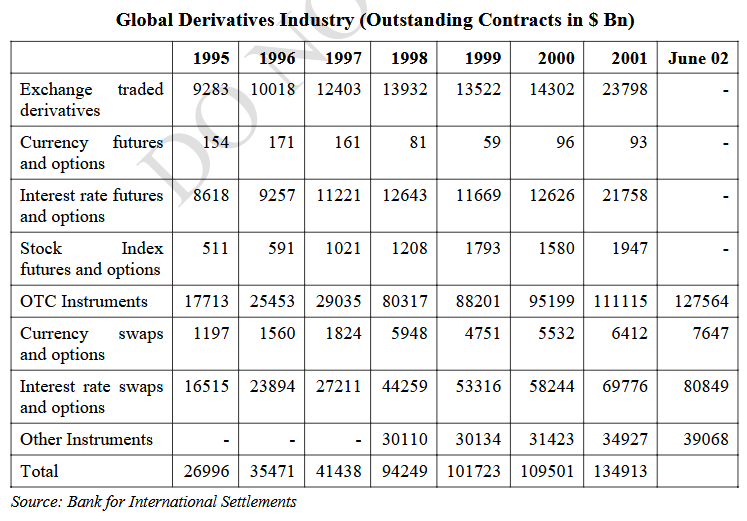
Though the regulatory framework for administering the derivatives market in India (Refer Exhibit VII) conformed to international norms, some more steps were required to strengthen the financial infrastructure. There was a need for bankruptcy and insolvency laws to explain clearly the rights of securities holders on winding up or on insolvency of intermediaries. In order to bring in transparency and create stability in the financial markets, public disclosure of trading and derivatives activities of the banks and security firms were required to be made mandatory. Allowing cross-margining9 between spot and derivatives market was an issue which had to be addressed. Cross-margining resulted in a far more efficient use of a member's capital for trading in related products and in more than one market. A clearing corporation could easily compute and levy a single net margin amount based upon offsetting positions in different products/markets/exchanges.
Other issues that analysts felt had to be addressed for further development of derivatives market were related to the settlement procedures and transparency of derivative transactions. All the derivative transactions were cash settled. This was appropriate in the case of index derivatives but in the case of single stock derivatives, analysts felt that the regulatory authorities could consider physical settlement. In the past, derivatives trading had led to financial disasters the world over. It was estimated that the cumulative losses over a period of eight years (1987 to 1995) in derivatives trading globally amounted to $16.7 bn. To prevent such disasters in India, analysts commented that the margin requirements needed to be stringently enforced and a proper process of surveillance had to be established.
With the number of NSE branches across India increasing, analysts were concerned about the role of the BSE and the problem that derivative markets might be monopolized by NSE. Though there had been growth in derivatives trading volumes, it had been limited to NSE. In fact, NSE comprised 98.84% of the derivatives market. On the other hand, BSE had been experiencing low volumes to the extent that it was forced to consider closing its derivative segment. BSE blamed SEBI for low volumes on its bourses, as it was not allowed to expand its operations beyond Mumbai. More than 60% of volumes in NSE came from cities other than Mumbai.
As of early 2004, derivatives trading in India had been restricted to a limited range of products including index futures, index options and individual stock futures and options limited to certain select stocks. Analysts felt that index futures/options could be extended to other popular indices such as the CNX Nifty Junior. Similarly, stock futures/options could be extended to all active securities. Efforts were also on to encourage participation from domestic institutional investors. SEBI had authorized mutual funds to trade in derivatives, subject to appropriate disclosures. A broader product rollout for institutional investors was also on the cards. Steps were taken to strengthen the financial infrastructure. These included developing adequate trading mechanisms and systems, and establishing proper clearing and settlement procedures. Regulations hampering the growth of derivative markets were being reviewed. The taxation aspect of the income from derivatives trading was also being looked into. NSE and BSE conducted training programs for investors to create awareness and educate them about derivatives trading.
In January 2004, the Insurance Regulatory and Development Authority (IRDA) allowed insurance companies to deal in financial derivatives and participate in the Collateralized Borrowing and Lending Obligation (CBLO) of the Clearing Corporation12. In an amendment to the IRDA Investment Regulations 2000, the insurance regulatory body allowed all life and general insurance companies to deal in financial derivatives to the extent permitted according to the guidelines issued by it. In January 2004, the Reserve Bank of India (RBI) allowed FIIs to fully hedge their equity exposure. FIIs were allowed to trade in the derivatives market subject to the condition that their
overall open position did not exceed 100 per cent of the market value of their total investments. Managed future funds were permitted to take a position in the derivatives market without having any exposure in the cash market. Moreover, FIIs intending to invest funds in the cash market were also permitted to take a long position in the futures market. Registered FIIs were allowed to participate in both index-based and stock specific derivative contracts provided their positions were within the laid down limits.
In February 2004, RBI prepared a report on derivatives trading with the objective of harmonizing the regulatory aspects for over-the-counter and exchange-traded products. To encourage trading in interest rate derivatives, the central bank was in the process of laying out certain parameters which would allow banks with strong risk management systems to trade and act as 'market makers' for interest rate derivatives.
However, a section of analysts felt that merely allowing institutional investors would not be enough to make the derivatives market more vibrant. There were still lots of issues that needed to be resolved. Moreover, though mutual funds had been allowed to trade in the derivatives market, SEBI (MF) Regulations restricted the use of equity derivatives only to 'hedging and portfolio re-balancing.' It did not permit mutual funds to use equity derivatives for arbitrage strategies, portfolio optimization and return enhancement strategies.
1. In June 2000, derivatives trading were finally flagged off in India. Briefly discuss the events that led to the introduction of derivatives trading in Indian stock markets.
2. Industry analysts were divided in their opinion over introducing derivatives trading in India. Critically comment on the views expressed for and against the introduction of derivatives. Do you think derivatives should have been introduced? Take a stand and justify it.
3. Though trading in derivatives has been introduced in India, analysts feel that there is still a long way to go before we realize their full potential. What issues need to be addressed to accelerate the growth of derivatives market? Do you think the recent measures taken by SEBI, RBI and the stock exchanges are adequate? What other measures can be taken?
Exhibit I
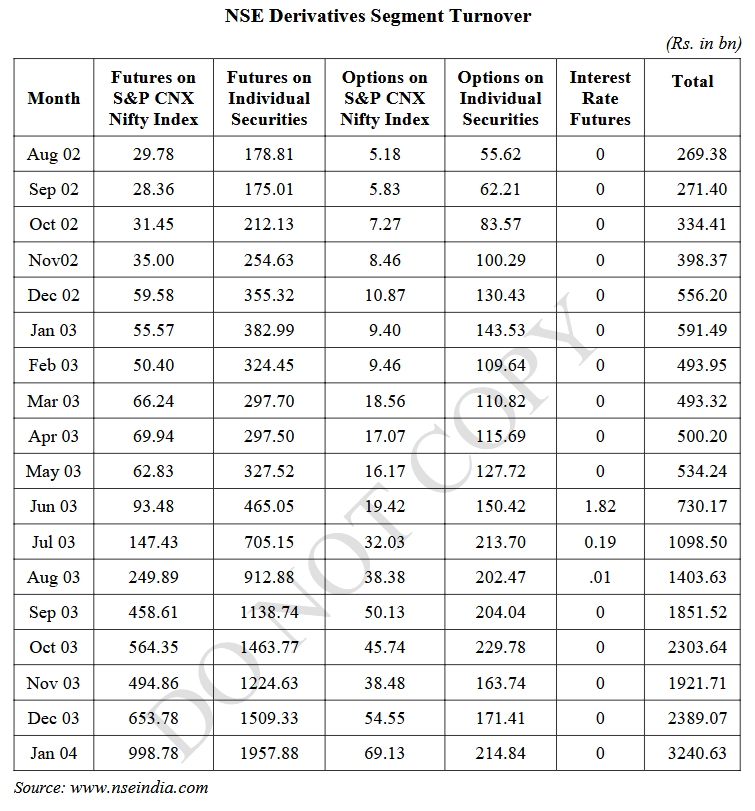 |
Exhibit II
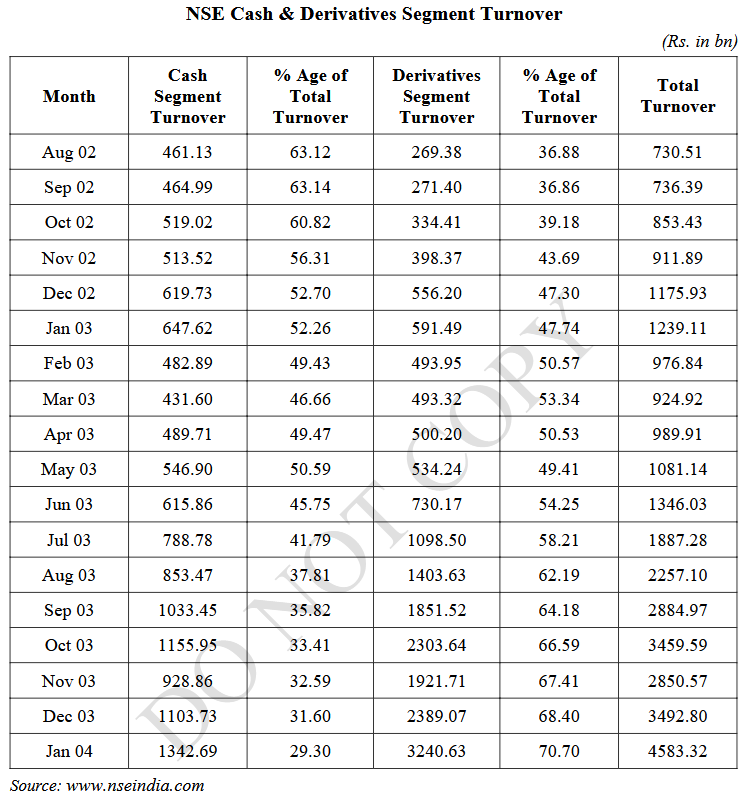 |
Exhibit III
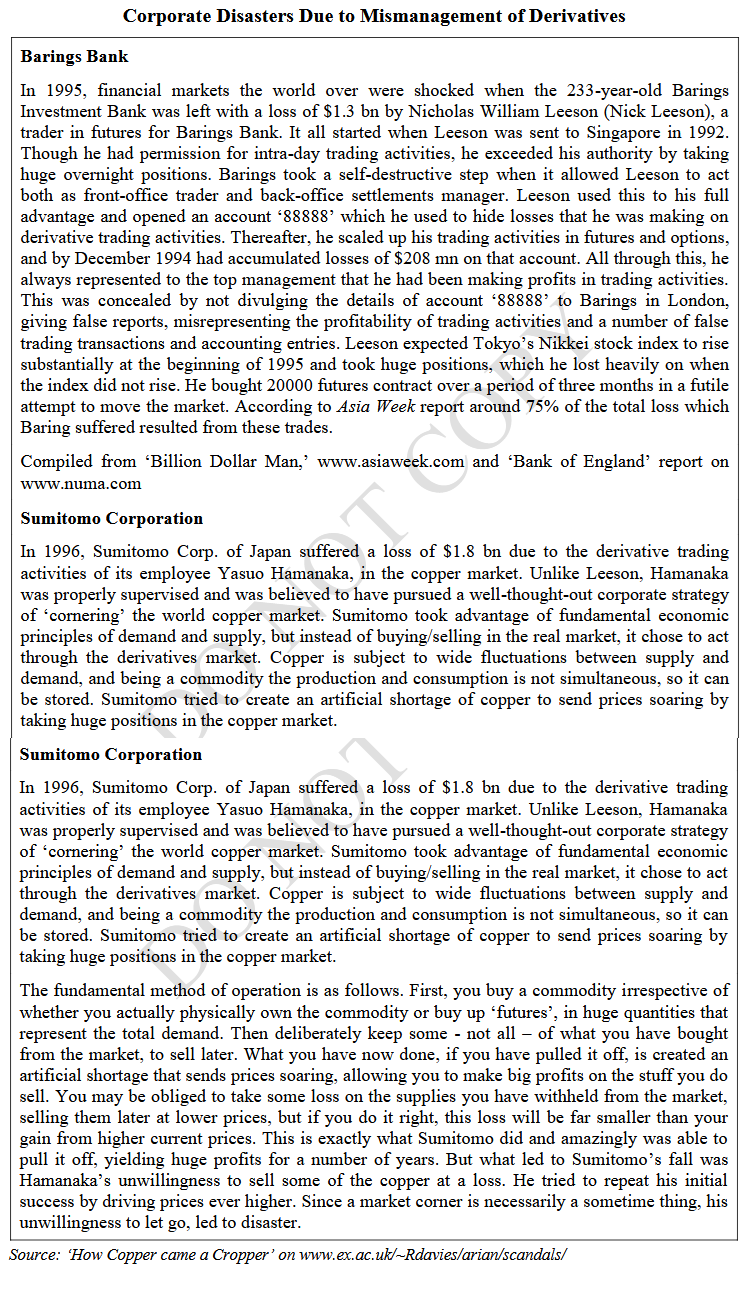 |
Exhibit IV
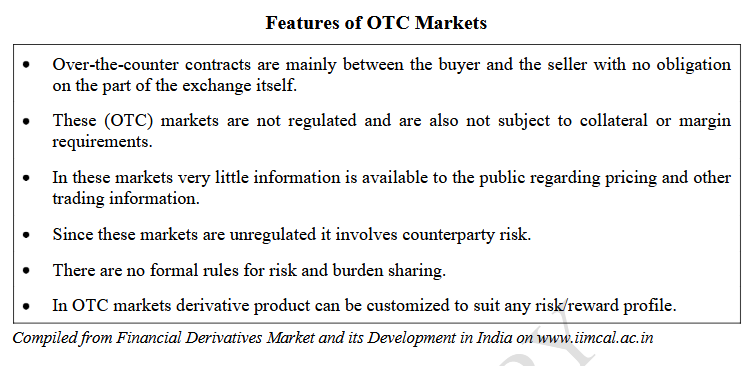 |
Exhibit V
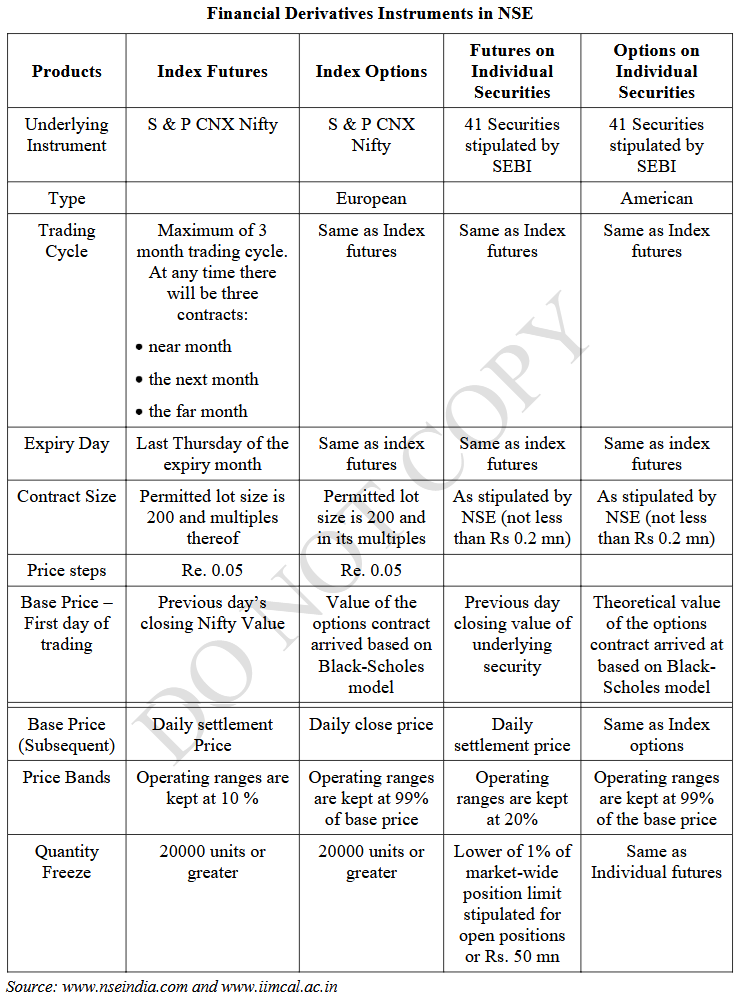 |
Exhibit VI
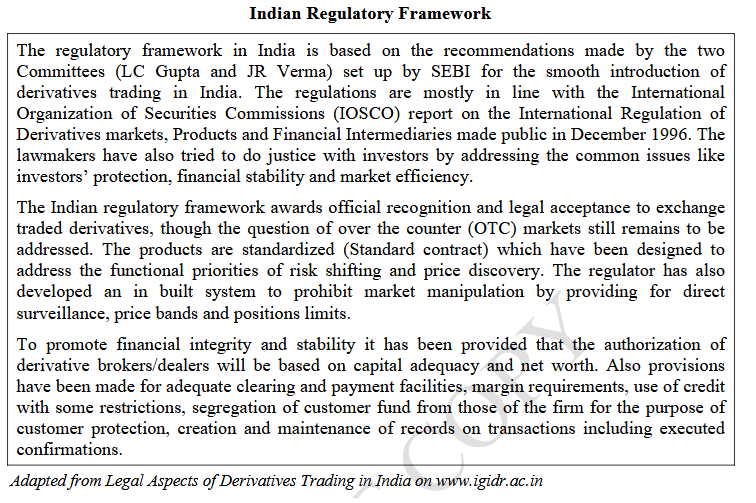 |
Exhibit VII
 |
Keywords
Growth, derivatives market, India, introduction, derivatives trading, opposition, industry analysts, media, regulatory authorities, long-term growth, steps, concerned authorities, 2004
Related Case Studies
| Case Title | Details | Price | Add to Cart |
|---|---|---|---|
|
Case Title Options Strategies on Microsoft and Facebook Stocks (A)Case Code: FINC102 |
Details | 400 | Add to Cart |
|
Case Title Options Strategies on Microsoft and Facebook Stocks (B)Case Code: FINC101 |
Details | 600 | Add to Cart |
|
Case Title Options Strategies on Microsoft and Facebook Stocks (C)Case Code: FINC100 |
Details | 600 | Add to Cart |
|
Case Title Turnaround Story of Wockhardt LimitedCase Code: FINC086 |
Details | 600 | Add to Cart |
|
Case Title Interest Rate Future in IndiaCase Code: FINC083 |
Details | 400 | Add to Cart |