
Tisco - The EVA Journey
🌐 International Buyers — Pay via PayPal
Details
FINC035
9
2004
NO
300
TISCO
Metals & Mining
India
Financial strategy
Abstract
The case discusses the implementation of economic value added (EVA) framework in Tata Iron & Steel Company Limited (TISCO), the largest private sector steel company in India. It covers in detail the reasons for implementing the EVA framework in TISCO and the benefits derived from it. The case then describes the limitations of EVA implementation in a cyclical industry. It examines the possible options under consideration by TISCO to ensure that the company posts a positive EVA figure in future
Learning Objectives
The case is structured to achieve the following Learning Objectives:
- Implementation of EVA.
Contents
“Every third sentence spoken by the Muthuraman (MD of TISCO) seems to have ‘EVA’ in it. Muthuraman breathes, sleeps and eats the word, and is trying to get the rest of the company to do so as well. Every sign, placard and memo in Jamshedpur has it.”
- Businessworld, June 23, 2003.
The retirement of JJ Irani (Irani), former managing director of Tata Iron and Steel Company (TISCO)1 in August 2001, marked the end of his long, challenging and eventful career in TISCO. He was credited for bringing about a major transformation in the oldest and the largest private sector steel plant in India. On his retirement, Irani, who had numerous achievements under his belt, was asked, “Is there anything that you wished to accomplish but could not?” He honestly replied, “The shareholder value for Tata Steel should have been higher than what it is today. I feel sorry that the share today is only priced at Rs. 100. I think it should be at least double that figure.”
Irani’s successor, B Muthuraman (Muthuraman) also held the same opinion. Muthuraman was well aware of the fact that TISCO had not generated enough returns to increase the shareholders’ value. The company’s share price had been hovering in the range of Rs. 70 to Rs 180 since 1998. In an interview, he confessed, “We have inadvertently ignored the shareholder. It’s time to fix that.” In order to improve shareholders’ value, Muthuraman decided to introduce the Economic Value Added (EVA) concept (Refer Exhibit I) in TISCO. He made every effort to ensure that the concept of EVA sank in at each hierarchical level of the organization. This meant putting the concept across effectively to 43,000 employees in the company. Bimalendra Jha, the chief of the improvement program in TISCO said, “There’s a finance manager in every individual. We tried to tap into him.”4 TISCO’s officials were determined to achieve a positive EVA figure by 2007.
However, analysts felt that this was a big challenge for TISCO’s management because for a highly capital intensive and cyclical industry like steel, a positive EVA would be difficult to achieve. TISCO was however, able to declare a positive EVA of Rs 3.31 bn5 for the financial year 2002-03. Industry analysts were surprised at TISCO’s pulling off the feat four years ahead of schedule. Now expectations were high, and they wondered whether TISCO would be able to do it again in 2003-04.
The idea of making steel in India was conceived in 1867 when, during a visit to Manchester (UK), Jamshetji Tata, the founder of TISCO, was inspired by a speech made by Thomas Carlyle (famous Scottish writer of 19th century), in which he said, “The nation which gains control of iron, soon acquires control of gold.” Jamshetji Tata returned to India and commissioned a series of studies and analysis for the viability of a steel plant in India, and eventually TISCO was set up in 1907. In 1954, the Indian government established Steel Authority of India Limited (SAIL) with a much larger production capacity as compared to TISCO. The government regulations of controlled pricing of input and output, licensing, and freight equalization favored SAIL. On the other hand, TISCO was not allowed to build up its capacity to derive economies of scale. However, since the domestic steel market was a seller’s market during the first four or five decades after independence, TISCO did not face problems in selling its entire output and making reasonable profits during this period.
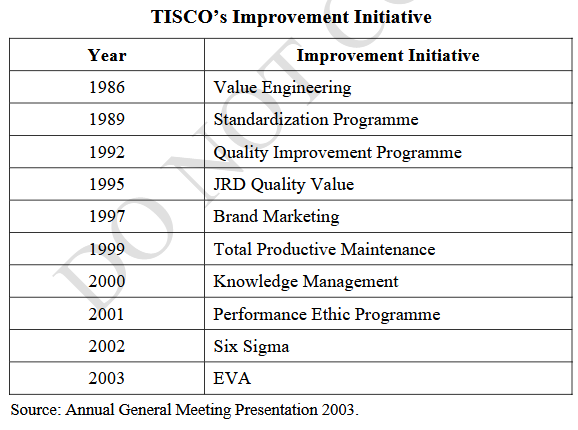
In 1991, the Indian economy was liberalized. Import tariffs and custom duties were cut, making steel imports cheaper. This put TISCO through a rough period. Financial institutions started funding additional capacities in steel production. A lot of new industrial group/companies like Essar, Lloyds, Jindal, Mittal and Mideast entered the steel industry operating on very low margins. TISCO soon realized that the technology it had been using was outdated and did not match global standards since now the company had to compete with global steel majors. To overcome this handicap, Irani invested heavily in technology improvement, instead of focusing only on capacity addition. He introduced several process and quality improvement initiatives like TQM, Six Sigma, Benchmarking and many more (Refer Table I).
Table I
 |
However, in spite of all these initiatives, TISCO’s share price crashed in 1998. It figured among the companies that had destroyed shareholders’ value in a big way, during the late 1990s. The ‘new economy’ stocks became the favorites of investors as they outperformed the ‘old economy’ shares in terms of capital appreciation on the stock exchanges. Describing the situation, a journalist wrote, “A tonne of mild steel costs around US$ 200-250. A young, twenty-something, software programmer can earn that much in a day.”
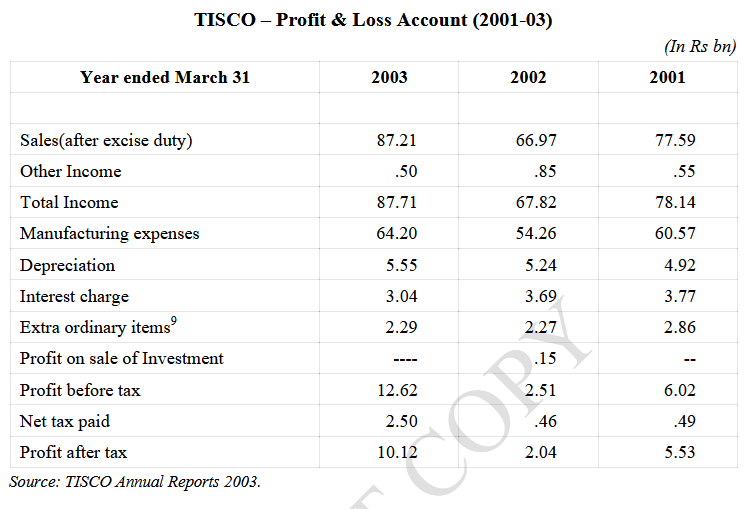
Irani’s improvement initiatives yielded fruit in the financial year 2000-01 when TISCO reported an improved financial performance. The company’s revenues increased by a modest 6% while its profit after tax (PAT) increased by 33% compared to the previous fiscal year. The initiatives had resulted in cost reduction and increased productivity. Through the use of better technology, raw material consumption was reduced by almost 25%. Alternative forms of energy reduced the company’s reliance on costly petro fuel cost by about 90%. Labour productivity more than doubled compared to five years earlier.
In 2001, TISCO’s high operational efficiency helped it to become the lowest cost producer of steel in the world. However, the company’s improved financial performance did not lead to the increase in shareholders’ returns. TISCO’s share was trading around Rs 100 in August 2001 (at this time, Irani opined that it should have been at least Rs 200).
In the light of the low stock market value of TISCO, the new MD Muthuraman was looking for a measure that could send the right signals to shareholders and ensure them that the company was maximizing their returns. Muthuraman was convinced that EVA was the right measure to arrive at the actual financial status of a company, and so the EVA framework was adopted in the company.
In the next year financial year 2001-02, TISCO reported dismal financial results. The company’s revenues came down by 14% while the PAT decreased by 63%. Ratan Tata, Chairman of TISCO, blamed the recessionary phase in the global steel industry due to the buildup overcapacity for the company’s poor performance. However, the fact remained that TISCO was not improving shareholders’ value. Media reports estimated that TISCO had destroyed shareholders’ value8 to the extent of about 35% though TISCO’s officials claimed that the value destruction was limited to 5%. This controversy cropped up even as Muthuraman insisted that making TISCO an EVA positive company by 2007 was top of his agenda.
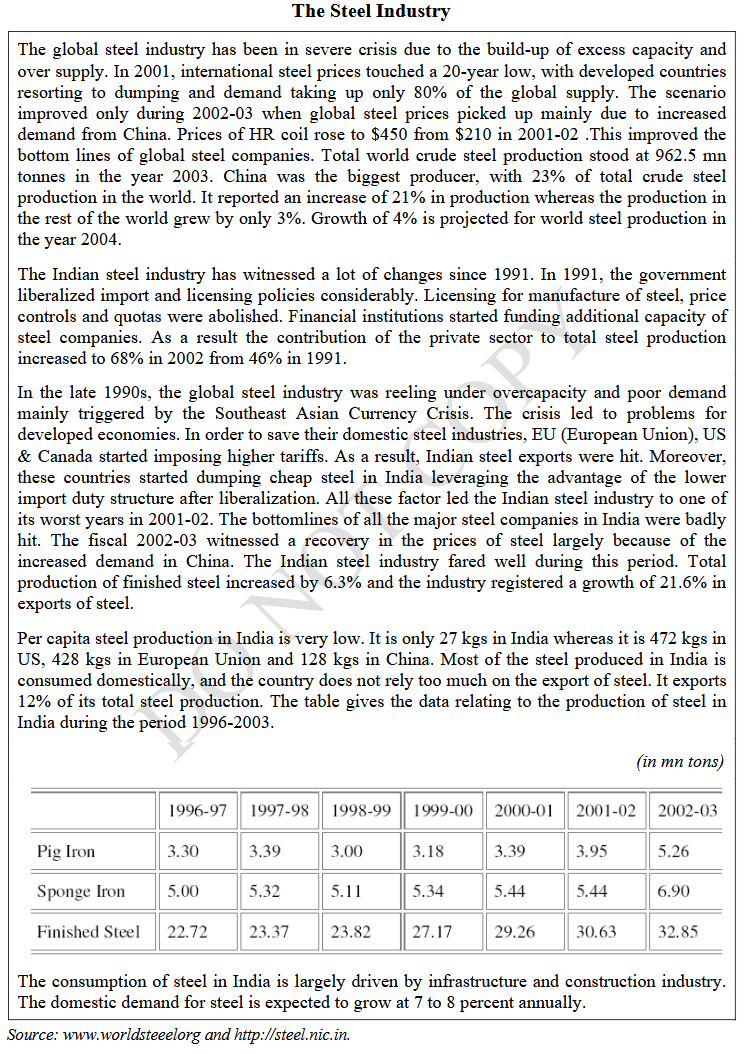
After a prolonged phase of poor financial performance, TISCO reported significantly improved financial results for the financial year 2002-03. The company’s revenues increased by 29% while the PAT increased by 400% (Refer Table II). In March 2003, TISCO’s share price went up to the Rs. 300 figure. TISCO reported a positive EVA of Rs 3.31 bn, well before its original schedule of 2007. Analysts opined that the improved performance of TISCO was the result of the Indian steel industry getting out of recession. They said the company’s financial performance was not exceptional and was just in line of the improving trends in the global and Indian steel industry (Refer Exhibit II and III).
Analysts dismissed TISCO’s reporting of positive EVA by saying that it was a ‘mere chance.’ They said that apart from the upturn in the industry, there was another factor that helped in achieving positive EVA, namely the decline in interest rates that allowed the company to replace its higher cost debt with lower one, thereby reducing its cost of capital and improving the EVA figure.
Moreover, analysts felt that registering positive EVA for one year was not a big achievement; it was necessary to keep delivering a positive EVA figure, year after year. They argued that since TISCO, which was operating in a capital-intensive industry, its capital employed (a factor that reduces EVA) was much higher. Another problem was that the company was in a cyclical industry leading to a large variation in operating profit figures. In the light of these factors, it was very unlikely that the company would be able to sustain a positive EVA for long.
Table II
 |
Analysts held the view that in order to sustain a positive EVA, TISCO would need to insulate itself from the ups and downs of the business cycles that affected the steel industry. Muthuraman accepted this point of view, saying, “The price of steel should be irrelevant to us.” In order to achieve a positive EVA, analysts suggested that TISCO needed to diversify extensively. They said that by widening the scope of its operations, TISCO would be somewhat insulated from business cycles. In this context, the company evaluated a plan to invest Rs. 50 bn in the telecom business. However, industry experts argued that telecom was too unrelated a business and one with a long gestation period. They cited the fact that Essar Steel which had invested in an unrelated business, had landed in a major financial mess, even defaulting on an international debt obligation in 1999. Another option for TISCO was to diversify operations in a related business sector. Towards this end, TISCO mooted a plan to set up a 20,000 tonne ferrochrome plant in South Africa, where the ferrochrome industry was booming. TISCO had its own chrome ore mines from which it planned to ship the chrome ore. Another advantage of setting up the plant in South Africa was that the process of making chrome was power-intensive and power cost was cheaper in South Africa. However, analysts felt that such a venture would not amount to a substantial diversification effort as (drop expressed doubts on TISCO’s plans since they felt that) ferrochrome is an input in stainless steel manufacture, and this move would not insulate the company from a downtrend in the steel industry.
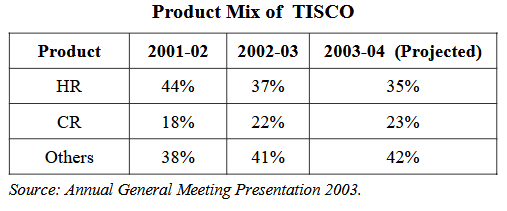
Another option for TISCO was to bring in some change in its existing product mix. For instance, sales of cold rolled (CR) coils was contractual; its prices were fixed beforehand and did not experience much volatility as compared to hot rolled (HR) coils which was sold in the spot market. Hence, increasing the share of CR coils in the product mix could neutralize the impact of major price variations. The company was, in fact, making plans to change its product mix to reap this benefit (Refer Table III). But industry experts also pointed out that this might result in TISCO’s losing opportunities to make more profits, in case steel prices went up during a boom in the industry.
Table III
 |
Muthuraman was very clear that he could not ignore the fundamental goal of a company – ‘maximizing shareholders’ wealth.’ However, he also knew that it would be tough going for TISCO to deliver positive EVA consistently.
1. TISCO’s financial performance has been very inconsistent in the past. For a long time, its shareholders’ value has been getting eroded. In the light of this, do you think Muthuraman’s step to implement the EVA framework was the right move? Is EVA a good measure of financial performance for cyclical and capital intensive industries? Justify your stand giving reasons.
2. Muthuraman knew that it would be tough for TISCO to consistently deliver positive EVA in the future. Study the three options (given in the case) that TISCO was planning to adopt to consistently deliver positive EVA in the long run. Which option makes most sense to you and why? What other measures can TISCO adopt to achieve this objective?
3. Although Stern & Stewart, the pioneer of the EVA framework, suggests some 175 assumptions and adjustments while calculating EVA, yet an approximate calculation is possible. With the information given in the case, calculate the EVA figure of TISCO for the financial year 2002-03. The weighted cost of capital (WACC)11 for the company during 2002- 03 is 10.70% (to be taken as 11%) and the capital employed for the year was Rs 85.66 bn. Make suitable assumptions and state the specific assumptions made.
Exhibit I
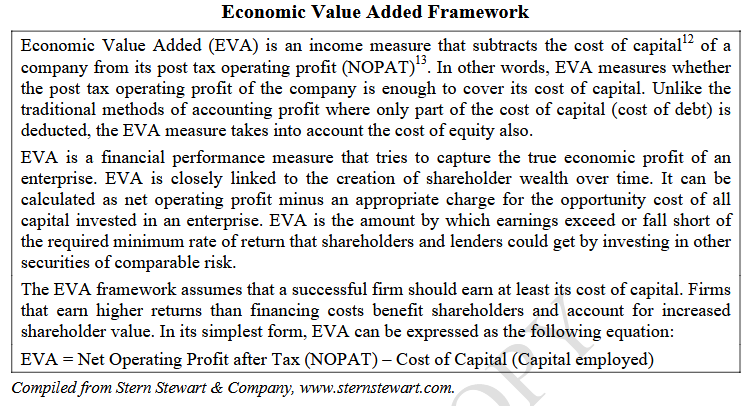 |
Exhibit II
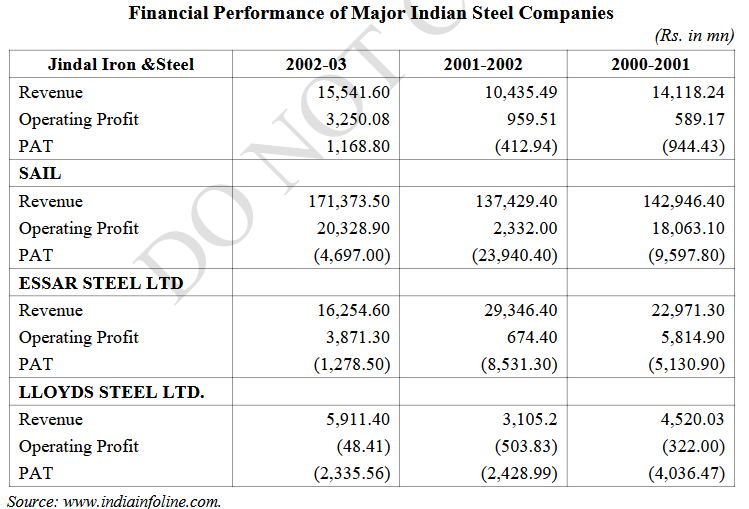 |
Exhibit III
 |
Keywords
TISCO, Economic Value Added, EVA, Deployment of EVA Framework, Maximizing Shareholder's Wealth, EVA in Cyclical Industry, Calculation of EVA, Steel Industry in India
Related Case Studies
| Case Title | Details | Price | Add to Cart |
|---|---|---|---|
|
Case Title Options Strategies on Microsoft and Facebook Stocks (A)Case Code: FINC102 |
Details | 400 | Add to Cart |
|
Case Title Options Strategies on Microsoft and Facebook Stocks (B)Case Code: FINC101 |
Details | 600 | Add to Cart |
|
Case Title Options Strategies on Microsoft and Facebook Stocks (C)Case Code: FINC100 |
Details | 600 | Add to Cart |
|
Case Title Trouble at Wockhardt LimitedCase Code: FINC084 |
Details | 500 | Add to Cart |
|
Case Title Valuation Challenges of Impossible FoodsCase Code: FINC175 |
Details | 400 | Add to Cart |