
The Indian Call Center Journey
🌐 International Buyers — Pay via PayPal
Details
HROB005
8
2002
YES
0
Not Applicable
Technology & Communications
India
Employee Development ,Human Capital, Organizational Culture
Abstract
The case provides a detailed insight into the reasons behind the Indian Call Center (CC) industry in not being as successful as was expected by analysts. Outlining the CC industry history, concept and functioning, the industry’s problems on the human resources front are explored in detail.
Learning Objectives
The case is structured to achieve the following Learning Objectives:
- HR Problems faced in the Indian Call Centers.
Contents
“The call center business appears to be going the dot-com way with a lot of big names pumping in dough. Ultimately, only the fittest will survive.”
- A Mumbai based call center agent, in 2001.
In the beginning of 1999, the teleworking industry had been hailed as 'the opportunity' for Indian corporates in the new millennium. In late 2000, a NASSCOM1 study forecast that by 2008, the Indian IT enabled services business2 was set to reach great heights. Noted Massachusetts Institute of Technology (MIT) scholar, Michael Dertouzos remarked that India could boost its GDP by a trillion dollars through the IT-enabled services sector. Call center (an integral part of IT-enabled services) revenues were projected to grow from Rs 24 bn in 2000 to Rs 200 bn by 2010. During 2000-01, over a hundred call centers were established in India ranging from 5000 sq. ft. to 100,000 sq. ft. in area involving investments of over Rs 12 bn.
However, by early 2001, things seemed to have taken a totally different turn. The reality of the Indian call center experience was manifested in rows after rows of cubicles devoid of personnel in the call centers. There just was no business coming in. In centers which did retain the employees, they were seen sitting idle, waiting endlessly for the calls to come. Estimates indicated that the industry was saddled with idle capacity worth almost $ 75-100 mn. Owners of a substantial number of such centers were on the lookout for buyers. It was surprising that call centers were having problems in recruiting suitable entry-level agents even with attractive salaries being offered. The human resource exodus added to the industry's misery. Given the large number of unemployed young people in the country, the attrition rate of over 50% (in some cases) was rather surprising.
The industry, which was supposed to generate substantial employment for the country, was literally down in the dumps - much to the chagrin of industry experts, the Government, the media and above all, the players involved. The future prospects of the call center business seemed to be rather bleak indeed.
In 2001, the global call center industry was worth $ 800 mn spread across around 100,000 units. It was expected to touch the 300,000 level by 2002 employing approximately 18 mn people. Broadly speaking, a call center was a facility handling large volumes of inbound and outbound telephone calls, manned by 'agents,' (the people working at the center). In certain setups, the caller and the call center shared costs, while in certain other cases, the clients bore the call's cost. The call center could be situated anywhere in the world, irrespective of the client company's customer base.
Call centers date back to the 1970s, when the travel/hospitality industry in the US began to centralize their reservation centers. With the rise of catalog shopping and outbound telemarketing, call centers became necessary for many industries. Each industry had its own way of operating these centers, with its own standards for quality, and its own preferred technologies.
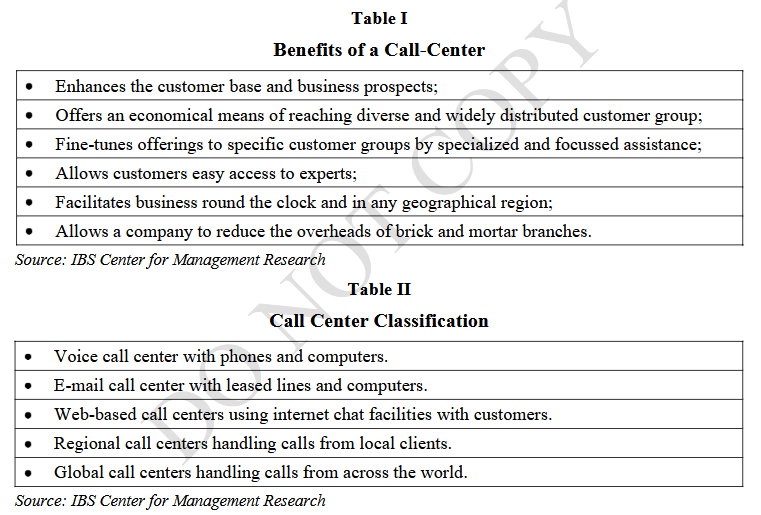
The total number of people who worked at the center at any given point of time were referred to as 'seats.' A center could range from a small 5-10 seat set-up to a huge set-up with 500-2,000 seats. The calls could be for customer service, sales, marketing or technical support in areas such as airline/hotel reservations, banking or regarding telemarketing, market research, etc. For instance, while a FMCG company could use the call centers for better customer relationship management, for a biotechnology company, the task could be of verifying genetic databases. (Refer Table I). Call centers began as huge establishments managing large volumes of communications and traffic.
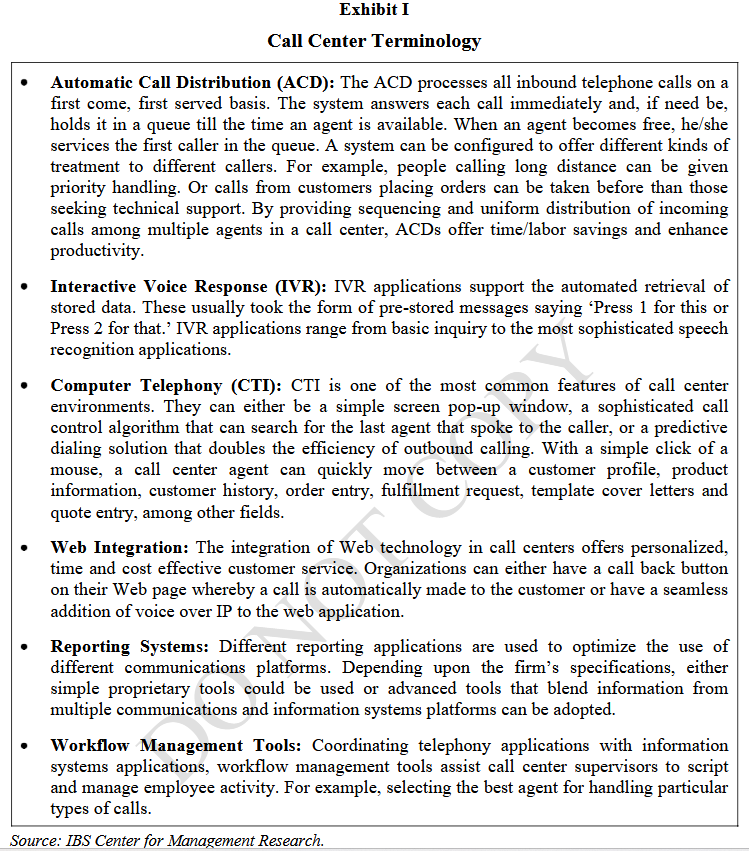
These centers were generally set up as large rooms, with workstations, interactive voice response systems, an EPABX,3 headsets hooked into a large telecom switch and one or more supervisor stations. (Refer Table II). The center was either an independent entity, or was linked with other centers or to a corporate data network, including mainframes, microcomputers and LANs.
Call centers could either be 'captive/in-house' or in form of an 'outsourced bureau.' Captive call centers were typically used by various segments like insurance, investments and securities, retail banking, other financial services, telecommunications, technology, utilities, manufacturing, travel and tourism, transport, entertainment, healthcare and education etc. Outsourcing bureaus were outfits with prior experience in running call centers. These helped the new players in dealing with complex labor issues, assisted in using latest technologies, helped in lowering the operating expenses and financial risks. Outsourced bureau operators were utilized by companies at various stages viz. setting up of the center, internal infrastructure revamps, excess traffic situations etc.
There were many reasons why India was considered an attractive destination to set up call centers. The boom in the Indian information technology sector in the mid 1990s led to the country's IT strengths being recognized all over the world. Moreover, India had the largest English-speaking population after the US and had a vast workforce of educated, reasonably tech-savvy personnel. In a call center, manpower typically accounted for 55-60% of the total costs in the US and European markets - in India, the manpower cost was approximately one-tenth of this. While per agent cost in US worked out to approximately $ 40,000, in India it was only $ 5,000. This was cited to be the biggest advantage India could offer to the MNCs. Apart from these, the Government's pro call center industry approach and a virtual 12-hour time zone difference with the US added to India's advantages.
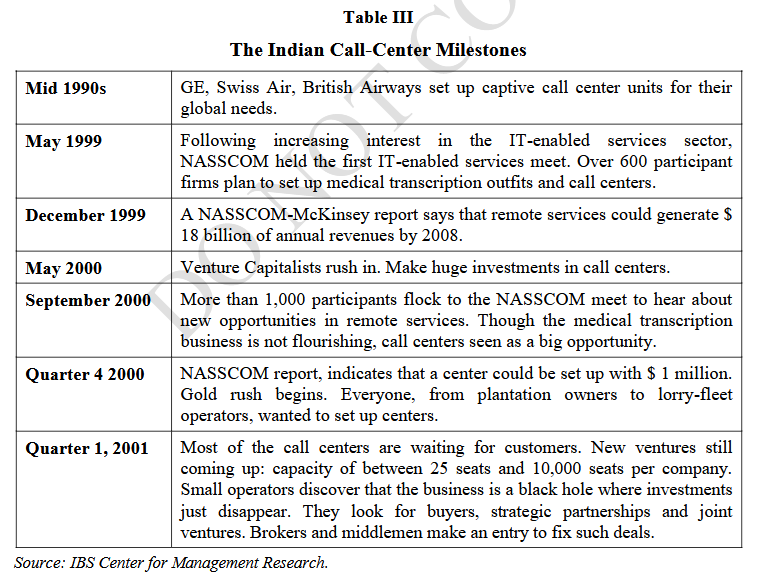
There were a host of players in the Indian call center industry. Apart from the pioneers British Airways, GE and Swiss Air, HLL, BPL, Godrej Soaps, Global Tele-Systems, Wipro, ICICI Banking Corporation, American Express, Bank of America, Citibank, ABN AMRO, Global Trust, Deutsche Bank, Airtel, and Bharati BT were the other major players in the call-center business. After the projections of the NASSCOM-McKinsey report were made public, many people began thinking of entering the call center business. (Refer Table III). During this rush to make money from the call center 'wave,' NASSCOM received queries from many people with spare cash and space, including lorry-fleet operators, garment exporters, leather merchants, tyre distributors and plantation owners among others.
However, most of these people entered the field, without having any idea as to what the business was all about. Their knowledge regarding the technology involved, the marketing aspects, client servicing issues etc was very poor. They assumed that by offering cheaper rates, they would be able to attract clients easily. They did not realize that more than easy access to capital and real estate, the field required experience and a sound business background. Once they decided to enter the field, they found that most of the capital expenditure (in form of building up the infrastructure5) occurred even before the first client was bagged. These players seemed to have neglected the fact that most successful call centers were quite large and had either some experience in the form of promoters having worked abroad in similar ventures or previous experience with such ventures or were subsidiaries of foreign companies.
The real trouble started when these companies began soliciting clients. As call centers were a new line of business in India, the lack of track record forced the clients to go for much detailed and prolonged studies of the Indian partners. Many US clients insisted on a strict inspection of the facilities offered, such as work-areas, cafeterias and even the restrooms. The clients expected to be shown detailed Service Level Agreements (SLAs), which a majority of the Indian firms could not manage. Under these circumstances, no US company was willing to risk giving business to amateurs at the cost of losing their customers. Because of the inadequate investments in technology, lack of processes to scale the business and the lack of management capabilities, most of the Indian players were unable to get international customers. Even for those who did manage to rope in some clients, the business was limited. As if these problems were not enough, the players hit another roadblock - this time in form of the high labor turnover problem.
Agent performance was the deciding factor in the success of any call center. Companies had recognized agents as one of the most important and influential points of contact between the business and the customer. However, it was this very set of people whom the Indian call centers were finding extremely difficult to recruit and more importantly, retain. In 2000, the average attrition rate in the industry was 40-45%, with about 10-15% of the staff quitting within the first two months itself. Even though attrition rates were very high in this industry worldwide, the same trend was not expected to emerge in India, as the unemployment levels were much higher.
The reasons were not very hard to understand. In a eight-and-a-half hour shift, the agents had to attend calls for seven-and-a-half hours. The work was highly stressful and monotonous with frequent night shifts. A typical call center agent could be described as being 'overworked, underpaid, stressed-out and thoroughly bored.' The agents were frequently reported to develop an identity crisis because of the 'dual personality' they had to adopt. They had to take on European/US names or abbreviate their own names and acquire foreign accents in order to pose as 'locals.' The odd timings took a toll on their health with many agents complaining of their biological clocks being disturbed. (Especially the ones in night shifts). Job security was another major problem, with agents being fired frequently for not being able to adhere to the strict accuracy standards. (Not more than one mistake per 100 computer lines.)
The industry did not offer any creative work or growth opportunities to keep the workers motivated. The scope for growth was very limited. For instance, in a 426-seat center, there were 400 agents, 20 team leaders, four service delivery leaders, one head of department and one head of business. Thus, going up the hierarchy was almost impossible for the agents.
Analysts remarked that the fault was mainly in the recruitment, training, and career progression policies of the call centers. Organizations that first set up call centers in India were able to pick and choose the best talent available. The entry norms established at this point were - a maximum age limit of 25 years, a minimum qualification of a university degree, English medium school basic education and a preference to candidates belonging to westernized and well-off upper middle class families. The companies hence did not have to spend too much time and effort in training the new recruits on the two important aspects of a good level of spoken and written English and a good exposure to western culture and traditions. However, companies soon realized that people with such backgrounds generally had much higher aspirations in life. While they were initially excited to work in the excellent working environment of a multinational company for a few months, they were not willing to make a career in the call center industry. They generally got fed up and left within a few months when the excitement waned.
A consistently high attrition rate affected not only a center's profits but also customer service and satisfaction. This was because a new agent normally took a few months before becoming as proficient as an experienced one. This meant that opportunities for providing higher levels of customer service were lost on account of high staff turnover.
The Indian call center majors were trying to handle the labor exodus through various measures. Foremost amongst these was the move to employ people from social and academic backgrounds different from the norms set earlier. Young people passing out of English medium high schools and universities and housewives and back-to-work mothers looking for suitable opportunities were identified as two of the biggest possible recruitment pools for the industry. Such students with a good basic level of English could be trained easily to improve their accents, pronunciation, grammar, spelling and diction. They could be trained to become familiar with western culture and traditions. The housewives and back-to-work mothers' pool could also be developed into excellent resources. This had been successfully tried out in the US and European markets, where call centers employed a large number of housewives and back-to-work mothers. Another solution being thought about was to recruit people from non-metros, as people from these places were deemed to be more likely to stay with the organization, though being more difficult to recruit and expensive to train.
Even as the people and infrastructure problems were being tackled, a host of other issues had cropped up, posing threats for the Indian call centers. The promise of cheap, English speaking and technically aware labor from India was suddenly not as lucrative in the international markets. A survey of Fortune 1,000 companies on their outsourcing concerns showed that cost-reduction was not the most important criterion for selecting an outsourcing partner. This did not augur well for a country banking on its cost competitiveness. Also, China was fast emerging as a major threat to India, as it had embarked on a massive plan to train people in English to overcome its handicap in the language.
In February 2001, Niels Kjellerup, editor and publisher of 'Call Center Managers Forum' came out strongly against India being promoted as an ideal place to set up call centers. He said: “The English spoken by Indians is a very heavy dialect – in fact, in face to face conversations, I found it very difficult to understand what was said. How will this play out over the telephone with people much less educated that my conversation partners? The non-existent customer service culture in India will make training of reps mandatory and difficult, since such a luxury as service is not part of everyday life in India. The infrastructure is bad, no, make that antiquated: The attempts by a major US corporation to set up a satellite link has so far been expensive and not very successful. Electricity infrastructure is going from bad to worse – in fact during my stay at a 5 star hotel and at the corporate HQ of a big MNC, we had on average 7 black-outs a day where the generators would kick in after 2-3 seconds. The telephony system is analog and inadequate. It took on average three attempts just to get a line of out my hotel. The telecom market is not deregulated, and international calls are very expensive. The business culture and the mix of Government intervention will be a cultural shock for Western business people with no previous experience. Add to this a lack of a call center industry and very few people with call center experience which makes it very hard to recruit call center managers with a proven track record.”
Despite the mounting criticisms and worries, hope still existed for the Indian call center industry. Analysts remarked that the call center business was in the midst of a transition, wherein only the fundamentally strong players would remain in the fray after an inevitable 'shakeout.' Unlike other industries, the shakeout in this industry was not only because of an over supply of call center providers, but also because of the quality of supply offered. In spite of the downturn, the call center business was considered to hold a lot of potential by many corporates.
With the US economy facing a slowdown, the need for US companies to outsource was expected to be even higher. The Reliance group was planning to open call centers in 10 cities across the country. Other companies including Spectramind and Global Telesystems planned to either enter or enhance their presence in the business.
Whether the dream of call centers contributing to substantial economic growth for India would turn into reality was something only time would reveal.
1. Prepare a note on the functioning of a call center and comment on its necessity and viability in the Indian context.
2. India had certain inherent advantages because of which, it had been identified as the preferred destination on a global basis for outsourcing IT services. However, these very advantages were proving to be its drawbacks in the early 21st century. Critically examine the above statement giving reasons to support your stand.
3. What were the problems being faced on the human resources front by the call centers? How were the players planning to address them?
Exhibit I
Keywords
Insight, Indian Call Center, ICC, industry, analysts, CC, industry, history, concept, functioning, industry, problems, human resources