
Reorganizing HP
🌐 International Buyers — Pay via PayPal
Details
HROB009
11
2002
YES
0
The Hewlett-Packard Company
Technology & Communications
US
Restructuring,Organizational Design
Abstract
The case discusses the problems faced by HP during the mid 1990s due to its highly decentralized organization structure. The case also analyzes the aggressive management reorganization plan implemented by CEO Carly Fiorina and its effect on the company.
Learning Objectives
The case is structured to achieve the following Learning Objectives:
- Need to alter organization structure to facilitate growth, coordination and control.
Contents
In the mid 1990s, global computer major HP1 was facing major challenges in an increasingly competitive market. In 1998, while HP's revenues grew by just 3%, competitor Dell's rose by 38%. HP's share price had remained more or less stagnant, while competitor IBM's share price had increased by 65% during 1998. Analysts said HP's culture, which emphasized teamwork and respect for co-workers, had over the years translated into a consensus-style culture that was proving to be a sharp disadvantage in the fast-growing Internet business era. Analysts felt that instead of Lewis Platt, HP needed a new leader to cope with the rapidly changing industry trends. Responding to these concerns, the HP board appointed Carleton S. Fiorina (Fiorina) in July 1999 as the CEO of the company. Revenues grew by 15% for the financial year ended October 2000 (Refer Exhibit I), prompting industry watchers to say that Fiorina seemed all set to put HP's troubles behind for good. However, for the quarter ended January 31, 2001, the net profits were well below the stock market expectations. Soon there was more bad news from the company. In late January 2001, after forcing a five-day vacation on the employees and putting off wage hikes for three months in December 2000, HP laid off 1,700 marketing employees. By early February 2001, HP's share price fell 18.9%, from $45 in July 1999 to $36.
In April 2001, citing a slowdown in consumer spending, Fiorina announced that HP's revenues would decrease by 2% to 4% for the quarter ending April 30, 2001. She also said that HP would in all likelihood show no growth for the next two quarters. Many analysts and competitors were surprised at this announcement. According to some analysts, the major reason for the shortfall in revenue was Fiorina's aggressive management reorganization. They said that with the global slowdown in the technology sector, it was the wrong time to reorganize.
Things worsened when HP laid off 6,000 more workers in July 2001. The lay-offs came less than a month after 80,000 employees had willingly taken pay-cuts. The management also sent memos saying that layoffs would continue and just volunteering for pay-cuts would not guarantee continued employment. According to company insiders, though these changes were necessary, they had affected employee morale. Many employees had lost faith in Fiorina's ability to execute her reorganization plans.
Stanford engineers Bill Hewlett and David Packard founded HP in California in 1938 as an electronic instruments company. Its first product was a resistance-capacity audio oscillator, an electronic instrument used to test sound equipment. During the 1940s, HP's products rapidly gained acceptance among engineers and scientists. HP's growth was aided by heavy purchases made by the US government during the Second World War.
Till the 1950s, HP had a well-defined line of related products, designed and manufactured at one location and sold through an established network of sales representative firms. The company had a highly centralized organizational structure with vice-presidents for marketing, manufacturing, R&D, and finance. HP had 90 engineers in product development. To have a clear demarcation of goals and responsibilities, and to promote individual responsibility and achievement, HP began to organize these engineers into smaller, more efficient groups by forming four product development groups. Each group concentrated on a family of related products and had a senior executive reporting to the vice-president of R&D. The product-development staff functions were so restructured as to allow a design engineer to concentrate only on the division's products and to work closely with the field salespeople.
As HP grew larger, it moved towards a divisional structure. By the 1960s, HP had many operating divisions, each an integrated, self-contained organization responsible for developing, manufacturing and marketing its own products. This structure, it was thought, would give each division considerable autonomy, and create an environment that would encourage individual motivation, initiative, and creativity in working towards common goals and objectives. In the words of Packard, “We wanted to avoid bureaucracy and to be sure that problem-solving decisions be made as close as possible to the level where the problem occurred. We also wanted each
division to retain and nurture the kind of intimacy, the caring for people, and the ease of communication that were characteristic of the company when it was smaller.”
In the 1960s, HP made organizational changes for the sales representative firms. These firms represented and sold the products of other non-competing electronics manufacturers along with those of HP. This arrangement was creating problems3 in the 1960s due to HP's rapid growth. To get around these difficulties, HP set up its own sales organization, taking care not to break ties with the existing representatives who were encouraged to join the sales divisions of the company. In 1968, HP adopted a group structure in response to the increasing number of operating divisions and product lines. Divisions with related product lines and markets were combined into a group headed by a group manager. Each group was made responsible for the coordination of divisional activities and the overall operations and financial performance of its members. The new structure had two objectives – to enable compatible units to work together more effectively on a day-to-day basis, and to decentralize some top management functions so that the new groups would be responsible for some of the planning activities and other functions previously assigned to corporate vice-presidents.
The group structure improved HP's field marketing activities by enabling sales engineers to understand and sell the entire line of HP products. Under this structure, the sales engineer became the representative of a specific group, selling and supporting only that group's products. Packard said, “As the company moved to a group structure, I stressed to our people that this change did not represent any deviation from our traditional philosophy of management. From the beginning we had a strong belief that groups of people should be given full responsibility for specific areas of activity with wide latitude to develop their own plans and make their own decisions. Our new organization did not alter this basic concept, but strengthened it.”
By the early 1970s, HP had grown from a highly centralized, rather narrowly focused company into one with many widely dispersed divisions and activities. HP began to use a concept called 'local decentralization,' wherein a division was given the full responsibility for a product line (when it had grown large enough) at a separate, but close, location.
HP's organizational charts provided only general guidelines. As one divisional manager said, “In no way do charts dictate the channels of communication used by HP people. We want our people to communicate with one another in a simple and direct way, guided by common sense rather than by lines and boxes on a chart. To get the job done, an individual is expected to seek information from the most likely source. HP systems increasingly include products from different groups and divisions. Even though an organization is highly decentralized, its people should be regularly reminded that cooperation between individuals and coordinated efforts among operating units are essential for growth and success. Although we minimize corporate direction at HP, we consider ourselves one single company, with the flexibility of a small company and the strengths of a large one – the ability to draw on corporate resources and services, shared standards, values and culture, common goals and objectives, and a single world-wide identity.”
Notwithstanding the efforts made by the top management to generate synergies across divisions, the decentralized structure that HP had, till the 1980s, created major problems for the company. HP began to be perceived by users as three or four companies, with little coordination between them. When users of HP 3000 computers went to buy HP printers, they found that the software loaded on their computers (which were made by another HP division) wouldn't allow them to use it for graphics.
In the 1990s, HP found that its elaborate network of committees was slowing down its ability to take quick decisions, especially those pertaining to new product development. To address this problem, the then CEO John Young, dismantled the committee network, and as a part of reorganization, also cut a layer of management from the hierarchy. He further decentralized decision-making and divided the computer business into two primary groups. One group was made responsible for PCs, printers and other products sold though dealers and the other for workstations and minicomputers sold to large customers. To enable the company to respond faster to market needs, each group was given its own sales and marketing team. These changes enabled HP to gain market share in workstations and minicomputers, and till the mid 1990s, HP performed well. The company's huge success in printers and PCs had increased revenues from $13.2 billion in 1990 to $38.42 billion in 1996, with profits increasing at a fast pace.
However, with the growth in size of operations, came problems as well. With 83 different product divisions, the bureaucracy had increased significantly. For instance, when Best Buy, a retailing company wanted to buy some computer products, 50 HP employees came forward to sell their units' products. A former executive at HP said, “I left HP because I did not want to spend 80% of my time managing internal bureaucracy anymore.” He revealed that he once had to get an operational change cleared by 37 different internal committees.
There were reports that the bureaucracy was hindering innovation as well. Managers were often reluctant to invest in new ideas for fear of missing their quarterly goals – HP had not had a mega- breakthrough product since the inkjet printer was introduced in 1984. Despite the lack of new products, Platt did nothing to motivate the product development teams. Instead, he focused on promoting diversity in the workplace and on ensuring a more humane balance of work and personal life for HP employees. Analysts felt that while these efforts were praiseworthy, they did little to help the company face the tough business environment in which it was operating.
Meanwhile, HP spun off its test-and-measurement unit (See Exhibit II) and divided its huge portfolio of products into four divisions – Home PCs, Handhelds, and Laptops; Scanners, Laser Printers, and Printer Paper; Consulting, Security Software, and Unix Servers; and Ink Cartridges, Digital Cameras, and Home Printers. The head of each of these divisions was given the same powers as that of a CEO. However, the company's stagnant revenues and the declining profit growth rate in 1998 compounded its problems. It was at this stage that Fiorina took over the company's reins.
Fiorina immediately introduced several changes, in an attempt to set things right at HP. She began by demanding regular updates on key units. She also injected the much-needed discipline into HP's computer sales force, which had reportedly developed a habit of lowering sales targets at the end of each quarter. Sales compensation was tied to performance and the bonus period was changed from once a year to every six months.
HP Labs, the company's R&D center had only been making incremental improvements to existing products. This was because engineers' bonuses were linked to the number, rather than the impact of their inventions. To boost innovation and new product development, Fiorina increased focussed on 'breakthrough' projects. She started an incentive program that paid researchers for each patent filing.
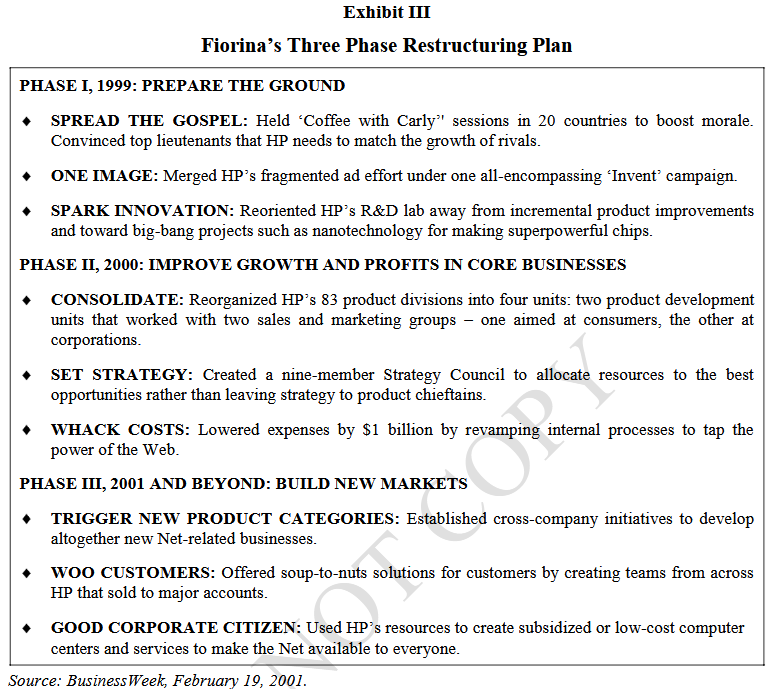
Fiorina developed a multiyear plan to transform HP from a 'strictly hardware company' to a Web services powerhouse (See Exhibit III). To achieve this plan, Fiorina dismantled the decentralized organization structure. In early 2000, HP had 83 independent product divisions, each focused on a product such as scanners or security software. The company had 83 product chiefs having their own R&D budgets, sales staff, and profit-and-loss responsibility. In a bid to make HP an effective selling organization, Fiorina reorganized these units into six centralized divisions (See Exhibit IV). Three of these were product development groups – printers, computers, and tech services & consulting (the 'back-end' units) and the other three were sales and marketing groups – for consumers, corporate markets, and consulting services (the 'front-end' units).
The back-end units developed and built computers, and handed over the products to the front-end groups that sold these products to consumers as well as corporations. Fiorina expected the new structure to strengthen collaboration, between sales & marketing executives and product development engineers thus helping to solve the customer problems faster. Industry experts said that this was the first time a company with thousands of product lines and scores of businesses had attempted a front-back approach, a strategy that required laser focus and superb coordination.
The new arrangement solved a number of long-standing HP problems, making the company far easier to do business with. Rather than too many salespeople from various divisions, now customers dealt with one person. It helped HP's product designers focus on what they did best and gave the front-end marketers authority to make the deals that were most profitable for the company. For instance, now they could sell a server at a lower margin to customers who opted for long-term consulting services. The new R&D strategy resulted in the doubling of patent filings from HP in 2001 to 3000, putting the company among the top three patent filers in the world.
However, the reorganization soon ran into problems. In the past, HP's product chiefs had run their own operations from designing of the product to providing sales and support. In the new set-up, they had a very limited role. Though they were still responsible for keeping HP competitive, achieving cost goals, and getting products to market on time, they had to pass on those products to the front-end organizations responsible for marketing and selling them. With no authority to set sales forecasts, back-end managers were unable to allocate the R&D funds accordingly. At the same time, front-end sales representatives had trouble meeting their forecast if their back-end colleagues came up with the wrong products.
With HP's 88,000 employees adjusting to the biggest reorganization in the company's history, expenses had risen out of control. According to one HP manager, “It was frantic. The financial folks were running all around looking for more dollars.' Freed from the decades-old lines of command, employees began spending heavily, with dinner and postage expenses running far over the normal amount. Such lavish spending was rare under the old structure where product chiefs kept a tight control on their expenditures.
Analysts also claimed that in the new structure, the back-end product designers would not be able to stay close enough to the customers to deliver products as per their requirements. Neither would the executives responsible for selling thousands of HP products be able to give sufficient attention to each of the products. Moreover, while productivity-linked commissions to the sales force were intended to boost revenues and profitability, they only helping in raised sales for low-margin products that did little for corporate profits.
The new structure did not clearly assign responsibility for profits and losses. With responsibility for growth and profits shared between front-and back-end managers, there was less financial control and more disorder. With employees in 120 countries, redrawing the lines of communication and getting personnel from different divisions to work together was proving very troublesome. According to one HP manager, “The people who deal with Fiorina directly feel very empowered, but everyone else is running around saying, 'What do we do now?'
HP's customers were not happy either. The front-back reorganization had created confusion internally, and many customers said they had noticed little improvement. According to one computer reseller who had struggled for two months to get HP to work out a customized configuration for one of its new servers, “It's beyond my ability to communicate our frustration. It's painful to watch them mess up million-dollar deals."
Apart from these structural problems, Fiorina's tenure reportedly did little to improve HP's business performance. The market share gains made in Fiorina's first year as CEO had begun to recede in late 2000. While HP continued to dominate the inkjet and laser printer business with a 41% market share, its PC share had fallen from 7.8% to 6.9% for the 12 months ended January 31, 2001.
Sales of HP's Windows servers had dropped from 10.6% to 8.2% in the same period. HP did not perform well in the software, storage and consulting businesses where it had only a single-digit market share. However, HP's share of the high-end Unix server business had increased to 28% in the quarter ended January 31, 2001, (up from 23.3% the year before).
According to analysts, Fiorina had tried an approach that had never been attempted before at a company of HP's size and complexity. She was accused of being over-ambitious in trying to tackle all of HP's problems together at the same time. They said that putting in place such sweeping changes was tough anywhere – more so in the case of the tradition-bound HP, already suffering from the slowdown in the technology sector.
1. HP had consistently transformed itself to meet the needs of the changing business environment over the years. Analyze the company's reorganization efforts in the pre-Fiorina era and comment on their efficacy.
2. Examine the restructuring plan put in place by Fiorina and critically comment on its advantages and disadvantages in light of the company's performance after the plan's implementation.
Exhibit I
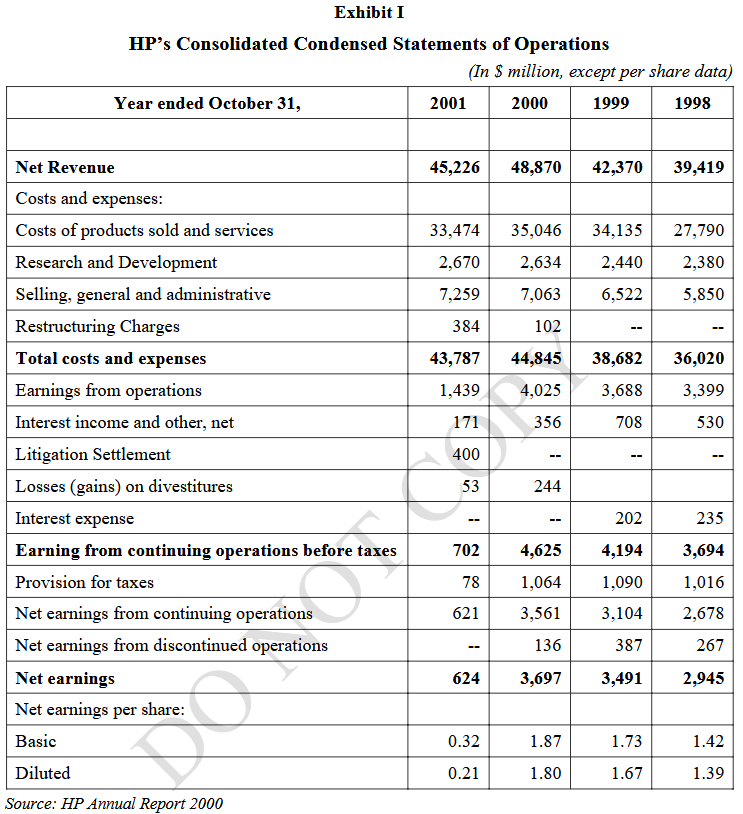
Exhibit II
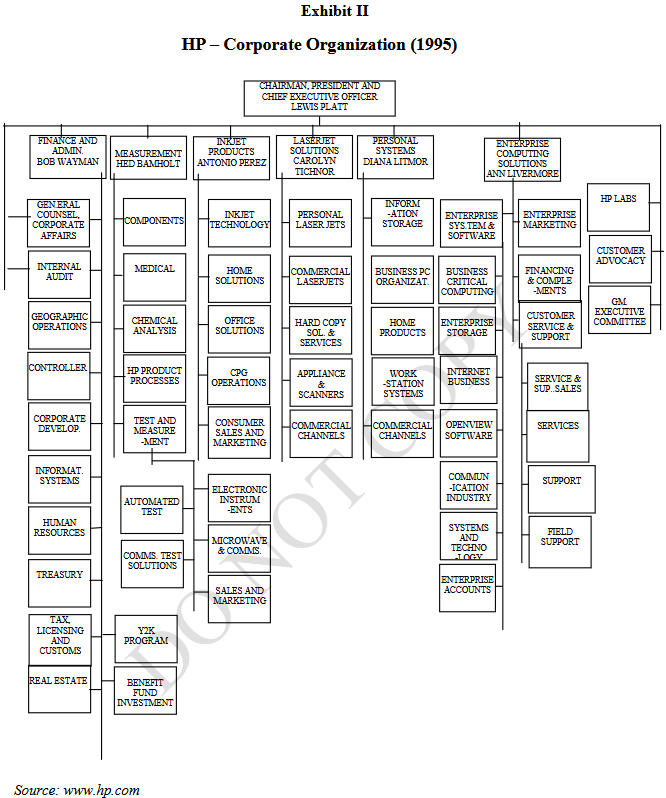
Exhibit III
Keywords
HP, 1990, decentralized, organization structure, aggressive management, reorganization, CEO, Carly Fiorina
Related Case Studies
| Case Title | Details | Price | Add to Cart |
|---|---|---|---|
|
Case Title Spotify: Can Aligned Autonomy Survive Global Scale?Case Code: HROB299 |
Details | 400 | Add to Cart |
|
Case Title Restructuring Levi Strauss & Co.: Challenges Ahead for Michelle GassCase Code: BSTR706 |
Details | 500 | Add to Cart |
|
Case Title The Tech Phoenix: Satyam’s 100-Day TurnaroundCase Code: BSTR703 |
Details | 600 | Add to Cart |
|
Case Title Zomato: Downsizing to Remain CompetitiveCase Code: CLBS152 |
Details | 200 | Add to Cart |
|
Case Title Holacracy at ZapposCase Code: HROB178 |
Details | 600 | Add to Cart |