
HP at Cultural Crossroads
🌐 International Buyers — Pay via PayPal
Details
HROB012
11
2002
YES
0
The Hewlett-Packard Company
Technology & Communications
US
Organizational Culture
Abstract
The case discusses HP’s organization culture and the role of ‘HP Way’ in strengthening it. It also discusses the steps implemented by the new CEO Carly Fiorina in a bid to cut costs and improve the financial performance of HP, which proved to be a major departure from HP’s long cherished culture.
Learning Objectives
The case is structured to achieve the following Learning Objectives:
- Evolution of culture in a large organization
- Implications of radical cultural change.
Contents
“The HP Way is a tricky thing. It’s what makes HP great, but it can also be used as an excuse for practices that are no longer relevant. It can be an excuse for not changing. When you boil it down to its fundamentals, it’s about keeping core values constant and frequently changing practices –and a lot of people inside HP and outside HP get confused about that.”
- Lewis Platt, former HP CEO, in August 1999.
“The HP Way gave me the courage to change it as quickly as we are. Because it really is all about having this company achieve what it is capable of. It is important, and it is worth doing.”
- Carly Fiorina, Chairperson, HP CEO, in February 2001.
During the late 1990s, HP,3 the second largest computer manufacturer in the world, faced major challenges in an increasingly competitive market. In 1998, while HP's revenues grew by just 3%, competitor Dell's rose by 38%. HP's share price remained more or less stagnant, while competitor IBM's share price increased by 65% during 1998. Analysts said HP's culture, which emphasized teamwork and respect for co-workers, had over the years translated into a consensus-style culture that was proving to be a sharp disadvantage in the fast-growing Internet business era. Analysts felt that instead of Lewis Platt, HP needed a new leader to cope with rapidly changing industry trends.
Responding to these concerns, in July 1999, the HP board appointed Carleton S. Fiorina (Fiorina) as the company's CEO. Fiorina implemented several cost-cutting measures to streamline the company's operations. Some of the measures included forced five-day vacation for the workers and the postponement of wage hikes for three months in December 2000. In January 2001, HP laid off 1,700 marketing employees.
In April 2001, Fiorina announced that HP's revenues would decrease by 2% to 4% for the quarter ending April 30, 2001 due to the decrease in consumer spending. In yet another move to cut costs, in June 2001, employees were forcibly asked to take pay-cuts. More than 80,000 employees volunteered saving the company $130 million.
Things became worse when the HP management announced that it would lay off another 6,000 workers in July 2001, the biggest reduction in the company's 64-year history. The management also sent memos saying that the layoffs would continue and that the volunteering for pay-cuts would not guarantee continued employment.
In September 2001, HP and Compaq Computer Corporation announced their merger5. According to company insiders, once the merger was implemented, Fiorina was likely to lay off another 15,000 to 30,000 employees as a part of a major cost saving drive. The merger was expected to yield cost savings upto $2.5 billion primarily because of layoffs. The steps taken by Fiorina surprised analysts. They said that these steps were a major departure from HP's organizational culture – „The HP Way' of promising lifelong employment and employee satisfaction.
According to the company insiders, though change was necessary, employees' morale had suffered badly. Many employees had lost faith in Fiorina's ability to execute her plans. They also felt that her changes were destroying much of the company's cherished culture. HP Vice - President for Human Resources Susan Bowick admitted, “Morale statistics are lower than we've ever seen them.”
Stanford engineers Bill Hewlett and David Packard founded HP in California in 1938 as an electronic instruments company. Its first product was a resistance-capacity audio oscillator, an electronic instrument used to test sound equipment. During the 1940s, HP's products rapidly gained acceptance among engineers and scientists. The company's growth was further aided by heavy purchases by the US government during the Second World War. As their business succeeded, the confidence of Hewlett and Packard increased. The founders, who shared some basic values, also hired and promoted like-minded people. They also explicitly communicated their beliefs and values to the employees.
Since its inception, HP was known for its relaxed and open culture. The company followed an 'open-door policy', which encouraged employees to discuss their personal and job-related matters with their managers. Most of the employees worked in open cubicles while the managers kept their doors open to encourage communication and idea sharing. A typical HP office building had a vast open area, in some cases the size of a football field, with dozens of cubicles. Most of the employees were technically oriented engineers who enjoyed learning and sharing their knowledge.
According to Hewlett, “The open-door policy is very important at HP because it characterizes the management style to which we are dedicated. It means managers are available, open and receptive. Everyone at HP, including the CEO, works in open-plan, doorless offices. This ready availability has its drawbacks, in that interruptions are always possible. But at HP, we have found that the benefits of accessibility far outweigh the disadvantages. The open door policy is an integral part of the management by objective philosophy. Also, it is a procedure that encourages and, in fact, ensures that the communication flow be upward as well as downward.”
Packard followed a practice, which he called as 'management by walking around' – impromptu get-togethers with employees that kept him in close touch with the everyday business. The founders believed in the 'individual's own motivation to work' and treated their employees as family members; hence the custom to call each other by first name. Even the two chiefs were only known as Bill and Dave.
Over the years, HP developed and maintained its work culture through extensive training of its managers and employees. In 1957, HP's founders and key managers formalized a set of corporate objectives. These and the existing values of the organization became the foundation for the 'HP Way' of doing business (Refer Exhibit I). The 'HP Way' created a strong and powerful culture in the organization.
The HP Way laid great emphasis on servicing all stakeholders with integrity and fairness. The founders stressed that the company would always share its success with the employees, recognize their individual achievements, and treat them with trust and respect. The HP Way also stressed that customers and shareholders had to be kept happy by the development of technically superior products and generating satisfactory profits. It encouraged initiative and creativity, and promoted managers who were enthusiastic and effective team players.
All the employees participated in a profit sharing program including stock options and received additional bonus when the company performed well. These measures served to identify the employees with their work and encouraged them. The HP way also included scholarships for the employees' children.
HP encouraged lower level employees through empowerment. The company took pains to identify the most competent employees for new assignments. The company's founders once remarked, “We believe that people want to do a good job and that it is important for them to enjoy their work in HP. We try to make it possible for our people to feel a real sense of accomplishment in their work.”
HP normally promoted people from within. This meant that managers had to involve themselves actively in the development of lower level employees. HP's policies emphasized that employees be exposed to challenging work assignments and relevant training programs, to broaden their capabilities and prepare them for more responsible jobs.
HP's fast growth and employee-friendly policies had obviated the need for layoffs. The company avoided the 'hire and fire' policy, wherein many people were employed for a single big order and dismissed later. Instead, HP offered its employees 'almost perfect job security.' Even in 1974, when the US economy was in crisis and many people were unemployed, HP avoided layoffs by a four-day workweek, which was a unique measure in corporate America.
HP had a decentralized organizational structure and mode of operations. Business units that performed well were given higher degree of autonomy. There was little organized sharing of information, resources, or employees across units. Few business units were willing to invest time or money in efforts that do not had an obvious and immediate payback for the unit. It was common, however, for employees to move from one business unit to another; making possible some degree of informal knowledge transfer within HP.
By 1990, HP had completed a strategic reorientation with computers, accounting for two-thirds of sales. Externally, the competition intensified, while internally, the organization saw a major upheaval when Hewlett retired in 1987 followed by Packard in 1993. All these changes had an impact on HP's organizational culture. HP departed from its lifelong employment tradition when it offered early retirement to its employees. In 1989, after acquiring Apollo Computers, HP laid off employees.
Though senior employees, used to the HP Way, resisted these changes, the company went ahead with its new policies. Edward Barnholt, then manager of the Electronic Instrumentation Group explained that HP's culture of innovation, entrepreneurship and customer satisfaction had helped it to cope with the changes. When HP altered its promotional policies, after entering the computer business, the employees, though not happy with the decision, accepted it as part of the changing circumstances.
When HP's operations expanded, problems also increased. In the mid 1990s, HP had 83 different product divisions, which had increased the bureaucracy significantly. There were reports that the bureaucracy was hindering innovation as well6. Managers were often reluctant to invest in new ideas for fear of missing their quarterly goals – HP had not had a mega-breakthrough product since the inkjet printer was introduced in 1984. Despite the lack of new products, Platt7 did nothing to motivate the product development teams. Instead, he focused on promoting diversity in the workplace and ensuring a more humane balance of work and personal life for the employees. Analysts felt that though these efforts were praiseworthy, they did not help the company to face the competition. These led to Platt's replacement. In July 1999, the HP board appointed Fiorina as the CEO.
The toughest challenge Fiorina faced was in changing the HP culture, which had been influenced by the company's engineering heritage. The challenge was to keep the edge in engineering and innovation while making the employees more adaptable and responsive. Fiorina immediately introduced several changes to set things right at HP. She demanded regular updates on key units. She also injected the much-needed discipline into HP's computer sales force, which had reportedly developed a habit of lowering sales targets at the end of each quarter. Sales compensation was tied to performance and the bonus period was changed from once a year to every six months. She linked compensation to improvements in customer-approval ratings. To develop better leadership skills, she instituted the 360-degree feedback concept. This meant that the pay for the company's managers would be based on input from employee surveys.
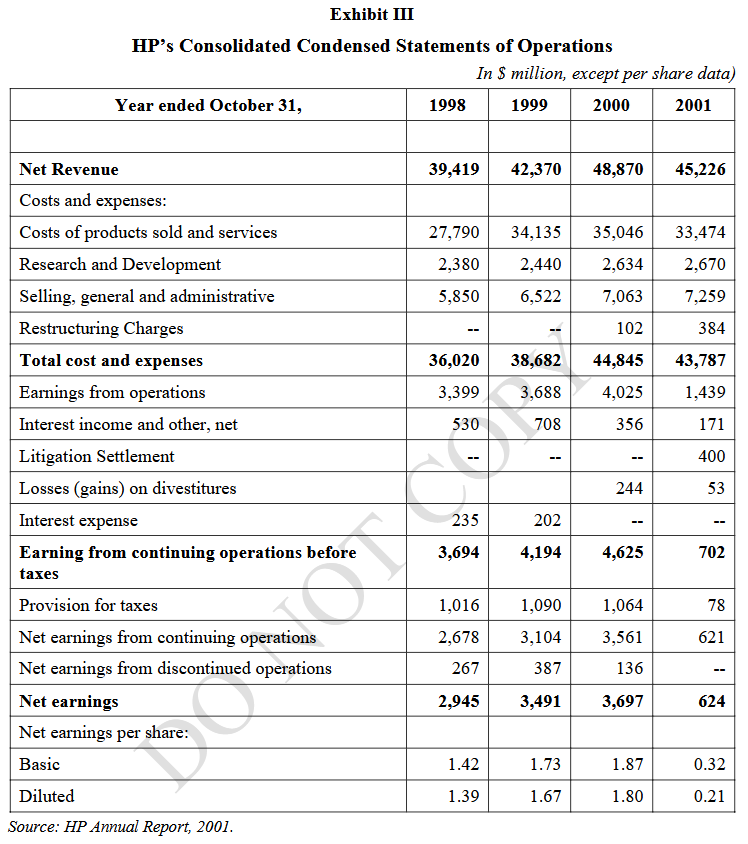
HP Labs, the company's R&D center, had only been making improvements to the existing products. This was because the engineers' bonuses were linked to the number rather than the impact of their inventions. To encourage innovation and product development, Fiorina increased focus on 'breakthrough' projects. She started an incentive program that paid researchers for each patent filing. In 2000, the increasing competition and slowdown in the technology sector had affected HP's financial performance (refer Exhibit III). This forced Fiorina to change the compensation structure and initiate several cost cutting measures. Previously a percentage of the company's profit was divided among the employees based on their salary. Bonuses were paid when the company beat its own numbers for revenue, profit and return on assets. Fiorina came up with a new system, where the bonus was based on HP's performance vis-à-vis its competitors. Thus, inspite of HP reporting a profit in the first half of financial year 2001 (November 2000 to April 2001) for the first time in 39 years, the employees did not get their bonus.
In January and April 2001, HP laid off 1,700 marketing positions and 3,000 management positions respectively. The company claimed that this was to make its ratio of managers to employees less top-heavy and more in line with industry standards. In June 2001, HP asked its employees to take pay cuts or use accumulated vacation days as a cost-saving measure. The employees were given an option to take a 10 percent pay cut for the next four months or take a 5 percent cut plus four additional paid vacation days in the same period. A third option was given to take eight additional paid vacation days.
In July 2001, HP laid off 6,000 employees – the biggest ever in the company's history. According to an employee in HP, “Morale is as low as it has been in a long time. The President/CEO tried to change too much too fast. In such a case, the organization doesn't know what to do and flounders.”
The steps taken by Carly attracted lot of criticism among the analysts. Geoffrey Moore, a high-tech management expert, remarked, “HP was built as a collaborative culture – not a star system. She drives a competence culture, which puts performance ahead of teams, values and intuition. That's a wrenching problem.” According to Grinstein, former CEO of Burlington Northern and Western Airlines, “Carly is articulate, with a wonderful style and flair. But in breaking from culture, you cannot elevate yourself too high above it.”
Employees had their own share of grievances too. Larry Mitchell complained, “Layoffs had always been kind of non-traditional for HP. HP's culture is definitely changed these days. With the prior culture we probably would have figured out something other than laying off 6,000 people. There are other ways to get rid of performance problems other than just layoffs.”
The chances of massive layoffs after the HP-Compaq merger has met with stiff resistance from David W. Packard, Dave Packard's son. He was against the merger because of the changes it would bring into HP's egalitarian culture. He said, “I am perfectly aware that HP has never guaranteed absolute tenure status to its employees. But I also know that Bill and Dave never developed a premeditated business strategy that treated HP employees as expendable.” However, Fiorina felt, “HP's culture is both the company's greatest strength and weakness. It is strength because it binds many of our customers and our partners to this company. It is a weakness when it causes people to get frozen looking into the rearview mirror instead of forward at the oncoming cars.”
The fact that Fiorina's efforts did not seem to be yielding results added to the growing criticism of her strategies. During her tenure, HP shares came down by 50%, substantially more, compared to the Dow Jones industrial average. Revenues were stagnant and profits had fallen significantly (refer Exhibit III). Analysts said that with the global tech slowdown and rising competition in the computer industry the near-term outlook wasn't any better. They wondered whether replacing the 'HP Way' with the 'Carly Way' had been a mistake. The answer would be critical to Fiorina's ability to execute her plans and pull out the company from its biggest ever slump.
1. Analyze the evolution of HP's culture over the years leading to the 'HP Way.' Discuss the key components of HP's culture and evaluate its contribution to the company's success.
2. Comment on Fiorina's approach to alter the HP culture. Examine the reaction to the steps taken by her.
3. Compare and contrast the 'HP Way' with 'Fiorina's Way.' Should Fiorina change the culture radically in response to the rising competition and HP's falling profits? How should Fiorina manage HP's culture to improve the company's performance and meet business challenges?
Exhibit I
The HP Way – HP’s Corporate Objectives
|
In the late 1950s, Bill and Dave decided to write down the company's objectives, which would serve as guidelines for decision-making by HP employees. They stated: “The achievements of an organization are the result of the combined efforts of each individual in the organization working towards common objectives. These objectives should be realistic, should be clearly understood by everyone in the organization and should reflect the organization's basic character and personality.” These corporate objectives included: Profit, Customers, Fields of Interest, Growth, People, Management, and Citizenship. PROFIT CUSTOMERS FIELDS OF INTEREST GROWTH PEOPLE MANAGEMENT CITIZENSHIP |
Source: www.hp.com
Exhibit II
The HP Way – HP’s Organizational Values
|
HP?s organizational values shaped its strategies and practices, including Management by Wandering Around (MBWA), Management by Objectives (MBO), the Open Door Policy and Open Communication. The HP Way became the center of HP?s management style. HP?s mission statement had listed the following values:
HP used some unique management techniques to follow the “HP Way.” MANAGEMENT BY OBJECTIVES (MBO) Individuals at each level contributed to company goals by developing objectives, which were integrated with those of their superiors, as well as, other departments. Flexibility and innovation in recognizing alternative approaches to meeting objectives provided an effective means of meeting customer needs. Written plans ensured that accountability existed throughout the organization. OPEN DOOR POLICY This policy gave employees the freedom to express their dissent with the management without having to worry about adverse consequences. The policy was based on trust and integrity. It encouraged the employees to speak out openly on issues relating not only to the business or the job but also their own career progression. OPEN COMMUNICATION HP believed that people performed well if given the right tools, training and information. Open Communication was aimed at promoting teamwork among the employees, customers and other stakeholders. MANAGEMENT BY WANDERING AROUND (MBWA) The informal communication practice helped managers to be updated with activities in their respective departments. A manager consistently reserved time to walk through the department or be available for impromptu discussions. |
Source: www.hp.com
Keywords
HP, organization culture, HP Way, steps, CEO, Carly Fiorina, cut costs, financial performance, HP, major departure, culture