
Netscape’s Work Culture
🌐 International Buyers — Pay via PayPal
Details
HROB013
13
2002
YES
0
Netscape Communications Corporation
Technology & Communications
US
Organizational Culture
Abstract
The case discusses the organizational culture of Netscape, one of the leading Web browser companies. The case discusses various aspects of the culture that contributed to the success of the company. In 1998, America Online acquired Netscape Communications. The case examines the post-merger culture at Netscape and the impact of the new culture on Netscape employees.
Learning Objectives
The case is structured to achieve the following Learning Objectives:
- Role of culture in the success of a software company, cultural problems after mergers.
Contents
“It took Microsoft and Oracle 11 years to reach the size Netscape reached in 3 years, both in terms of revenues and the number of employees. Which is just cosmically fast growth.”
- Marc Andreessen, Co-founder, Netscape.
“Netscape's relaxed work environment drives up productivity and creativity. Because there aren't layers of management and policies to work through, Netscape can turn out products in a month.”
- Patrick O’Hare, Manager (Internal Human Resources Web Site), Netscape.
On November 24, 1998, America Online1 (AOL) announced the acquisition of Netscape Communications (Netscape), a leading Internet browser company, for $10 billion in an all - stock transaction. With this acquisition, AOL got control over Netscape's three different businesses – Netcenter portal, Netscape browser software and a B2B e-commerce software development division. According to the terms of the deal, Netscape's shareholders received a 0.45 share of AOL's common stock for each share they owned. The stock markets reacted positively and AOL's share value rose by 5% just after the announcement. Once shareholders and regulatory authorities approved the deal, Netscape's CEO James Barksdale (Barksdale) was supposed to join AOL's board.
Many analysts felt that this acquisition would help AOL get an edge over Microsoft, the software market leader, in the Web browser market. Steve Case, (Case) Chairman and CEO of AOL, remarked, “By acquiring Netscape, we will be able to both broaden and deepen our relationships with business partners who need additional level of infrastructure support, and provide more value and convenience for the Internet consumers.”
However, a certain section of analysts doubted whether AOL's management would accept Netscape's casual and independent culture. Moreover, they were worried that this deal may lead to a reduction in Netscape's workforce, the key strength of the company. A former Netscape employee commented, “People at Netscape were nervous about the implications of AOL buying us.” Allaying these fears, in an address to Netscape employees, Case said, “Maybe you joined the company because it was a cool company. We are not changing any of that. We want to run this as an independent culture.”
In spite of assurances by AOL CEO, it was reported that people at Netscape were asked to change the way they worked. In July 1999, Netscape employees were asked to leave if they did not like the new management. By late 1999, most of the key employees, who had been associated with Netscape for many years, had left. Barksdale left to set up his own venture capital firm, taking along with him former CFO Peter Currie. Marc Andreessen (Andreessen) stayed with AOL as Chief Technology Officer till September 1999, when he left to start his own company, Loudcloud.
Mike Homer, who ran the Netcenter portal, left the company while he was on a sabbatical.
Netscape was co-founded by Jim Clark (Clark) and Andreessen. Clark was a Stanford University professor turned entrepreneur.4 Andreessen was an undergraduate from the University of Illinois, working with the National Center for Supercomputing Applications.5 In 1993, with a fellow student, Andreessen developed the code for a graphical Web browser and named it Mosaic. In April 1994, Clark and Andreessen founded a company, which was named as Electric Media (See Exhibit I). The name was changed to Mosaic Communications in May 1994. In November 1994, Mosaic Communications was renamed Netscape Communications.
In December 1994, Netscape introduced Navigator, its first commercial version of its browser6. By March 1995, six million copies of Navigator were in use around the world. This was without any advertising, and with no sales through retail outlets. Netscape allowed users to download the software from the Internet. By mid 1995, Navigator accounted for more than 75% of the browser market while Mosaic share was reduced to just 5%.
In the same month, Netscape launched Navigator 1.0. During February-March 1995, Netscape launched Navigator 1.1. This new version could be run on Windows NT7 and Macintosh Power PC.8 Within three months, the beta version9 of Navigator 1.2 for Windows 95 was launched. At the same time, Netscape announced its plans to launch the commercial version of Navigator 1.2 in the next August 1995. By launching new versions of browsers quickly, Netscape set new productivity standards in the web browser market.
Numerous Netscape servers were also launched within a short period of time. Netscape Communications Server, News Server, and Commerce Server were launched within a year. In total, within the first 15 months of its inception, Netscape rolled out 11 new products. Within a year of its inception, Netscape made an Initial Public Offering (IPO), which was well received by the investing public.
In 1997, Netscape broadened its product portfolio by developing Internet content services. In June 1997, Netscape launched its Communicator10 and in August rolled out Netcaster.11 In August 1997, Netscape also announced its plans to strengthen its presence in the browser market by forming 100 industry partnerships. In September 1997, Netscape transformed its corporate website into Netcenter website – a site featuring news and chat group services.
During 1998, Netscape faced increasing competition from Microsoft in the browser market. Netscape therefore entered new businesses like enterprise and e-commerce software development. By the fourth quarter of 1998, the enterprise and e-commerce software business accounted for 75% of Netscape's earnings. In November 1998, Netscape was acquired by AOL, the world's largest online services provider.
Analysts remarked that Netscape's ability to respond quickly to market requirements was one of the main reasons for its success. The ability to introduce new versions of products in a very short span of time had made the company stand apart from thousands of startup dotcom companies that were set up during that period. Analysts said that Netscape's culture, which promoted innovation and experimentation, enabled it to adapt quickly to changing market conditions. They also said that the company's enduring principle „Netscape Time' (See Exhibit II) had enabled it to make so many product innovations very quickly.
Netscape promoted a casual, flexible and independent culture. Employees were not bound by rigid schedules and policies and were free to come and go as they pleased. They were even allowed to work from home. The company promoted an environment of equality – everyone was encouraged to contribute his opinions. This was also evident in the company's cubicle policy. Everyone including CEO Barksdale, worked in a cubicle.
Independence and hands-off management12 were important aspects of Netscape's culture. There was no dress code at Netscape, so employees, were free to wear whatever they wanted. Barksdale laid down only one condition, “You must come to work dressed.” The company promoted experimentation and did not require employees to seek anyone's approval for trying out new ideas. For example, Patrick O'Hare,13 who managed Netscape's internal human resources website, was allowed to make changes to any page on the site, without anyone's approval.
Netscape's management reposed a high degree of trust in its employees, which translated into empowerment and lack of bureaucracy. Beal,14 a senior employee said, “Most organizations lose employees because they don't give them enough opportunities to try new things, take risks and make mistakes. People stay here because they have space to operate.” Realizing that some experiments do fail, Netscape did not punish employees for ideas that did not work out. However, to maintain discipline at work, employees were made accountable for their decisions. They were also expected to give sound justifications for their actions.
Job rotation was another important feature of Netscape's culture. By doing so, the company helped its employees learn about new roles and new projects in the company. For example, Tim Kaiser, a software engineer, worked on four different projects in his first year of employment. The company believed in letting its staff take up new jobs – whether it was a new project in the same department or a new project in another department. Moreover, related experience was not a requirement for job rotation. Netscape played a proactive role in identifying new positions for its employees inside the company.
Employees were offered a wide range of training options and an annual tuition reimbursement of US $6,000. This opportunity to expand their skills on the job was valued by all employees. The company also helped employees learn about the functioning of other departments. There were quarterly 'all-hands' meetings in which senior managers of different departments gave presentations on their strategies. These efforts created a sense of community among employees. An employee remarked, “They really try to keep us informed so we feel like we are involved with the whole company.”
Netscape offered a wide range of on-campus services to its employees. Apart from the standard package of health and vision benefits (See Exhibit III), Netscape also offered a 'Total Health and Productivity' plan. The on-campus services program was introduced through an agreement with a San Francisco based service provider, LesConcierges.15 Under the program, employees were able to get some of their routine work done like dry cleaning, paying bills, getting the oil changed in their automobiles, etc. They could also consult a dentist or even have a massage. The program also helped employees to plan for holidays as well as order gifts. Sick children of employees were also looked after at a child-care facility near the campus for US $10 a day.
Since employees worked for long hours, Netscape gave them paid vacations. Employees were given a six week paid sabbatical after the completion of four years of full-time employment. Incentives were given to employees at all levels, not just senior employees. Employees earned bonuses on the basis of individual or group performance. Senior executives were entitled to bonuses in the range of 1-30% of their annual salaries. There was also an annual company-wide bonus plan based on revenues per employee and customer satisfaction figures. Employees also qualified for bonuses based on their manager's discretion, for specific projects/assignments.
Netscape developed innovative methods of reducing employee stress and preventing them from shifting to rival companies. The company was one of the pioneers in introducing the 'canines-in- the-cubicle' policy, which allowed employees to bring their dogs to work. The company believed that this policy increased productivity by reducing stress. The company also felt that pets were good icebreakers for shy workers, and that they forced employees to take breaks from their work. Another element of Netscape's success was its quick recruitment process. The company's employees strength had increased from 2 to 330 in just 15 months between April 1994 and July 1995. The company attracted promising student's fresh out of college by offering them a lot of incentives including beach parties, free clothes, signing-on bonuses and free computers. Once they joined, to keep up morale, employees were offered stock options, which translated into huge profits when the company performed well. Netscape launched an aggressive recruitment campaign: it went to some of the most popular campuses like UC Berkley, MIT, Stanford, Cornell, Michigan, and Carnegie Mellon in the US.
Netscape's efforts to build a flexible and supportive culture seemed to have motivated employees and made them highly productive. According to an analyst,16 employee retention is the key to success in the IT industry. Compared to the industry attrition rate of 30%, Netscape's attrition rate was 20%. Netscape's management believed that more than the pay check, employees were interested in meaningful work, independence, flexibility, and a desire to learn on the job. Tim Garmager, principal of the Human Resources Strategies Group at Deloitte & Touche LLP in Chicago, confirmed this belief: “There is less emphasis on pay today than ever. In today's job market, employers need to look closely not only at the benefits they offer but at the culture they engender.”
After the acquisition, AOL planned to integrate Netscape's web-browser products and Netcenter portal site with its Interactive Services Group. The company created a Netscape Enterprise Group in alliance with Sun Microsystems18 to develop software products ranging from basic web servers and messaging products to e-commerce applications. However, overlapping technologies and organizational red tape slowed down the process of integration.
Within a year of the acquisition, Netscape browser's marketshare fell from 73% to 36%. Andreessen, who had joined AOL as chief technology officer, resigned only after six months on the job. His departure triggered a mass exodus of software engineering talent from Netscape. Soon after, engineers from Netscape joined Silicon Valley start-ups like Accept.com, Tellme Networks, Apogee Venture Group and ITIXS. Former Netscape vice president of technology Mike McCue and product manager Angus Davis founded Tellme Networks. They brought with them John Giannandrea. As chief technologist and principal engineer of the browser group, John Giannandrea was involved with every Navigator release from the first beta of 1.0 in 1994 to the launch of 4.5 version in Oct. 1998.
Ramanathan Guha, one of Netscape's most senior engineers, left a $4 million salary at AOL to join Epinions.com. He was soon joined by Lou Montulli and Aleksander Totic, two of Netscape's six founding engineers. Other Netscape employees helped start Responsys. Some employees joined Accept.com and others AuctionWatch. Spark PR was staffed almost entirely by former Netscape PR employees.
Market watchers were surprised and worried about this exodus of Netscape employees. Some of them felt that the mass exodus might have been caused by monetary considerations. Most of the employees at Netscape had stock options. Once the acquisition was announced, the value of those options rose significantly. David Yoffie, a Harvard Business School professor said, “When AOL's stock went up, the stock of most of the creative people was worth a ... fortune.” Most of them encashed their options and left the company.
But some analysts believed that there were other serious reasons for the exodus. Netscape employees always perceived themselves as an aggressive team of revolutionaries who could change the world. Before resigning from AOL, Jamie Zawinski, the 20th person hired at Nescape, said, “When we started this company, we were out to change the world. We were the ones who actually did it. When you see URLs on grocery bags, on billboards, on the sides of trucks, at the end of movie credits just after the studio logos – that was us, we did that. We put the Internet in the hands of normal people. We kick-started a new communications medium. We changed the world.” Another ex-employee said, “We really believed in the vision and had a great feeling about our company.” But the merger with AOL reduced them to a small part of a big company, with slow-moving culture.
Some employees felt that AOL was more interested in the Netscape's brand name. An ex-Netscape executive said, “AOL always turned its nose up at technology – what Netscape was trying to do. The opportunity AOL had was to make Netscape the technology arm of AOL. As rich of a resource as Netscape was for technology, equally notable is at AOL the lack of that resource. AOL had a hard time understanding how to best tap into it.” They felt that AOL had just paid lip service to Netscape's technology by naming Andreessen its Chief Technology Officer. According to Rob Enderle, vice president of Giga Information,19 “All Andreessen got was a corner. All they wanted was Web presence… They got the [Netscape] name, they just had to figure out how to get rid of the people.”
AOL's corporate philosophy was also completely different from Netscape philosophy. Yoffie explained, “...The heart and soul of the Netscape engineers' culture was to try to change the world through technology, not to change the world through media.” That difference made many employees feel that they were working in the wrong place. So most of the engineers left and Netscape was transformed from a technology to a media company. Zawinski said, “AOL is about centralization and control of content. Everything that is good about the Internet, everything that differentiates it from television, is about empowerment of the individual. I don't want to be a part
of an effort that could result in the elimination of all that.”
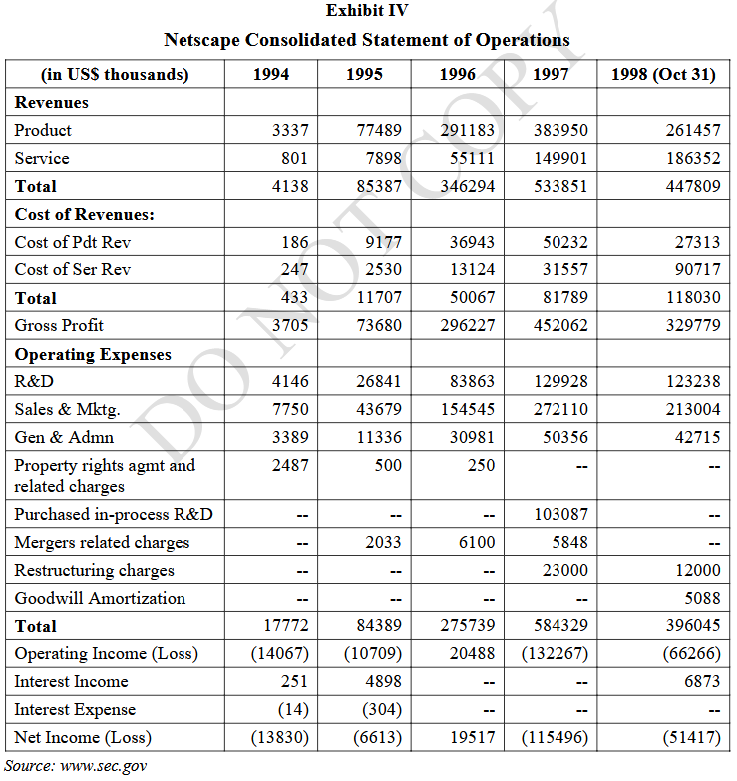
Would Netscape have survived on its own had AOL not bought it in 1998, when the company was reeling under huge losses? (See Exhibit IV). The ex-employees of Netscape did not care to answer that question. They only knew that their old company and its culture had gone forever. An analyst remarked, “Unfortunately, AOL is a good technology company that doesn't know what to do with good technology. It's sad what they did to Netscape.”
1. Analyze and describe the culture of Netscape and comment on its strengths and shared assumptions. How far do you think the culture contributed to Netscape's success as a leading Internet browser company?
2. Andreessen's exit from Netscape triggered a mass exodus of software engineering talent from the company. Did the cultural incompatibility of AOL and Netscape cause the mass exodus of key persons in a short itme? Were there any other reasons for this exodus?
3. What could AOL have done to retain Netscape employees? Did AOL miss an opportunity to make Netscape the technology arm of AOL?
Exhibit I
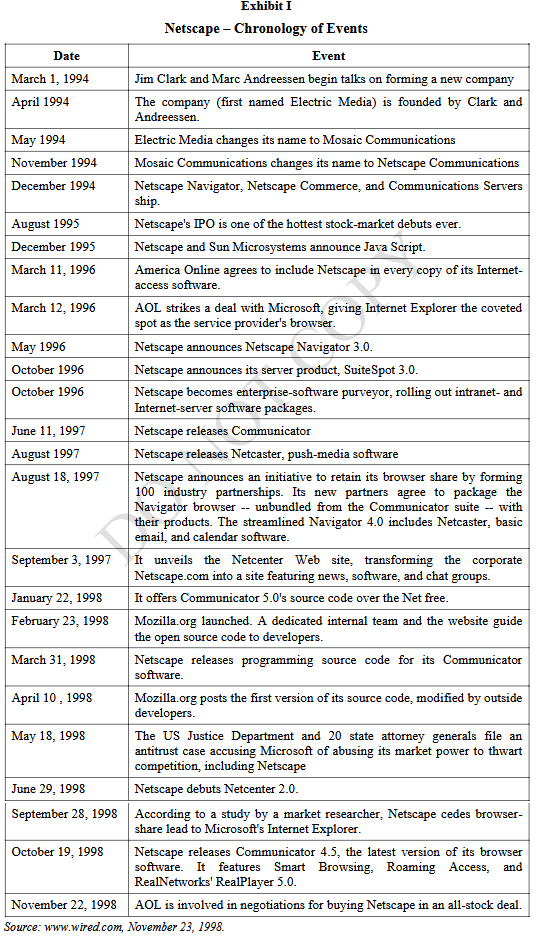
Exhibit II
Netscape Time
|
Netscape Time was Netscape's most enduring principle. It was about the speed, at which the employees worked and delivered new products. It concerned the mind-set of employees than the business model of the company. Netscape Time had six core principles: The first principle was 'fast enough never is.' Ever since its inception, Netscape maintained a lightening speed in whatever it did. Analysts felt that the company could move quickly because it knew what it wanted. It hired programmers from the best schools and from companies like Oracle, Silicon Graphics etc. The company wanted them to get used to Netscape's code-writing culture. 'The paranoid predator' was the second principle. Netscape knew that even a predator could become a prey. The company's management believed that their role was to instill urgency at all levels. They always portrayed Netscape as a startup which had to compete with industry giants like Microsoft and Oracle. The third principle was 'all work, all the time.' Netscape's employees seemed to be habituated to non-stop work. For example, to launch the company's first product, employees worked round-the-clock for eight months. Even at 1 am, there were employees to give ideas, talk code, or discuss a problem. Jim Sha, General Manager, worked for 11 hours a day at the office, went home for dinner and then came back to office and worked till late night. 'Just enough management' was the fourth principle. Netscape seemed to consciously undermanage. Neither Clark nor Andreessen played major roles in the management. Andreessen said, “If you over manage software, the result is paralysis.” Another principle of Netscape Time was doing things 'four times faster.' Netscape described Netscape Time as “turning out new product releases four times faster than the competition.” In less than nine months, Netscape launched three versions of its browser as well as servers. The last and most important aspect of Netscape Time was 'Web squared.' Netscape placed Web at the heart of its operations. Andreessen believed that “worse is better,” and released usable software quickly, without waiting for perfection. He believed in using the Web to access the source of perfection. The company did not use any retail outlets or resellers. Interested users could download an 'evaluation copy' from the Internet. A fully supported version of the software was later sent to interested users. This helped increase the company's interaction with the customers. Their feedback was utilized to design the next version. |
Source: www.fastcompany.com, Can You Work at Netscape Time? , November 1995.
Exhibit III
Benefits for Netscape Employees
|
Medical Benefits Dental Benefits Flexible Spending Accounts Vision Care Life Insurance Income Protection Disability Benefits Business Travel Accident Insurance Vacation Paid Holidays 401(k) Retirement Savings Plan Employee Stock Purchase Plan (ESPP) Tuition Assistance Program Hyatt Legal Employee Services Employee Assistance Program (EAP) Concierge Service Onsite Services ClubNet Child & Elder Care Referral Service Credit Unions and Banking |
Source: www.netscape.com
Exhibit IV
Keywords
Organizational culture, Netscape, Web browser, culture ,1998, America Online, Netscape Communications, post-merger culture, Netscape, Netscape employees