
Xerox - People Problems
🌐 International Buyers — Pay via PayPal
Details
HROB015
9
2002
YES
0
Xerox Corporation
Home Appliances & Consumer Products
US
Leadership & Values,Organizational Culture
Abstract
The case study discusses the problems faced by leading document management company, Xerox, as a result of a change in the leadership and work culture. The case explores in detail the problems that arose during the tenures of Paul Allaire as well as Rick Thoman. The case also mentions briefly the steps taken by the current CEO Anne Mulcahy to bring back the company to its erstwhile glory and restore employee confidence.
Learning Objectives
The case is structured to achieve the following Learning Objectives:
- Importance of treating HR as an integral part of the organizational setup.
Contents
“Over the years, they’ve hyped their HR organization, but it ain’t a pretty picture.”
- Jim W Lundy, former Xerox manager, in August 2001.
In August 2000, Paul Allaire (Allaire), chairman of the leading document management company Xerox, fired the company's CEO Rick Thoman (Thoman). Commenting on his decision, Allaire said, “We are grateful for Rick's contributions in leading the company through a period of major repositioning. However, both Rick and the board felt it best for the company to move forward with an experienced Xerox team that will lead Xerox people and efficiently execute the strategy.” The move attracted a lot of media attention with analysts commenting how Allaire had himself persuaded Thoman to leave a top position at IBM in 1998 and join Xerox.
Thoman, who was second only to IBM head Lou Gerstner, had also been the Senior Vice President and General Manager of IBM's Personal Systems Group, one of IBM's most troubled operating units, which he helped turn around. Prior to this, he had also been the President and CEO of Nabisco International, President and CEO of American Express International, and Chairman and co-CEO of American Express Travel Related Services Co.
However, company observers were not very surprised by Allaire's decision, as from the time Thoman had joined Xerox in May 2000, the company had lost around $ 20 billion in market value. Thoman was reportedly made to resign for his apparent failure to arrest this massive decline. Allaire made Anne M. Mulcahy (Mulcahy) the President and Chief Operating Officer and reinstated himself as the CEO, though he was past the company's mandatory retirement age for executives.
Though analysts agreed that Thoman had failed to a certain extent at Xerox, they also argued that he seemed to have been made a scapegoat. Allaire's return as the CEO sparked off a round of heated debates regarding Thoman being blamed for the company's troubles, while Allaire himself was being blamed for being party to the deterioration of Xerox's work culture over the decades.
The Xerox story goes back to 1938, when Chester Carlson, a patent attorney and part-time inventor, made the first xerographic image in the US. Carlson struggled for over five years to sell the invention, as many companies did not believe there was a market for it. Finally, in 1944, the Battelle Memorial Institute in Columbus, Ohio, contracted with Carlson to refine his new process, which Carlson called 'electrophotography.' Three years later, The Haloid Company, maker of photographic paper, approached Battelle and obtained a license to develop and market a copying machine based on Carlson's technology.
Haloid later obtained all rights to Carlson's invention and registered the 'Xerox' trademark in 1948. Buoyed by the success of the Xerox copiers, Haloid changed its name to Haloid Xerox Inc in 1958, and to The Xerox Corporation in 1961. Xerox was listed on the New York Stock Exchange in 1961 and on the Chicago Stock Exchange in 1990. It is also traded on the Boston Cincinnati, Pacific Coast, Philadelphia, London and Switzerland exchanges. The strong demand for Xerox's products led the company from strength to strength and revenues soared from $37 million in 1960 to $268 million in 1965.
Throughout the 1960s, Xerox grew by acquiring many companies including University Microfilms, Micro-Systems, Electro-Optical Systems, Basic Systems and Ginn and Company. In 1962, Fuji Xerox Co., Ltd. was launched as a joint venture of Xerox and Fuji Photo Film. Xerox acquired a majority stake (51.2%) in Rank Xerox in 1969. During the late 1960s and the early 1970s, Xerox diversified into information technology business by acquiring Scientific Data Systems (makers of time-sharing and scientific computers), Daconics (which made shared logic and word processing systems using minicomputers), and Vesetec (producers of electrostatic printers and plotters).
In 1969, it set up a corporate R&D facility, the Palo Alto Research Center (PARC), to develop in-house technologies. In the 1970s, Xerox focused on introducing new and more efficient models to retain its share of the reprographic market and meet competition from US and Japanese companies. While the company's revenues increased from $ 698 million in 1966 to $ 4.4 billion in 1976, profits increased five-fold from $ 83 million in 1966 to $ 407 million in 1977.
According to analysts, Xerox management failed in giving a strategic direction to the company as it ignored new entrants (Ricoh, Canon, and Sevin) who were consolidating their positions in the lower end market and in niche segments. The company's operating cost (and therefore, the prices of its products) was high, and its products were of relatively inferior quality compared to its competitors'. Return on assets soon reduced to less than 8% and marketshare in copiers came down sharply from 86% in 1974 to just 17% in 1984. Between 1980 and 1984, Xerox's profits decreased from $ 1.15 billion to $ 290 million.
In 1982, David T. Kearns (Kearns) took over as the CEO. He discovered that the average cost of Japanese machines was 40-50% of that of Xerox, which allowed them to undercut Xerox's prices effortlessly. Kearns quickly began emphasizing reduction of manufacturing costs and gave new thrust to the improvement of quality by launching a program that was popularly referred to as 'Leadership Through Quality.' In addition, he initiated major efforts to develop innovative new copiers and related products. He also worked towards reestablishing the entrepreneurial culture at Xerox. Management layers were cut, greater authority was delegated to lower levels and employees were allowed to participate in decision-making.
In the 1980s, Xerox bought Kurzweil, Datacopy and Ventura – companies that specialized in optical character recognition, scanning and fax machines and desktop publishing. It also diversified into financial services, insurance and investment banking. Allaire succeeded Kearns as the new CEO in 1990 and immediately embarked on a major restructuring program to sharpen Xerox's focus on document processing. In 1992, Xerox entered into various tie-ups with Dell Computer Corporation and Microsoft. In the same year, the company announced a worldwide restructuring program including a 10% reduction in the workforce. Over the next few years, the company expanded its global network further by setting up/strengthening facilities and research centers in various parts of the world.
In 1993, Xerox announced a companywide initiative to reduce costs drastically and improve productivity. The company indicated that it would reduce the worldwide workforce by more than 10,000 and close or consolidate a number of operations. This restructuring program achieved pre tax cost savings of approximately $ 350 million in 1994, $ 650 million in 1995 and $ 770 million in 1996. Xerox reinvested a major portion of these cost savings to streamline business processes and support expansion plans in growth markets. As a result, the company's gross margins improved from 40.7% in 1994 to 43.6% in 1995.
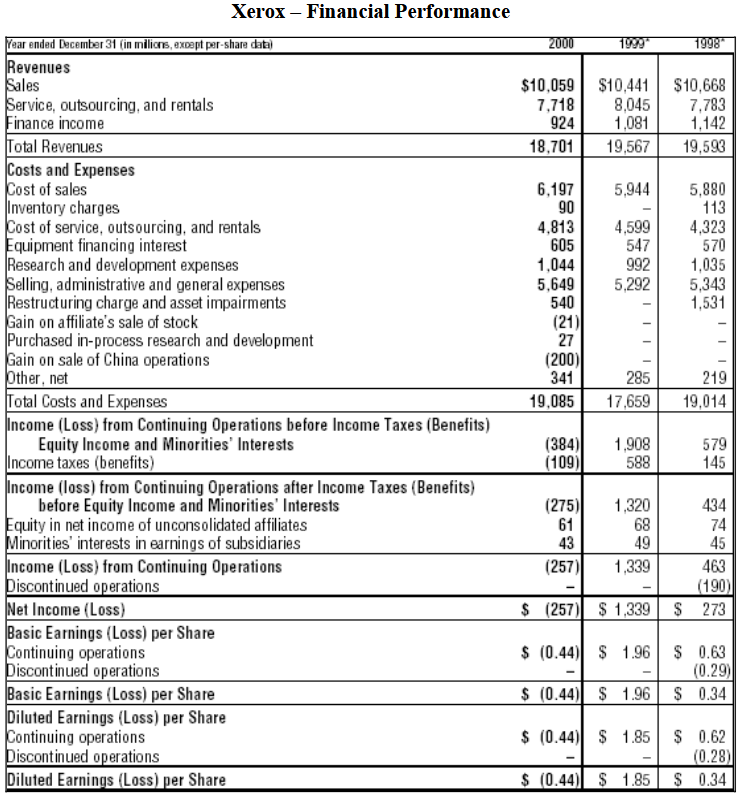
In 1998, Xerox announced another round of worldwide restructuring, including the elimination of 9,000 jobs through voluntary reduction, early retirement and layoffs and the closing and consolidation of various facilities. Xerox announced another worldwide restructuring program to cut costs, improve productivity and spur growth. The program included cutting costs by $ 1 billion, sale of $ 2-4 billion worth of assets and elimination of 5,200 positions worldwide. In the same year, Thoman replaced Allaire as the CEO though Allaire continued as chairman. Despite these restructuring efforts, poor market conditions resulted in the company reporting a loss of $ 257
million on revenues of $ 18.7 billion in 2000.
In the initial years, Xerox's work culture was reported to be the 'envy of the corporate world.' The company's chairman Joseph C. Wilson (Wilson) and his successor Kearns were lauded for forming a positive culture at the company that went on to play a major part in establishing the company's supremacy in the copier business. A former Xerox HR executive said, “Wilson brought in progressive HR people schooled in HR at outstanding institutions. They helped him build a very people-oriented tradition that became famous for its training, development and sales selection policies.”
The strong influence of the HR department on the company's affairs continued when Kearns took over from Wilson. Douglas Reid (Reid), who worked as the chief HR executive under Kearns said, “People came first. There was never any question as senior HR people that people would be treated with respect at all times. We had to make hard decisions, but always treated people fairly and generously. Compensation was designed to be fully competitive. We paid well, attracted quality people and rewarded people well.”
In the 1980, Xerox faced stiff competition from Canon and Ricoh in the low-end copier business. The company then decided to opt for a total quality movement and cut manufacturing costs. According to analysts, it was the company's strong work culture, which helped it fight back effectively as the employees participated whole-heartedly in these programs. However, things changed when Allaire replaced Kearns as the CEO in 1990. Reid, who had been an integral part of the company's HR function for almost three decades decided to leave the organization and was replaced by William F. Buehler (Buehler), who had hardly two years of HR experience. Employees saw Buehler's appointment an indication of the fact that HR's role in Xerox's corporate setup was on the decline.
Soon after, many HR executives who were part of Reid's team left the company. According to analysts, they did not want to work under Buehler, who lacked a sufficient HR background. One employee said, “An aura of fear has descended on the HR operations, making it difficult for HR to come forward. Earlier in my career, you would lay your body down on the tracks for certain principles. Today it's not being done for anything big. HR has shifted away from being the ombudsman and voice for the employees to being the implementer of management's policies. The culture that flourished under Reid until 1990 – the culture that fostered employee involvement – is disappearing. When I talk to colleagues still there in influential positions, there's a sense of disenfranchisement.”
The restructuring moves notwithstanding, the changed work culture at Xerox seemed to have hurt those who mattered the most – the employees. An ex-HR executive at Xerox Ken Larson said about the people at Xerox, “They thought they would be there a lifetime; now they have seen their value shrink. They are angry; they feel abandoned. There's a great sense of dissatisfaction with the top leadership. That's pushing the good people out.”
The departures were also due to the way employees were being promoted at Xerox after Kearns and Reid left. While the company's policy framework was very clear regarding employee promotion norms, it was reportedly not practised. Favoritism had become an order of the day –people were promoted on the basis of their relation with the top management. An ex-Xerox executive remarked, “We would gather background and assessment information on all senior managers and sit down with the president and review their potential. The good thing was there was a lot of knowledge shared about the strengths of the executives. But the way people really got promoted was by politicizing with each other. There was always an in-crowd and out-crowd.”
Many analysts said that Allaire had decided to treat the HR head position as a 'building ground' for preparing promising executives to handle higher positions in the company. This was proved when Buehler was promoted within two years of joining the HR department. Within a short span of time, Xerox began losing its top executives and was reportedly finding it tough to attract new employees as well. Critics of the company's policies said that while in the earlier years, Xerox used to get the best candidates and pay handsome salaries, it was now employing people for short term and paid only the industry averages.
It was at this point of time that Thoman took control of the company. After joining Xerox, Thoman found severe lapses in the HR control systems of the company. For instance, there were no measures in place to measure per employee income. In addition, there were a host of problems on the financial management front. Thoman said that he was surprised to realize that the Xerox culture had become all about patronizing the salesforce instead of focusing on enhancing customer service.
Based on his findings, Thoman decided to set things right at Xerox by focusing more strongly on digital equipment rather than the analog ones and by reorganizing the salesforce to sell digital solutions instead of copying machines in the existing setup. For the first time in Xerox's history, sales personnel had to focus on industry based targets (such as the automobile industry customers) instead of individual clients. This also meant that their commissions reduced significantly. Much to Thoman's chagrin, the reorganization plan met with severe criticism despite the fact that it had been endorsed by a committee of senior executives. Not only were there hassles in the implementation, Thoman found out that certain instructions he had given regarding the plan had not been followed at all. As sales representatives began losing their accounts, they left Xerox and sales staff attrition increased by almost 100%. According to analysts, the company failed in training the sales representatives to make the transition from selling photocopiers to offering long-term solutions.
However, there was more bad news in store. Thoman revealed his decision to carry out large-scale layoffs in two installments of 12,000 and 4,500 respectively. The decision was received with unprecedented opposition from various parties concerned. Soon after this, Thoman had to leave Xerox.
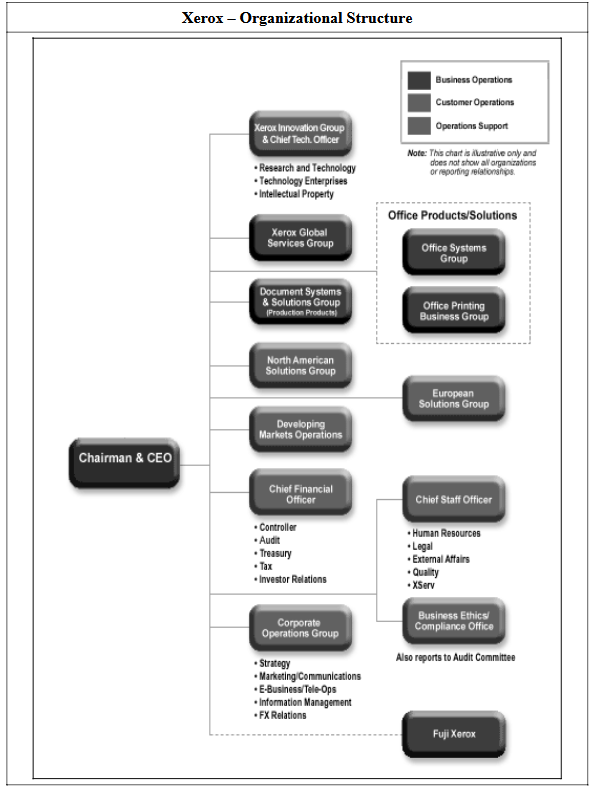
Media reports claimed that Thoman's ouster had a lot to do with the fact that Allaire had just not been able to „let go' of the company's control. This was surprising considering the fact that Allaire had invited Thoman to join Xerox, instead of promoting a CEO from within, mainly because he wanted to infuse fresh thoughts into the company. Allaire joined the board after Thoman, which was a typical boardroom move followed in many companies. However, what seemed to have worked to everyone's disadvantage was Allaire's constant interference in Xerox's affairs. For instance, when Thoman wanted to make some changes in the top management, Allaire did not allow him to do so. There were reports that Allaire's „in circle' comprising Mulchay, Buelher and others even threatened to resign if Thoman continued in the company.
Though critics of Thoman's leadership style remarked that he had failed to take into confidence the employees of Xerox for his plans, the debate as to how much he was responsible for the issue continued. Meanwhile, the Mulcahy-Allaire team began working towards putting the company back on tracks. Mulcahy claimed that her two-decade long association with Xerox would give her substantial mileage over Thoman.
Mulcahy's first concern was to put in place „retention programs' to arrest the abnormally high salesforce attrition rate. This included increasing their pay and other incentives. Soon, the attrition dropped back to normal levels. The company also decided to offer training and education via e-learning to the personnel. Mulcahy and Allaire got in touch personally with thousands of employees to restore their confidence in the company.
However, Xerox continued to face a fall in its profitability, which indicated that the company would have to keep the options of downsizing, consolidating and cost cutting open. The company reported a loss of $ 384 million for the year 2000. By January 2001, its stock had dropped 72% over the previous year. The company was reported to be on the brink of bankruptcy; however a $ 345 million timely credit from GE Capital helped avoid this. Interestingly enough, brushing off any doubts about the company's future, Mulcahy said, “Paul and I make a great team. We have confidence in each other and support of the board. I have a leadership team that's signed up, is loyal and is participating in the turnaround.”
For the fiscal year December 2001, total revenues fell 12% to $ 16.5 billion and net loss rose by 18% to $ 342 million. Company sources attributed this to the global economic meltdown and a higher effective income tax rate. Mulcahy and Allaire indeed seemed to have a tough battle on their hands. According to industry observers, it was all the more important for the duo to pull Xerox out of the various problems it was facing – for this time around, they did not even have Thoman to blame.
1. Analyze the changes brought about by Allaire after he took charge at Xerox. Do you agree that he was responsible for diluting the standing of the HR department in Xerox's corporate setup? Give reasons to support your answer.
2. According to some analysts, 'Thoman had to pay the price for trying too many things too fast.'Critically analyze this allegation against Thoman and comment on the circumstances that led to his ouster from Xerox.
3. 'The future prospects of Xerox did not seem to be very promising in the backdrop of its declining financial performance and the allegations of 'political boardroom scheming' against Anne Mulcahy and Paul Allaire.' Do you agree? How do you think Xerox should work towards recreating its work culture which was reported to be the 'envy of the corporate world?'
Exhibit I
Source: www.xerox.com
* Financial Statements for 1999 and 1999 were restated as a result of two separate investigations conducted by the Audit Committee of the Board of Directors. These investigations involved previously disclosed issues in our Mexico operations and a review of our accounting policies and procedures and application thereof. As a result of these investigations, it was determined that certain accounting practices and the application thereof misapplied GAAP and certain accounting errors and irregularities were identified. The Company corrected these accounting errors and irregularities in its Consolidated Financial Statements.
Exhibit II
Source: www.xerox.com
Keywords
Leading, document management, company, Xerox, leadership, work culture, problems, tenures, Paul Allaire, Rick Thoman, steps, CEO, Anne Mulcahy, glory, restore, employee confidence
Related Case Studies
| Case Title | Details | Price | Add to Cart |
|---|---|---|---|
|
Case Title Dharma Over Entitlement: Rama’s Ethics of LeadershipCase Code: LDEN240 |
Details | 400 | Add to Cart |
|
Case Title Can Kelly Ortberg help Boeing Navigate through its Troubles?Case Code: HROB292 |
Details | 500 | Add to Cart |
|
Case Title Persuasion under Pressure: Duryodhana`s Negotiation with King ShalyaCase Code: LDEN227 |
Details | 300 | Add to Cart |
|
Case Title Rolls-Royce: The Turnaround ChallengeCase Code: BSTR505 |
Details | 500 | Add to Cart |
|
Case Title Battling Perceptions: The Next Challenge in Huawei’s Globalization AgendaCase Code: BSTR498 |
Details | 700 | Add to Cart |