
The Story of Benetton’s Advertisement Campaigns
🌐 International Buyers — Pay via PayPal
Details
MKTG019
7
2002
YES
300
United Colors of Benetton
Textiles & Apparel
Italy
Advertising & Promotion
Abstract
The case examines the problems that the apparel manufacturer Benetton had to face as a result of its controversial advertisements. The case also provides information about the company’s recognition of these problems and the corrective measures it took. The case is so structured as to enable students to see the importance of ethics in advertising. Though Benetton intended to address social issues through its advertisements, its handling of the campaigns resulted in many problems. After reading this case, students should be able to discuss the merits and demerits of using controversial advertisements. The case is aimed at MBA/PGDBA students, and is intended to be a part of the Marketing or Business Ethics elective curriculum.
Learning Objectives
The case is structured to achieve the following Learning Objectives:
- Controversial advertisements of Benetton, ethics in advertising.
Contents
"Benetton is used to unfavorable publicity.”
- An article in The New Statesman, January 24, 2000.
In January 2000, the United Colors of Benetton (Benetton), Europe's largest clothing manufacturer, released its 'death-row' advertisement campaign featuring prisoners who had been sentenced to death. The campaign appeared on billboards and in major news publications in Europe, America and Asia. Benetton had worked for two years on the campaign, for which a special booklet and video were also released. Benetton claimed that leaving aside any social, political, judicial or moral consideration, the campaign aimed at showing the public the reality and futility of capital punishment.
The campaign resulted in widespread protests against the company from the customers as well as a number of governments. The families of the victims (whom the death row inmates were convicted of having killed) objected strongly to the campaign. The state of Missouri in the US decided to sue Benetton, claiming that the company had deceived the state by using the death row inmates as part of an advertising campaign. (Benetton was reported to have falsely told the state that the inmates were being interviewed for a project sponsored by the National Association of Criminal Defense Lawyers.) In an out of court settlement, Benetton had to write apology letters to the families of the victims. Benetton was also ordered to pay $ 50,000 to the Missouri Crime Victims Fund.
Benetton expected the protests against this campaign to die down, as they had for its earlier campaigns. However, public opposition in the US intensified further. The biggest setback for Benetton came in the form of the cancellation of its deal with the US retailing major Sears, Roebuck & Co. to open Benetton outlets in Sears stores across the US.
Benetton was counting heavily on the deal, signed in late 1999, to improve its miserable performance in the US markets during the 1990s. (In the early 1980s, Benetton had over 700 stores in US, the number had declined to 200 by 1999.) After the release of the 'death row' campaign, Sears stores across the US were picketed and numerous letters of protest were written by the families of the victims. Alarmed by the protests over its association with Benetton, Sears opted out of the deal in February 2000.
Sears was not the only store alarmed by the public's reaction to Benetton's advertisement campaign. Analysts commented that most of 500 stores in US were closed because of the storeowners' personal conflicts with the company's campaigns. Meanwhile, reports appearing in CNN, Wall Street Journal, and Advertising Age, revealed that the campaign was not liked by a majority of the US consumers.
Benetton, however, stood by its campaign. The company's US director of communications said, “Once again, it's very hard for people to see what we're doing and understand that it's not advertising, that it's a way to get people to think.”
The Benetton story began in 1955, when the Benetton family, led by Luciano Benetton (Luciano) started a small fashion company in Italy. The business expanded significantly in the 1960s and the Benettons constructed a factory in Ponzano Veneto, Italy. In 1964, Luciano entered into a deal to open a store for the exclusive marketing of the Benetton range of apparel, a concept hitherto untried in Italy. The first store was opened in Belluno in 1969 and was an immediate success. The same year, the company began its overseas business by establishing a store in Paris, France.
During the 1970s, the Benetton empire spread across the globe and established a strong brand equity. The company was made a public limited company in 1978. In June 1986, Benetton published its first annual report and secured a stock listing on the Milan Stock Exchange. Soon, the stock was listed on five other exchanges world wide, including London, Frankfurt, New York, Toronto, and Tokyo. In June 1989, Benetton made a public offering of American Depositary Shares (ADS), listed on the New York Stock Exchange. By 1995, Benettons were reported to be the wealthiest family in Italy.
The company had three production facilities in the industrial complex near Treviso, Italy, on a 190,000 square meter area. The complex was reported to be one of the most modern and advanced in the world, with a capacity to manufacture around 100 million garments every year. One facility, in operation since September 1993, manufactured outerwear, skirts and jeans, and the other two, in operation since July 1995, manufactured cotton jackets and shirts. Benetton's wool facility in Castrette, Italy was operative since 1986. The company also had an automated distribution center in Castrette (built in 1982), for handling warehousing, invoicing, payment and dispatch operations.
By 2001, Benetton had a presence in 120 countries around the world. The company, selling apparel for women, men and children and sportswear and sports equipment through 7,000 retail stores, was even referred to as the 'McDonald's of the fashion industry.' Benetton directly managed some of the retail outlets, but a majority was run on a franchise basis. Besides the flagship United Colors of Benetton brand, Benetton's other brands comprised Sisley, Playlife, Nordica, Prince, Rollerblade and Killer Loop. Over the years, Benetton had diversified its product line by licensing the manufacture of sunglasses, stationery, cosmetics, linens, lingerie, watches, toys, steering wheels and knobs for automobile gearshifts, golf equipment, designer condoms, luggage and designer pagers. Besides being Europe's largest clothing manufacturer, Benetton was also the world's largest consumer of wool in the garment industry. Table I provides a summary of the company's financial performance.
Table I
Benetton’s Financial Performance
(in million Liras)
| Year | Revenue | Net Profits |
| 1994 | 2,787,672 | 210,220 |
| 1995 | 2,939,134 | 220,255 |
| 1996 | 2,871,108 | 245,642 |
| 1997 | 3,636,800 | 290,100 |
| 1998 | 3,833,900 | 293,200 |
| 1999 | 3,838,000 | 322,000 |
| 2000 | 3,908,000 | 471,000 |
Source: www.benetton.com
Benetton has been credited with pioneering a new era of advertising by removing its product from its advertisements, and focusing only on colors and the selection and placement of items on the copy' Analysts remarked that Benetton deliberately manipulated its advertisements over the years to gain publicity and thus stimulate interest in its products'
Till the 1980s, Benetton advertisements focused on the products, with the logo - a stylized knot of yarn with the word 'Benetton' printed under it - contained within a dark green rectangle' In 1982, Oliverio Toscani (Toscani), a prominent fashion and advertising photographer, joined the Benetton group' On Toscani's recommendation, Luciano handed over Benetton's advertising account to Eldorado - a small advertising agency in Paris' The initial advertisements were conventional in style, showing groups of young people wearing Benetton clothing' Toscani soon convinced Luciano that Benetton's campaigns should promote Benetton as a 'lifestyle accessory,' rather than a clothing brand'
In 1984, the 'All the Colors in the World' campaign was launched, showing groups of teenagers from many countries and ethnic groups dressed in Benetton clothing, with the company logo in the corner' In 1985, Toscani created the immensely popular 'United Colors of Benetton' theme, aimed at presenting the message of racial unity' By now, Toscani's 'rebel' streak had become rather evident, and complaints had been made against the use of the United States flag in one of the advertisements'
In 1989, Benetton terminated the contract with Eldorado, and began managing its advertisements internally' This change was accompanied by a significant change in advertising philosophy as well' The new campaigns neither showed the product, nor used any slogan' The Benetton knot logo was replaced with the small green rectangle' By 1991, Toscani's photographs were reported to have completely shifted from being slightly disturbing to socially and politically incorrect' The company's campaigns appeared only on billboards, at art-shows and in select print media' Since Benetton wanted its advertisements to appear 'exclusive and art-oriented,' it did not use electronic media like radio and television'
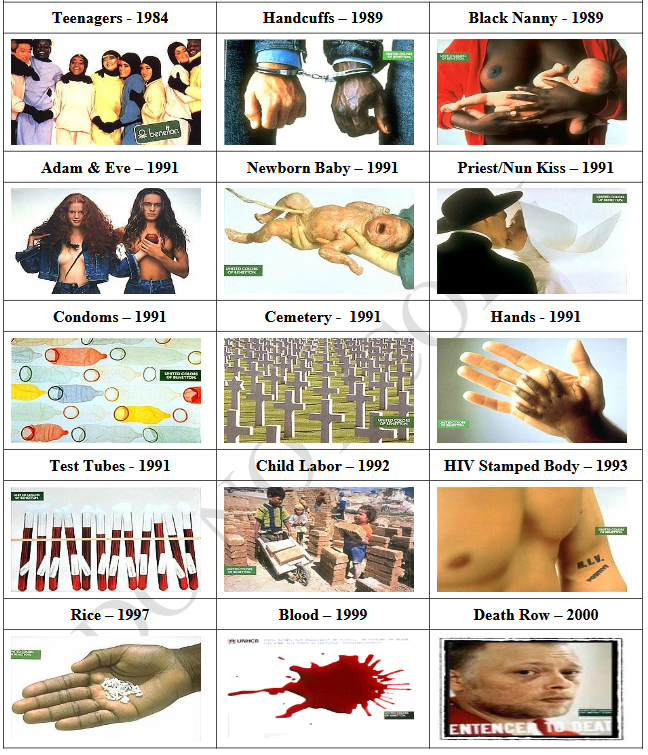
Throughout the early 1990s, Benetton's advertisements – featuring a war cemetery, many different brightly colored condoms, a baby with the umbilical cord, a priest and a nun kissing – invited severe criticism' Though Benetton covered sensitive issues such as child labor, the death penalty, poverty, the abuse of nature, violence, intimidation, AIDS and peace between the Arabs and Israelis, their portrayal was almost always a subject of controversy' (Refer Table II)'
During the late 1990s, Benetton seemed to have become even bolder, increasingly featuring nudity in its advertisements' Even Luciano posed naked for a campaign' In 1998, Luciano said, “It's our prerogative to photograph a new collection in unusual places: we're more interested in discovering people than in selling them dreams' So here is the search for real people and real stories, here is the discovery of beauty without stereotypes; here is diversity highlighted by uniqueness'” However, there were few buyers for this explanation'
Over the years, many newspapers in countries around the world refused to print Benetton's advertisements' The company was accused by some of making money out of the blood of war victims' Reacting to this, Toscani said, “Provocation is a good word' It takes somebody and (makes them) see something from another perspective'”
In 1995, government authorities in Germany banned Benetton advertisements featuring child laborers, the human body stamped 'HIV-positive,' and a waterfowl stuck in an oil slick' A German appeals court claimed that these advertisements were unacceptable as they exploited suffering' The newborn baby advertisement had to be withdrawn after a public outcry in Italy, France, and the U'K'
However, Benetton seemed to have had the last laugh in many of these cases, as it was able to project itself as a 'martyr to censorship'' Though many experts agreed that Benetton's advertisements used 'exploitation' solely for financial profit, such bans just created more notoriety for the company'
Table II
Some of Benetton’s Controversial Advertisements
| The Advertisements… | …And the Criticism |
| A line up of lots of test tubes' | Was seen as Benetton's support for the controversial subject of cloning' |
| A nun and a priest kissing' | Offended religious sentiments' |
| A semi-naked couple based on the 'Adam & Eve' theme' |
Offended religious sentiments by mocking a biblical event' |
|
A black man's hand handcuffed to a white man's hand' A black and a white baby sitting opposite to each other' A black woman nursing a white baby' |
– Uncalled trivialization of the racial tensions around the world' – The ad was displayed on the world's largest billboard opposite the Milan city (Italy) cathedral, inviting severe criticism' – Attempting to remind the US/UK black people of the era of slavery when black women used to feed white babies; Rejected by many US magazines' The ad did not appear in the US and UK, but was used it in 77 other countries' |
| Prisoners sentenced to death, war cemeteries, clothes from a dead Croatian soldier' |
Resorting to unnecessary sensationalism |
| A newborn baby still covered in blood and with the umbilical cord attached | The innocent birth of a baby being exploited' |
| AIDS victims with HIV positive stamped on their bodies' | Resorting to unnecessary sensationalism and ignoring the seriousness of the AIDS problem' |
| Featured very young models in a provocative manner' | Exploitation of children' |
Source: IBS Center for Management Research
All along, Benetton maintained that these advertisements were designed to prompt debate on serious social issues and draw the public's attention to the victims of these issues' “Bitterly attacked by some and internationally acclaimed by others, Benetton's campaigns have managed to tear down the wall of indifference, contributing at raising the awareness of universal problems among world's citizens' At the same time, they have paved the way for innovative modes of corporate communication,” Benetton sources said'
The notoriety that Benetton's campaigns attracted ensured that the company was in the news all over the world' Thousands of articles were written on the company's campaigns' This 'free- publicity' helped the company's brand become globally popular'
While for some people Benetton's advertisements seemed offensive and tasteless, to others they were a crusading effort to promote social values' Benetton worked hard to promote itself as a socially responsible business by supporting social organizations and discussing moral issues in its print campaigns throughout the world' The fact that Toscani's photographs won awards and were displayed in art galleries around the world strengthened the company's claim regarding the artistic value of its campaigns' In this context, it was difficult to label the 'death-row' campaign as 'offensive'' According to the company, the advertisement was intended to highlight the 'human aspects' of the murderers and express its opposition to capital punishment'.
The bitter experience of the 'death-row' campaign seemed to have made Benetton realize the damage its advertising strategy was causing. The fact that many people had decided not to shop at Benetton as a result of its campaigns could no longer be denied.
Benetton sources admitted that the main problem with the company's current and past advertising campaigns was the repeated use of controversial subjects. The sources also admitted that the advertisements were not targeted towards the actual customers of Benetton. The presence of controversial issues, combined with the lack of a television campaign and appropriate, informative subject matter, were identified as weaknesses that had to be eliminated in order to reach the target clientele more effectively.
A Benetton official commented, “Our world is a very diverse place, one where people have many different opinions. Consumers from all different parts of the world see our advertisements. By stating our opinions on controversial issues, we are setting ourselves up for destruction.” The company decided that in order to make the advertising campaigns more effective, they should be made more informative and should reach a larger audience. The company thus began considering the use of magazines and television.
A document posted on the Benetton website revealed that the company also felt that the advertisement campaign needed to be changed. The document stated, “We need to have models wearing clothes by UCB in our advertisements. We need to show consumers that we are an actual clothing line, and not a political or governmental company. By picturing our stylish clothes, we will attract more business. Consumers want to buy our clothes because they are attractive and have a high quality reputation. People who respect our clothing line are the only ones that actually buy it, despite the political issues that we represent. If we can undo the damage that we have already caused in the minds of many consumers by ceasing to offend them, our sales will greatly increase. Let's show the world that we make great clothing, not that we have controversial opinions on various subjects.”
Though Benetton had always been a supporter of a variety of causes, such as the fight against racial discrimination, whale hunting, ozone layer depletion, land mines, and North Korean girls being sold into marriage etc., it stepped up its involvement in these non-controversial social issues. Benetton took special efforts to project itself as a responsible company by sponsoring sport events and focusing on racial integration (through its magazine 'Colors'). Benetton also organized AIDS benefits and educational programs around the world. With this newfound focus on moral and ethical self-policing, Benetton seemed to be working hard towards non-controversial advertising.
1. Critically comment on the controversies associated with Benetton's campaigns, with special reference to the 'death-row' campaign. Do you think it was a wise move on the company's part to eliminate the product from their advertisements?
2. Do you think Benetton's advertising strategy was aimed only at creating scandals and controversies? Can this strategy be justified by the fact that it resulted in free publicity for the company? Support your answer with reasons.
Exhibit I
| Benetton’s Advertisements over the Years |
 |
Keywords
Apparel manufacturer, Benetton, controversial advertisements, company, recognition, corrective measures, ethics, advertising, campaigns, merits, demerits, controversial advertisements