
Maggi - Nestlé ’s Problem Child
🌐 International Buyers — Pay via PayPal
Details
MKTG021
10
2002
YES
300
Nestlé S.A.
Food & Beverage
Switzerland; India
Brand Strategy ,Advertising & Promotion, Marketing Strategy
Abstract
The case examines the brand and line extension strategies adopted by FMCG major Nestlé for its Maggi brand in India. It provides a detailed account of Nestlé’s promotion and advertising strategies for creating a noodles market from scratch. The various products and variants launched under the umbrella brand Maggi, and the rationale behind these launches (and their failure) is explored in detail. The case also discusses the company’s attempt to change the formulation of its flagship brand Maggi noodles and how it was forced to bring back the old formulation.
Learning Objectives
The case is structured to achieve the following Learning Objectives:
- Scope and limitations of adopting an umbrella brand.
Contents
“The Maggi brand revolutionized „fast food? made-at-home.”
- A Financial Express News report, in March 1999.
In late 1997, global FMCG major Nestlé SA's Indian subsidiary Nestlé India (Nestlé) launched a 'new, improved,' formulation of its noodles brand, Maggi (a snack food cooked in water along with a flavoring agent called the 'tastemaker.') This change was the first since the brand's launch in India in the 1980s. The new formulation had thinner noodles and a different flavor. The company reportedly wanted to infuse fresh life into the brand to deal with stagnating sales.
Nestlé was in for a major shock. Maggi lovers all over the country rejected the new formulation. Sales started declining alarmingly and even maintaining the previous year's sales level of 13,000 tonnes seemed very difficult. Around the same time, Maggi Macaroni, launched in mid-1997 with a Rs 10 million1 ad spend, was also faring badly. Against a target of 1000 tonnes, it managed to sell only 300 tonnes for the year 1997. Reportedly, many shops had stopped carrying the product. To add to the company's woes, Maggi lost its leadership status in the soup segment to a new entrant, Knorr, in the same year. Knorr cornered a 55% market share of the 425 tonne soup market – around 75% of which came by eating into the customer base of Maggi soups. Competition had intensified in the ketchup segment as well. Unilever subsidiary Hindustan Lever Ltd's (HLL) Kissan brand had almost reached Maggi's market share figures. Other products under the Maggi umbrella – instant food mixes, seasoning cubes, and pickles – were also faring poorly with limited sales scattered in different regions of the country (Refer Exhibit I for products available under the Maggi brand).
Even after more than 15 years of heavy advertising, promotion, and brand building, the Maggi brand remained a loss-making proposition for the company. Though Nestlé had successfully created an entire product segment afresh with Maggi noodles in India, analysts commented that the company had made some serious blunders somewhere down the line. Questions were raised about Nestlé's marketing acumen and whether its brand/line extension decisions had stretched Maggi 'too thin.'
Established in 1866, the Switzerland based Nestlé S A was a wholly owned subsidiary of Nestlé Holdings Ltd., Nassau, and Bahama Islands. The Group produced, among other things, beverages, milk products, processed foods, cooking aids, bakery products, chocolates, confectioneries, and pharmaceutical products. Nestlé Holdings had a presence in 83 countries worldwide with 509 factories spread across Europe, America, Africa, Asia, and Oceania. Nestlé S A was the world leader in many product categories like coffee, mineral water, snack foods, beverages, and chocolates. In 2001, the company earned revenues of $ 50.2 billion and a net profit of $ 3.9 billion,
and was ranked 55 in the 2002 Fortune 500 list. With a workforce of around 229,765 people, Nestlé had established itself as one of the world's most successful FMCG companies.
The Group entered India in 1959 through Nestlé India, a wholly-owned subsidiary of Nestlé Holding Ltd. Initially, it imported and sold condensed milk and infant food. Manufacturing operations began in 1962 when a factory was set up in Moga, Punjab to produce Nestlé's condensed milk brand, Milkmaid. In 1964, the company started manufacturing the Group's flagship coffee brand, Nescafe, at the same factory. The company set up another factory at Cherambadi in Tamil Nadu, for manufacturing infant food and coffee. Nestlé set up four more factories – at Nanjangad (Karnataka) in 1989, at Samlakha (Haryana) in 1992, at Ponda (Goa) in 1995, and at Bicholim (Goa) in 1997.
Nestlé's products fell into four broad categories: milk products, beverages, prepared dishes and cooking aids (added while cooking certain dishes), and chocolates and confectionery. Its products soon became an integral part of the lives of Indian packaged food consumers and enjoyed a strong brand equity. The product portfolio comprised some of the world's best-known brands. Many of these were market leaders in their respective categories: condensed milk (around 100%), baby food (87%), coffee (60%), and ketchup (43%). (Refer Table I).
Table I
Nestlé – Product Profile*
| Category (% Contribution to Revenue in 2001) |
Brands |
| Milk Products (43) | Everyday Dairy Whitener, TeaMate, Milkmaid, Mithai Magic, Mikmaid Dessert Mixes, Ceralac, Nestum, Lactogen, Nestogen, Dairy Mate. |
| Beverages (29) | Milo, Nesquik, Nescafe Classic, Nescafe Sunrise, Nescafe Gold, Nescafe Gold Decaf, Nestea, Nescafe Frappe, Choc Cafe. |
| Prepared Dishes & Cooking Aids (14) | The Maggi range. |
| Chocolates & Confectionery (14) | KitKat, Bar One, Charge, Crunch, Munch, Polo Mint and its variants, Choco Stick, Eclairs, Polo- Holes, Nestlé Rich Dark, Marbles, Soothers, Frootos, Allens, MaxiMunch. |
Source: IBS Center for Management Research
* The list does not include dairy products (milk, butter, clarified butter, curd) and mineral water (Pure
Life, San Pellegrino, Perrier) launched in 2000-01.
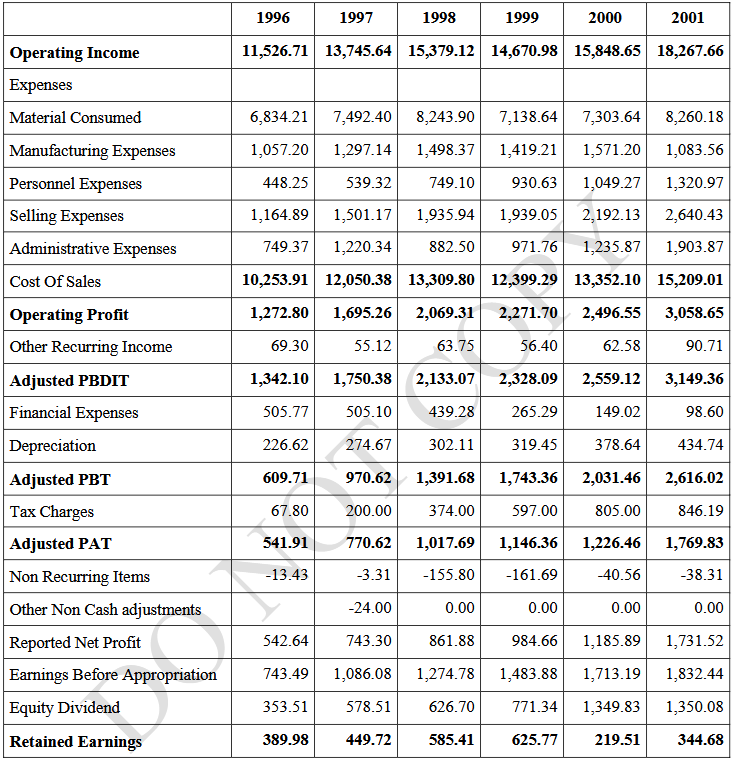
By 2001, with an operating income of Rs 18 billion and a net profit of Rs 1.7 billion, Nestlé had emerged as India's third largest food company after HLL and Amul (Refer Exhibit II for a summary of the company's financial performance). According to industry observers, the company's success over the years was largely due to its strong brands and brand-building initiatives. In 2000-01, with an advertisement expenditure of Rs 1.28 billion, Nestlé had the sixth largest ad spend in the country. The immensely popular Maggi range of products (especially Maggi noodles) was often cited by analysts as an example of Nestlé's focused marketing efforts. Maggi came in Nestlé S A's fold in 1947, when the company merged with Alimentana, a Swiss company that produced and sold Maggi brand soups, spices and other food products in many countries. Over the next few decades, the Maggi snack food brand became very popular in various markets across the world. In the late 1970s, Nestlé's Indian subsidiary, impressed by Maggi's huge success in Southeast Asia, decided to bring the brand to India. The first product,2 Maggi noodles, was launched soon after in 1982.
Launched in five flavors initially – Masala, Chicken, Capsicum, Sweet & Sour, and Lasagna –Maggi had to fight hard to be accepted by Indian consumers with their hard-to-change eating habits. The packaged foods market was very small at this point in time (Refer Exhibit III for a brief note on the Indian packaged foods market). Nestlé had to promote noodles as a concept, before it could promote Maggi as a brand. It therefore devised a two-pronged strategy to attract mothers on the 'convenience' plank and lure kids on the 'fun' plank. Gradually, the market for instant noodles began to grow. The company also decided to focus on promotions to increase the
brand's awareness. In the initial years, Nestlé's promotional activities for Maggi included schemes offering gifts (such as toys and utensils) in return for empty noodle packs.
According to analysts, the focus on promotions turned out to be the single largest factor responsible for Maggi's rapid acceptance. Nestlé managers utilized promotions as measures to meet their sales targets. Gradually, sales promotions became a crutch for Maggi noodle's sales. Later, many of Maggi's extensions also made considerable use of promotional schemes. A Nestlé source even commented, “The focus for all Maggi extensions is more on below-the-line activities rather than direct communication.” In addition to promotional activities, Maggi associated itself with mainstream television programs and advertised heavily on kid's programs and channels. Its advertisements with taglines like 'Mummy bhookh lagi hai' (Mom, I'm hungry), ' Bas 2- Minute,' (Only 2 minutes) and 'Fast to cook-Good to eat,' became part of Indian advertising folklore. Maggi's popularity was also attributed to its 'extremely high appeal' to children. The brand successfully used the kids' 'pester power' to get mothers to buy Maggi. Soon, mothers got used to the convenience offered by Maggi and children got used to its taste. Interestingly, Maggi gradually began to be consumed by people across age segments, even though it was always positioned as a kids' product. As a result, Maggi's annual growth reportedly touched 15% during its initial years.
In 1988, Nestlé launched Maggi's first brand extension, Maggi soups. At this stage, there was no organized packaged soup market in India. Nestlé planned to create a market for packaged soups as it felt the category had a lot of potential. However, according to analysts, the company had introduced soups only to cash in on the Maggi brand name, and was never very serious about the segment. Maggi soups met with limited success – with sales averaging 100 tonnes by 1992. In 1993, 'Sweet Maggi,' the first variant of Maggi noodles was launched. The company supported the launch with a huge advertising outlay that amounted to 75% of the total yearly expenditure on the Maggi brand. However, as the product was launched without any research, it failed to generate the desired sales volume and Nestlé was forced to withdraw it. At the end of the year, Maggi noodles was generating sales volumes of around 5000 tonnes and remained a loss-making proposition for Nestlé.
To boost sales, Nestlé decided to reduce the price of Maggi noodles. This was made possible by using thinner and cheaper packaging material. By January 1994, Nestlé brought down the price of a 100-gm pack of noodles to Rs 5 from Rs 7. The company also introduced 'moneysaver multipacks' in the form of two-in-one and four-in-one packs. As a result of these initiatives, volumes increased phenomenally to 9,700 tonnes in 1994 and further to 13,000 tonnes in 1995. Nestlé's euphoria was, however, short-lived, as sales stagnated in 1995 at the previous year's level. The soups business, meanwhile, was being threatened by a new entrant, Knorr soups. Launched in 1995 (the brand was launched nationally in 1996), Knorr offered 10 flavors against Maggi's four. Knorr not only launched 'local flavors' such as curried vegetable, it also advertised the fact that it was 100% vegetarian. Backed by a huge advertising budget and cashing in on Nestlé's rather dull focus on the soup business, Knorr was able to snatch Maggi's market share very soon. With HLL's Kissan also entering the fray, Nestlé began rethinking its strategies for the soup market.
Nestlé made plans to stretch the Maggi brand to include Indian ethnic foods to complement its existing range of offerings. It tied up with the Pune-based (Maharashtra) Chordia Foods to launch pickles under the Maggi brand in mid-1995. The company also tied up with Indian Food Fermentations (IFF), a Chennai based food company, to market popular south Indian food preparations such as sambhar, dosa and vada batter, and spices in consumer packs in December 1995. Nestlé agreed to source up to 2000 tonnes of products from IFF. The company reportedly saw a lot of untapped potential in the market for 'ready-to-use' south Indian food (which normally took a lot of time to prepare).
In 1996, products from these two ventures received lukewarm response from the market; sales were rather poor in the regions in which they were launched. Analysts attributed the failure of these Maggi extensions to the fact that Nestlé seemed to be particularly bad at dealing with traditional Indian product categories. However, according to an official at the Indian FMCG/pharmaceutical major Dabur, “No one is really making money in pickles. Not only is the unorganized and made-at-home sector too well entrenched, even the consumer shows no brand loyalty towards pickles. What drives her purchase pattern is new taste and not brand preference.” Maggi noodles performed badly in 1996. Despite slow sales in the previous two years, Nestlé had set a sales target of 25,000 tonnes for the year. However, Maggi couldn't cross even 14,000 tonnes. Adding to the company woes was the failure of Maggi Tonite's Special, a range of cooking sauces aimed at providing 'restaurant-like-taste' to food cooked at home. The range included offerings such as Butter Chicken gravy and tomato sauce for pizzas. Tonite's Special failed to click from the very beginning and the response to the range was very poor.
Undeterred by these failures, and buoyed by the fact that the Maggi brand finally broke even in 1997, Nestlé continued to explore new options for leveraging on the brand equity of Maggi noodles. The company realized that the kids who had grown up on Maggi noodles had become teenagers by the late 1990s. As they associated the product with their childhood, they seemed to be moving away from it. To lure back these customers and to explore new product avenues, Nestlé launched 'Maggi Macaroni' in July 1997. According to analysts, Maggi Macaroni was launched partly to deal with the growing popularity of competing noodles brand Top Ramen.
Maggi Macaroni was made available in three flavors, Tomato, Chicken, and Masala. The company expected to repeat the success of Maggi noodles with Maggi Macaroni. As with most of its product launches, Maggi Macaroni's launch was backed by a multi-media advertisement campaign including radio, television, outdoors and print media with the tagline, 'Tum Roz Baby Khana.' (Eat it everyday baby). Nestlé officials even declared that the company was prepared to face the prospect of Maggi Macaroni eating into the market share of Maggi noodles. The product was received well in the market and a large number of customers tried it out.
The product's pricing, however, proved to be a major hurdle. A 75-gm Maggi Macaroni pack was priced at Rs 11, while a 100-gm noodles pack was available at Rs 9. According to analysts, Nestlé failed to justify this price-value anomaly to customers, who failed to see any noted value addition in Maggi Macaroni (packaging and flavor variants were similar to those of Maggi noodles). In addition, customers failed to see any significant difference between Maggi Macaroni and the much cheaper macaroni that was sold by the unorganized sector players.
The biggest problem however was the taste of the new product. Since macaroni is thicker than noodles, Maggi Macaroni did not absorb the tastemaker well and consequently did not taste very good. The interest generated by the novelty of the product soon died out and sales began tapering off. Eventually, Nestlé had to withdraw Maggi Macaroni completely from the market. Nestlé had not even recovered from Macaroni's dismal performance, when it learnt to its horror that Knorr had dethroned Maggi as the leader in the soup segment (end of 1997).
The only saving grace for Maggi seemed to its ketchups and sauces, which were turning out to the 'rare' successful extensions of Maggi. These products were supported by a popular advertisement campaign for the Maggi Hot & Sweet sauce brand. These humorous advertisements, featuring actors Pankaj Kapoor and Javed Jafri, used the tagline, 'It's different.' However, during mid-1997, HLL began promoting its Kissan range of sauces aggressively and launched various innovative variants in the category. Nestlé responded with a higher thrust on advertising and different size packs at different price points. Though Kissan gained market share over the next few years, Maggi was able to hold on to its own market share.
Meanwhile the operational costs of Maggi noodles had increased considerably, forcing the company to increase the retail price. By early 1997, the price of a single pack had reached Rs 10. Volumes were still languishing between 13,000-14,000 tonnes. It was at this point in time that Nestlé decided to change the formulation of Maggi noodles. The purpose was not only to infuse 'fresh life' into the brand, but also to save money through this new formulation. The company used new noodle-processing technology, so that it could air-dry instead of oil-fry the noodles. The tastemaker's manufacturing process was also altered. As a result of the above initiatives, costs reportedly came down by 12-14%. To cook the new product, consumers had to add two cups of water instead of one-and-a-half cups. The taste of the noodles was significantly different from what it used to be.
The customer backlash that followed the launch of the new noodles took Nestlé by surprise. With volumes declining and customer complaints increasing, the company began to work on plans to relaunch 'old Maggi' to win back customers. In addition, in 1998, Nestlé began working out a strategy to regain Maggi's position in the soup segment. To counter the Knorr threat, the company relaunched Maggi soups under the 'Maggi Rich' brand in May 1998. The soups were not only thicker in consistency than those produced earlier, the pricing was also kept competitive and the packaging was made much more attractive. However, Knorr took Nestlé by surprise by launching one-serving soup sachets priced as low as Rs 4. HLL too launched two-serving sachets of Kissan soup priced at Rs 7. As Maggi did not have any offerings in this price-range, it lost a huge portion of its market share to Knorr.
In March 1999, Nestlé brought back the earlier formulation of Maggi. A company spokesperson said, “Maggi is back to form. We are going back to the past to re-invent the future.” The relaunch was accompanied by a Rs 200 million advertising campaign with the tagline 'Ab sab kuch pehle jaisa.' (Now everything is as it used to be). The campaign focused purely on the re-introduction of the 'old Maggi.' Apart from six TV spots, print and outdoor ads were also used. The TV commercials retained the erstwhile doting-mother-hungry-brats theme. The children were shown to be relieved to have the former Maggi back.
The relaunch prompted market observers to compare Nestlé's move with US soft drinks major Coca-Cola's 'New Coke' fiasco.5 However, the company disagreed, “It's a hard-nosed strategy, that mixes nostalgia with the consumer's voiced preference for the product it has been bred and brought up on. The reintroduction is Nestlé's acknowledgement of the loyalty of the Indian mother and the child to the original product.”
By May 1999, Nestlé's decision to bring back the 'old Maggi' seemed to have paid off. Two months after the relaunch, the monthly average sales of Maggi noodles in the northern region rose 50% in comparison to the previous year.
In July 1999, 'Maggi' the brand, was promoted as the biggest brand in Nestlé's portfolio of brands in India, overtaking brands such as Nestum and Cerelac. Nestlé believed that Maggi had immense potential as it was a very 'flexible' brand under which regional variants could be introduced to meet various market needs. Company sources claimed that with reasonable price points and innovative products, Maggi could emerge as a top brand and a major growth driver for the company.
To further support the brand, Nestlé carried out various promotional activities as well. These included the August 1999 'Fun-Dooz' campaign and Jungle Jackpot campaigns.6 As a result of the above initiatives, Nestlé claimed to have cornered an 81% market share of the 20,000 tonnes noodles market by the end of 1999. Nestlé sources claimed that Maggi noodles outsold the competition four times over and that more than four Maggi noodle cakes were consumed every second in the country.
In July 2001, Nestlé revealed plans to increase its focus on Maggi. According to company sources, Maggi would now receive the same type of financial and marketing support that Nestle enjoyed. Donati said, “The focused approach on Nescafe, which was the company's flagship brand over the last few years has yielded rich dividends and we plan to replicate the same in case of Maggi as well.” In 2001, Maggi noodles was able to sustain its leadership position by introducing small, 50 gm packs and launching of two new flavors – Tomato and Curry. The company rationalized the prices of Maggi soups and launched a new Tomato-Vegetable variant. New flavors were introduced in the Maggi seasonings range as well. Maggi sauces also reportedly showed good volume growth. However, the performance of Maggi pickles was deemed unsatisfactory and Nestlé was reportedly reviewing the product's presence in its portfolio.
Despite the failure of many extensions, Nestlé seemed to have stuck to its decision to use the Maggi brand for many new product launches. In mid-2001, it launched packaged coconut milk, named 'Maggi Coconut Milk.' Donati said that this move was in line with the company's decision to focus on the Maggi umbrella brand as one of its core thrust areas. Analysts were skeptical regarding the performance of branded coconut milk, as its shelf life was limited, compared to many other products launched under the Maggi brand. Moreover, Dabur's Hommade brand had substantial brand equity in the packaged coconut milk segment.
During 2001-02, Nestlé launched two more variants under the Maggi umbrella, namely, Maggi Tamarind Sauce and Maggi Chinese noodles. Donati said that many more products were likely to be added under the Maggi brand name.
Critics claimed that Nestlé kept on hoping to repeat the success of Maggi noodles by extending the brand to various product categories – and failed on most occasions. However, company sources disagreed stating that, globally, Nestlé followed the same extension strategies for Maggi. They argued that the brand had been extended to market frozen foods in Eastern Europe, instead of the brand 'Findus,' which the company used elsewhere in Europe. In South Africa for instance, the brand encompassed products as diverse as noodles, spaghetti, stock (soup) powder, stock tablets, cook-in-sauces, and regular soups, with numerous variants under each category. The story was the same in almost all the countries Maggi products were sold in.
Perhaps the biggest argument in favor of Nestlé's handling of Maggi in India was from a market observer who said that the Maggi brand's equity stood for 'innovative, value-added foods.' And perhaps this image is exactly what Nestlé has been trying to live up to.
1. Discuss the marketing strategies adopted by Nestlé initially to popularize Maggi noodles. Critically comment on the way the company handled the stagnation in sales in the early 1990s.
2. As a brand manager, critically analyze the launch of 'new' Maggi followed by the relaunch of 'old' Maggi? Was Nestlé's decision to withdraw the new version an appropriate response to the situation? Support your answer with reasons.
3. Evaluate Nestlé's attempts at brand and line extensions under the Maggi brand and analyze the reasons for their failures. In light of your evaluation, discuss the pros and cons of using an umbrella brand and making brand/line extensions.
Exhibit I
Maggi – Product/Brand Profile*
| Category | Variants |
| Maggi Noodles | Masala, Chicken, Tomato, Curry, Chatpata, Sweet & Sour, Capsicum, Lasagna, Sweet, Soup Style. |
| Maggi Ketchup | Tomato Ketchup, Hot & Sweet, Chilli Garlic, Masala Chili, Tamarind. |
| Maggi Seasoning | Masala, Chicken, Lime, Prawn. |
| Maggi Soups | Tomato, Chicken, Sweet Corn (Vegetable/Chicken), Mushroom. |
| Maggi Pickles | Mango Punjabi, Mango Teekha, Mixed. |
| Maggi Macaroni | Tomato, Chicken, Masala. |
| Maggi Instant Mixes | Dosa, Vada. |
| Maggi Tonite's Special | Butter Chicken, Pizza Sauce. |
| Maggi Coconut Milk. | - |
Source: IBS Center for Management Research.
* Many of these products were taken off the market by Nestlé.
Exhibit II
Nestlé India – Profit & Loss Statements
(in Rs million)
 |
Source: www.indiainfoline.com
Exhibit III
A Brief Note on the Indian Packaged Food Market
|
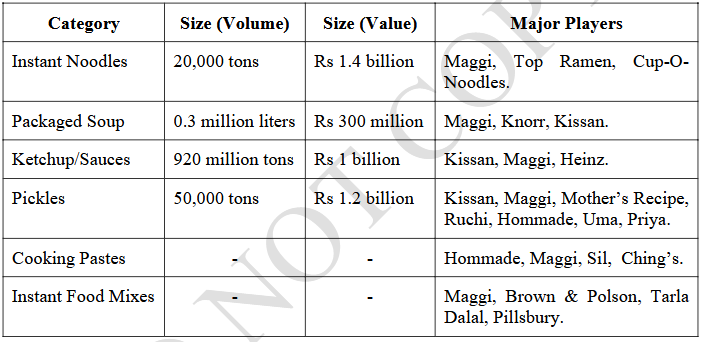
The Indian culinary products market is largely unorganized and a majority of the output is sold in an unpackaged form. The market can be broadly classified into tomato-based products, instant noodles, ready-to-cook food/snacks (cake/desert mixes and idli/dosa mixes), ready-to-eat foods (pickles and jams) and cooking aids (garlic/ginger pastes, onion pastes, and pizza sauce). Though the market for packaged food products is small in size, it is growing at a fast pace due to the increase in urbanization. The market for processed foods is largely urban-centric because the distribution network in rural areas is inadequate for marketing perishable food products. Consumers of packaged food products are highly price sensitive. The industry is dominated by a large number of small-scale players. Large players such as HLL, Nestlé, and Dabur usually got their products manufactured by small manufacturers and market them under their own brand. Consequently, most of the leading brands are regional in nature. On the other extreme are the imported food products, which are retailed only in metros at premium prices. The following table gives a snapshot of the major categories in the industry in 2001.
|
Source: www.indiainfoline.com
Keywords
Brand, line extension, FMCG, Nestlé, Maggi, Nestlé, promotion, advertising, noodles, market, scratch, umbrella brand, Maggi, formulation, Maggi noodles
Related Case Studies
| Case Title | Details | Price | Add to Cart |
|---|---|---|---|
|
Case Title Calbee’s Monochrome Packaging: Crisis Management Response or Marketing Strategy?Case Code: MKTG497 |
Details | 500 | Add to Cart |
|
Case Title Coca Cola’s Christmas AI-ad campaigns: Appeal with Algorithms or Emotions?Case Code: MKTG495 |
Details | 400 | Add to Cart |
|
Case Title Reliance Jio’s Next Act: Monetizing a Mass Brand without Breaking TrustCase Code: MKTG494 |
Details | 500 | Add to Cart |
|
Case Title Hulken Bags: Can the Premium Viral Product Achieve Mass-Retail Success?Case Code: LDEN242 |
Details | 400 | Add to Cart |
|
Case Title The Nirma StoryCase Code: MKTG008 |
Details | 200 | Add to Cart |