
Film-Based Merchandising - Taking the Movies Home
🌐 International Buyers — Pay via PayPal
Details
MKTG023
8
2002
YES
300
Not Applicable
Leisure & Entertainment
India
Advertising & Promotion
Abstract
The case examines the concept of film-based merchandising and briefly introduces its emergence and popularity in the US film industry. The developments in the Indian film-based merchandising business over the years have also been explored in detail. Moreover, the problems associated with FBM in India have been examined along with its future prospects in the country.
Learning Objectives
The case is structured to achieve the following Learning Objectives:
- Film-based merchandising and its growth in India as compared to the USA.
Contents
“It is important to realize the potential of merchandising in the marketing of a movie. Merchandising brings extra value to a film by way of long lasting mementos in the hands of the consumer.”
- Anil Moolchandani, CMD, Archies Greetings, in July 2001
The 76th Academy Awards ceremony for excellence in the field of cinema, held in March 2002, brought with it a wave of disappointment for many people in India. This was because the nomination from India in the 'Best Foreign Film' category, 'Lagaan,' failed to win the coveted Oscar statuette. Lagaan, which was a phenomenal success at the box-office in India, had been appreciated for its cinematic excellence and entertainment value in many other countries as well. It's nomination for the awards met with different reactions from various sections of the society. There were skeptics who said that Lagaan did not 'need' an Oscar, even as many others prayed for its success.
While Lagaan's nomination for the Oscars was being seen by some as a symbol of the US acceptance of the credentials of Indian cinema – the issue was that finally Indian cinema was waking up to the challenge of being globally popular. Analysts remarked that though the movies made in India still lacked in terms of technical inputs, they were capable of entertaining audiences. However, it was primarily in the distribution and marketing aspects that the industry lagged far behind its Western counterparts.
In Hollywood for instance, movie making is an extremely serious business. Most of the movies are made in a systematic manner under a corporate, studio set-up. Moreover, the distribution and marketing aspects are paid utmost attention. This is one of the major reasons why English movies are screened in almost every country of the world, whereas India, despite being the largest producer of movies in the world, had a limited market. One of the most notable aspects about the marketing of English movies were their merchandising deals.
A large number of movies made significant amount of money from merchandising – in fact, the 'Star Wars' series has reportedly earned more money from its merchandising deals than the actual screening of the movies. The movie generated around $ 4.8 billion through publishing and selling of toys, games, collectibles, apparel, and home furnishings.
The producers of Lagaan realized this and entered into merchandising deals with various companies for marketing 'Lagaan' inspired merchandise across the country. Soon, fans of the movie were able to buy 'Lagaan' writing pads, jigsaw puzzles, greeting cards, posters, photo albums and comics. Soon after, many other films such as 'Na Tum Jano Na Hum,' 'Badhaai Ho Badhai,' 'Aankhen,' '23rd March 1931-Shaheed,' and 'Devdas.' Although Lagaan was not the first instance of an Indian movie entering into a merchandising deal, it was credited for giving the biggest boost to the hitherto untapped potential of film-based merchandising (FBM).
Simply put, FBM is selling articles that are in some way or another, related to the movie's characters, events and places. They include a wide range of products such as posters, clothing, stationery, toys and other gift articles. The producers of the movie license merchandising rights to manufacturers (independent and/or own) called as licensees. In a majority of the cases, the licensees bear all the manufacturing and distribution expenses. The producer/distributor receives an advance payment for each product, as well as royalty payments, calculated as a percentage of gross revenues from sales to retailers. In case, the movie does not do well and sales of the related merchandise do not pick up, manufacturers incur the losses.
The aim of FBM is to promote the product(s) by creating, increasing and positively influencing a consumer's purchase decision and it also helps to re-create the experience of the movie and allows the viewers to take home some souvenir of the movie. The US based animation major Walt Disney, was the first company to create character merchandise in the 1930s. In fact, a large part of its success over the decades can be attributed to the revenues generated by marketing toys and other merchandise related to its famous cartoon characters such as Mickey Mouse and Donald Duck. These Disney characters are cited as one of the best examples of a successful FBM program.
The release of the Steven Spielberg movie 'E.T.' in 1982 heralded a new era in the field of FBM. A scene from the movie depicted a child sharing some candy (for the brand Reese's Pieces) with an alien. As a result of this, the brand's sales increased by 65%. This made a rival brand, M&M, (who had denied a request to use their candy stating that having an alien eat their candies would reflect badly on the product) realize their mistake for not tapping the enormous potential of FBM. The US corporates woke up to FBM with a renewed vigor. Movie studios now began entering into product placement and merchandising deals with various companies right from the inception stage. FBM soon evolved into multi-million merchandising deals where the moviemakers licensed manufacturers the right to use names, characters and artwork for spin-off products such as toys, clothing, novelizations and soundtrack albums.
FBM was even credited for being the sole motive behind making computer-animated films such as 'A Bug's Life' and 'Toy Story'. The sale of movie-related products not only generated substantial revenue, but also were of great promotional value for the producers. In US, 40% of movie merchandise is sold even before a film is actually released. Moreover, royalties accruing from FBM help the producer offset a considerable portion of the costs. The merchandise also creates considerable business opportunities for the licensees.
For its film '101 Dalmatians' made in 1996, Disney entered into deals with more than 130 companies including McDonald's, Dr. Pepper, Frito-Lay and Alpo. Similarly, Warner Bros. entered into more than 200 deals for 'Space Jam'. The movie 'Inspector Gadget' was released with a scheme wherein kids had to collect eight separate pieces to assemble a 15-inch Inspector Gadget. The pieces were being given along with the 'Happy Meal' combination boxes by McDonald's – thus enabling the fast food major to sell eight 'Happy Meals' to one child wishing to complete the gadget. For the movie 'Star Wars: Episode I – The Phantom Menace', the merchandising deals were valued at around $ 2 billion and involved companies such as Hasbro, Pepsi, Frito-Lay, Taco Bell, Pizza Hut and KFC. By 2002, movies such as 'Harry Potter', 'Lord of the Rings', 'Monsters Inc.', 'Spiderman', 'and Lara Croft – Tomb Raider' had all earned substantial revenues through FBM in addition to their box office collections.
By 2001, India was undoubtedly the world's largest film producing country with over 27,000 feature films and thousands of documented short films (on an average, around 800 films were produced annually) in over 52 languages. As per a study conducted in March 2000 by FICCI- Arthur Andersen, the Indian film industry is expected to grow from Rs 84 billion in 2000 to Rs 340 billion by 2005.
Even though Hollywood had been using FBM for a long time, a majority of Indian producers did not seem to be too keen on using it for Hindi and regional language movies. However, product placements within the movie were commonly used. Many movies such as 'Yaadein,' 'Taal,' 'Gardish,' 'Dilwale Dulhaniya Le Jayenge,' and 'Hero' advertised products like Coca-Cola, Pass Pass, Stroh's Beer, Kenstar, BPL and Hero cycles. Corporates also employed films and filmstars to market their products.
One of the earliest films that was involved in an FBM exercise was 'Maine Pyar Kiya.' The film was released in 1989 under the renowned Rajshri Productions banner. The producers had tied up with the leading greeting cards company, Archies. Archies launched a greeting card and poster range based on the blockbuster. The unorganized sector too launched a few items based on the movie such as caps and toys, which were runaway successes.
In the early 1990s, another movie 'Roop Ki Rani, Choron Ka Raja' offered dolls modeled on the movie's actress, Sridevi. However, as the movie was a flop, the dolls didn't fare too well. Soon after, 'Hum Aaapke Hain Kaun' became the first movie to go in for successful, organized and planned FBM exercises with its tie-ups for merchandise retailing. However, the FBM trend was slow with only a few movies entering into merchandising deals.
In the late 1990s, the growing popularity of Hollywood movies (aided by their dubbed versions) resulted in the growth of merchandising in India. Simultaneously, merchandise for Hindi movies like 'Hum Saath Saath Hain,' 'Kuch Kuch Hota Hai,' 'Tera Jadoo Chal Gaya,' literally flooded the retail shelves. Regional cinema (Tamil, Telugu and Bengali) soon joined the FBM bandwagon. One of the major players on the Indian FBM scene have been the gifts and card companies. Companies such as Archies' Greetings and Gifts Ltd. and Hallmark have been involved in FBM for a long time now. Their FBM initiatives include retailing merchandise comprising stationery items, photo albums, greeting cards, posters, paper bags and postcards for movies. However, as compared to Hindi movies, FBM for English movies was more popular. Toys, apparel, stationery and gift articles based on the movies 'Jurassic Park', 'Godzilla', 'The Lost World', 'Anaconda', 'The Lion King', '101 Dalmatians' were a few examples of successful FBM initiatives in India. The 'Star Wars Episode I' FBM frenzy was experienced in India as well with fast food chains Pizza Hut and KFC launching various promotion campaigns. Given the limited success of FBM for Hindi movies, the efforts made by the producers of Lagaan were thus termed commendable by many industry observers.
'Lagaan' comics were published under an agreement with Egmont Imagination India Ltd2. It opened with a message from producer-actor Aamir Khan (Khan) and provided interesting trivia about the film's making as well. Commenting on the movie's merchandising, Khan said, “It will be an opportunity for fans to own a part of their favorite film and to feel like they are a part of the film themselves.” Available in English as well as Hindi, the 41-page comics was a huge success and Egmont had to send it for reprint four times within a few months. In the words of Vikram Phadnis, Egmont's marketing head, “We have already crossed one lakh copies, including exporting about 20,000 copies to the Middle East, US and UK.”
The producers of 'Lagaan' also entered into various innovative marketing deals for the movie. One such successful move was the 'Britannia Lagaan Match3.' The producers even tied-up with the leading Indian portal, www.indiatimes.com, to sell 'Lagaan' merchandise online. The portal in turn allowed viewers to discover more about the film and interact with the filmmakers and actors. There were contests, special chats, auctions of autographed 'Lagaan' CDs and cassettes; discounts were also given in retailing outlets of Planet M.
Another major FBM exercise was in form of Egmont's tie-up with Kapoor and Kaushik Entertainment Pvt. Ltd. for their film 'Badhaai ho Badhaai' in May 2002. The merchandise included a graphic novel containing the movie's story, a pencil book, a coloring book, a board game and some toys. The products were targeted at children in the age group of 4-14 years and were priced between Rs 25 and Rs 300. The merchandise was made available at various gift and bookshops, kid stores, supermarkets, and malls across India (Refer Exhibit I for details on FBM in US and India).
Egmont's Uday Mathur said, “In the past when we launched products based on Hindi films, we received overwhelming response not only from kids but also from all Bollywood4 film followers. We believe merchandising is an interesting method whereby fans can preserve precious moments from films for a long time. We are proud to be the pioneering company in the country to offer such products to the film loving people of India.”
Actor Anil Kapoor, Chairman, Kapoor & Kaushik, said, “Film merchandising is a very evolved concept in the West, and I have always thought of having a merchandising program for my films, but could not find the right partner. So when Egmont approached me with their plan I was very happy to start off this association. Now I think film merchandising has come of age in India and movie lovers can expect more of these products in the days to come.''
Egmont had reportedly approached Kapoor & Kaushik realizing that the movie would appeal to children. The extent of marketing thrust for the merchandise was to be decided by its success. Egmont planned to take the merchandising to the Middle East and UK. However, since the movie was a disaster at the box-office, the merchandise too did not do well. However, the failure of the movie and its related merchandise brought into focus the various problems that could hamper the growth of FBM in the country.
FBM had not really caught the fancy of the Indian film industry. While most distributors agreed that there was definitely a large market in terms of volume, problems such as the licensing issues were yet to be dealt with. The only leading licensed merchandiser in India was Disney with about 40 licences including Weekender Kids, Timex, Cadbury, Parry's, Leo Mattel and Funskool, making a wide range of character based merchandise.
Import restrictions added to the lack of large-scale adoption of FBM in the country. Apparel, one of the most lucrative categories of FBM does not require very high start-up costs and the entire range can be made and retailed at a nominal price range. A Disney T-shirt could easily be sold for Rs 150-300. However, since manufacturing was so cheap, a thriving grey market had emerged. There were virtually no checks on copyright infringement with apparel, caps, school bags, water bottles and pencil boxes all bearing registered brands. With legal recourse not being of much help due to loopholes and lengthy procedures, brand owners did not consider FBM very viable. However, in the case of toys, the high cost of manufacturing kept the grey market at bay to a certain extent. The centralized manufacture of toys ensured greater economies of scale worldwide, and competitive pricing for the countries that could freely import them. However, due to import restrictions, an imported toy was priced at Rs 500 as compared to Rs 75-300 for an indigenously made toy. Moreover, the consumer did not seem to be willing to pay a premium for a limited range of expensive toys.
One of the major drawbacks of FBM for Hindi movies is that they are more or less based on a particular actor or actress, rather than the character they portray. And therefore, success largely depends on that star's popularity, which keeps fluctuating. Moreover, the failure of most movies at the box office added to the woes. In general, around 80% of the movies released per year are flops.
Also, live films (films with 'real' characters as compared to animation movies) were not really amenable for FBM. Animated films by far proved to be the best bet as cartoon characters were much more suitable to adaptations of icons, colors, background, etc. They were also deemed more suitable, as their personality, activities and environment could be very easily controlled. Moreover, cartoons, being child-oriented are more lucrative considering that most merchandise was targeted primarily at children. Besides, cartoons cut through language and cultural barriers, making their appeal wider. But, inspite of this, the Indian movie industry virtually made no efforts in this direction. Analysts explained this stating that an average Indian moviegoer would in all probability, never spend money to watch a movie like 'Toy Story.'
Another problem seemed to be the lack of experience in carrying out FBM programs in India. For any FBM program to succeed, merchandise needed to be on the shelves much before the movie was released. However, when 'Aladdin' was released, merchandise came a month late – leading to sales much below the expected level. These anomalies were taken care of later with '101 Dalmatians' (merchandise was in the stores two months before the movie released).
Furthermore, every movie released abroad was promoted as a major event in a very systematic fashion. There were interviews with the stars, the crew, a film on the making of the movie, extensive media coverage etc. months before the release. The movies achieved something of a cult status and excitement was made to reach a fever pitch. This facilitated the sale of merchandise to a great extent. In sharp contrast, Indian movie producers had only recently begun these kind of exercises regarding movie promotion.
However, all was not lost for the FBM market in India as merchandising deals continued even after the debacle of 'Badhaai Ho Badhaai'. In July 2002, Biba Apparels, the makers of women's ethnic wear sold under the brand Biba, tied up with leading producer-director Subhash Ghai's Mukta Arts to sell clothing worn by the characters in the movies made under the banner. The apparel was made available through its retail outlets across the country.
The fact that the limited amount of Star Wars merchandise that was imported after the release of 'Star Wars: Episode I' sold out in no time at all, despite the prohibitive pricing, proved that the trend was catching up in India. In 2002, books, board games, puzzles, dolls, apparel, bags and other toys related to 'Harry Potter', 'Lord of the Rings' and 'Spiderman' reportedly did very well in India.
Similarly, toys and apparel based on the movie 'Na Tum Jaano Na Hum' did well – though largely attributed to the fact that the merchandise was retailed by the movie's producers, Pantaloon Fashion House Entertainment through their own retail outlets across the country. In August 2002, producers of a Tamil language movie, 'Baba' were cited to have entered into hitherto unprecedented merchandising deals. These developments indicated that there definitely existed a potentially huge market in India, just waiting to be tapped.
For the common man, movies have largely been a way to escape reality. The people who like a particular movie (story, characters, actors, incidents) decide to buy merchandise because they want to take home a souvenir of their 'good' experience associated with watching that movie. In the US, media companies and their movie studios are even being accused of breaking what is supposed to be a form of artistic expression, that is movies, into cleverly disguised revenue earners in form of associated books, soundtracks, comic books, licensing ventures and other merchandising deals. The same trend could be expected to emerge in India in the future.
According to analysts, it is essential for producers to ensure that FBM does not become a purely marketing exercise and that merchandise is recognized as a token of the person's movie experience. If this could be ensured, FBM in India was believed to have the potential to emerge as a huge business.
1. Examine the role of FBM as a promotional tool in India for both Hindi and English movies. As the marketing manager for a media conglomerate, what measures would you adopt to fully utilize the potential of FBM as a promotional tool for a movie?
2. With a majority of movies made in India failing at the box-office, do you think associating their brands in such a speculative manner is advisable for the companies? Support your answer with reasons.
3. What are the problems that hamper the growth of the FBM business in India? What measures do you think need to be taken to boost FBM in India and help it become as successful as in the US movie industry?
Exhibit I
| Movie Merchandising in the US and India |
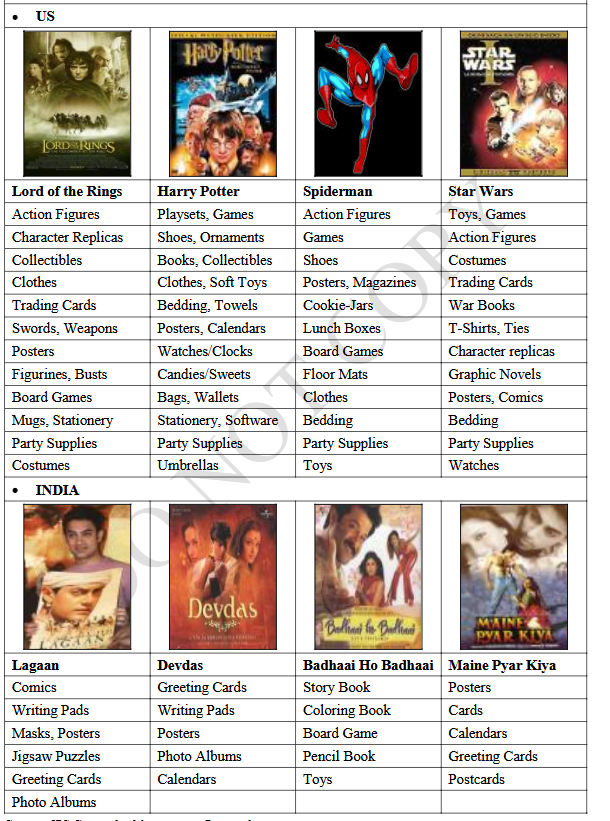 |
Source: IBS Center for Management Research
Keywords
Indian film industry, Film-based merchandising, Star Wars, US film industry