
Revamping Rasna - A Marketing Overhaul Saga
🌐 International Buyers — Pay via PayPal
Details
MKTG025
11
2002
YES
300
Pioma Industries Limited
Food & Beverage
India
Marketing Strategy,Market Segmentation, Pricing, Advertising & Promotion
Abstract
The case examines the market revamping exercise undertaken by Rasna Ltd., manufacturer of the leading soft-drink concentrate brand Rasna, in the Indian market. The case provides a detailed account of how the company built up the preparatory drink segment in the Indian beverages market by focusing on distribution, promotion and advertising. The problems faced by Rasna in the late 1990s that led to the decision of a marketing strategy overhaul have been examined. One of the revamping strategies of Rasna, in terms of new product launches, segmentation, pricing and advertising have also been discussed.
Learning Objectives
The case is structured to achieve the following Learning Objectives:
- Dynamics of the soft drink concentrate business in the Indian beverages market.
Contents
“At Rasna we are constantly looking at new innovations and strategies. Today, the per capita consumption of Rasna is 15 glasses and our vision is to increase the per capita consumption to 100 glasses by 2005 and to reach out to one billion Indians every year.”
- Piruz Khambatta, Chairman and Managing Director, Rasna Ltd., in March 2002.
Pioma Industries Ltd. (Pioma) is perhaps not a familiar name for the average Indian consumer. However, Pioma's brand 'Rasna' is very well known. In fact, the name Rasna is almost a generic name for soft drink concentrates (SDC), a segment that had been created and nurtured by the company in the Indian beverages market. Rasna's extremely popular advertisements with the tagline, 'I love you Rasna,' had become an integral part of the Indian advertising folklore. In March 2002, Pioma announced a radical overhauling of its strategies for the Rasna brand. This development was rather unexpected, as the brand had been lying dormant since long.
Company sources revealed that these developments were in line with a restructuring program that had been conceptualized in mid-2001. Keeping in line with this plan, Pioma launched two new brands, Rasna Utsav (Rasna Festive) and Rasna Rozana (Rasna Daily) in March 2002. The launch was accompanied by a multi-media advertisement campaign, for which the company allocated Rs 160 million.
The television campaign that ran across all major national and regional channels featured a 'song' exclusively composed for the new launches. A notable feature of this commercial was the fact that it was voiced by one of the country's most well known singers, Asha Bhonsle, who had never sung for any commercial before. Pioma soon released music cassettes and CDs featuring remixes of old, popular Hindi songs and the new Rasna song. In addition to this, the company sponsored musical events across the country.
Industry observers were however, viewing the above developments as Pioma's desperate attempts to infuse fresh life into Rasna. There were apprehensions regarding its success given the fact that previous attempts in form of brand extensions had failed to have any significant impact on Rasna's growth prospects. And unlike the late 70s, the average beverage consumer in India had a host of other options, such as colas, fruit juices, iced tea, tetrapacked juices and other soft drinks. Most importantly, Rasna's stronghold in the SDC market was facing severe competition from Coca-Cola's newly launched Sunfill and Dr. Morepen's C-sip. Rasna's fading 'brand awareness' and its lacklustre image had become major hurdles, capable of marring the prospects of the new marketing overhaul exercise as well.
Pioma, an Ahmedabad (Gujarat) based company was the first to introduce the concept of SDCs in India. Its proprietors, the Khambattas saw a huge untapped potential in the market with Coca-Cola, an MNC cola major, on the verge of closing all its operations in India, due to policy changes with regard to MNCs operating in India. At that point of time, there were no major players in the preparatory SDCs market. Pioma thus launched an SDC under the brand name 'Jaffe' in 1976 and marketed it with the help of Voltas. The brand name was changed to Rasna in 1979.
Rasna's SDC, comprised a powder sachet and a small bottle of thick, coloured liquid. While the powder provided the taste, the liquid gave the flavor. These ingredients had to be mixed with a specified amount of water and sugar. The resulting syrup could then be used over a period of time by mixing it with water. Though many analysts felt that Rasna's do-it-yourself concept would be cumbersome and hence unappealing to consumers, it became the very reason for its success. This was because Rasna was able to exploit the Indian middle class housewife's traditional distrust for food and drink not made at home.
Not only was Rasna easy to prepare, it was reportedly the first brand in the country that provided consumers real fruit-like flavor and taste. And at only 50 paise per glass, it was easily one of the most affordable drinks available in the market. With many popular flavors such as Pineapple, Orange, Mango and Lime becoming runaway successes, Rasna soon established itself as an effective alternative to other products such as squashes, soft drinks and syrups.
Pioma had eight factories that manufactured its SDC – five in Gujarat, two in Silvassa and one in Punjab. The company had a dedicated R&D team in Ahmedabad (Gujarat) to support its policy of launching new flavors in quick succession. The division was constantly involved in monitoring new flavor developments, controlling quality, innovating new flavors at regular intervals and analyzing new flavors at regular intervals. As a result, many new flavors were launched over the years. In addition to the standard fruity flavors, Rasna was made available in many local flavors such as 'Kala Khatta' (tangy), 'Khus' and 'Rose' that became very popular.
To ensure high quality standards, Rasna's products were manufactured in a totally automated environment. Advanced world-class technology was used for packaging. The packs were pilferage-proof with moisture-resistant lining, thus, retaining both flavor and freshness. One of the major factors responsible for Rasna's rapid sales growth was its well-entrenched, efficient sales and distribution network covering the entire country. The sales force was managed by the company's five regional offices, which ensured availability of Rasna products to consumers in the retail outlets nearest to them. During summer, when the sales of the company soared, Pioma recruited additional sales force on a temporary basis to ensure availability of the products. The company had 24 warehouses in various parts of the country, 24 distributors and 2000 stockists. These stockists served over 2,00,000 retail outlets directly and over 2,00,000 retail outlets indirectly via wholesalers. Reportedly, Rasna's product range was one of the world's largest distributed food brands at that time.
To retain the interest and loyalty of its consumers, the company undertook various creative promotional activities. These included shop sampling, house-to-house calls, and live demos on the method of preparation, retail window displays, gift offers to customers and other trade schemes. The company devised innovative methods every year to sustain the element of fun and surprise. In addition, Pioma participated in various exhibitions and fairs that provided an excellent opportunity for direct interaction with the consumers. The fairs also helped the company increase its visibility in the rural markets by distributing large number of free product samples to consumers in the fairs.
Above all, Rasna's advertisement campaigns helped it become a trusted and popular brand amongst Indian consumers. Pioma was one of the few companies that went in for large-scale advertising on the state-owned TV channel, Doordarshan. Rasna also sponsored many programs on the channel, especially the ones that appealed to children, such as the animated series, 'Spiderman.' The advertisements essentially revolved around cute and very-likeable children who were floored by Rasna's attractive colors, taste and fruity flavors. Eventually, Rasna's TV commercial featuring a small girl with the tagline 'I love you Rasna,' was adopted as the brand's tagline for many more commercials over the next couple of years.
As a result of all the above, Rasna virtually ruled the market during the 1980s and the early-1990s. For over 17 years, it remained the undisputed market leader in the Indian SDC market. This was aided largely by the fact that there was no serious competition in the market. Soft drinks as a segment was virtually stagnant and only a few syrups (Rooh Afza, Sharbet-e-azam) and squashes (Dipy's, Kissan) were available in the market (Refer Exhibit II for the soft drink market in India). However, most of these products were priced higher. Moreover, there was very little marketing support provided by their respective companies.
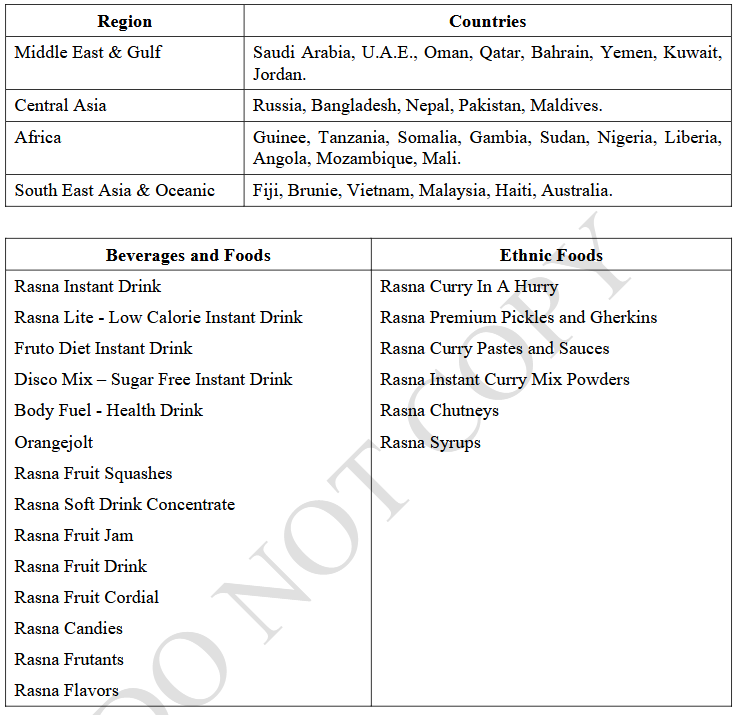
Buoyed by its success in the Indian market, in 1993 Pioma decided to market Rasna on the global platform as well. Besides the SDC, Pioma developed a whole new range of non-alcoholic beverages under the Rasna brand for in-house consumption. The company took special care to meet the specific requirements and preferences of global customers and leverage its own core competencies in terms of flavors and technology. By this time, Pioma also realized that it could tap the demand for ethnic Indian foods in global markets and cash in on the brand's strong image. This realization led to the launch of products under two different categories – Rasna Beverages and Foods and Rasna Ethnic Basket. While the former comprised a range of drinks, the latter constituted a complete range of ready to consumer or easy to cook authentic Indian foods (Refer Exhibit I for products offered globally).
By 1995, Rasna accounted for an estimated 90% of the total SDC market in India. The brand also led the in-home soft drink consumption market in India with an estimated market share of 75%. However, Pioma's 'dream-run' seemed to be coming to an end with the heightened activity in the Indian beverages market. In the early 1990s, after the markets opened up due to the liberalization a Coca-Cola and Pepsi changed the dynamics of the market. Moreover, with the advent of fruit juices in tetrapacks and aerated drinks in plastic bottles, the scope for SDC products such as Rasna that needed to be 'prepared' began declining. The consumers soon began turning towards colas, fruit juices and other 'ready to drink' products. At the same time, a large number of other national and regional players entered the market. Reportedly, Pioma found it extremely difficult to hold on to its market shares and sales figures.
According to many analysts, the decline in Pioma's fortunes was mostly of its own making, as it failed to understand the shifting preference of the consumers towards ready-to-drink preparations. They pointed that Rasna ignored the changing trends in the market. Variations were launched only when competition had strongly established itself. Moreover, Rasna failed to sustain its stronghold in the lower-income segment as it did little to sustain the brand's popularity among the consumers (after its initial promotional exercises)
Pioma finally decided to extend Rasna's brand portfolio and launched a pre-sweetened mix-and-drink product in 1996. Targeted at the upper end of the market, Rasna International was a nutritious and vitamin-enriched version of the regular Rasna SDC version. This was followed by the launch of Rasna Royal, positioned as a vitamin-enriched version of Rasna. It was targeted at health-conscious consumers who did not prefer Rasna SDC on account of its synthetic image (that is usage of synthetic colors and artificial flavors). These two products were priced at the higher end, as against the 'low price' policy followed by Rasna for the other products.
The sales of Rasna Royal did not pick up from the very beginning. Analysts attributed its failure to the strong positioning of Rasna SDC as a cost-effective drink. While consumers were willing to bear the inconvenience of preparing the SDC version on account of its lower cost, they were unwilling to do so for Rasna Royal as they had paid a higher price for it (Rasna Royal was priced Rs 4 higher than the SDC version). Eventually, the company had to discontinue Rasna Royal. On the other hand, Rasna International became quite successful, primarily because it did not need any preparation. Commenting on the analysts forecasts that Rasna International might not succeed given the high pricing of the product, Khambatta said, “Contrary to common perception, Rasna International has done exceedingly well and has created a market segment for pre-sweetened fortified soft drinks.” By 1999, Rasna International's sales accounted for an estimated 15% of the Rasna's total turnover of Rs 650 million, even as SDC's contribution kept declining.
In summer 1999, Rasna also went against its tradition of launching 'one-new-flavour per season' and launched two new flavours, Rasna Yorker (Yorker) and Rasna Aqua Fun (Aqua Fun). The company launched these products in order to exploit the Cricket World Cup fever. Kapil Dev was brought in to endorse Rasna Yorker. Though Yorker succeeded moderately, Aqua Fun was a dismal failure. The failure of Aqua Fun was attributed mainly to its blue color, which was not readily accepted by the Indian consumer in the food products segment.
Pioma's efforts at broadening its product portfolio continued with the launch of Oranjolt in 2000, an aerated fruit drink, available in 1.5 litre PET bottles. The brand, launched in selected outlets, failed to attract customers and soon had to be withdrawn. Commenting on Oranjolt's failure, Khambatta said “Oranjolt was never meant to be an aerated drink and it was just, one in the range of innovations that Rasna constantly did.” However, he agreed that Oranjolt's failure was a result of certain inherent product problems. It was common practice for many Indian retailers to switch their shop refrigerators at night. This resulted in quality problems, as Oranjolt required refrigeration at all times. The short shelf life of the Oranjolt also contributed to its failure as the company failed to set up a strong distribution network for the product, which could allow it to replace Oranjolt every three to four weeks. Following its failure, the company sent the product for further improvement at its R&D facility.
Despite its efforts, the woes of Rasna increased through the late 1990s and 2000. Rasna SDC's volume continued to shrink by over 7% every year. Moreover, the steadily increasing prices of Rasna SDC, over the years proved to be another significant hurdle for Pioma. Initially priced between Rs 8-10, Rasna SDC was sought by the middle-class family as an affordable hospitality drink during the 1980s. By the late 1990s, it had gone up to Rs 22-24, which according to the analysts was supposedly above the reach of its target audience. However, company sources argued that the rise in prices had been in line with the inflation through the years and was always in the affordable range.
The growing awareness among the consumers regarding the difference between natural and artificial synthetic flavors, the increasing purchasing power and availability of more international products in tetrapacks all resulted in the decline of Rasna's market. According to estimates, the tetrapack category had increased three fold (to Rs 6 billion) between 1993 and 2001. In 2001, only 12% of the soft drinks were consumed at home. The shift in consumer tastes towards colas and fruit juices continued unabated. Alarmed by its failure to extend Rasna's product portfolio, Pioma began planning a three-year revamping program in mid-2001. The program aimed at overhauling all its operations and creating a new brand identity for Rasna. In the fiscal year 2001-2002, Pioma Industries changed its name to Rasna Ltd.
The major thrust of the company's restructuring exercise was to reach out to the masses and create brand awareness in towns and remote villages. Emphasis was also laid on the availability of Rasna products in the price range of 80 paise per glass to Rs 4 per glass. Till now, Rasna was available only in two price segments – Rs 4 and Re 1. The company's principal focus in 2002 was to increase the number of segments to make Rasna products more affordable to larger various sections of society. The company also extended its strategy of Rasna being a mass drink to its global markets. Commenting on this, Khambatta said, “We have made sure that the Rasna International brand is placed along with the other preparatory soft drink brands such as Tang in international retail stores, and not in the Indian foods counter in those stores.”
Rasna's revamping exercise included increasing the per capita consumption of Rasna from 15 to 100 glasses, reaching across to all sectors of society and age groups. Moreover, plans were also made to foray into related segments in the food sector in the next two years and strengthen its global operations. Efforts were also made to establish itself as one of India's top 10 products in terms of brand recall and visibility and become one of the top 20 most admired companies in the country. Rasna announced these plans in early 2002 and called the overall exercise as the 'Rasna for one billion Indians' project.
Khambatta, explaining the company's new marketing strategy said, “We are implementing a strategy through which we wish to make consumers drink more Rasna as well as get new people accustomed to the brand. We have come out with more product offerings to attract the new consumers. For those who are already used to the Rasna taste, we have brought out value-added products. We are more aware than anybody else about the price-centric behavior of the Indian market and have accordingly positioned our products.”
According to its renewed distribution strategy, Rasna planned to reach an estimated 7,00,000 retailers annually. With its plans to reach the rural areas, the company began strengthening its distribution channels in order to cover villages with a population of up to 5,000. Following this, the company appointed 47 additional sales personnel, 350 cycle salesmen, and 145 pilot salesmen in addition to new stockists for the relevant areas. It also engaged 500 vans for the coverage of rural areas. However, Rasna was careful not to neglect the urban markets. According to company sources, “There are pockets with rural consumers even in the metros and they are large in number.” Hence, the company's advertisements also targeted the urban and semi-urban families.
As a part of its new strategy, the company focused on multi-media advertising and promotion, wherein an effective marketing strategy was adopted to communicate the brand message, using the different media such as TV, radio and print. Mudra Communications (Mudra), a leading advertising agency, undertook the advertising and promotional activities. Mudra developed an advertisement campaign constituting five television commercials, radio advertising and outdoor media campaigns. Special emphasis was laid on 'outdoor visibility' and over 45,000 bus shelters, 5,000 pole kiosks, 300 bus panels and over 200 billboards were used to display the brand message across the country.
With a new, catchy brand tagline, 'Relish a gain,' the campaign highlighted the affordability and easy availability of Rasna products. Speaking about the changed corporate identity and its reflection in advertising campaigns, Khambatta said, “Our aim is to reach out to the masses and we wanted a direct link between the brand and our advertising.” Commenting on the advertisement campaigns Sachin Kamath, Accounts Director, Mudra Communications said, “We changed the advertising strategy to include every age group and every section of the society. 'Relish a Gain' concept has been created in Hindi as a song, which covers the total range of products to focus on Rasna's values in different moments of life.” According to company sources, the message expected to be conveyed through the advertisements was, “Whenever you feel like celebrating, drink Rasna”. Special emphasis was laid on its affordability and value-for-money.
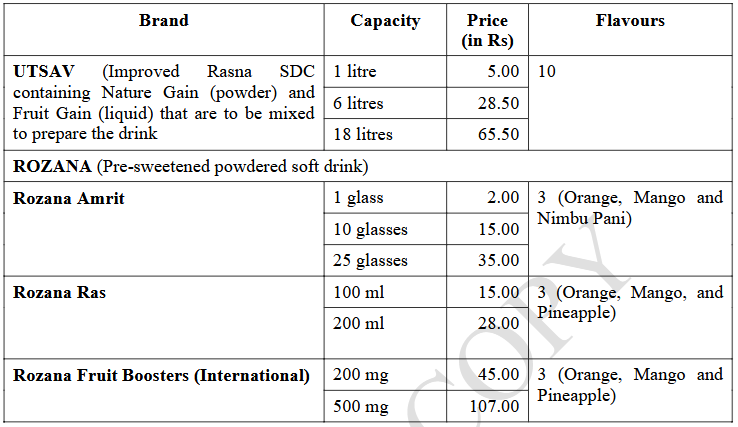
Moreover, its product lines were categorized into two brands (Rasna Utsav and Rasna Rozana) so as to effectively target different consumer segments in India. While Utsav, an improvement over Rasna SDC, targeted the lower income group in rural markets, Rozana, a mix and serve powdered drink (no need to add sugar) targeted the convenience seeking semi-urban and urban consumers. Rasna relaunched Rasna International as well under the sub-brand, Rozana Fruit Booster. Fruit Booster was aimed at competing with Sunfill and Tang (both pre -sweetened powdered soft drinks), serving the upper end of the market (See Table I for Rasna's new brand profile).
Table I
Rasna’s New Brand Profile
 |
Source: IBS Center for Management Research
In addition, a completely new identity, a new 'leaf' symbol was added to the Rasna brand name. Commenting on this, Khambatta said, “Apart from talking about the core values of Rasna, we also wanted a symbol for Rasna so that the product gets distinct visibility. We want the consumers to identify Rasna from the image of the leaf.” Since the company planned to focus on rural markets, it felt that the product awareness could be best created by means of a symbol and hence the leaf (with red and green background) was chosen as the brand symbol.
All the new brands were enriched with vitamins and ingredients to render instant energy. Commenting on the launches Khambatta said, “With the launch of the Rozana line, we are reiterating our commitment to providing a health gain to our consumers. The products in the Rozana line contain Fruit Powder, Glucose/lactose, Vitamin A, C, B2, B6 as well as Niacin, Folic Acid, Calcium and Phosphorus, making it one of the healthiest and most refreshing soft drinks available. Cutting across all segments, Rasna has also ensured that the Rozana line is affordable to all sections of society.”
Rasna in order to establish its Rozana line strongly in the market, priced Rozana Amrit sachets at Rs.2, while its major competitors Sunfill and Tang sachets were priced at Rs 2 and Rs 5 respectively. This was expected to help Rasna beat competition as well as increase its reach among the lower-income groups. Speaking about the launch of the Rs 2.00 Rozana Amrit sachets, Khambatta said, “At Rs 2 per sachet, it will be both a value-for-money product as well as convenient as you just have to mix it in water and drink.” It also seemed to be more convenient compared to other product offerings of Rasna, as you did not need to add sugar to the mix. According to the company sources, the launch of single-use sachets was expected to trigger the sales of powdered soft drinks in India expanding the market exponentially and increasing the share of powdered soft drinks in the total cold drinks market in India (in 2002, the powdered soft drink market accounted for less than 1% of the 12.1 billion cold drink market).
As a result of the above initiatives, Rasna was able to retain its leadership in the Rs 2.5 billion preparatory soft drink market, with an estimated 82% market share. The other major players, Kissan and Roohafza respectively shared 8% and 7% of the market. In 2002, Rasna was credited to be one of the most widely distributed products in India reaching over 5,00,000 independent retail outlets throughout the country. Rasna emerged as a mass brand appealing to all socio-economic classifications (SEC) in both rural and urban markets. In 2002, Rasna was rated 7th in the Food and Beverages category in India and was rated 21st among the most recalled brands in India.
Although Rasna succeeded in increasing its sales in mid-2002, few analysts were skeptical about the long-term success of revamping strategy. The entry of players like Coca-Cola, Kraft Foods, Dr.Morepen Labs and Hindustan Lever Ltd. and their financial muscle was expected to pose tough competition for Rasna in the future.
In 2002, Rasna was in the process of finalizing a joint venture with Del Monte, the largest producer of canned fruits and vegetables in the US to offer convenience foods. While Del Monte wanted to leverage Rasna's vast and efficient distribution network, the latter planned to access Del Monte's technical expertise. Though the venture was planned to take off in mid-2002, analysts felt that the decision to foray into other segments of the food market might not yield expected results given the intense competition in the sector. However, brushing off the apprehensions, Khambatta said, “I believe that competition is an opportunity for growth. We will fight competition with good quality. Our strength lies in Rasna's nationwide distribution network. We are not scared or nervous of the cola giant Coke.”
Analysts also commented that Rasna was making a big mistake by trying to make Rasna 'everything to everyone.'1 Commenting on this, Jagdeep Kapoor, Managing Director, Samsika Marketing Consultancy, said, “If you try to be everything to everyone you might end up being nothing to anyone.” Kapoor said that focus on children had significantly contributed to Rasna's success. By broadbasing its target audience, and by extending its product to all the sectors of the community, Rasna brand lost its core slot, which its competitor Sunfill captured with its commercial depicting a child on a hunger strike giving in to his temptation for a glass of Sunfill. However, Rasna countered this argument saying that Rasna products were always targeted at the family and never specifically for children. (However, company sources agreed that in the past, children had been their means to get households to buy their product). According to an advertising professional who was previously associated with Rasna, “The problem with Rasna lies in its advertising, which is clueless about where the brand really fits in today's scenario. Rasna entered middle-class homes by saying you have so many glasses from one pack, which works out to so much per glass. However, with the colas getting belligerent and prices coming down steeply, that advantage ceased to exist. A glass of cola would be at most 20% more expensive, but that is offset by the cola associations – young, hip, aspirational. Increasingly, in middle-class homes, Rasna is not seen to be 'with it'. So what is Rasna? Where does it fit? Is it still relevant?”
Industry observers remarked that there were three critical success factors in the preparatory drinks segment – economy, taste and children's affinity. And with almost all the players focusing equally on all the three factors, Rasna indeed seems to have a tough time ahead to retain its leadership status.
1. Analyze the environment in which Pioma started selling Rasna and highlight the reasons for the brand?s runaway success. Do you think Rasna is losing its stronghold in the Indian beverages market? Justify your stand.
2. Critically comment on the failure of products such as Rasna Royal, Rasna Aqua Fun and Oranjolt. What were the factors that led Rasna to go for a major revamping exercise for the brand?
3. Discuss the initiatives taken by Rasna to rejuvenate its brand with specific reference to the positioning and advertising aspects. In light of the changing market dynamics and the intensifying competition, will the current strategies help Rasna sustain its leadership position?
Exhibit I
Rasna –International Presence and Offerings
 |
Source: www.rasnainternational.com
Keywords
Market, revamping exercise, Rasna Ltd., soft-drink, concentrate, Rasna, Indian market, preparatory drink , Indian beverages, focusing, distribution, promotion, advertising, Rasna, 1990, marketing strategy, new product launches, segmentation, pricing, advertising
Related Case Studies
| Case Title | Details | Price | Add to Cart |
|---|---|---|---|
|
Case Title Coca Cola’s Christmas AI-ad campaigns: Appeal with Algorithms or Emotions?Case Code: MKTG495 |
Details | 400 | Add to Cart |
|
Case Title Reliance Jio’s Next Act: Monetizing a Mass Brand without Breaking TrustCase Code: MKTG494 |
Details | 500 | Add to Cart |
|
Case Title The Nirma StoryCase Code: MKTG008 |
Details | 200 | Add to Cart |
|
Case Title IKEA’s ‘Punch’ Moment: Using Reactive Marketing to Build Brand ConnectionCase Code: MKTG493 |
Details | 300 | Add to Cart |
|
Case Title Amul and the D2C Dairy Challenge in IndiaCase Code: MKTG492 |
Details | 400 | Add to Cart |